Page 282 of 428
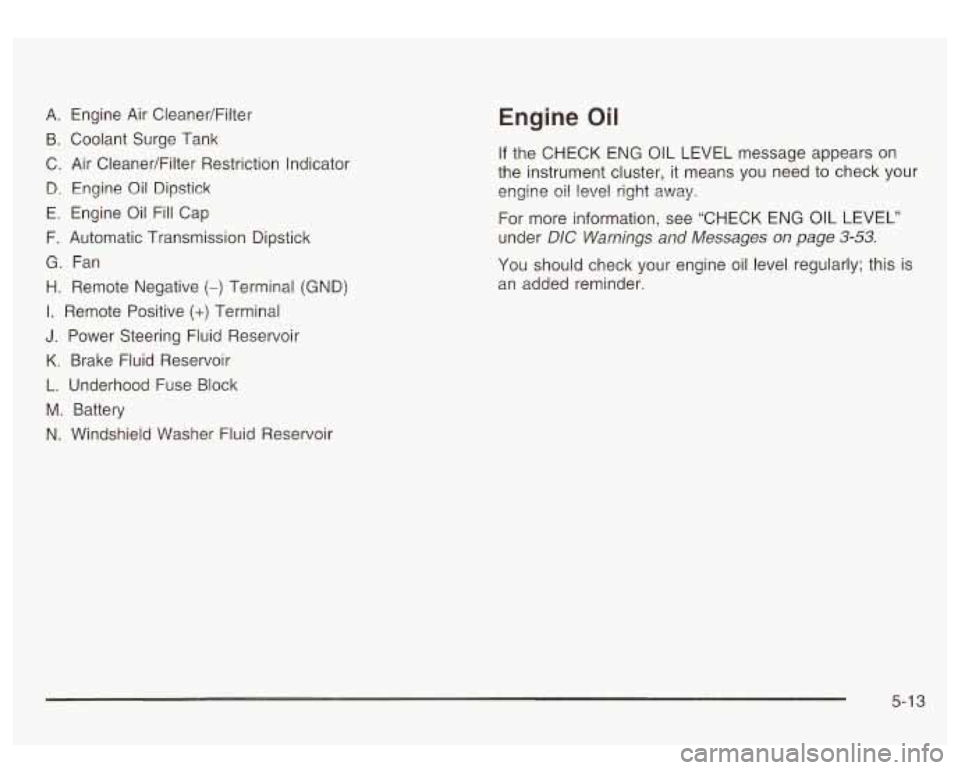
A. Engine Air CleanedFilter
B. Coolant Surge Tank
C. Air CleanerlFilter Restriction Indicator
B. Engine Oil Dipstick
E. Engine Oil Fill Cap
F. Automatic Transmission Dipstick
G. Fan
H. Remote Negative
(-) Terminal (GND)
I. Remote Positive (+) Terminal
J. Power Steering Fluid Reservoir
K. Brake Fluid Reservoir
L. Underhood Fuse Block
M. Battery
N. Windshield Washer Fluid Reservoir
Engine Oil
If the CHECK ENG OIL LEVEL message appears on
the instrument cluster, it means you need to check your
engine
oil level right away.
For more information, see “CHECK ENG
OIL LEVEL”
under
DIC Warnings and Messages on page 3-53.
You should check your engine oil level regularly; this is
an added reminder.
5-1 3
Page 283 of 428
Checking Engine Oil
It’s a good idea to check your engine oil every time you
get fuel. In order to get an accurate reading, the oil
must be warm and the vehicle must be on level ground.
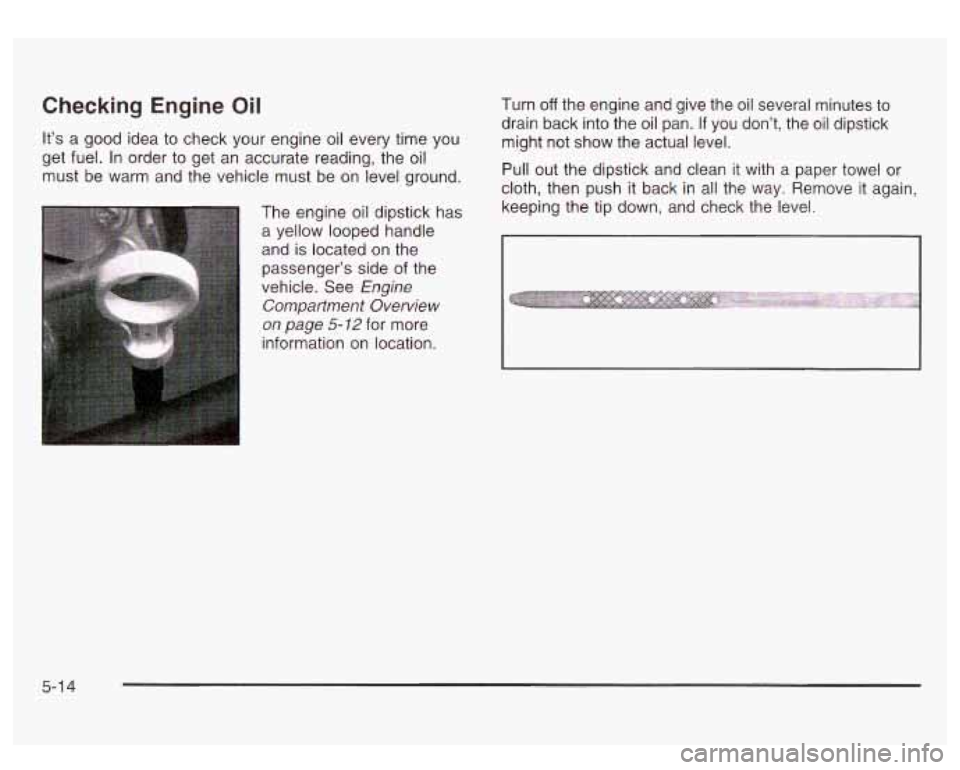
The engine oil dipstick has
a yellow looped handle
and is located on the
passenger’s side of the
vehicle. See
Engine
Compartment
Overview
on page 5- 12 for more
information on location. Turn
off the
engine and give the oil several minutes to
drain back into the oil pan.
If you don’t, the oil dipstick
might not show the actual level.
Pull out the dipstick and clean it with a paper towel or
cloth, then push it back in all the way. Remove it again,
keeping the tip down, and check the level.
5-1 4
Page 284 of 428
When to Add Engine Oil
If the oil is at or below the cross-hatched area at the dip
of the dipstick, then you’ll need to add at least one quart
of oil. But you must use the right kind. This part explains
what kind of oil to use. For engine oil crankcase capacity,
see
Capacities and Specifications on page 5- 104.
Notice: Don’t add too much oil. If your engine has
so much oil that the oil level gets above the
cross-hatched area that shows the proper operating
range, your engine could be damaged.
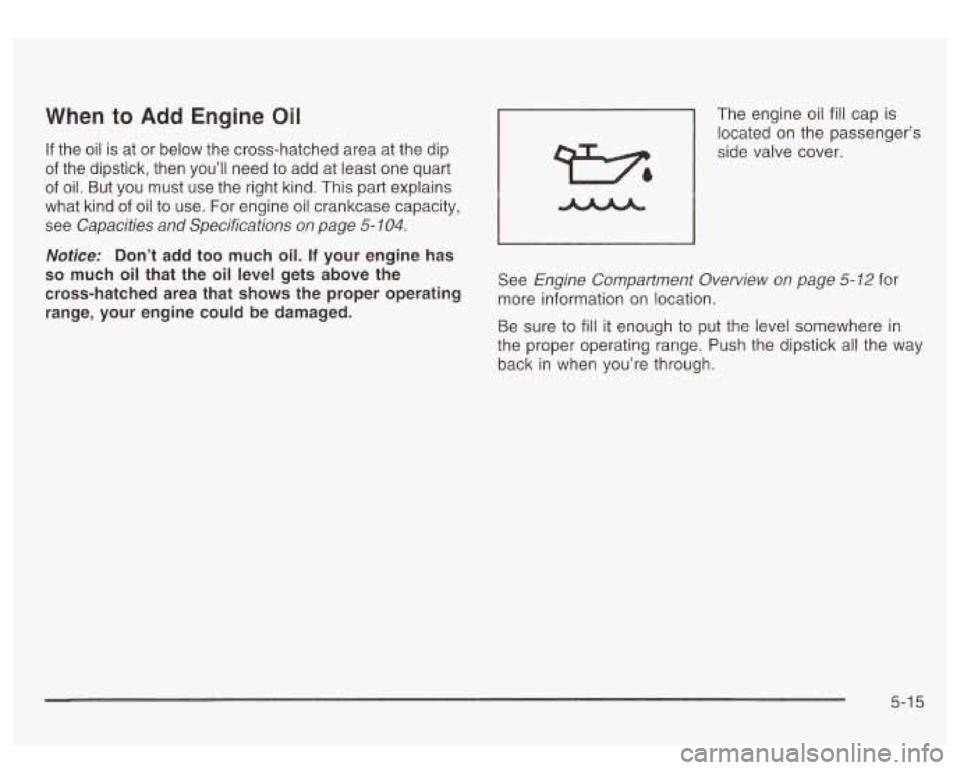
71 located on the passenger’s
The
engine oil
fill cap is
side valve cover.
See
Engine Comparfment Overview on page 5-12 for
more information on location.
Be sure to
fill it enough to put the level somewhere in
the proper operating range. Push the dipstick
all the way
back in when you’re through.
5-1 5
Page 286 of 428
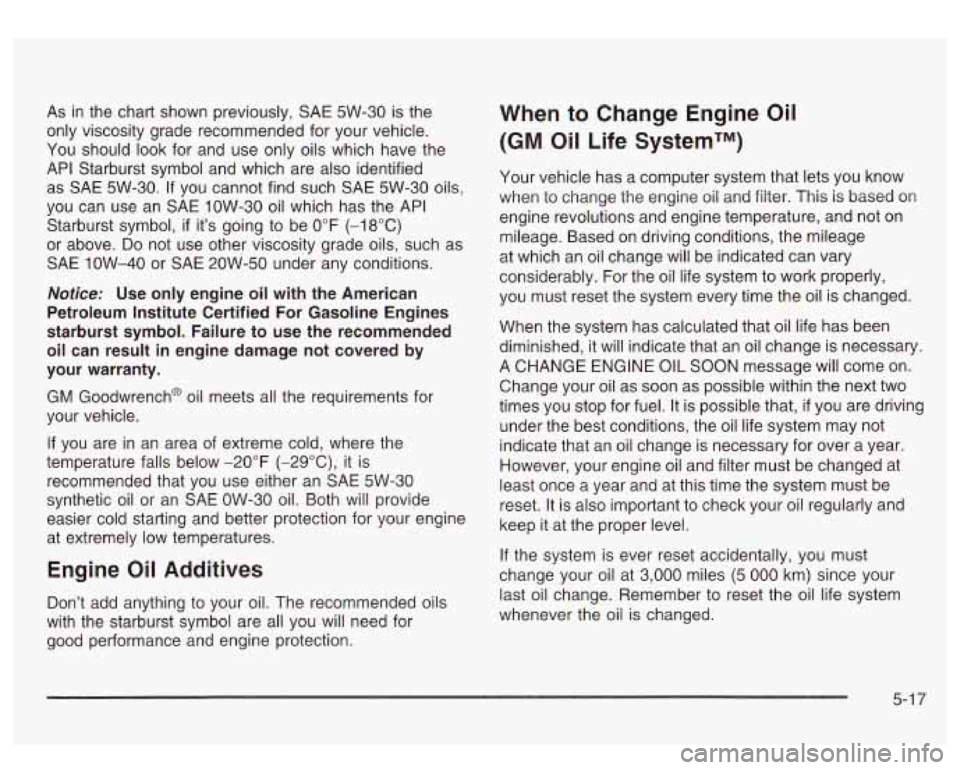
As in the chart shown previously, SAE 5W-30 is the
only viscosity grade recommended for your vehicle.
You should look for and use only oils which have the
API Starburst symbol and which are also identified
as SAE 5W-30. If you cannot find such SAE 5W-30 oils,
you can use an SAE IOW-30 oil which has the API
Starburst symbol,
if it's going to be 0°F (-18°C)
or above. Do not use other viscosity grade oils, such as
SAE 1OW-40 or SAE 20W-50 under any conditions.
Notice: Use only engine oil with the American
Petroleum Institute Certified For Gasoline Engines
starburst symbol. Failure to use the recommended
oil can result in engine damage not covered by
your warranty.
GM Goodwrench@ oil meets all the requirements for
your vehicle.
If you are in an area of extreme cold, where the
temperature falls below -20°F
(-29"C), it is
recommended that you use either an SAE 5W-30
synthetic oil or an SAE OW-30 oil. Both will provide
easier cold starting and better protection for your engine
at extremely
low temperatures.
Engine Oil Additives
Don't add anything to your oil. The recommended oils
with the starburst symbol are all you will need for
good performance and engine protection.
When to Change Engine Oil
(GM Oil Life SystemTM)
Your vehicle has a computer system that lets you know
when to change the engine
oil and filter. This is based on
engine revolutions and engine temperature, and not on
mileage. Based on driving conditions, the mileage
at which an oil change will be indicated can vary
considerably. For the oil life system to work properly,
you must reset the system every time the oil is changed.
When the system has calculated that oil life has been
diminished, it will indicate that an oil change is necessary.
A CHANGE ENGINE
OIL SOON message will come on.
Change your oil as soon as possible within the next two
times you stop for fuel. It is possible that,
if you are driving
under the best conditions, the oil life system may not
indicate that an oil change is necessary for over a year.
However, your engine oil and filter must be changed at
least once a year and at this time the system must be
reset. It is also important to check your oil regularly and
keep it at the proper level.
If the system is ever reset accidentally, you must
change your oil at 3,000 miles (5
000 km) since your
last oil change. Remember to reset the oil life system
whenever the oil is changed.
5-1 7
Page 290 of 428
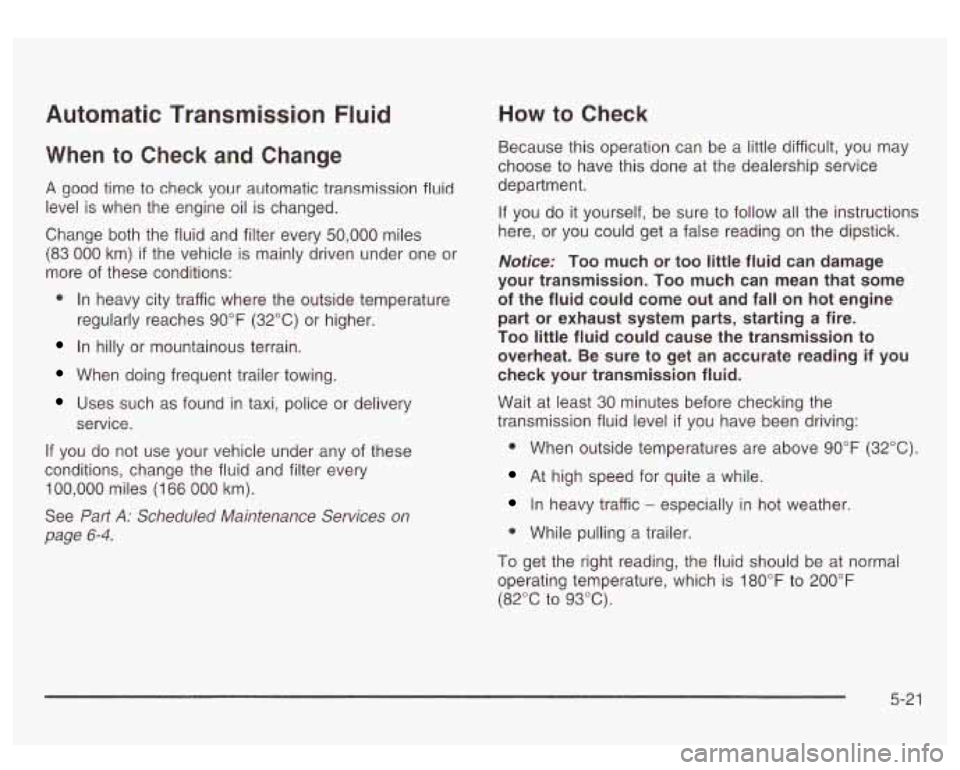
Automatic Transmission Fluid
When to Check and Change
A good time to check your automatic transmission fluid
level
is when the engine oil is changed.
Change both the fluid and filter every
50,000 miles
(83
000 km) if the vehicle is mainly driven under one or
more
of these conditions:
In heavy city traffic where the outside temperature
regularly reaches 90°F (32°C) or higher.
In hilly or mountainous terrain.
When doing frequent trailer towing.
Uses such as found in taxi, police or delivery
If you do not use your vehicle under any of these
conditions, change the fluid and filter every
100,000 miles (1 66 000 km).
See
Part A: Scheduled Maintenance Services on
page
6-4.
service.
How to Check
Because this operation can be a little difficult, you may
choose to have this done at the dealership service
department.
If you do it yourself, be sure to follow all the instructions
here, or you could get a false reading on the dipstick.
Notice: Too much or too little fluid can damage
your transmission. Too much can mean that some
of the fluid could come out and fall on hot engine
part
or exhaust system parts, starting a fire.
Too little fluid could cause the transmission to overheat. Be sure to get an accurate reading if you
check your transmission fluid.
Wait at least
30 minutes before checking the
transmission fluid level
if you have been driving:
0 When outside temperatures are above 90°F (32°C).
At high speed for quite a while.
In heavy traffic - especially in hot weather.
While pulling a trailer.
To get the right reading, the fluid should be at normal
operating temperature, which is 180°F
to 200°F
(82°C to 93°C).
5-2
1
Page 299 of 428
Cooling System
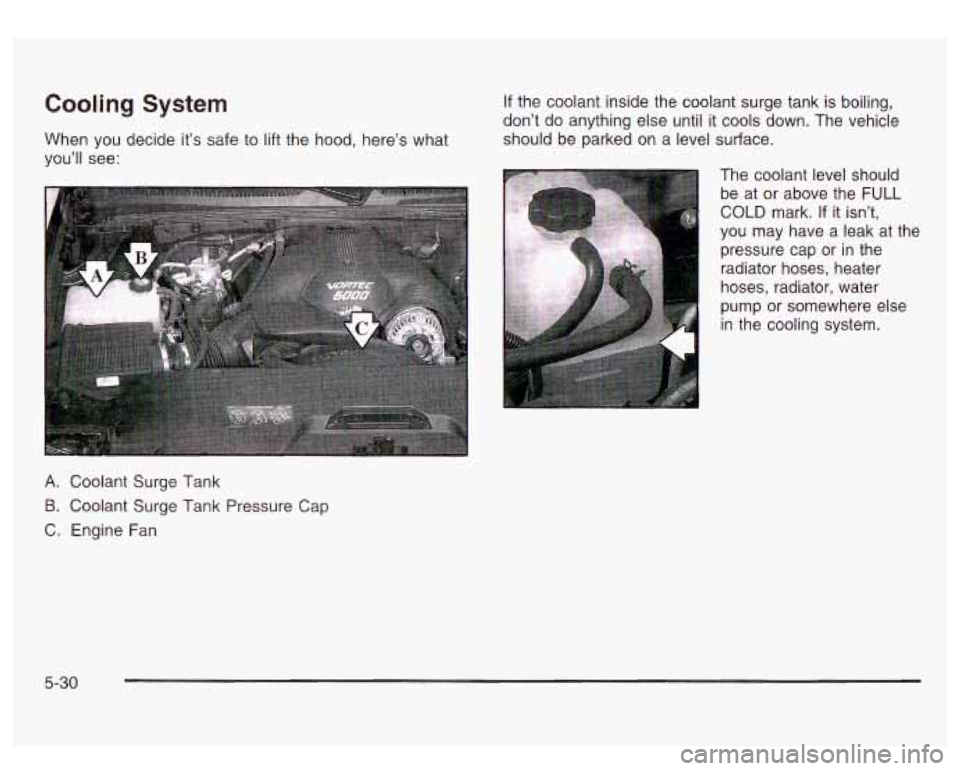
When you decide it's safe to lift the hood, here's what
you'll see:
If the coolant inside the coolant surge tank is boiling,
don't do anything else until it cools down. The vehicle
should be parked on a level surface.
A. Coolant Surge Tank
B. Coolant Surge Tank Pressure Cap
C. Engine Fan The coolant level should
be at
or above the FULL
COLD mark. If it isn't,
you may have a leak at the
rn*:A.~~ z,=7j_ . %%A" %!!:..- pressure cap or in the
*^" radiator hoses, heater
hoses, radiator, water
pump or somewhere else
in the cooling system.
I
5-30
Page 373 of 428
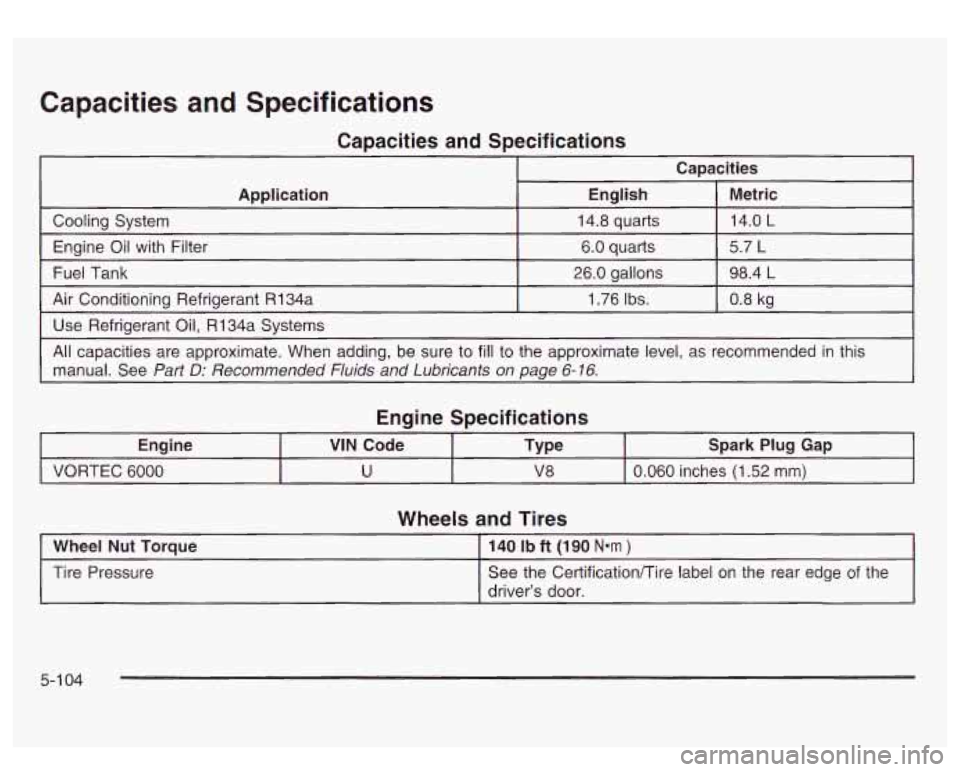
Capacities and Specifications
Capacities and Specifications
Capacities
Application
All capacities are approximate. When adding, be sure to
fill to the approximate level, as recommended in this
Use
Refrigerant Oil, R134a Systems 0.8
kg
1.76 Ibs.
Air Conditioning Refrigerant R134a 98.4
L 26.0 gallons
Fuel
Tank 5.7
L 6.0 quarts
Engine Oil
with Filter 14.0
L 14.8 quarts
Cooling
System Metric
English
manual. See
Part D: Recommended Fluids and Lubricants on page 6-16.
Engine Specifications
Engine Spark Plug Gap
Type
VIN Code
VORTEC 6000
0.060 inches (1.52 mm) V8
U
Wheels and Tires
Wheel Nut Torque
See the CertificationKire label on the rear edge of the
Tire
Pressure 140 Ib ft (190 N*m )
driver’s door.
5-1 04
Page 377 of 428
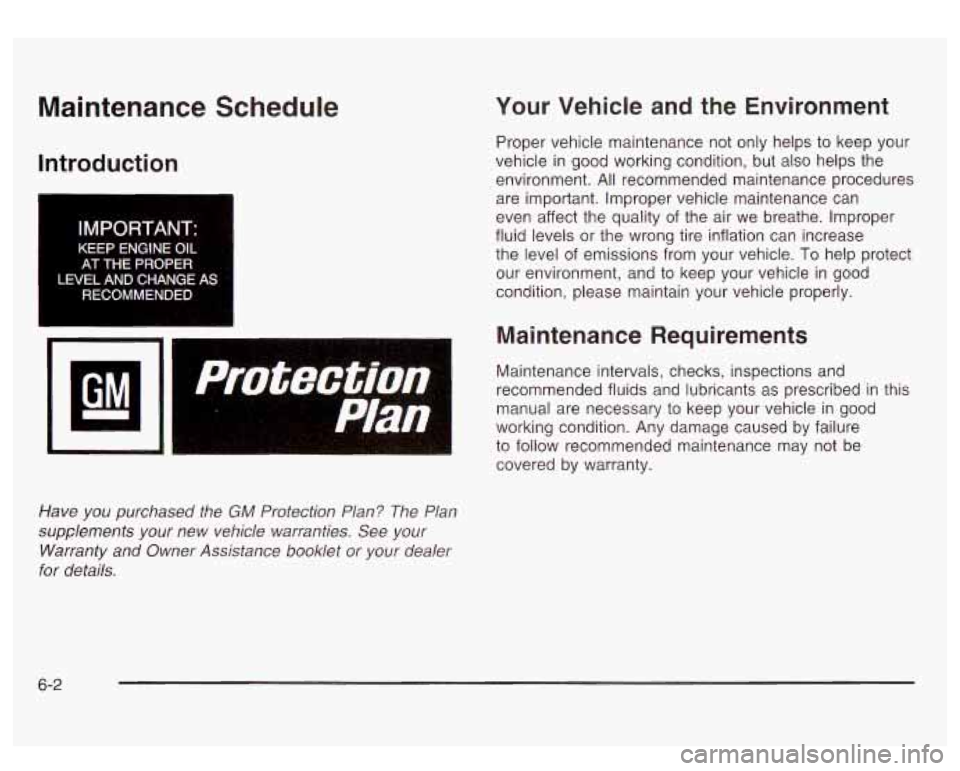
Maintenance Schedule
Introduction
I
IMPORTANT:
KEEP ENGINE OIL
AT THE PROPER
LNEL AND CHANGE
AS
RECOMMENDED
Have you purchased the GM Protection Plan? The Plan
supplements your new vehicle warranties. See your
Warranty and Owner Assistance booklet or your dealer
for details.
Your Vehicle and the Environment
Proper vehicle maintenance not only helps to keep your
vehicle in good working condition, but also helps the
environment. All recommended maintenance procedures
are important. Improper vehicle maintenance can
even affect the quality of the air we breathe. Improper
fluid levels or the wrong tire inflation can increase
the level of emissions from your vehicle.
To help protect
our environment, and to keep your vehicle in good
condition, please maintain your vehicle properly.
Maintenance Requirements
Maintenance intervals, checks, inspections and
recommended fluids and lubricants as prescribed in this
manual are necessary to keep your vehicle in good
working condition. Any damage caused by failure
to follow recommended maintenance may not be
covered by warranty.
6-2