2003 GMC SAFARI child restraint
[x] Cancel search: child restraintPage 63 of 376
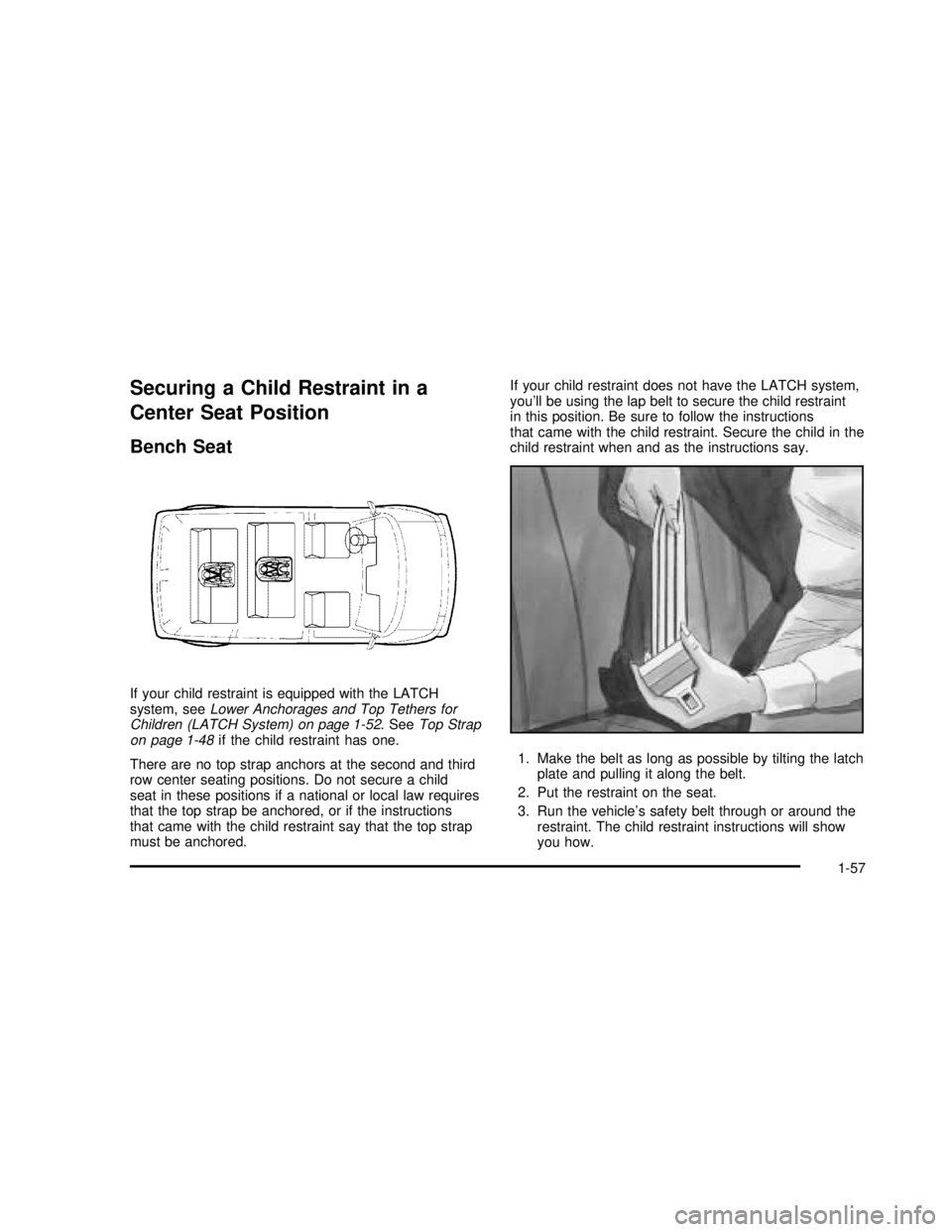
Securing a Child Restraint in a
Center Seat Position
Bench Seat
If your child restraint is equipped with the LATCH
system, seeLower Anchorages and Top Tethers for
Children (LATCH System) on page 1-52. SeeTop Strap
on page 1-48if the child restraint has one.
There are no top strap anchors at the second and third
row center seating positions. Do not secure a child
seat in these positions if a national or local law requires
that the top strap be anchored, or if the instructions
that came with the child restraint say that the top strap
must be anchored.If your child restraint does not have the LATCH system,
you’ll be using the lap belt to secure the child restraint
in this position. Be sure to follow the instructions
that came with the child restraint. Secure the child in the
child restraint when and as the instructions say.
1. Make the belt as long as possible by tilting the latch
plate and pulling it along the belt.
2. Put the restraint on the seat.
3. Run the vehicle’s safety belt through or around the
restraint. The child restraint instructions will show
you how.
1-57
2003 - Safari OM
Page 64 of 376
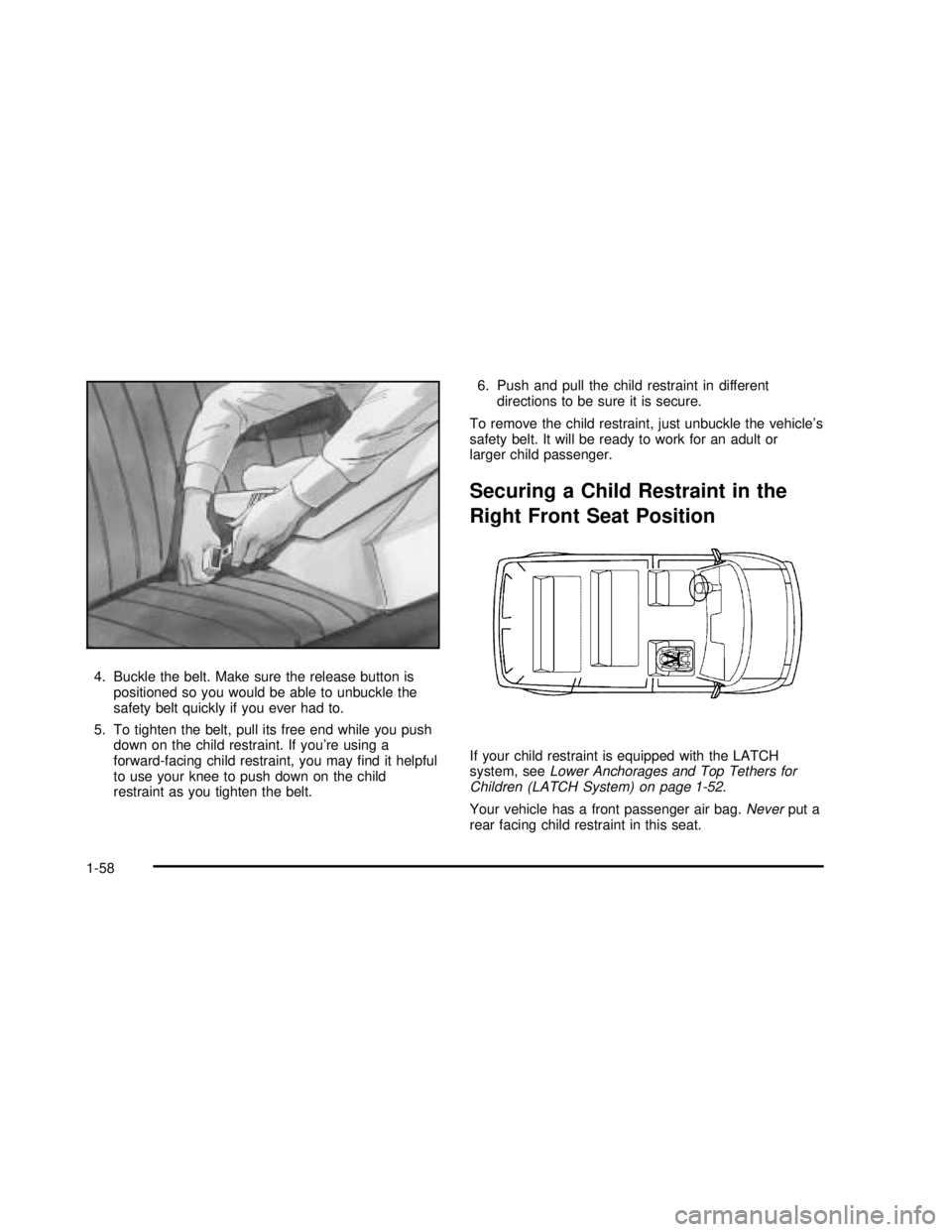
4. Buckle the belt. Make sure the release button is
positioned so you would be able to unbuckle the
safety belt quickly if you ever had to.
5. To tighten the belt, pull its free end while you push
down on the child restraint. If you’re using a
forward-facing child restraint, you mayfind it helpful
to use your knee to push down on the child
restraint as you tighten the belt.6. Push and pull the child restraint in different
directions to be sure it is secure.
To remove the child restraint, just unbuckle the vehicle’s
safety belt. It will be ready to work for an adult or
larger child passenger.
Securing a Child Restraint in the
Right Front Seat Position
If your child restraint is equipped with the LATCH
system, seeLower Anchorages and Top Tethers for
Children (LATCH System) on page 1-52.
Your vehicle has a front passenger air bag.Neverput a
rear facing child restraint in this seat.
1-58
2003 - Safari OM
Page 65 of 376
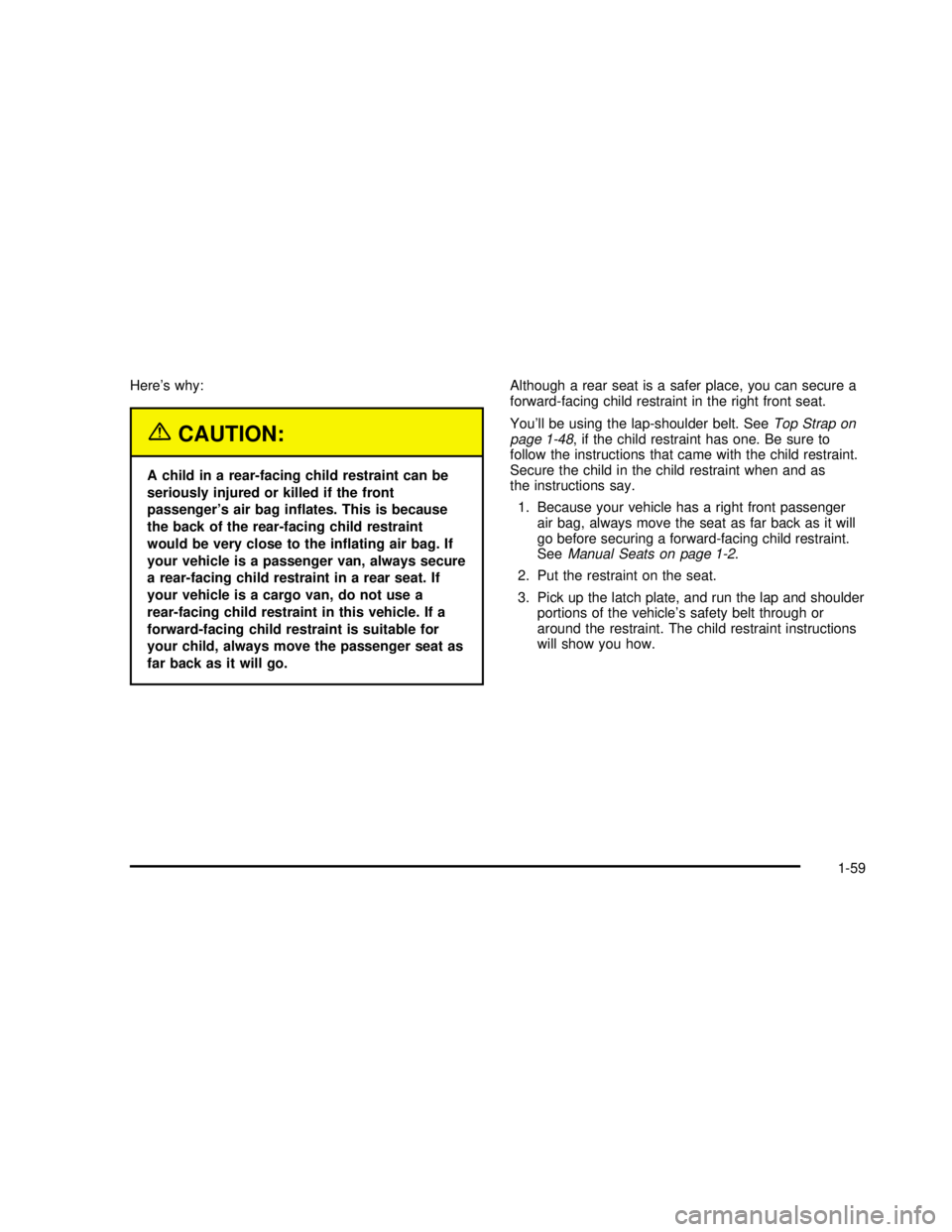
Here’s why:
{CAUTION:
A child in a rear-facing child restraint can be
seriously injured or killed if the front
passenger’s air bag inflates. This is because
the back of the rear-facing child restraint
would be very close to the inflating air bag. If
your vehicle is a passenger van, always secure
a rear-facing child restraint in a rear seat. If
your vehicle is a cargo van, do not use a
rear-facing child restraint in this vehicle. If a
forward-facing child restraint is suitable for
your child, always move the passenger seat as
far back as it will go.Although a rear seat is a safer place, you can secure a
forward-facing child restraint in the right front seat.
You’ll be using the lap-shoulder belt. SeeTop Strap on
page 1-48, if the child restraint has one. Be sure to
follow the instructions that came with the child restraint.
Secure the child in the child restraint when and as
the instructions say.
1. Because your vehicle has a right front passenger
air bag, always move the seat as far back as it will
go before securing a forward-facing child restraint.
SeeManual Seats on page 1-2.
2. Put the restraint on the seat.
3. Pick up the latch plate, and run the lap and shoulder
portions of the vehicle’s safety belt through or
around the restraint. The child restraint instructions
will show you how.
1-59
2003 - Safari OM
Page 67 of 376
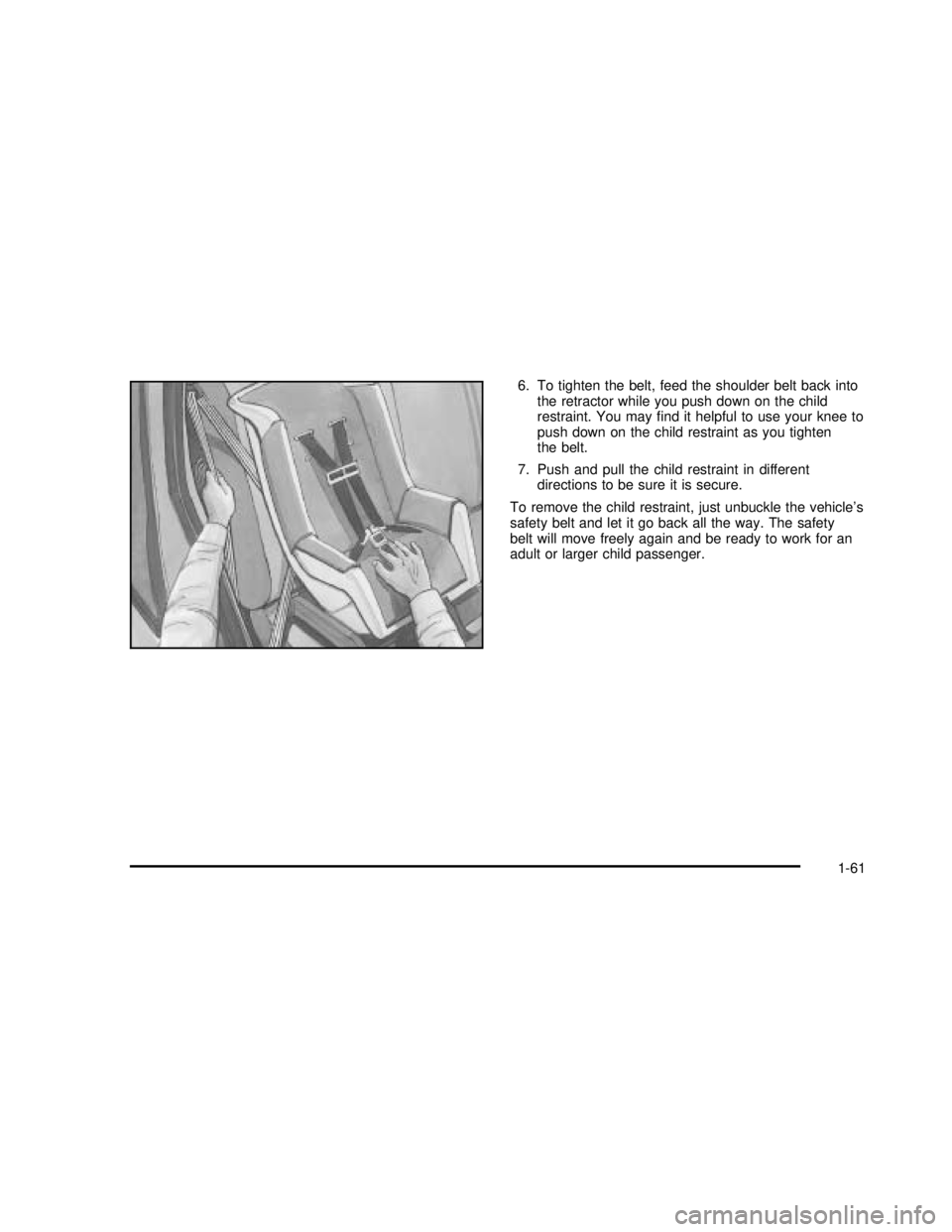
6. To tighten the belt, feed the shoulder belt back into
the retractor while you push down on the child
restraint. You mayfind it helpful to use your knee to
push down on the child restraint as you tighten
the belt.
7. Push and pull the child restraint in different
directions to be sure it is secure.
To remove the child restraint, just unbuckle the vehicle’s
safety belt and let it go back all the way. The safety
belt will move freely again and be ready to work for an
adult or larger child passenger.
1-61
2003 - Safari OM
Page 69 of 376
{CAUTION:
Anyone who is up against, or very close to,
any air bag when it inflates can be seriously
injured or killed. Air bags plus lap-shoulder
belts offer the best protection for adults, but
not for young children and infants. Neither the
vehicle’s safety belt system nor its air bag
system is designed for them. Young children
and infants need the protection that a child
restraint system can provide. Always secure
children properly in your vehicle. To read how,
see the parts of this manual called “Older
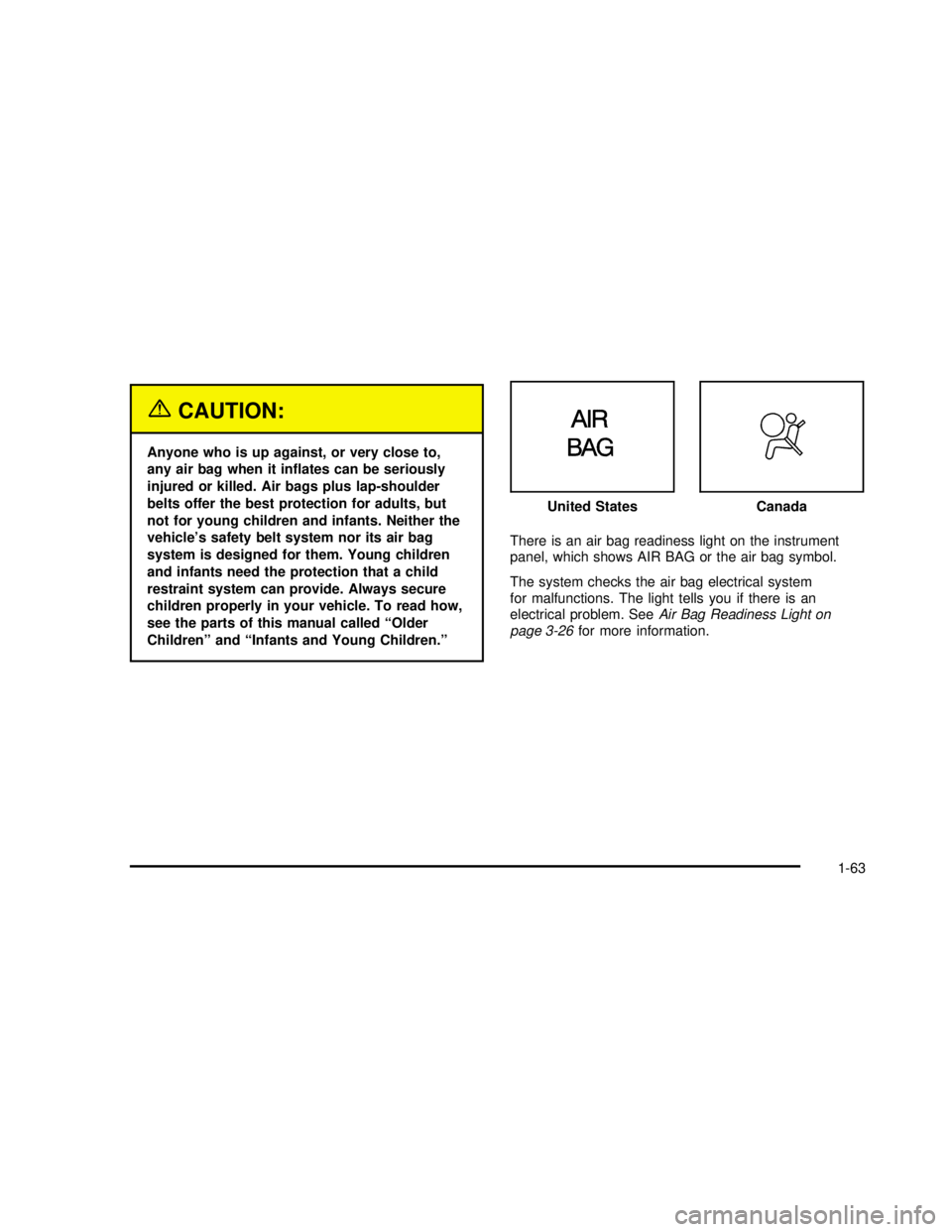
Children” and “Infants and Young Children.”There is an air bag readiness light on the instrument
panel, which shows AIR BAG or the air bag symbol.
The system checks the air bag electrical system
for malfunctions. The light tells you if there is an
electrical problem. SeeAir Bag Readiness Light on
page 3-26for more information. United States
Canada
1-63
2003 - Safari OM
Page 202 of 376
The Certication/Tire label also tells you the maximum
weights for the front and rear axles, called Gross Axle
Weight Rating (GAWR). Tond out the actual loads on
your front and rear axles, you need to go to a weigh
station and weigh your vehicle. Your dealer can help you
with this. Be sure to spread out your load equally on both
sides of the centerline.
Never exceed the GVWR for your vehicle, or the GAWR
for either the front or rear axle.
And, if you do have a heavy load, you should spread
it out.
{CAUTION:
Do not load your vehicle any heavier than the
GVWR, or either the maximum front or rear
GAWR. If you do, parts on your vehicle can
break, and it can change the way your vehicle
handles. These could cause you to lose
control and crash. Also, overloading can
shorten the life of your vehicle.
Using heavier suspension components to get added
durability might not change your weight ratings. Ask your
dealer to help you load your vehicle the right way.Notice:Your warranty does not cover parts or
components that fail because of overloading.
If you put things inside of your vehicle–like suitcases,
tools, packages, or anything else–they will go as
fast as the vehicle goes. If you have to stop or turn
quickly, or if there is a crash, they’ll keep going.
{CAUTION:
Things you put inside your vehicle can strike
and injure people in a sudden stop or turn, or
in a crash.
•Put things in the cargo area of your
vehicle. Try to spread the weight evenly.
•Never stack heavier things, like suitcases,
inside the vehicle so that some of them
are above the tops of the seats.
•Don’t leave an unsecured child restraint in
your vehicle.
•When you carry something inside the
vehicle, secure it whenever you can.
•Don’t leave a seat folded down unless you
need to.
4-30
2003 - Safari OM
Page 359 of 376

Check
Engine Light...............................................3-30
Gages Warning Light...................................3-35
Checking Brake Fluid......................................5-40
Checking Coolant............................................5-26
Checking Engine Oil........................................5-13
Checking Things Under the Hood
....................... 5-9
Checking Your Restraint Systems
......................1-68
Chemical Paint Spotting
...................................5-82
Child Restraints
Child Restraint Systems
...............................1-44
Infants and Young Children
...........................1-38
Lower Anchorages and Top Tethers for
Children (LATCH System)
..........................1-52
Older Children
.............................................1-35
Securing a Child Restraint Designed for the
LATCH System
........................................1-54
Securing a Child Restraint in a Center Seat
Position
..................................................1-57
Securing a Child Restraint in a Rear Outside
Seat Position
...........................................1-54
Securing a Child Restraint in the Right Front
Seat Position
...........................................1-58
Top Strap
...................................................1-48
Top Strap Anchor Location
............................1-50
Where to Put the Restraint
...........................1-47
Cigarette Lighter
.............................................3-17Cleaning
Inside of Your Vehicle..................................5-77
Outside of Your Vehicle................................5-79
Underbody Maintenance...............................5-82
Weatherstrips..............................................5-79
Cleaning Aluminum Wheels..............................5-81
Cleaning Exterior Lamps/Lenses.......................5-80
Cleaning Fabric/Carpet....................................5-77
Cleaning Glass Surfaces..................................5-78
Cleaning Interior Plastic Components.................5-78
Cleaning Leather............................................5-78
Cleaning the Top of the Instrument Panel...........5-78
Cleaning the Windshield and Wiper Blades.........5-81
Cleaning Tires................................................5-81
Cleaning Vinyl................................................5-78
Climate Control System...................................3-18
Rear ..........................................................3-21
Rear Air Conditioning System........................3-20
Rear Heating System...................................3-19
Compact Disc Messages..................................3-44
Compact Spare Tire........................................5-75
Composite Headlamps.....................................5-51
Control of a Vehicle.......................................... 4-5
Convenience Net............................................2-45
Coolant
Engine Temperature Gage............................3-29
Heater, Engine............................................2-21
Cooling System..............................................5-30
3
2003 - Safari OM
Page 363 of 376

Horn ............................................................... 3-5
How to Add Coolant to the Coolant
Recovery Tank............................................5-31
How to Add Coolant to the Radiator..................5-33
How to Add Fluid............................................5-25
How to Check........................................5-23, 5-58
How to Check Lubricant...................................5-49
How to Check Power Steering Fluid..................5-37
How to Inspect the Engine Air Cleaner/Filter.......5-22
How to Use This Manual...................................... ii
How to Wear Safety Belts Properly...................1-18
Hydroplaning..................................................4-17
I
If No Steam Is Coming From Your Engine..........5-29
If Steam Is Coming From Your Engine...............5-28
If the Light Is Flashing.....................................3-31
If the Light Is On Steady.................................3-31
If You Are Stuck in Sand, Mud, Ice or Snow.......4-28
If You Do Decide To Pull A Trailer.....................4-32
If You’re Caught in a Blizzard...........................4-26
Ignition Positions.............................................2-19
Ignition Transmission Lock Check......................6-30Infants and Young Children, Restraints...............1-38
Inflation -- Tire Pressure..................................5-58
Inspection
Brake System.............................................6-33
Engine Cooling System................................6-32
Exhaust System..........................................6-32
Fuel System...............................................6-32
Part C - Periodic Maintenance.......................6-32
Steering, Suspension and Front Drive Axle
Boot and Seal.........................................6-32
Throttle System...........................................6-33
Transfer Case and Front Axle
(All-Wheel Drive)......................................6-33
Installing a Garage Door Opener.......................2-40
Instrument Panel
Cluster.......................................................3-24
Overview..................................................... 3-2
Instrument Panel Brightness Control..................3-15
Instrument Panel Fuse Block............................5-86
Interior Lamps................................................3-15
J
Jump Starting.................................................5-43
7
2003 - Safari OM