2003 FORD WINDSTAR snow chains
[x] Cancel search: snow chainsPage 216 of 240
•Inflating a low tire will not clear the Low Tire Warning indicator light.
Only reseting the system will clear the light.
•The system will not detect a pressure loss without driving the vehicle
for at least 0.8 km (0.5 mile) at speeds greater than 40 km/h
(25 mph).
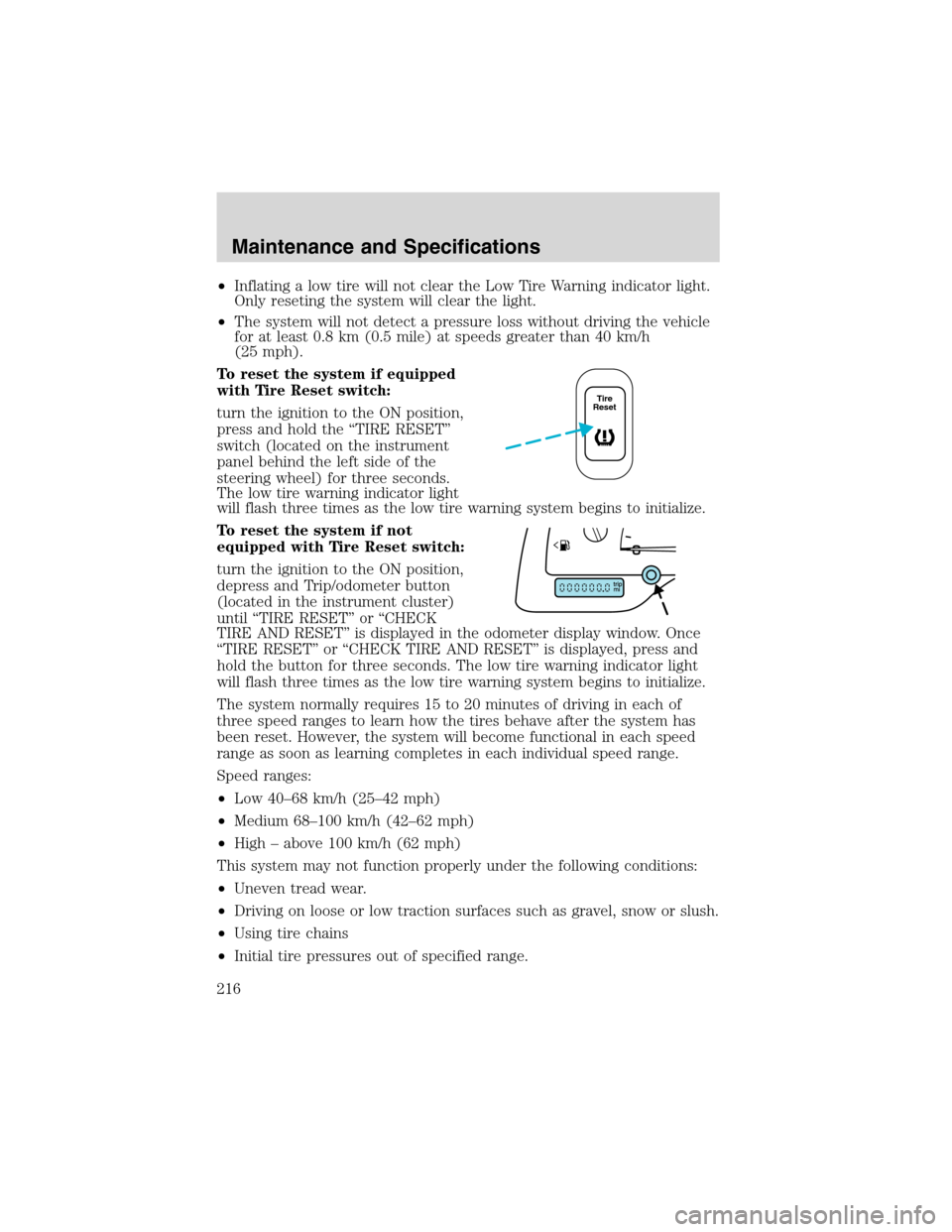
To reset the system if equipped
with Tire Reset switch:
turn the ignition to the ON position,
press and hold the“TIRE RESET”
switch (located on the instrument
panel behind the left side of the
steering wheel) for three seconds.
The low tire warning indicator light
will flash three times as the low tire warning system begins to initialize.
To reset the system if not
equipped with Tire Reset switch:
turn the ignition to the ON position,
depress and Trip/odometer button
(located in the instrument cluster)
until“TIRE RESET”or“CHECK
TIRE AND RESET”is displayed in the odometer display window. Once
“TIRE RESET”or“CHECK TIRE AND RESET”is displayed, press and
hold the button for three seconds. The low tire warning indicator light
will flash three times as the low tire warning system begins to initialize.
The system normally requires 15 to 20 minutes of driving in each of
three speed ranges to learn how the tires behave after the system has
been reset. However, the system will become functional in each speed
range as soon as learning completes in each individual speed range.
Speed ranges:
•Low 40–68 km/h (25–42 mph)
•Medium 68–100 km/h (42–62 mph)
•High–above 100 km/h (62 mph)
This system may not function properly under the following conditions:
•Uneven tread wear.
•Driving on loose or low traction surfaces such as gravel, snow or slush.
•Using tire chains
•Initial tire pressures out of specified range.
Tire
Reset
Maintenance and Specifications
216
Page 219 of 240
Make sure that all replacement tires are of the same size, type,
load-carrying capacity and tread design (e.g.,“All Terrain”,
“Touring”, etc.), as originally offered by Ford.
Do not replace your tires with“high performance”tires or larger
size tires.
Improperly inflated tires can affect vehicle handling and can fail
suddenly, possibly resulting in loss of vehicle control, vehicle
rollover and/or personal injury.
Tires that are larger or smaller than your vehicle’s original tires may also
affect the accuracy of your speedometer.
SNOW TIRES AND CHAINS
Driving too fast for conditions creates the possibility of loss of
vehicle control. Driving at very high speeds for extended periods
of time may result in damage to vehicle components.
Snow tires must be the same size and grade as the tires you
currently have on your vehicle.
The tires on your vehicle have all weather treads to provide traction in
rain and snow. However, in some climates, you may need to use snow
tires and chains. If you need to use chains, it is recommended that steel
wheels (of the same size and specifications) be used as chains may chip
aluminum wheels.
Follow these guidelines when using snow tires and chains:
•Do not use tire chains with 235/60R16 and P235/55R17 size tires.
•Use only SAE Class S chains.
•Install chains securely, verifying that the chains do not touch any
wiring, brake lines or fuel lines.
•Drive cautiously. If you hear the chains rub or bang against your
vehicle, stop and re-tighten the chains. If this does not work, remove
the chains to prevent damage to your vehicle.
•If possible, avoid fully loading your vehicle.
Maintenance and Specifications
219
Page 220 of 240

•Remove the tire chains when they are no longer needed. Do not use
tire chains on dry roads.
•The suspension insulation and bumpers will help prevent vehicle
damage. Do not remove these components from your vehicle when
using snow tires and chains.
MOTORCRAFT PART NUMBERS
Component 3.8L OHV V6 engine
Air filter element FA-1616
Fuel filter FG-986B
Battery (standard) BXT-65-650
Battery (optional) BXT-65-750
Oil filter FL-400S
PCV valve EV-152
Spark plugs* AWSF-42EE***
* Refer to Vehicle Emissions Control Information (VECI) decal for spark
plug gap information.
*** If a spark plug is removed for inspection, it must be reinstalled in the
same cylinder. Cylinders No. 1, 2, and 3 have a“EG”suffix. Cylinders No.
4, 5, and 6 have a“E”suffix. If a spark plug needs to be replaced, use
only spark plugs with the service part number suffix letter“EE”as
shown on the engine decal.
REFILL CAPACITIES
Fluid Ford Part
NameApplication Capacity
Brake fluid Motorcraft High
Performance
DOT 3 Motor
Vehicle Brake
Fluid
1
All Fill to MAX line
on reservoir
Engine oil
(includes filter
change)Motorcraft SAE
5W-20 Premium
Synthetic Blend
Motor Oil3.8L engine 4.7L (5.0
quarts)
Maintenance and Specifications
220
Page 234 of 240

Relays ........................................152
Remote entry system .................77
illuminated entry ..........36, 80–81
locking/unlocking doors .....75, 78
Reverse sensing system ...........142
Roadside assistance ..................150
Roof rack .....................................73
S
Safety belts (see Safety
restraints) ....................98, 101–105
Safety defects, reporting ..........181
Safety restraints ..........98, 101–105
belt minder .............................106
cleaning the safety belts ........110
extension assembly ................109
for adults .........................102–104
for children .....................117–118
lap belt ....................................105
Occupant Classification
Sensor ........................................99
warning light and chime ........106
Safety seats for children ..........121
Seat belts (see Safety
restraints) ....................................98
Seats ............................................87
child safety seats ....................121
memory seat .............................90
Servicing your vehicle ..............188
Spare tire (see Changing
the Tire) ............................161–162
Spark plugs,
specifications .....................220, 224
Specification chart,
lubricants ...........................222, 224
Speed control ..............................53Starting your vehicle ........131–133
jump starting ..........................167
Steering wheel
tilting .........................................45
T
Tire warning ..............................215
Tires ...................................213–215
changing ..........................161–163
checking the pressure ............217
replacing ..................................218
rotating ....................................217
snow tires and chains ............219
tire grades ...............................214
treadwear ................................214
Towing .......................................146
recreational towing .................149
trailer towing ..........................146
wrecker ....................................172
Traction control ........................135
Transaxle
automatic operation ...............139
fluid, refill capacities ..............220
lubricant specifications ..........224
Transmission
fluid, checking and adding
(automatic) .............................212
lubricant specifications ..........222
Turn signal ..................................38
V
Vehicle dimensions ...................224
Vehicle Identification Number
(VIN) ..........................................226
Vehicle loading ..........................144
Ventilating your vehicle ...........134
W
Warning lights (see Lights) .......10
Index
234