2003 FORD THUNDERBIRD trunk
[x] Cancel search: trunkPage 58 of 200
If there is any potential remote keyless entry problem with your vehicle,
ensureALL remote entry transmittersare taken to your authorized
dealer to aid in troubleshooting.
Locking the doors
1. Pressand release to lock all the doors and activate the anti-theft
system.Note:the turn signal lamps will flash once to confirm the doors,
trunk and hood are closed.
2. Press
and release again within three seconds to confirm that all the
doors, trunk and hood are closed and locked.Note:the doors will lock
again, and the horn will chirp once.
If any of the doors , the trunk or the hood are not properly closed the
horn will make two quick chirps.
Unlocking the doors
1. Pressand release to unlock the driver’s door and deactivate the
perimeter alarm (if activated).Note:The interior lamps will illuminate.
2. Press
and release again within three seconds to unlock all the
doors.
The remote entry system comes with an illuminated entry feature. This
feature turns on the interior lamps for 25 seconds or until the ignition is
turned to the RUN position.
The inside lights will not turn off if:
•they have been turned on using the dimmer control or
•any door is open.
The battery saver feature will turn off the interior lamps 30 minutes after
the ignition is turned to the OFF position.
Opening the trunk
Pressonce to open the trunk.
•Ensure that the trunk is closed and latched before driving your
vehicle. Failure to properly latch the trunk may cause objects to fall
out or block the driver’s rear view.
Sounding a panic alarm
Press
to activate the alarm. The horn will sound for a maximum of
30 seconds and the turn signal lamps will flash for a maximum of 5
Locks and Security
58
Page 65 of 200
PERIMETER ALARM SYSTEM
The perimeter anti-theft system will help prevent your vehicle from
unauthorized entry.
If there is any potential perimeter anti-theft problem with your vehicle,
ensureALL remote entry transmittersare taken to the dealership to
aid in troubleshooting.
Arming the system
When armed, this system will respond if unauthorized entry is
attempted. When unauthorized entry occurs, the system will flash the
turn signal lamps and will sound the horn.
The system is ready to arm whenever the key is removed from the
ignition. Either of the following actions will prearm the alarm system:
•Press the
control on the remote entry transmitter.
•Press the driver or passenger door lock control while the door is open.
Disarming the system
You can disarm the system by any of the following actions:
•Unlock the doors by pressing the
control on your remote entry
transmitter.
•Unlock the doors with a key. Turn the key full travel (toward the front
of the vehicle) to ensure the alarm disarms.
Triggering the anti-theft system
The armed system will be triggered if any door, the trunk or the hood is
opened without using the key or the remote entry transmitter.
Locks and Security
65
Page 129 of 200
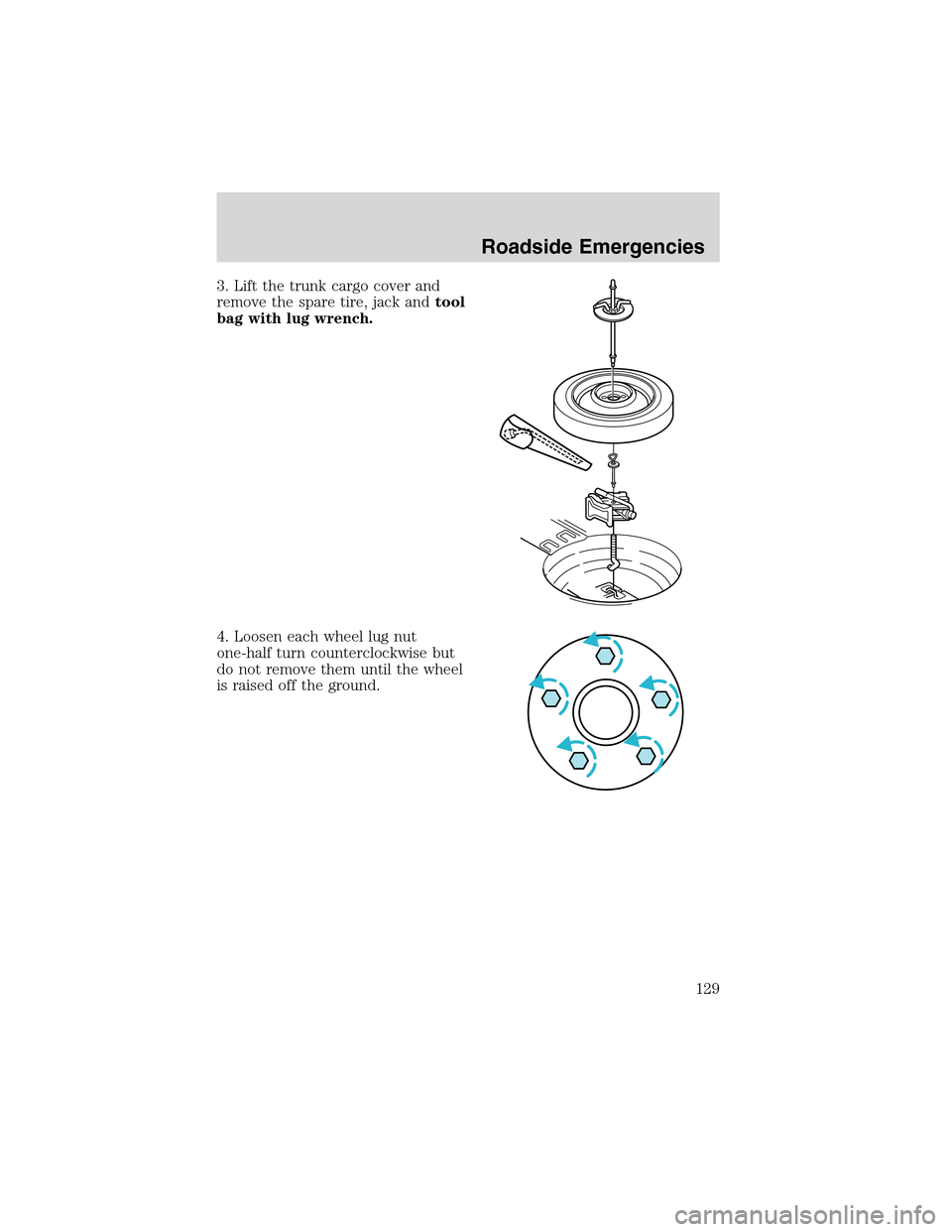
3.Liftthe trunk cargo cover and
remove the spare tire, jack andtool
bag with lug wrench.
4. Loosen each wheel lug nut
one-half turn counterclockwise but
do not remove them until the wheel
is raised off the ground.
Roadside Emergencies
129
Page 132 of 200
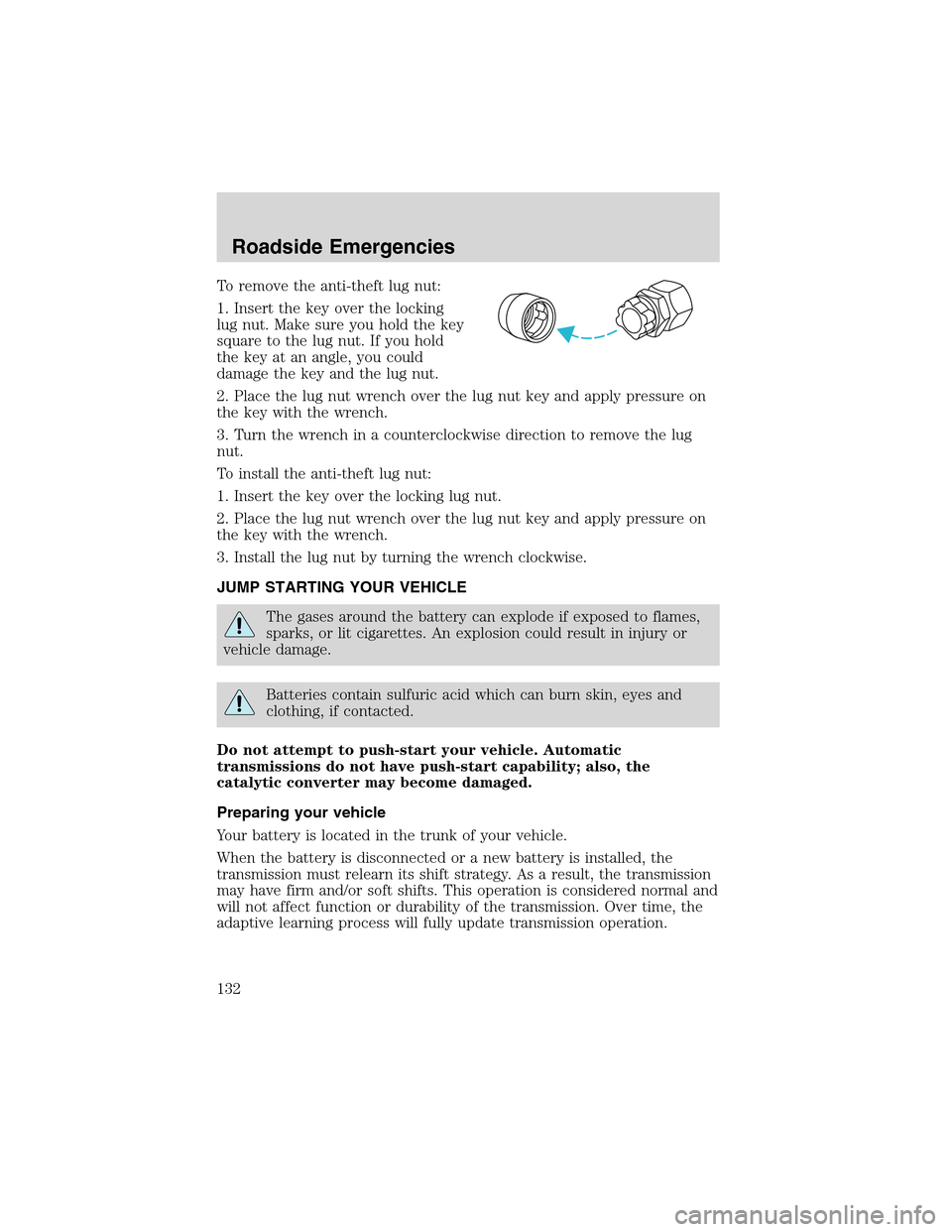
To remove the anti-theft lug nut:
1. Insert the key over the locking
lug nut. Make sure you hold the key
square to the lug nut. If you hold
the key at an angle, you could
damage the key and the lug nut.
2. Place the lug nut wrench over the lug nut key and apply pressure on
the key with the wrench.
3. Turn the wrench in a counterclockwise direction to remove the lug
nut.
To install the anti-theft lug nut:
1. Insert the key over the locking lug nut.
2. Place the lug nut wrench over the lug nut key and apply pressure on
the key with the wrench.
3. Install the lug nut by turning the wrench clockwise.
JUMP STARTING YOUR VEHICLE
The gases around the battery can explode if exposed to flames,
sparks, or lit cigarettes. An explosion could result in injury or
vehicle damage.
Batteries contain sulfuric acid which can burn skin, eyes and
clothing, if contacted.
Do not attempt to push-start your vehicle. Automatic
transmissions do not have push-start capability; also, the
catalytic converter may become damaged.
Preparing your vehicle
Your battery is located in the trunk of your vehicle.
When the battery is disconnected or a new battery is installed, the
transmission must relearn its shift strategy. As a result, the transmission
may have firm and/or soft shifts. This operation is considered normal and
will not affect function or durability of the transmission. Over time, the
adaptive learning process will fully update transmission operation.
Roadside Emergencies
132
Page 133 of 200

1.Useonly a 12–volt supply to start your vehicle.
2. Do not disconnect the battery of your disabled vehicle as this could
damage the vehicle’s electrical system. Keep the battery vent hose
attached at all times.
3. Park the booster vehicle close to the trunk of your disabled vehicle
making sure the two vehiclesdo nottouch. Set the parking brake on
both vehicles and stay clear of the engine cooling fan and other moving
parts.
4. Check all battery terminals and remove any excessive corrosion before
you attach the battery cables. Ensure the vent caps are tight and level.
5. Turn the heater fan on in both vehicles to protect any electrical
surges. Turn all other accessories off.
Connecting the jumper cables
1. Connect the positive (+) booster cable to the positive (+) terminal of
the discharged battery.
Note:In the illustrations,lightning boltsare used to designate the
assisting (boosting) battery.
+–+–
Roadside Emergencies
133
Page 194 of 200

K
Keylessentrysystem
autolock.....................................61
Keys
positions of the ignition .........102
L
Lamps
autolamp system .......................24
bulb replacement
specifications chart ..................28
cargo lamps ...............................26
daytime running light ...............25
headlamps .................................24
headlamps, flash to pass ..........25
instrument panel, dimming .....26
interior lamps .....................27, 29
replacing bulbs ....... 28–29, 31–34
Lane change indicator
(see Turn signal) ........................27
Lights, warning and indicator ......8
anti-lock brakes (ABS) ..........105
Load limits .................................114
GAWR ......................................114
GVWR ......................................114
trailer towing ..........................114
Locks
autolock .....................................61
doors ..........................................55
Lubricant specifications ...184, 186
Lug nuts, anti-theft ...................131
Lumbar support, seats ...............67
M
Manual transmission
fluid capacities ........................183
lubricant specifications ..........186Master lighting switch ................24
Mirrors .........................................38
side view mirrors (power) .......38
Motorcraft parts ................171, 182
O
Octane rating ............................170
Oil (see Engine oil) ..................156
P
Parking brake ............................106
Parts (see Motorcraft parts) ....182
Power distribution box
(see Fuses) .......................122, 125
Power door locks ........................55
Power point .................................36
Power steering ..................107–108
fluid, checking and adding ....176
fluid, refill capacity ................183
fluid, specifications .........184, 186
Power Windows ...........................37
R
Radio ............................................14
Rear window defroster ...............22
Relays ........................................118
Remote entry system .................58
illuminated entry ......................60
locking/unlocking doors ...........55
opening the trunk .....................58
Roadside assistance ..................116
S
Safety Belt Maintenance ............79
Index
194
Page 195 of 200

Safety belts
(see Safety restraints) .........70–73
Safety defects, reporting ..........147
Safety restraints ....................70–74
belt minder ...............................75
extension assembly ..................79
for adults .............................71–73
for children ...............................91
safety belt maintenance ...........79
warning light and chime ....74–75
Safety seats for children ............94
Seat belts
(see Safety restraints) ...............70
Seats ............................................66
child safety seats ......................94
cleaning ...................................151
Select Shift Transmission
(SST) shifter .............................111
Servicing your vehicle ..............154
Spare tire (see Changing
the Tire) ....................................127
Spark plugs,
specifications .....................182, 186
Specification chart,
lubricants ...........................184, 186
Speed control ..............................39
Starting your vehicle ........102–104
jump starting ..........................132
Steering
speed sensitive .......................108
Steering wheel
controls ......................................42
tilting .........................................36T
Tires ...........................127, 179–180
changing ..........................127–128
checking the pressure ............180
replacing ..................................181
rotating ....................................181
snow tires and chains ............182
tire grades ...............................180
treadwear ................................179
Towing .......................................115
recreational towing .................115
trailer towing ..........................115
wrecker ....................................138
Traction control ........................106
Transmission .............................108
fluid, checking and adding
(automatic) .............................177
fluid, refill capacities ..............183
lubricant specifications ..184, 186
Trunk ...........................................56
remote release ....................39, 58
Turn signal ..................................27
V
Vehicle dimensions ...................186
Vehicle Identification Number
(VIN) ..........................................188
Vehicle loading ..........................114
Ventilating your vehicle ...........105
Index
195