2003 FORD SUPER DUTY transmission
[x] Cancel search: transmissionPage 192 of 256
•Manual transmission:
1. Set the parking brake, depress the clutch and place the gearshift in N
(Neutral).
2. Block the wheels.
Note:Do not start your engine with the air cleaner removed and do not
remove it while the engine is running.
OPENING THE HOOD
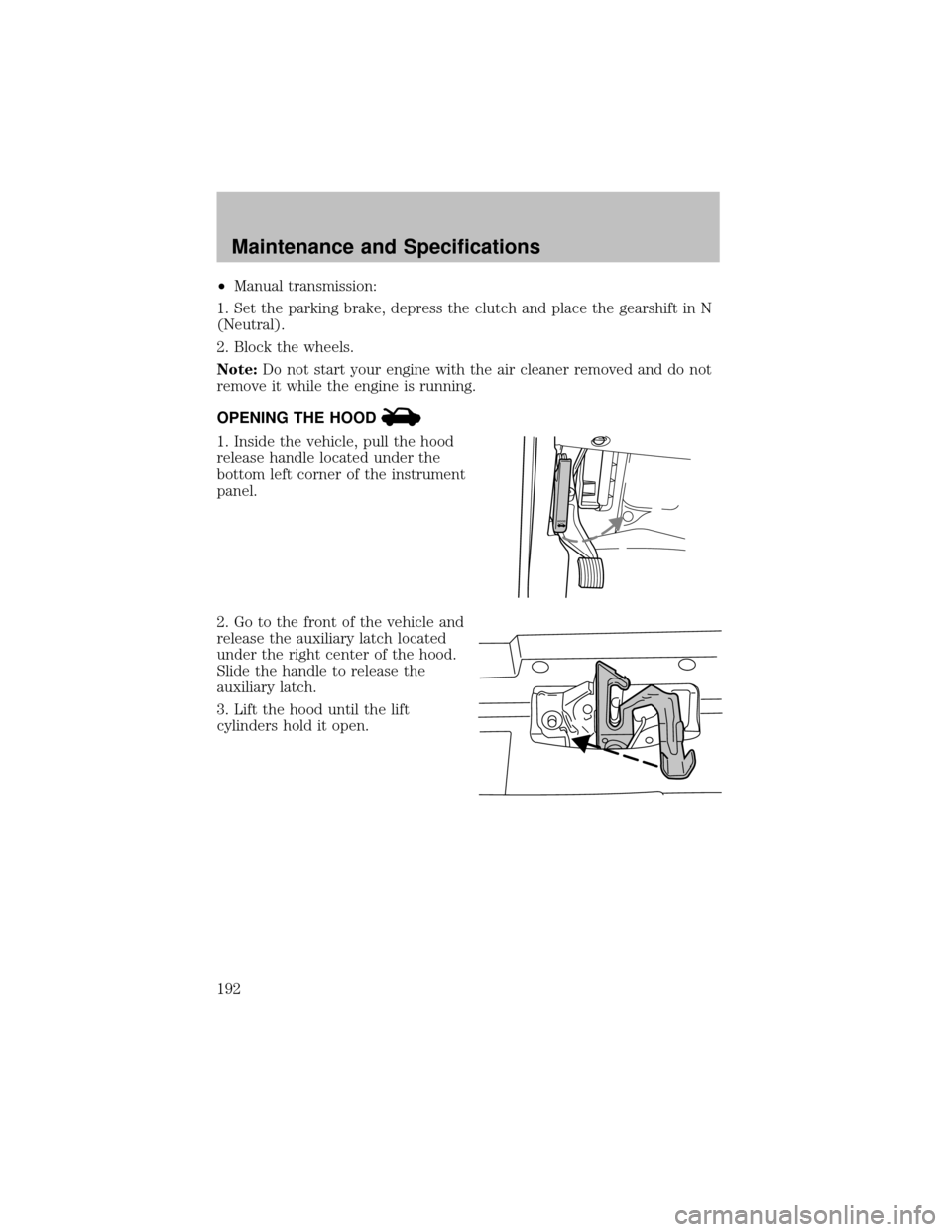
1. Inside the vehicle, pull the hood
release handle located under the
bottom left corner of the instrument
panel.
2. Go to the front of the vehicle and
release the auxiliarylatch located
under the right center of the hood.
Slide the handle to release the
auxiliarylatch.
3. Lift the hood until the lift
cylinders hold it open.
H
O
O
D
Maintenance and Specifications
192
Page 193 of 256
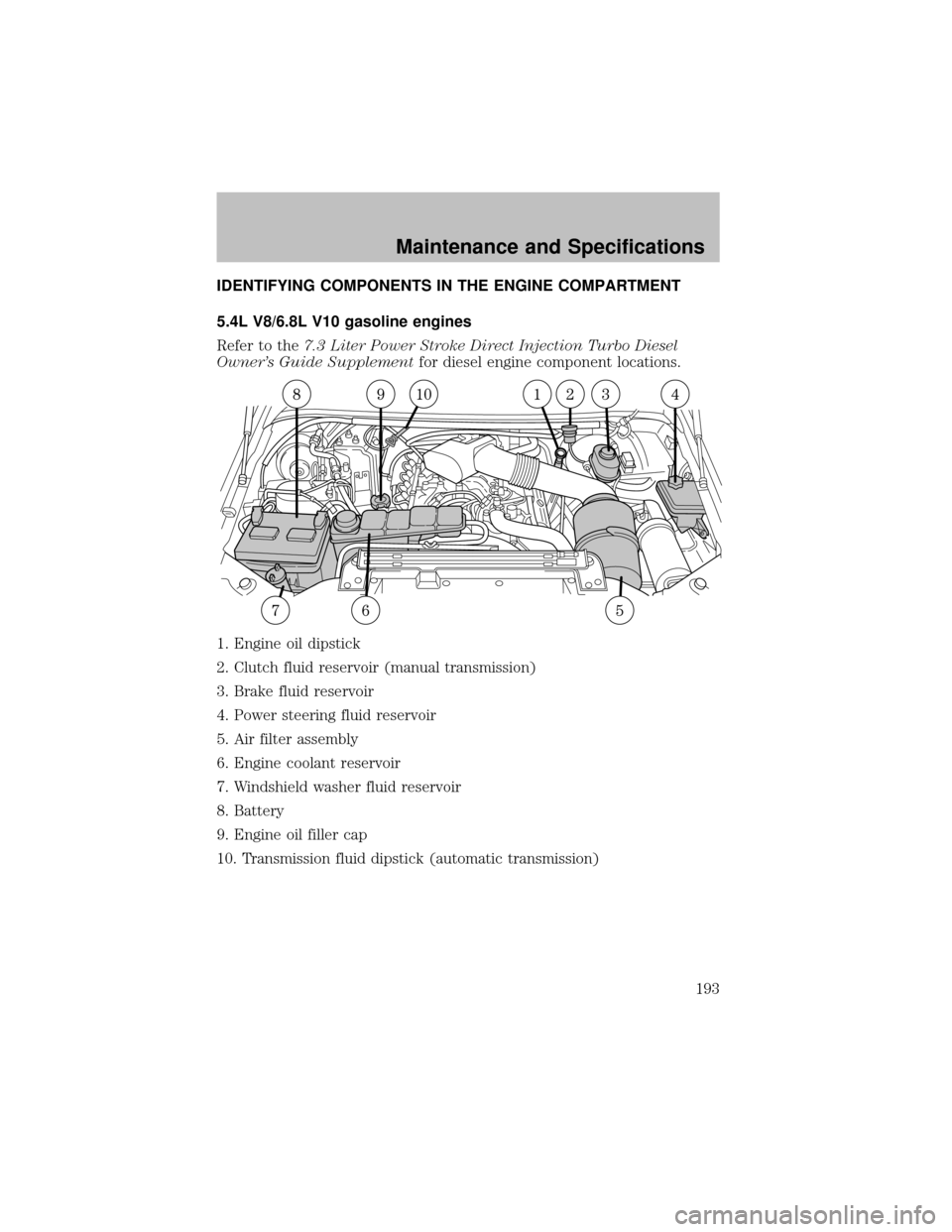
IDENTIFYING COMPONENTS IN THE ENGINE COMPARTMENT
5.4L V8/6.8L V10 gasoline engines
Refer to the7.3 Liter Power Stroke Direct Injection Turbo Diesel
Owner’s Guide Supplementfor diesel engine component locations.
1. Engine oil dipstick
2. Clutch fluid reservoir (manual transmission)
3. Brake fluid reservoir
4. Power steering fluid reservoir
5. Air filter assembly
6. Engine coolant reservoir
7. Windshield washer fluid reservoir
8. Battery
9. Engine oil filler cap
10. Transmission fluid dipstick (automatic transmission)
Maintenance and Specifications
193
Page 194 of 256
WINDSHIELD WASHER FLUID
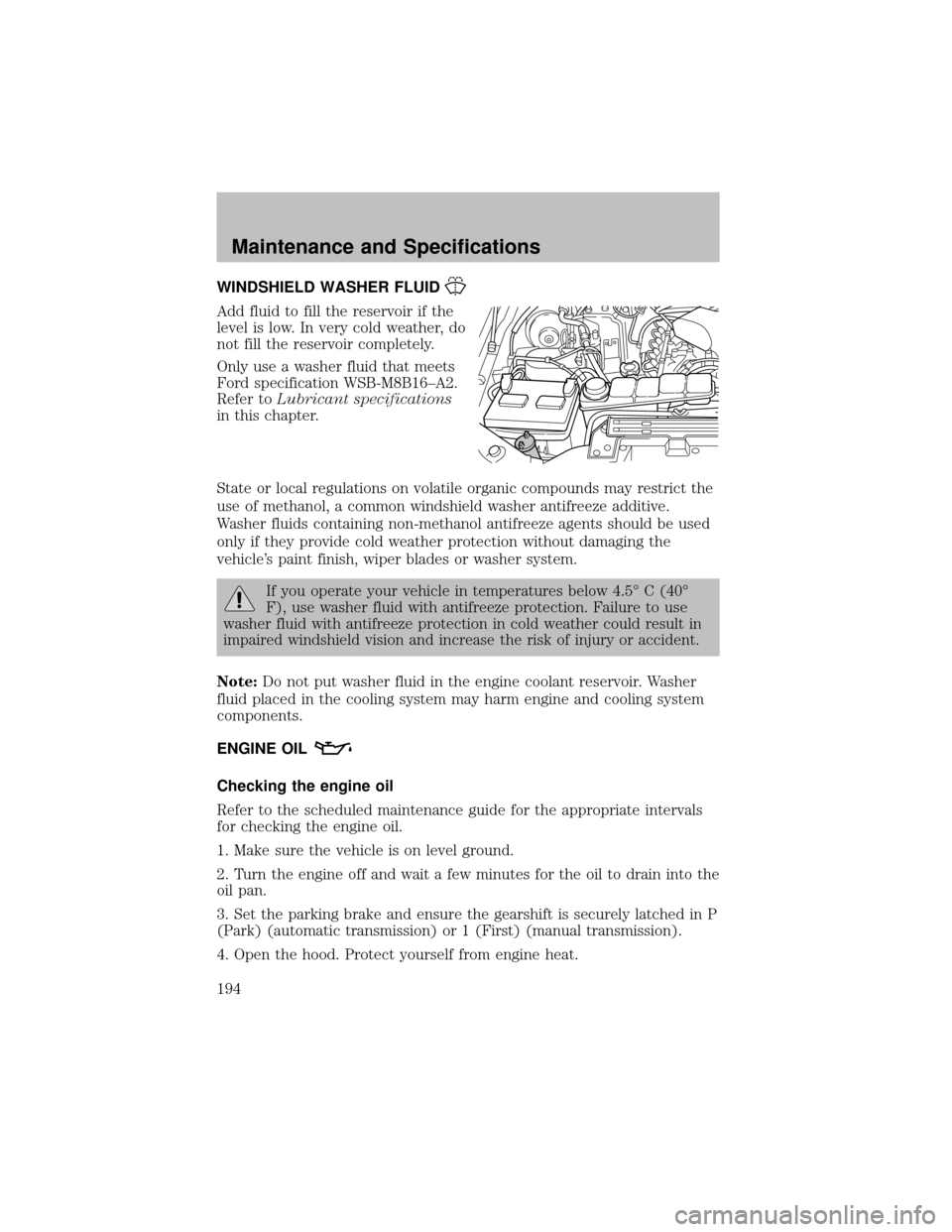
Add fluid to fill the reservoir if the
level is low. In verycold weather, do
not fill the reservoir completely.
Onlyuse a washer fluid that meets
Ford specification WSB-M8B16–A2.
Refer toLubricant specifications
in this chapter.
State or local regulations on volatile organic compounds mayrestrict the
use of methanol, a common windshield washer antifreeze additive.
Washer fluids containing non-methanol antifreeze agents should be used
onlyif theyprovide cold weather protection without damaging the
vehicle’s paint finish, wiper blades or washer system.
If you operate your vehicle in temperatures below 4.5° C (40°
F), use washer fluid with antifreeze protection. Failure to use
washer fluid with antifreeze protection in cold weather could result in
impaired windshield vision and increase the risk of injuryor accident.
Note:Do not put washer fluid in the engine coolant reservoir. Washer
fluid placed in the cooling system may harm engine and cooling system
components.
ENGINE OIL
Checking the engine oil
Refer to the scheduled maintenance guide for the appropriate intervals
for checking the engine oil.
1. Make sure the vehicle is on level ground.
2. Turn the engine off and wait a few minutes for the oil to drain into the
oil pan.
3. Set the parking brake and ensure the gearshift is securelylatched in P
(Park) (automatic transmission) or 1 (First) (manual transmission).
4. Open the hood. Protect yourself from engine heat.
Maintenance and Specifications
194
Page 197 of 256
BATTERY
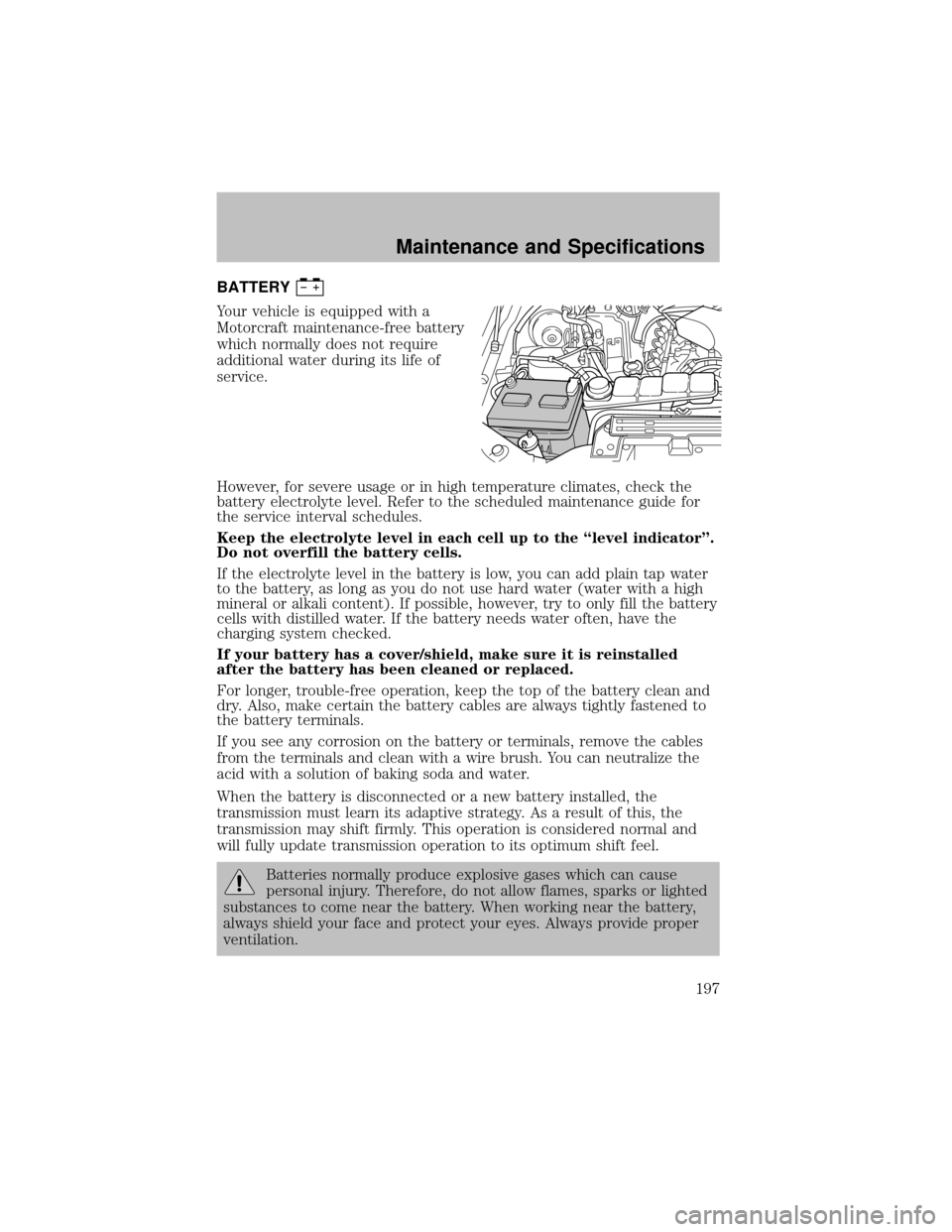
Your vehicle is equipped with a
Motorcraft maintenance-free battery
which normallydoes not require
additional water during its life of
service.
However, for severe usage or in high temperature climates, check the
batteryelectrolyte level. Refer to the scheduled maintenance guide for
the service interval schedules.
Keep the electrolyte level in each cell up to the “level indicator”.
Do not overfill the battery cells.
If the electrolyte level in the battery is low, you can add plain tap water
to the battery, as long as y ou do not use hard water (water with a high
mineral or alkali content). If possible, however, tryto onlyfill the battery
cells with distilled water. If the batteryneeds water often, have the
charging system checked.
If your battery has a cover/shield, make sure it is reinstalled
after the battery has been cleaned or replaced.
For longer, trouble-free operation, keep the top of the batteryclean and
dry. Also, make certain the batterycables are always tightlyfastened to
the batteryterminals.
If you see any corrosion on the battery or terminals, remove the cables
from the terminals and clean with a wire brush. You can neutralize the
acid with a solution of baking soda and water.
When the batteryis disconnected or a new batteryinstalled, the
transmission must learn its adaptive strategy. As a result of this, the
transmission mayshift firmly. This operation is considered normal and
will fullyupdate transmission operation to its optimum shift feel.
Batteries normallyproduce explosive gases which can cause
personal injury. Therefore, do not allow flames, sparks or lighted
substances to come near the battery. When working near the battery,
always shield your face and protect your eyes. Always provide proper
ventilation.
Maintenance and Specifications
197
Page 198 of 256
When lifting a plastic-cased battery, excessive pressure on the
end walls could cause acid to flow through the vent caps,
resulting in personal injuryand/or damage to the vehicle or battery.
Lift the batterywith a batterycarrier or with your hands on opposite
corners.
Keep batteries out of reach of children. Batteries contain sulfuric
acid. Avoid contact with skin, eyes or clothing. Shield your eyes
when working near the batteryto protect against possible splashing of
acid solution. In case of acid contact with skin or eyes, flush
immediatelywith water for a minimum of 15 minutes and get prompt
medical attention. If acid is swallowed, call a physician immediately.
Batteryposts, terminals and related accessories contain lead and
lead compounds.Wash hands after handling.
For information on transmission operation after the batteryhas been
disconnected see “Shift strategy” in the driving section.
Because your vehicle’s engine is also electronicallycontrolled bya
computer, some control conditions are maintained bypower from the
battery. When the batteryis disconnected or a new batteryis installed,
the engine must relearn its idle and fuel trim strategyfor optimum
driveabilityand performance. To begin this process:
1. With the vehicle at a complete stop, set the parking brake.
2. Put the gearshift in P (Park) (automatic transmission) or the neutral
position (manual transmission), turn off all accessories and start the
engine.
3. Run the engine until it reaches normal operating temperature.
4. Allow the engine to idle for at least one minute.
5. Turn the A/C on and allow the engine to idle for at least one minute.
6. Drive the vehicle to complete the relearning process.
•The vehicle mayneed to be driven 16 km (10 miles) or more to
relearn the idle and fuel trim strategy.
•If you do not allow the engine to relearn its idle trim, the idle
quality of your vehicle may be adversely affected until the idle
trim is eventually relearned.
If the batteryhas been disconnected or a new batteryhas been installed,
the clock and the preset radio stations must be reset once the batteryis
reconnected.
Maintenance and Specifications
198
Page 212 of 256

•Revving the engine before turning it off mayreduce fuel economy.
•Using the air conditioner or defroster mayreduce fuel economy.
•You maywant to turn off the speed control in hillyterrain if
unnecessaryshifting between third and fourth gear occurs.
Unnecessaryshifting of this type could result in reduced fuel
economy.
•Warming up a vehicle on cold mornings is not required and may
reduce fuel economy.
•Resting your foot on the brake pedal while driving may reduce fuel
economy.
•Combine errands and minimize stop-and-go driving.
Maintenance
•Keep tires properlyinflated and use onlyrecommended size.
•Operating a vehicle with the wheels out of alignment will reduce fuel
economy.
•Use recommended engine oil. Refer toLubricant specificationsin
this chapter.
•Perform all regularlyscheduled maintenance items. Follow the
recommended maintenance schedule and owner maintenance checks
found in your vehicle scheduled maintenance guide.
Conditions
•Heavilyloading a vehicle or towing a trailer mayreduce fuel economy
at anyspeed.
•Carrying unnecessaryweight mayreduce fuel economy(approximately
0.4 km/L [1 mpg] is lost for every180 kg [400 lb] of weight carried).
•Adding certain accessories to your vehicle (for example bug
deflectors, rollbars/light bars, running boards, ski/luggage racks) may
reduce fuel economy.
•Using fuel blended with alcohol maylower fuel economy.
•Fuel economymaydecrease with lower temperatures during the first
12–16 km (8–10 miles) of driving.
•Driving on flat terrain offers improved fuel economyas compared to
driving on hillyterrain.
•Transmissions give their best fuel economywhen operated in the top
cruise gear and with steadypressure on the gas pedal.
Maintenance and Specifications
212
Page 216 of 256
CLUTCH FLUID (IF EQUIPPED)
Check the clutch fluid level. Refer to the scheduled maintenance guide
for the service interval schedules.
Use onlya DOT 3 brake fluid designed to meet Ford specification
ESA-M6C25–A. Refer toLubricant Specificationsin this chapter.
Brake fluid is toxic. If brake fluid contacts the eyes, flush eyes
with running water for 15 minutes. Seek medical if irritation
persists. If taken internally, drink water and induce vomiting. Seek
medical attention immediately.
During normal operation, the fluid level in the clutch reservoir should
remain constant or rise slightly. If the fluid level drops, refill the fluid
level to the step in the reservoir.
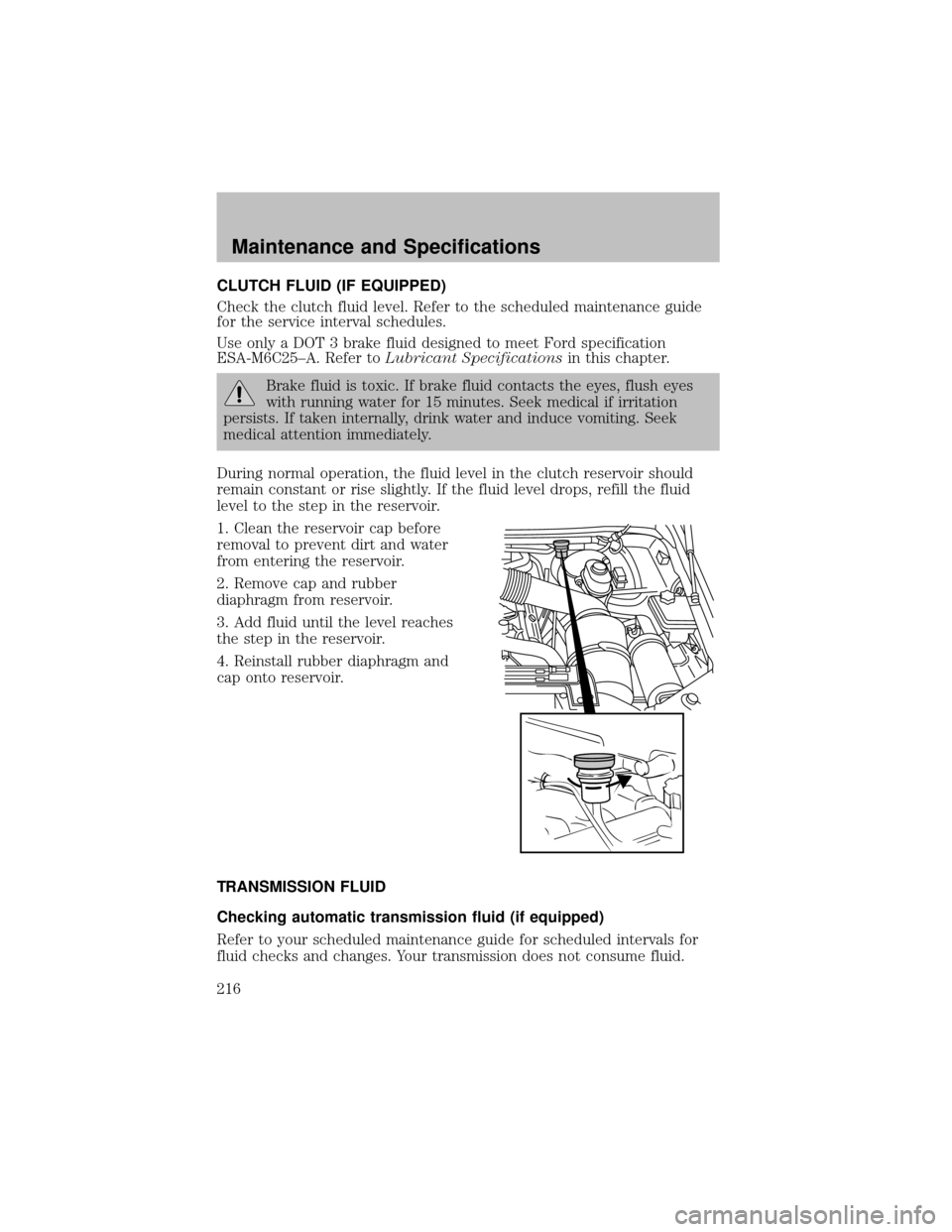
1. Clean the reservoir cap before
removal to prevent dirt and water
from entering the reservoir.
2. Remove cap and rubber
diaphragm from reservoir.
3. Add fluid until the level reaches
the step in the reservoir.
4. Reinstall rubber diaphragm and
cap onto reservoir.
TRANSMISSION FLUID
Checking automatic transmission fluid (if equipped)
Refer to your scheduled maintenance guide for scheduled intervals for
fluid checks and changes. Your transmission does not consume fluid.
Maintenance and Specifications
216
Page 217 of 256
However, the fluid level should be checked if the transmission is not
working properly, i.e., if the transmission slips or shifts slowly or if y ou
notice some sign of fluid leakage.
Automatic transmission fluid expands when warmed. To obtain an
accurate fluid check, drive the vehicle until it is at normal operating
temperature (approximately30 km [20 miles]). If your vehicle has been
operated for an extended period at high speeds, in citytraffic during hot
weather or pulling a trailer, the vehicle should be turned off for about 30
minutes to allow fluid to cool before checking.
1. Drive the vehicle 30 km (20 miles) or until it reaches normal operating
temperature.
2. Park the vehicle on a level surface and engage the parking brake.
3. With the parking brake engaged and your foot on the brake pedal,
start the engine and move the gearshift lever through all of the gear
ranges. Allow sufficient time for each gear to engage.
4. Latch the gearshift lever in P (Park) and leave the engine running.
5. Remove the dipstick, wiping it clean with a clean, drylint free rag. If
necessary, refer toIdentifying components in the engine compartment
in this chapter for the location of the dipstick.
6. Install the dipstick making sure it is fullyseated in the filler tube.
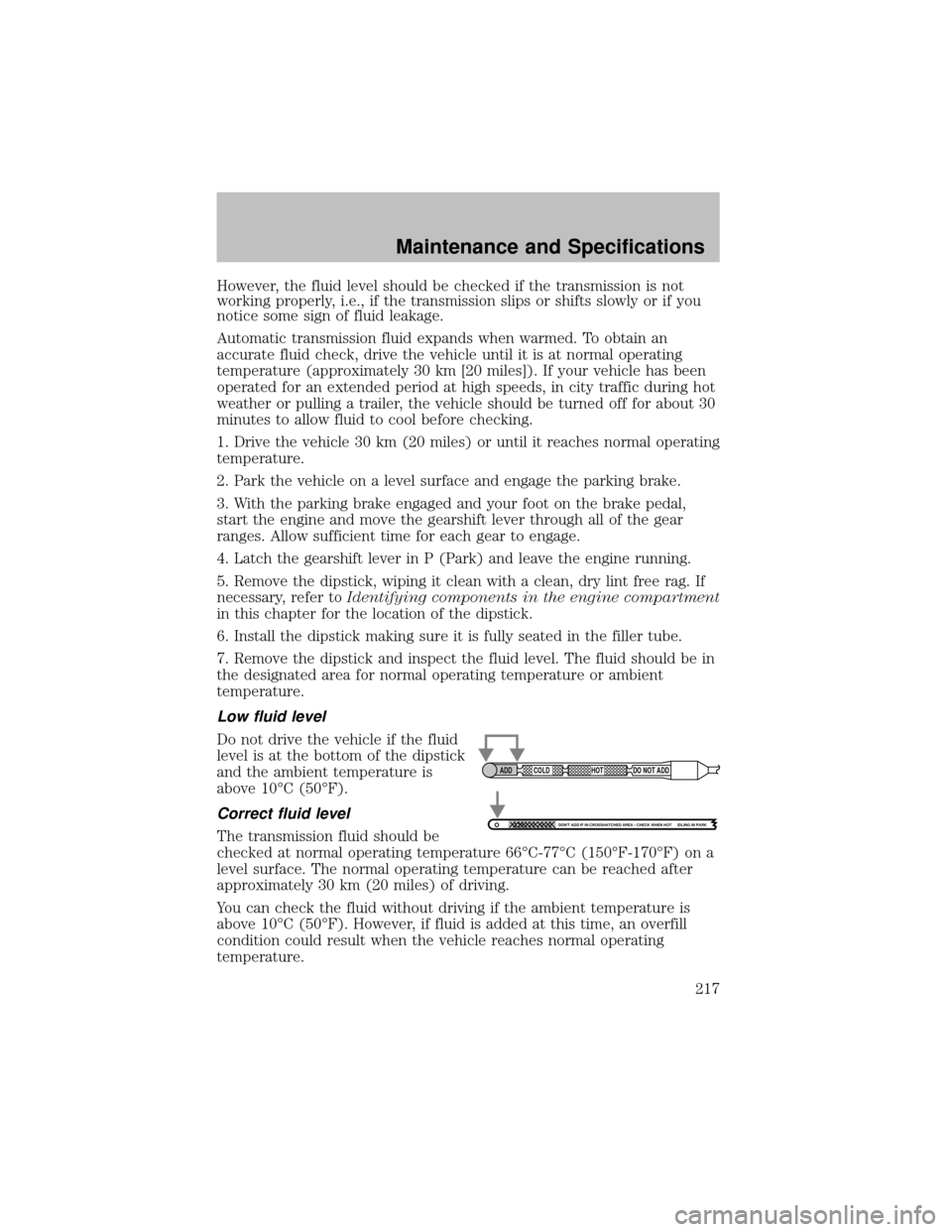
7. Remove the dipstick and inspect the fluid level. The fluid should be in
the designated area for normal operating temperature or ambient
temperature.
Low fluid level
Do not drive the vehicle if the fluid
level is at the bottom of the dipstick
and the ambient temperature is
above 10°C (50°F).
Correct fluid level
The transmission fluid should be
checked at normal operating temperature 66°C-77°C (150°F-170°F) on a
level surface. The normal operating temperature can be reached after
approximately30 km (20 miles) of driving.
You can check the fluid without driving if the ambient temperature is
above 10°C (50°F). However, if fluid is added at this time, an overfill
condition could result when the vehicle reaches normal operating
temperature.
ADD COLD HOT DO NOT ADD
DON'T ADD IF IN CROSSHATCHED AREA • CHECK WHEN HOT IDLING IN PARK
Maintenance and Specifications
217