Page 4 of 64
DIESEL ENGINE INFORMATION
The Diesel engine fuel system consists of:
•an engine-mounted secondary fuel filter
•frame-mounted Horizontal Fuel Conditioner Module (HFCM)
•a unit injector for each cylinder
The HFCM acts as a primary fuel filter/water separator which removes
both water and impurities from the fuel. The engine-mounted fuel filter
and the HFCM filter should be changed at the recommended service
interval. Refer to theScheduled maintenance guidesection of this
manual for more information.
The HFCM should be drained at
regular intervals or when the
WATER IN FUEL light illuminates in
the instrument cluster.
The fuel injectors are located in the center of the combustion chambers
in the cylinder head between the rocker arm assemblies. The glow plug
system and fuel injection system are controlled through the Powertrain
Control Module (PCM) and Fuel Injection Control Module (FICM).
Fuel is drawn from the fuel tank by a frame-mounted electric fuel pump.
The fuel pump provides pressurized fuel to the engine and is
electronically controlled by the fuel pump PCM relay. The fuel pump
contains a pressure relief valve for overpressure protection in the event
of restricted flow.
Lubrication system
It is important to change the engine oil at the recommended service
intervals, because oil viscosity is important in maintaining the oil
pressure required to actuate the fuel injectors. Extended oil change
intervals can negatively affect engine performance, fuel economy and
engine life. Refer to the engine oil specification chart located under
Engine oil specificationsin theGeneral maintenance information
chapter.
Diesel information
4
Page 28 of 64
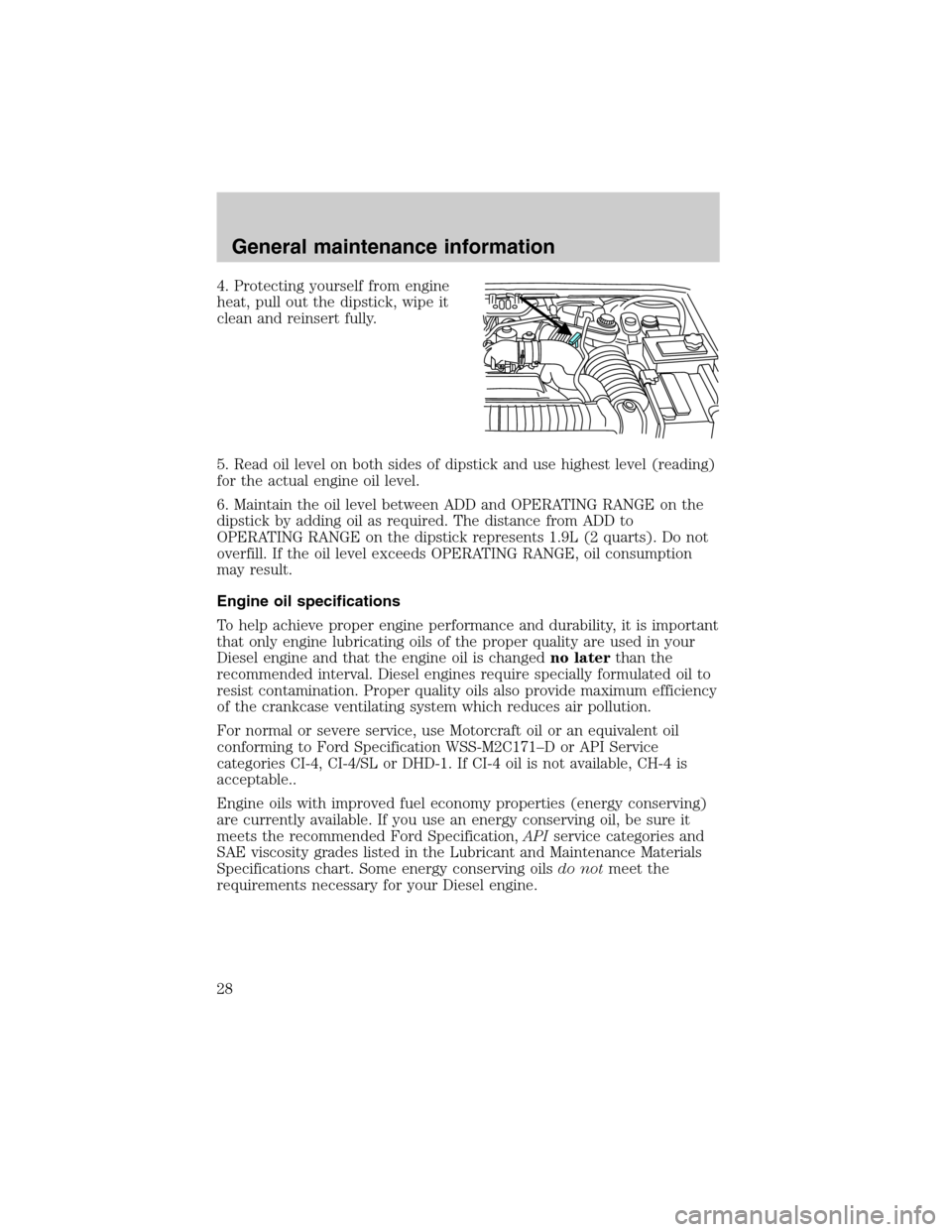
4. Protecting yourself from engine
heat, pull out the dipstick, wipe it
clean and reinsert fully.
5. Read oil level on both sides of dipstick and use highest level (reading)
for the actual engine oil level.
6. Maintain the oil level between ADD and OPERATING RANGE on the
dipstick by adding oil as required. The distance from ADD to
OPERATING RANGE on the dipstick represents 1.9L (2 quarts). Do not
overfill. If the oil level exceeds OPERATING RANGE, oil consumption
may result.
Engine oil specifications
To help achieve proper engine performance and durability, it is important
that only engine lubricating oils of the proper quality are used in your
Diesel engine and that the engine oil is changedno laterthan the
recommended interval. Diesel engines require specially formulated oil to
resist contamination. Proper quality oils also provide maximum efficiency
of the crankcase ventilating system which reduces air pollution.
For normal or severe service, use Motorcraft oil or an equivalent oil
conforming to Ford Specification WSS-M2C171–D or API Service
categories CI-4, CI-4/SL or DHD-1. If CI-4 oil is not available, CH-4 is
acceptable..
Engine oils with improved fuel economy properties (energy conserving)
are currently available. If you use an energy conserving oil, be sure it
meets the recommended Ford Specification,APIservice categories and
SAE viscosity grades listed in the Lubricant and Maintenance Materials
Specifications chart. Some energy conserving oilsdo notmeet the
requirements necessary for your Diesel engine.
General maintenance information
28
Page 29 of 64
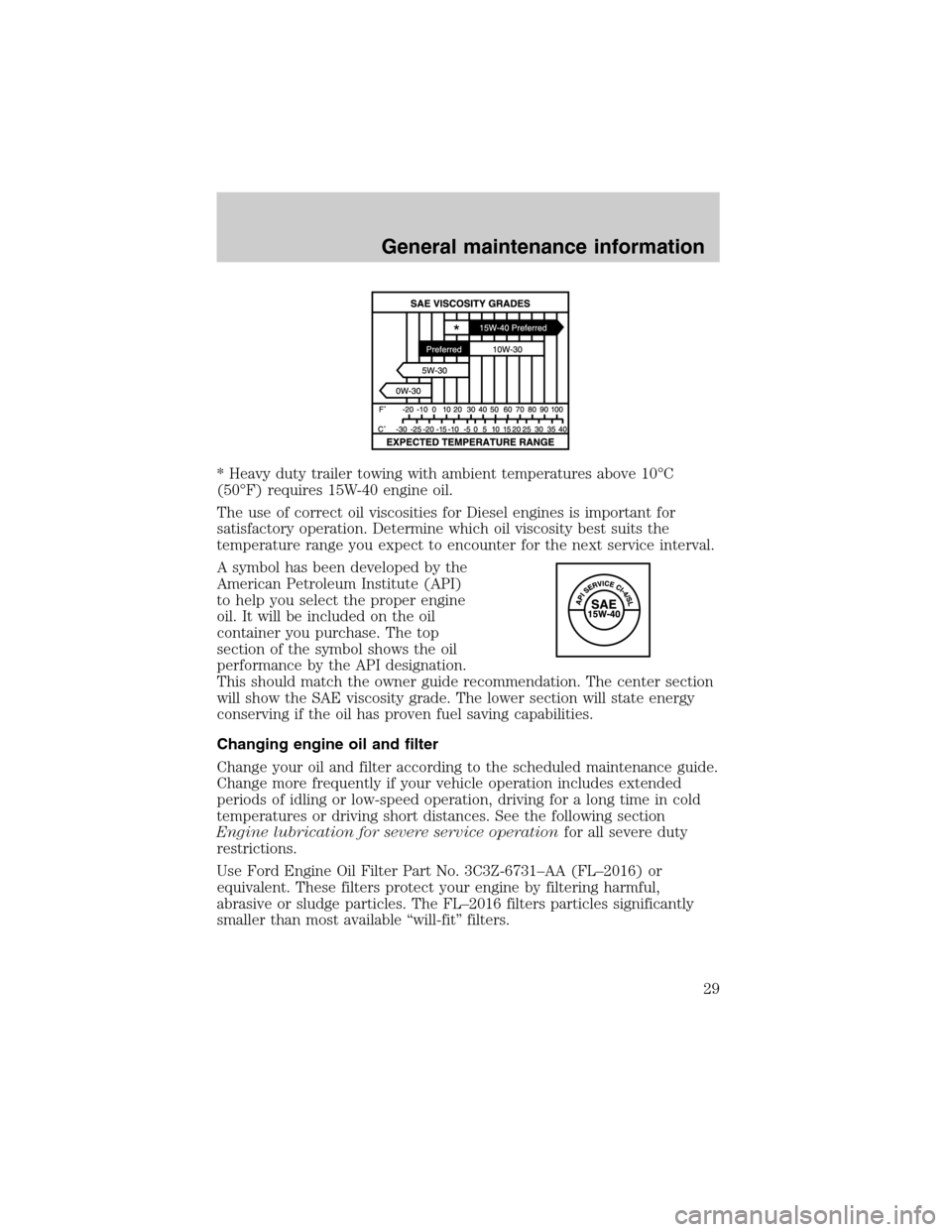
* Heavy duty trailer towing with ambient temperatures above 10°C
(50°F) requires 15W-40 engine oil.
The use of correct oil viscosities for Diesel engines is important for
satisfactory operation. Determine which oil viscosity best suits the
temperature range you expect to encounter for the next service interval.
A symbol has been developed by the
American Petroleum Institute (API)
to help you select the proper engine
oil. It will be included on the oil
container you purchase. The top
section of the symbol shows the oil
performance by the API designation.
This should match the owner guide recommendation. The center section
will show the SAE viscosity grade. The lower section will state energy
conserving if the oil has proven fuel saving capabilities.
Changing engine oil and filter
Change your oil and filter according to the scheduled maintenance guide.
Change more frequently if your vehicle operation includes extended
periods of idling or low-speed operation, driving for a long time in cold
temperatures or driving short distances. See the following section
Engine lubrication for severe service operationfor all severe duty
restrictions.
Use Ford Engine Oil Filter Part No. 3C3Z-6731–AA (FL–2016) or
equivalent. These filters protect your engine by filtering harmful,
abrasive or sludge particles. The FL–2016 filters particles significantly
smaller than most available“will-fit”filters.
General maintenance information
29
Page 39 of 64
The complexity of the Diesel engine makes it so the owner is
discouraged from attempting to perform maintenance other than the
services described in this supplement.
If you experience difficult starting, rough idling, excessive exhaust
smoke, a decrease in engine performance or excess fuel consumption,
perform the following checks:
•a plugged air inlet system or engine air filter element.
•water in the fuel filter/water separator.
•a clogged fuel filter.
•contaminated fuel.
•air in the fuel system, due to loose connections.
•an open or pinched sensor hose.
•low engine oil level.
•wrong fuel or oil viscosity for climactic conditions.
If these checks do not help you correct the engine performance problem
you are experiencing, consult an authorized dealer.
FUELING
Do not use starting fluid such as ether or gasoline in the Diesel
air intake system. Such fluids can cause immediate explosive
damage to the engine and possible personal injury.
If you fuel your vehicle at a truck stop, you may notice that the fuel
nozzle may shut off every 5–10 seconds. This is due to the flow rates
being designed for larger heavy duty trucks. You may have to fuel at a
slower rate (don’t depress the nozzle trigger fully).
Do not run your Diesel vehicle out of fuel as this will allow air to enter
the fuel system which will make restarting difficult. Longer engine
cranking time may be required once air is in the fuel system. If air enters
the fuel system (either through running the fuel tank(s) empty or during
a fuel filter change), the engine will self-purge the trapped air once it
starts running. The engine may run roughly and produce white smoke
while air is in the fuel system; this is normal and should stop after a
short time.
Minor troubleshooting guide
39