2003 FORD SUPER DUTY key
[x] Cancel search: keyPage 8 of 64
WAIT TO START
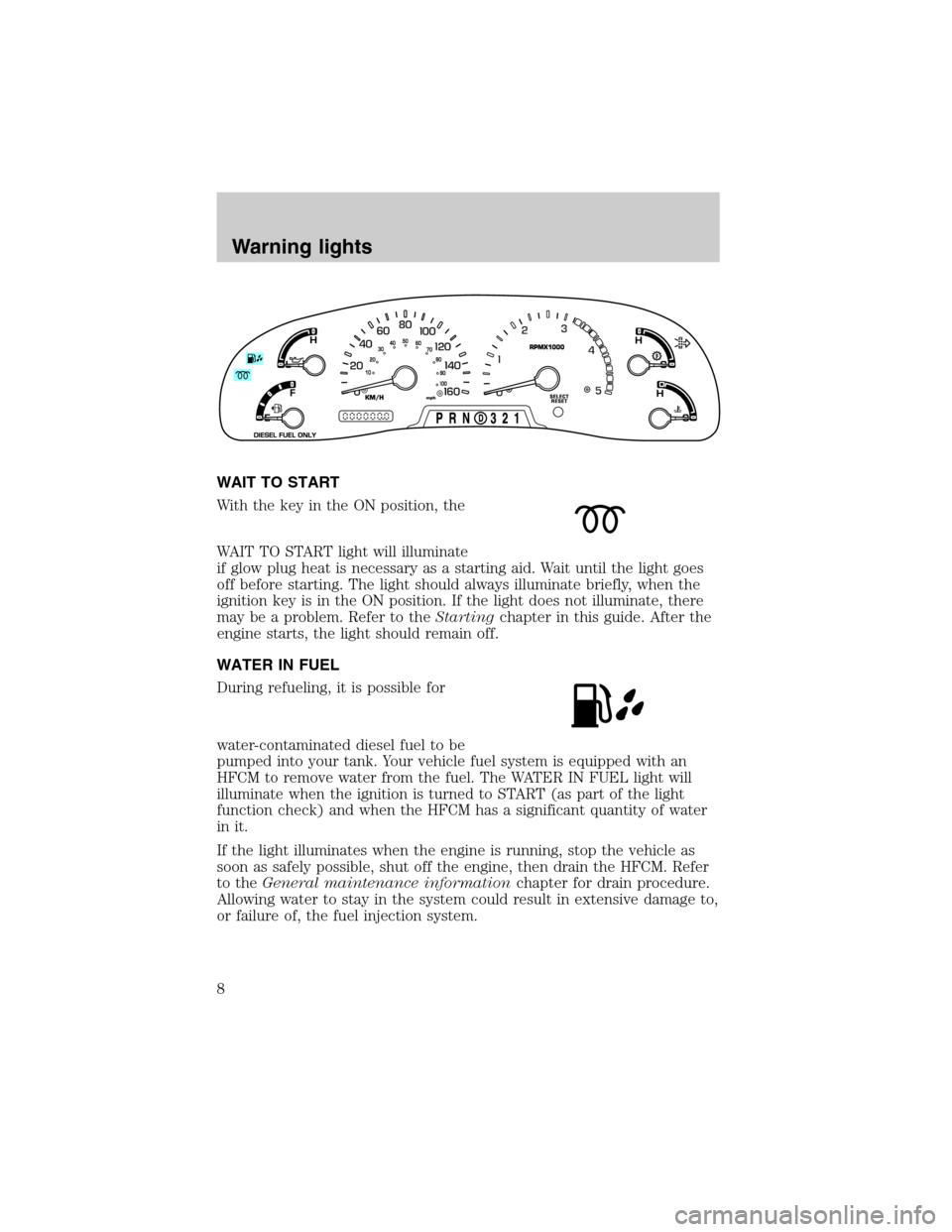
With the key in the ON position, the
WAIT TO START light will illuminate
if glow plug heat is necessary as a starting aid. Wait until the light goes
off before starting. The light should always illuminate briefly, when the
ignition key is in the ON position. If the light does not illuminate, there
may be a problem. Refer to theStartingchapter in this guide. After the
engine starts, the light should remain off.
WATER IN FUEL
During refueling, it is possible for
water-contaminated diesel fuel to be
pumped into your tank. Your vehicle fuel system is equipped with an
HFCM to remove water from the fuel. The WATER IN FUEL light will
illuminate when the ignition is turned to START (as part of the light
function check) and when the HFCM has a significant quantity of water
in it.
If the light illuminates when the engine is running, stop the vehicle as
soon as safely possible, shut off the engine, then drain the HFCM. Refer
to theGeneral maintenance informationchapter for drain procedure.
Allowing water to stay in the system could result in extensive damage to,
or failure of, the fuel injection system.
Warning lights
8
Page 10 of 64
STARTING THE ENGINE
Read all starting instructions carefully before you start your vehicle.
For temperatures below 0°C (32°F), the use of the correct grade engine
oil is essential for proper operation.
If your vehicle is equipped with a manual transmission, make sure the
parking brake is set fully before you turn the key. Depress the clutch
pedal and place the gearshift in the neutral position. The clutch must be
fully depressed in order to operate the starter. Do not press the
accelerator during starting.
If your vehicle is equipped with an automatic transmission, ensure the
gearshift lever is in P (Park) and the parking brake is set before you turn
the key. Do not press the accelerator during starting.
COLD WEATHER STARTING
Do not crank the engine for more than 30 seconds at a time as starter
damage may occur. If the engine fails to start, turn the key to OFF and
wait 30 seconds before trying again.
Do not use starting fluid such as ether in the air intake system
(see Air Cleaner Decal). Such fluid could cause immediate
explosive damage to the engine and possible personal injury.
Note:Do not add gasoline, gasohol or alcohol to Diesel fuel. This
practice creates a serious fire hazard and causes engine performance
problems.
1. Make sure all vehicle occupants have buckled their safety belts. For
more information on safety belts and their proper usage, refer toSeating
and safety restraintschapter in the owner guide.
2. Make sure the headlamps and vehicle accessories are off.
3. Turn the key to the ON position. When the WAIT TO START light
goes off, turn the key to START. (For Canadian vehicles, the daytime
running lamps will be on if the parking brake is not applied and the key
is turned to ON.)
4. When the engine starts, release
the key. The glow plugs will
continue to be activated for up to
two minutes after the WAIT TO
START light turns off. If the engine is not started before the activation
ceases, the glow plug system must be reset by turning the ignition key to
OFF.
Starting
10
Page 24 of 64

FUEL REQUIREMENTS
The engine is designed to use low sulfur number 1–Dor2–D Diesel fuel
only. At temperatures below -7°C (20°F), number 1–D or winter blend
number 2–D fuel is recommended. (SeeCold weather operationin the
Startingchapter.)
Do not use fuel intended for agricultural use (agricultural fuel is
dyed red), home heating oil or any Diesel fuel not intended for
highway use. Damage to the fuel injection system, engine and
exhaust catalyst can occur if an improper fuel is used.
Do not add gasoline, gasohol or alcohol to Diesel fuel. This
practice creates a serious fire hazard and engine performance
problems.
It should not be necessary to add any aftermarket additives to your fuel
tank if you use a properly formulated Diesel fuel that meets the ASTM D
975 industry specification. Aftermarket additives can damage the injector
system or engine.
Do not blend used engine oil with Diesel fuel under any
circumstances.Blending used oil with the fuel will significantly increase
your vehicle’s exhaust emissions and reduce engine life due to increased
internal wear.
Do not crank the engine for more than 30 seconds at a time as
damage to the starter motor may result.
If the engine fails to start in 30 seconds, turn the key to the OFF
position and wait 30 seconds before trying again.
If air is allowed to enter the fuel system (during fuel filter change or if
you run out of fuel) the engine will purge the trapped air as it runs. The
engine may run rough and produce white smoke while air is in the
system. This is normal and should correct itself in a short time.
An engine that suddenly becomes noisy or operates poorly after a fuel fill
could be using substandard fuel (i.e., high water content, low cetane
rating or gasoline in the fuel). Diesel fuel should be purchased from a
reputable station which sells a large amount of Diesel fuel.
Care should be taken whenever Diesel fuel is stored. Use only clean,
approved containers which will prevent the entry of dirt or water.
General maintenance information
24
Page 40 of 64

IF THE ENGINE WON’T CRANK
Turn on the headlights. If the lights are dim, do not go on at all or if
when the ignition is turned to START the lights become dim or go out,
the battery connections may be loose or corroded, or the battery may be
discharged. If there is a clicking or stuttering sound coming from the
engine compartment when you turn the key to START, this may also
indicate a loose or corroded battery connection.
Check the battery connections at the battery posts, cable connection to
the engine grounding point and at the starter connection.
If a discharged battery is suspected, have it checked and corrected.
•For vehicles with manual transmissions, the clutch pedalmustbe fully
depressed in order for the starter to operate.
•For vehicles with automatic transmissions, the gearshift lever must be
in Park or Neutral in order for the starter to operate.
•Try operating the starter switch several times. Should the switch be
corroded, this operation may clean the contacts or make the switch
temporarily operable until you can reach the dealer.
•If all electrical connections are tight and you need assistance to start,
seeJump Startingin theRoadside emergencieschapter of your
owner guide.
IF ENGINE CRANKS BUT WON’T START
Prolonged starter cranking (in excess of 30 seconds) could cause
damage to the starter motor.
•Check the fuel gauge. You may be out of fuel. If the gauge shows that
there is fuel in the tank, the trouble may be in the electrical system or
the fuel system. If equipped with an auxiliary tank, be sure that the
tank control switch is set for the tank with fuel and not on an empty
tank.
•Leaving the ignition key ON for over two minutes without starting may
make starting difficult because the glow plugs will cease activation.
Reset the system by turning the ignition key to OFF and then back to
ON again.
Minor troubleshooting guide
40
Page 47 of 64
FIND YOUR WAY
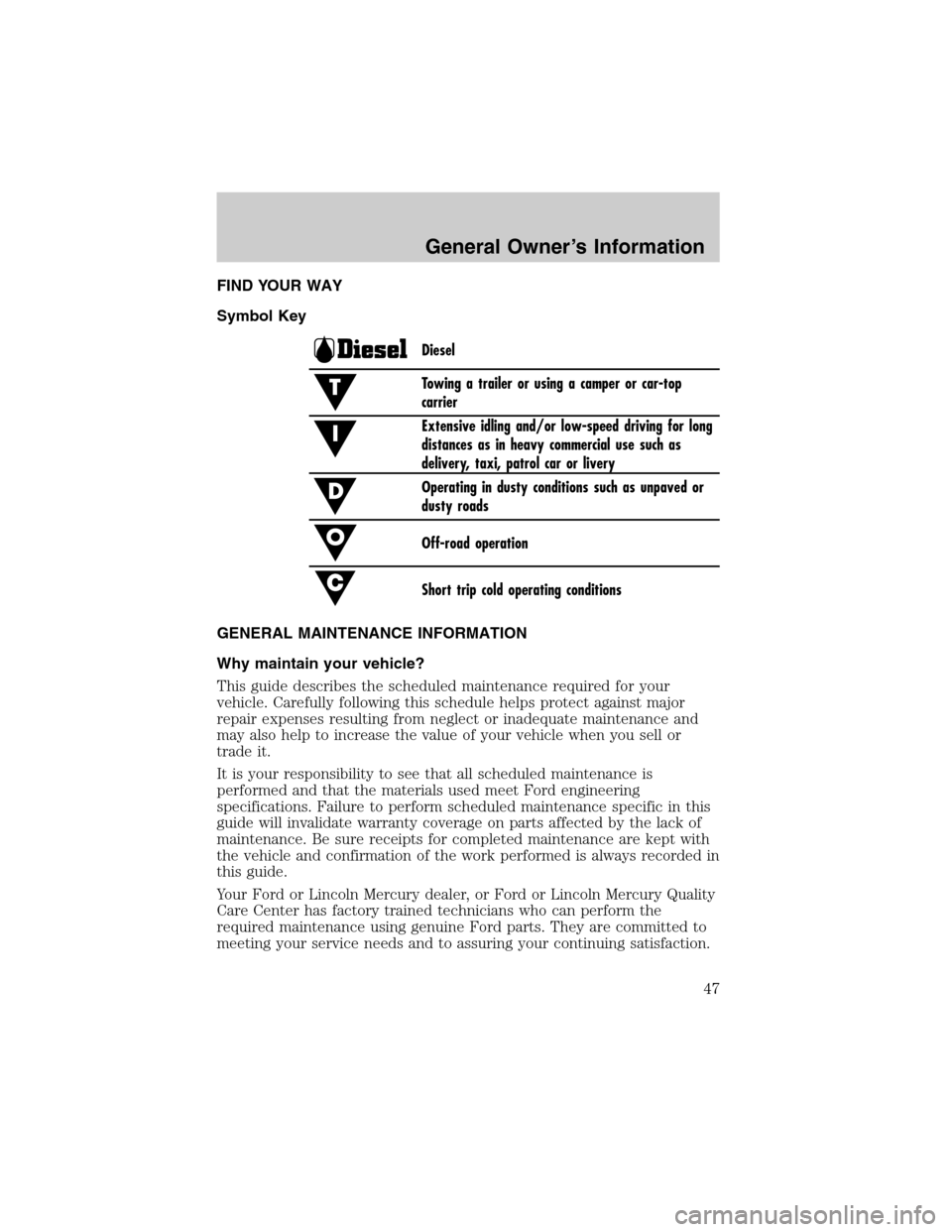
Symbol Key
Diesel
Towing a trailer or using a camper or car-top
carrier
Extensive idling and/or low-speed driving for long
distances as in heavy commercial use such as
delivery, taxi, patrol car or livery
Operating in dusty conditions such as unpaved or
dusty roads
Off-road operation
Short trip cold operating conditions
GENERAL MAINTENANCE INFORMATION
Why maintain your vehicle?
This guide describes the scheduled maintenance required for your
vehicle. Carefully following this schedule helps protect against major
repair expenses resulting from neglect or inadequate maintenance and
may also help to increase the value of your vehicle when you sell or
trade it.
It is your responsibility to see that all scheduled maintenance is
performed and that the materials used meet Ford engineering
specifications. Failure to perform scheduled maintenance specific in this
guide will invalidate warranty coverage on parts affected by the lack of
maintenance. Be sure receipts for completed maintenance are kept with
the vehicle and confirmation of the work performed is always recorded in
this guide.
Your Ford or Lincoln Mercury dealer, or Ford or Lincoln Mercury Quality
Care Center has factory trained technicians who can perform the
required maintenance using genuine Ford parts. They are committed to
meeting your service needs and to assuring your continuing satisfaction.
General Owner’s Information
47