Page 2251 of 4378
REMOVAL AND INSTALLATION
Supercharger Bypass Vacuum Solenoid
Removal and Installation
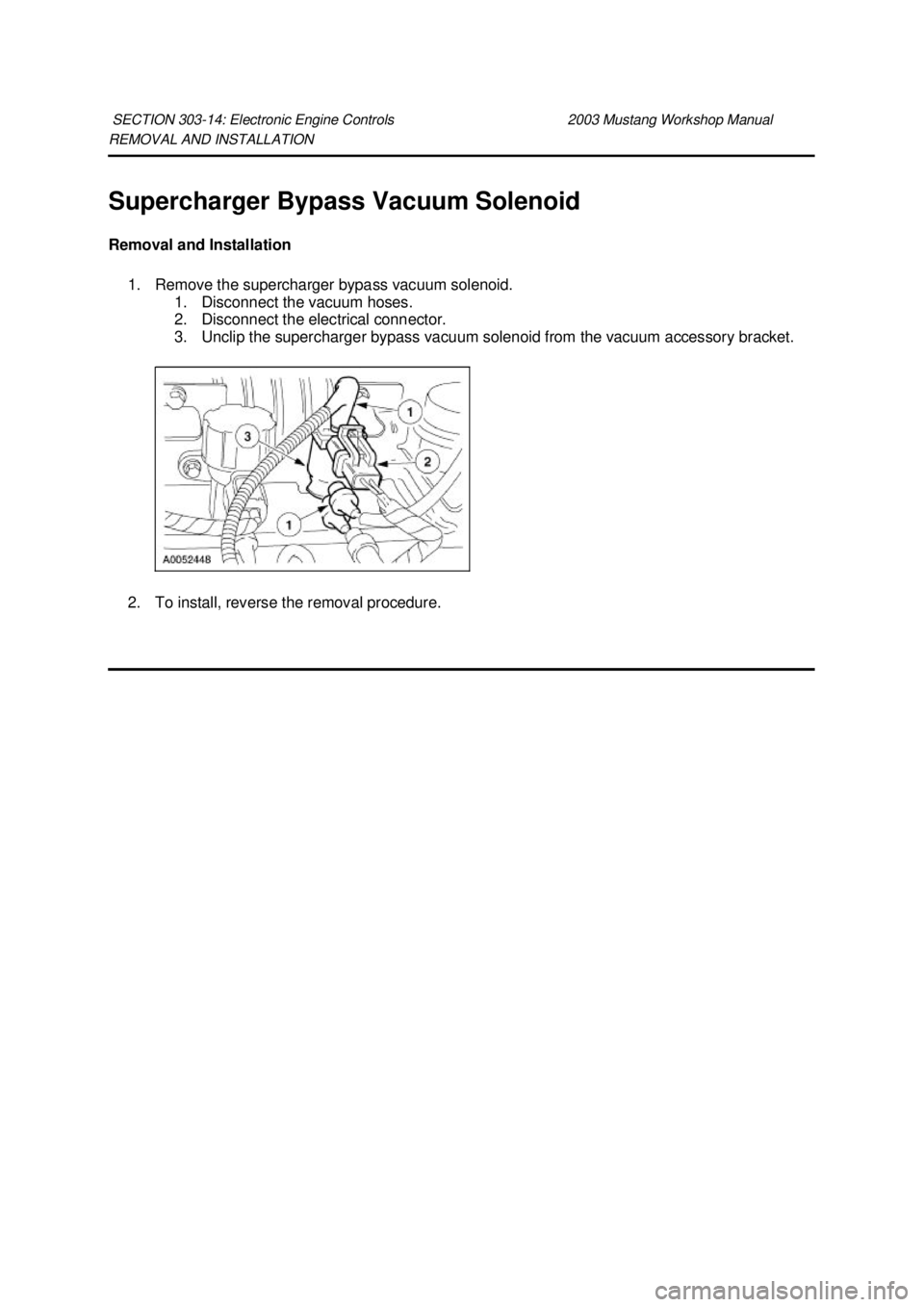
1. Remove the supercharger bypass vacuum solenoid. 1. Disconnect the vacuum hoses.
2. Disconnect the electrical connector.
3. Unclip the supercharger bypass vacuum solenoid from the vacuum accessory bracket.
2. To install, reverse the removal procedure.
SECTION 303-
14: Electronic Engine Controls 2003 Mustang Workshop Manual �K�l�j . 1 �b�a
12003 Mustang Workshop Manual
18. 11. 2011file:///C:/Ford/2000 - 2004/tsocache/SHEF_4464/S3B~us~en~ ...
Page 2252 of 4378
REMOVAL AND INSTALLATION
Supercharger Bypass Vacuum Solenoid —
Actuator
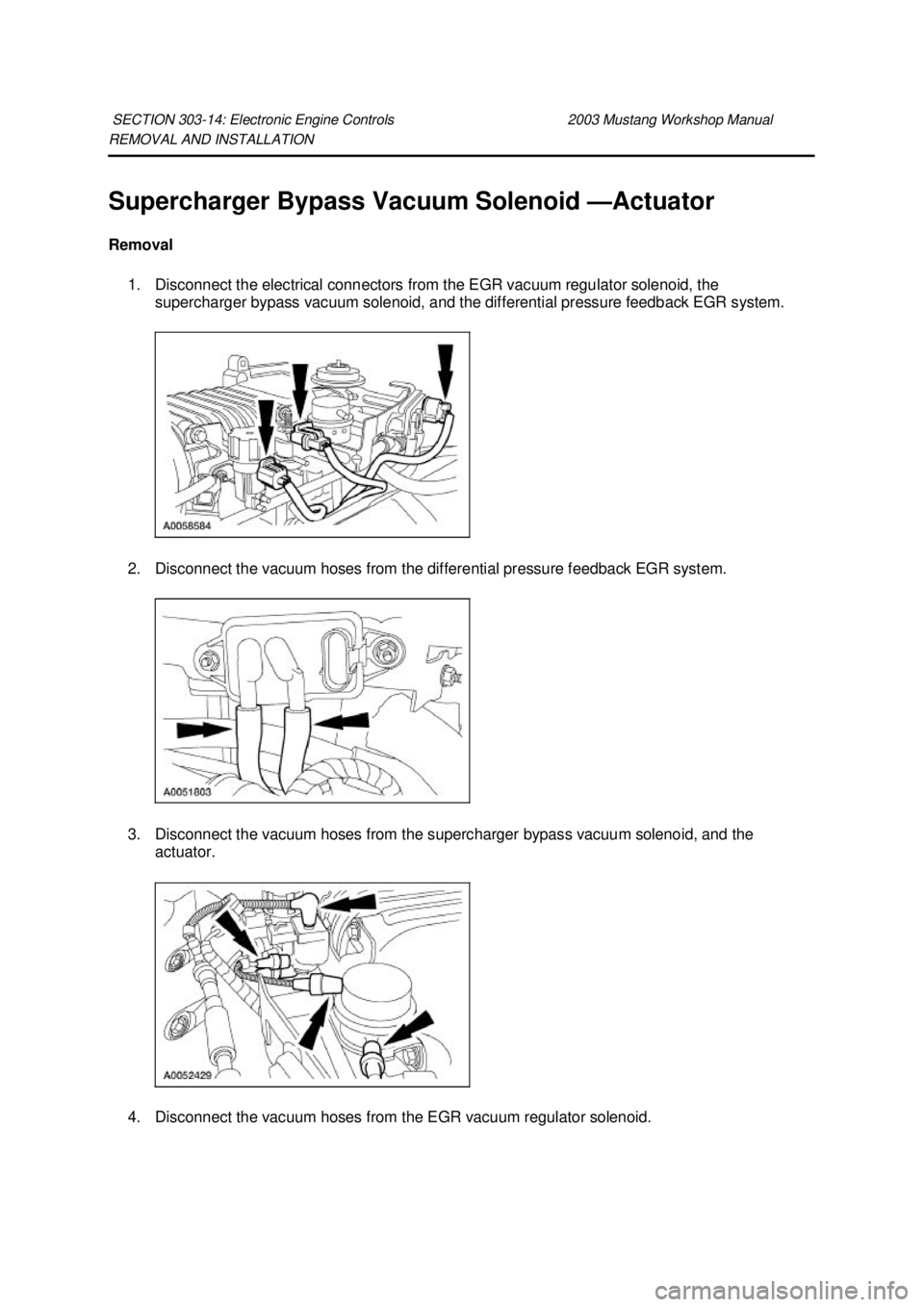
Removal 1. Disconnect the electrical connectors from the EGR vacuum regulator solenoid, the supercharger bypass vacuum solenoid, and the differential pressure feedback EGR system.
2. Disconnect the vacuum hoses from the differential pressure feedback EGR system.
3. Disconnect the vacuum hoses from the supercharger bypass vacuum solenoid, and the actuator.
4. Disconnect the vacuum hoses from the EGR vacuum regulator solenoid.
SECTION 303-
14: Electronic Engine Controls 2003 Mustang Workshop Manual �K�l�j . 1 �b�a
62003 Mustang Workshop Manual
18. 11. 2011file:///C:/Ford/2000 - 2004/tsocache/SHEF_4464/S3B~us~en~ ...
Page 2253 of 4378
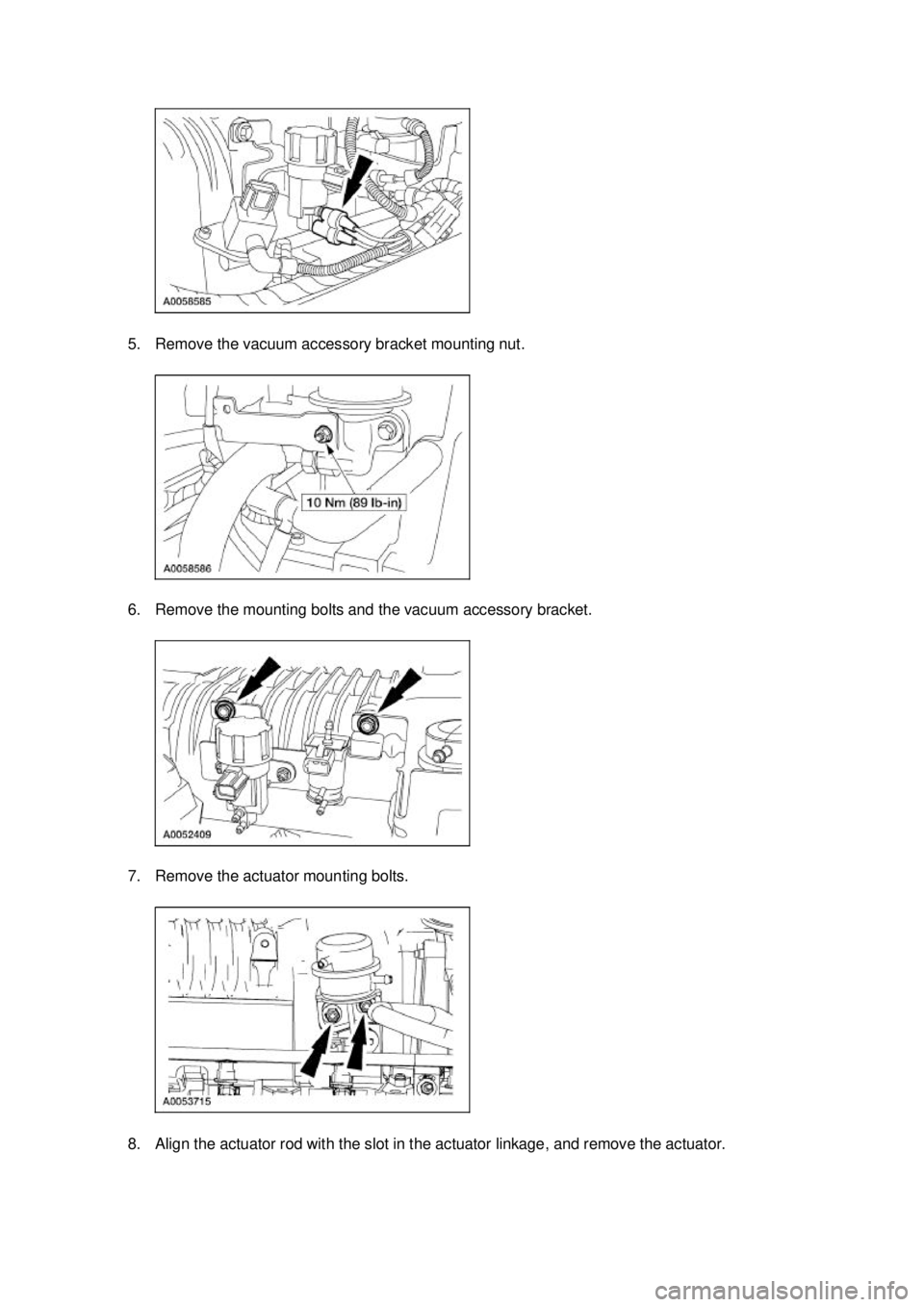
5. Remove the vacuum accessory bracket mounting nut.
6. Remove the mounting bolts and the vacuum accessory bracket.
7. Remove the actuator mounting bolts.
8. Align the actuator rod with the slot in the actuator linkage, and remove the actuator. �K�l�j . 2 �b�a
62003 Mustang Workshop Manual
18. 11. 2011file:///C:/Ford/2000 - 2004/tsocache/SHEF_4464/S3B~us~en~ ...
Page 2254 of 4378
Installation
1. CAUTION: The actuator adjustment tool included with the replacement actuator kit
must be used when installing the supercharger bypass vacuum actuator. Failure to
correctly adjust the actuator will result in incorrect operation of the supercharger
assembly.
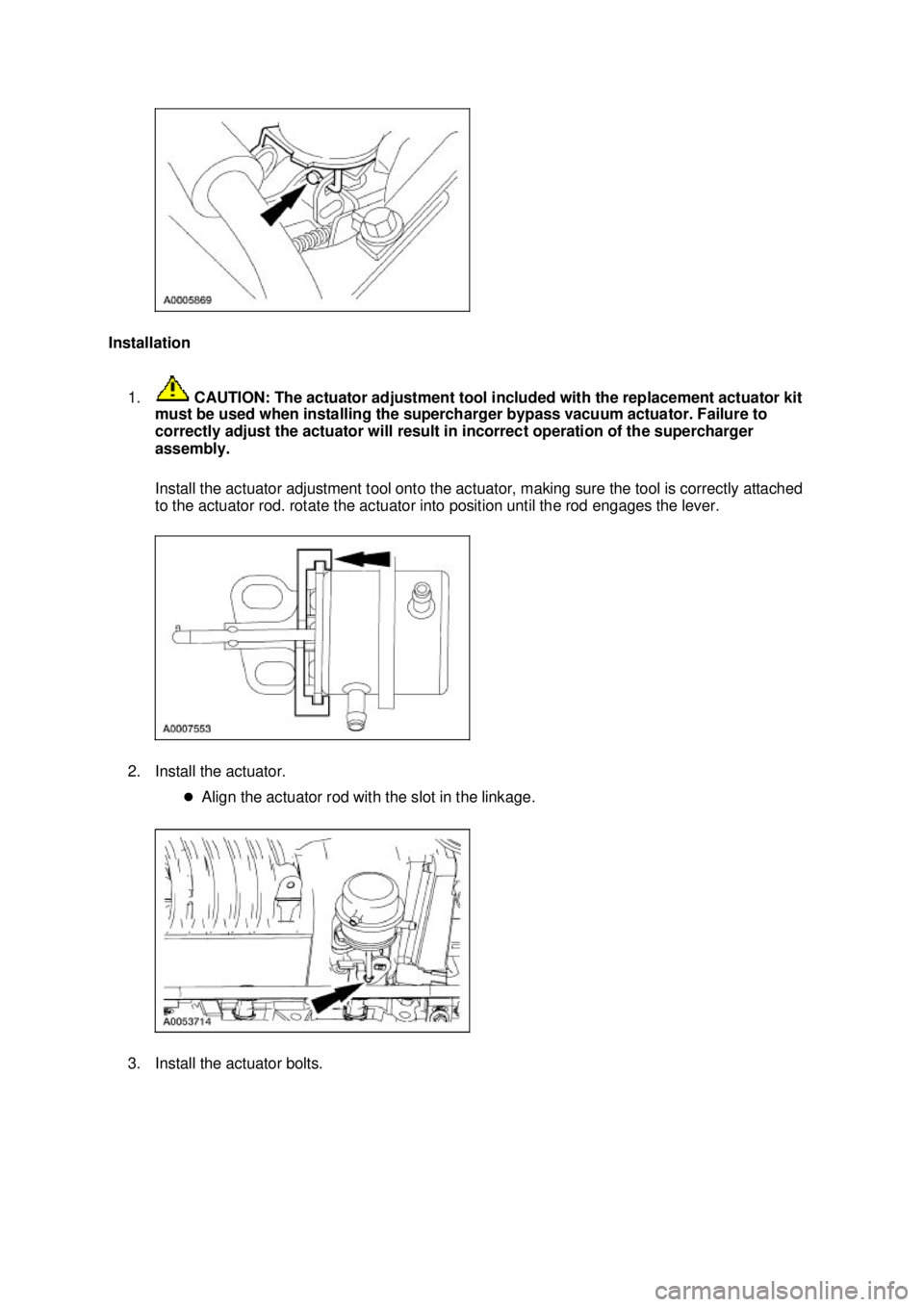
Install the actuator adjustment tool onto the actuator, making sure the tool is correctly attached
to the actuator rod. rotate the actuator into position until the rod engages the lever.
2. Install the actuator. zAlign the actuator rod with the slot in the linkage.
3. Install the actuator bolts. �K�l�j . 3 �b�a
62003 Mustang Workshop Manual
18. 11. 2011file:///C:/Ford/2000 - 2004/tsocache/SHEF_4464/S3B~us~en~ ...
Page 2255 of 4378
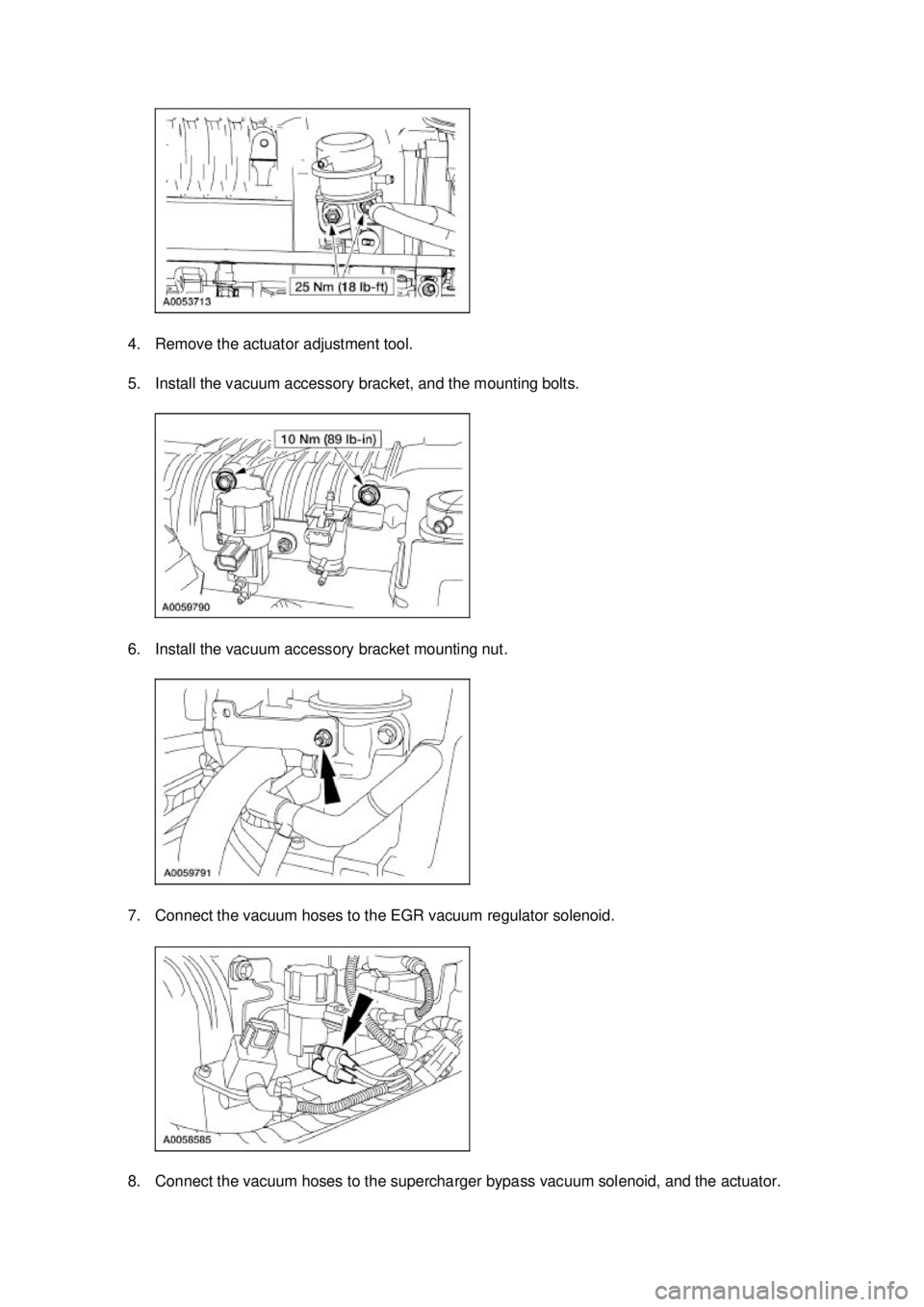
4. Remove the actuator adjustment tool.
5. Install the vacuum accessory bracket, and the mounting bolts.
6. Install the vacuum accessory bracket mounting nut.
7. Connect the vacuum hoses to the EGR vacuum regulator solenoid.
8. Connect the vacuum hoses to the supercharger bypass vacuum solenoid, and the actuator. �K�l�j . 4 �b�a
62003 Mustang Workshop Manual
18. 11. 2011file:///C:/Ford/2000 - 2004/tsocache/SHEF_4464/S3B~us~en~ ...
Page 2256 of 4378
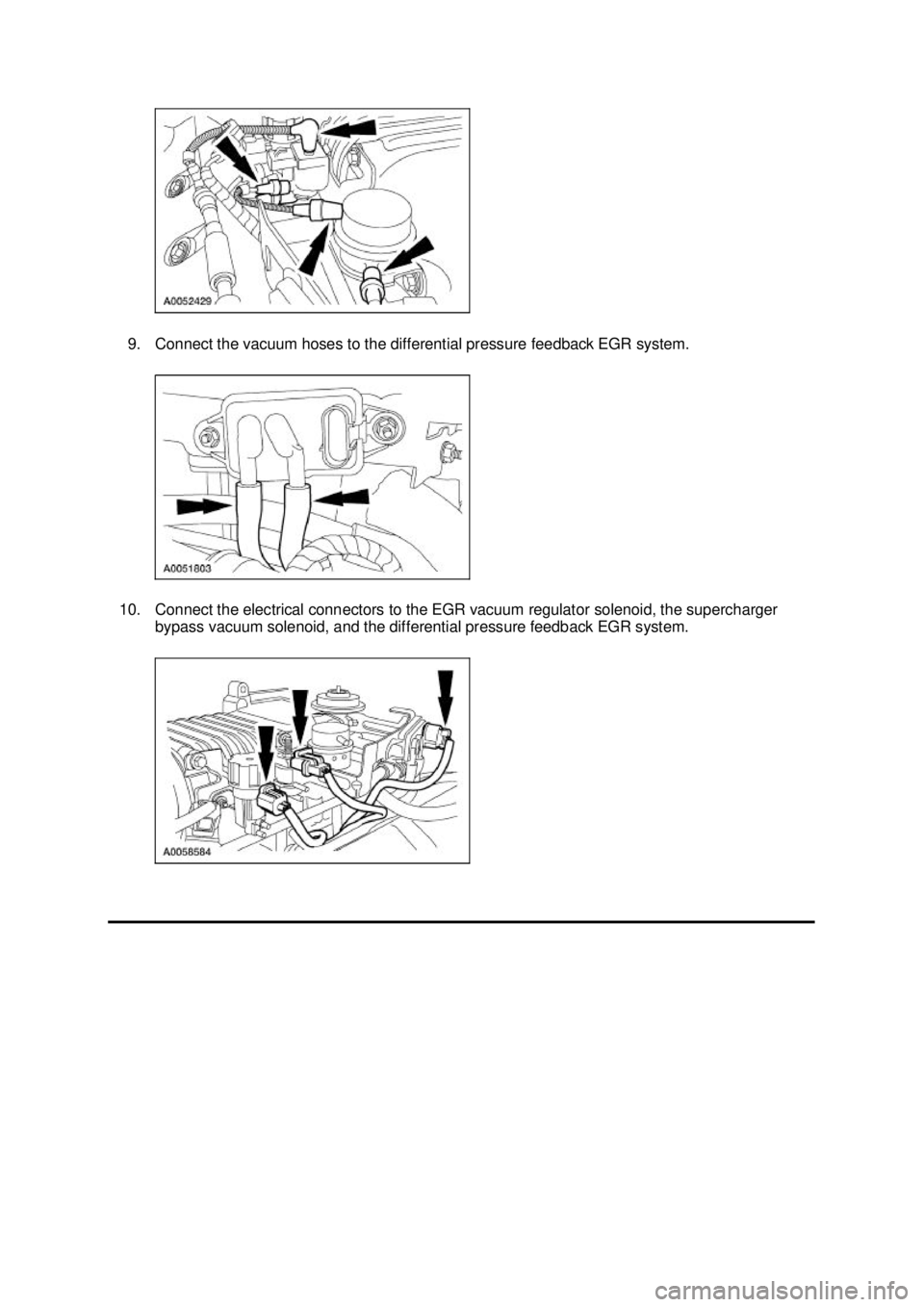
9. Connect the vacuum hoses to the differential pressure feedback EGR system.
10. Connect the electrical connectors to the EGR vacuum regulator solenoid, the supercharger bypass vacuum solenoid, and the differential pressure feedback EGR system. �K�l�j . 5 �b�a
62003 Mustang Workshop Manual
18. 11. 2011file:///C:/Ford/2000 - 2004/tsocache/SHEF_4464/S3B~us~en~ ...
Page 2313 of 4378
10. If the vehicle stalls in (D) or manual 2 at idle with vehicle at a stop, move the transmission range
selector lever to manual 1 position. If the vehicle stalls, see torque converter operation
concerns. For additional information, refer to Diagnosis By Symptom in this section. If the
vehicle does not stall in (D), refer to Diagnosis By Symptom in this section.
11. If the vehicle exhibits a vibration during the road test, complete the Road Test Evaluation Form. This form will aid the technician in determining the source of the vibration.
NOTE: The following is a list of common vehicle concerns that have been misdiagnosed as torque
converter clutch shudder. For diagnosis of the following items refer to the appropriate sections of the
workshop manual and the Powertrain Control/Emissions Diagnosis (PC/ED) manual.
zspark plugs - check for cracks, high resistance or broken insulators
z plug wires
z fuel injector - filter may be plugged
z fuel contamination - poor engine performance
z EGR valve - valve may let in too much exhaust gas and cause engine to run lean
z vacuum leak - engine will not get correct air/fuel mixture
z MAP/MAF sensor - incorrect air/fuel mixture
z HO2S sensor - too rich/lean air/fuel mixture
z fuel pressure - may be too low
z engine mounts - loose/damaged mounts can cause vibration concerns
z axle joints - check for vibration Torque Converter Road Evaluation Form
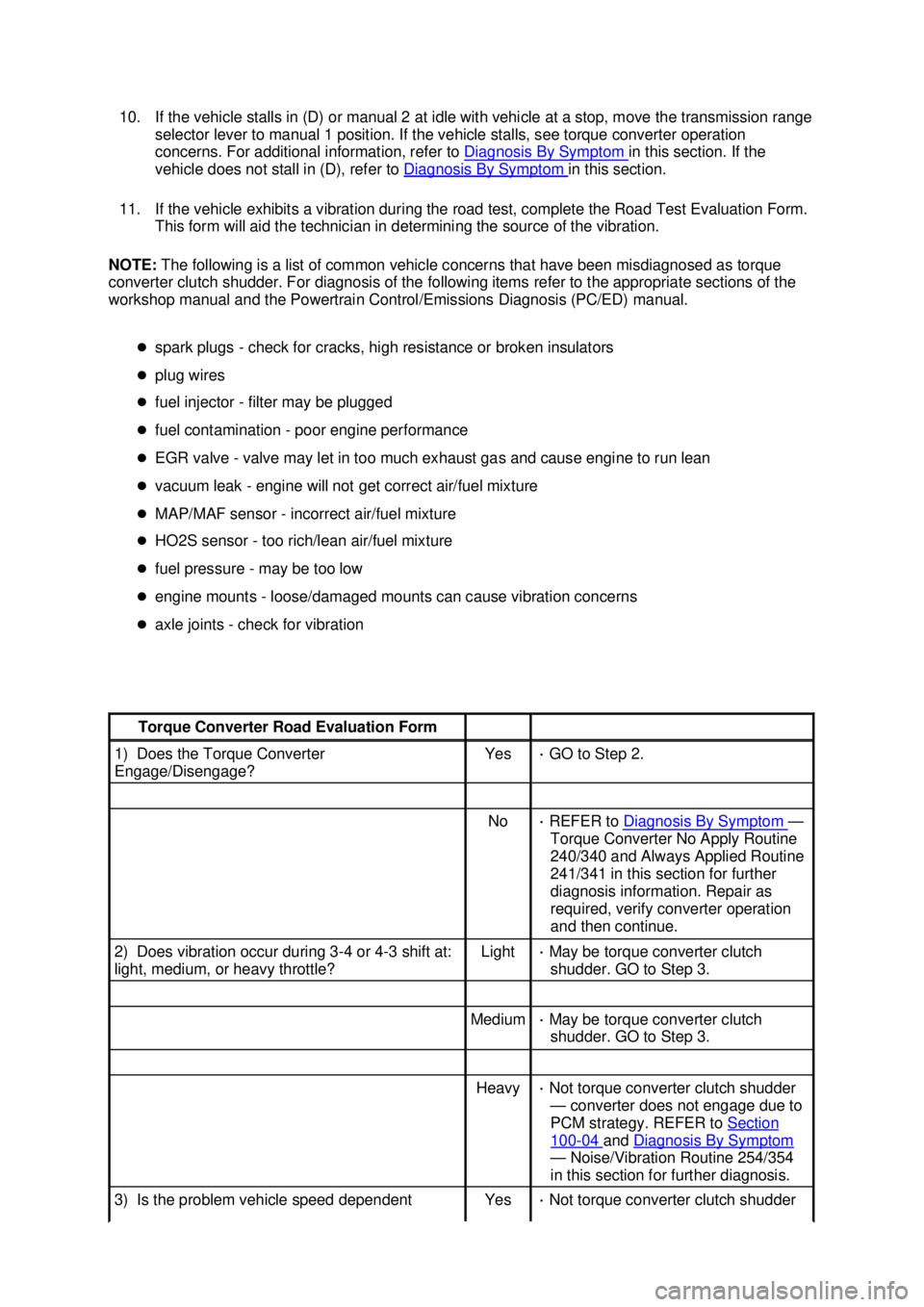
1) Does the Torque Converter
Engage/Disengage? Yes ·
GO to Step 2. No ·
REFER to Diagnosis By Symptom —
Torque Converter No Apply Routine
240/340 and Always Applied Routine
241/341 in this section for further
diagnosis information. Repair as
required, verify converter operation
and then continue. 2) Does vibration occur during 3-
4 or 4-3 shift at:
light, medium, or heavy throttle? Light ·
May be torque converter clutch
shudder. GO to Step 3. Medium ·
May be torque converter clutch
shudder. GO to Step 3. Heavy ·
Not torque converter clutch shudder
— converter does not engage due to
PCM strategy. REFER to Section 100 - 04 and
Diagnosis By Symptom —
Noise/Vibration Routine 254/354
in this section for further diagnosis. 3) Is the problem vehicle speed dependent Yes ·
Not torque converter clutch shudder �K�l�j . 2 �b�a
42003 Mustang Workshop Manual
18. 11. 2011file:///C:/Ford/2000 - 2004/tsocache/SHEF_2748/S3B~us~en~ ...
Page 2645 of 4378
GENERAL PROCEDURES
Disc Check
WARNING: Dust and dirt present on wheel brake and clutch assemblies may contain
asbestos fibers that are hazardous to health when made airborne by cleaning with compressed
air or by dry brushing. Failure to follow these instructions may result in personal injury.
WARNING: Wheel brake assemblies and clutch facings should be cleaned using a vacuum
cleaner recommended for use with asbestos fibers such as the brake automobile brake drum
system with vacuum. Dust and dirt from the vacuum should be disposed of in a manner that
prevents dust exposure such as sealed bags. The bag must be labeled according to OSHA
instructions and the trash hauler notified as to the bag's contents. Failure to follow these
instructions may result in personal injury.
WARNING: If a vacuum suitable for asbestos is not available, cleaning should be done
wet. If dust generation is still possible, technicians should wear government- approved toxic
dust purifying respirators. Failure to follow these instructions may result in personal injury.
WARNING: Grinding or sanding on the brake linings, pads, rotors, drums or clutch
facings should be done only while using correct exhaust- ventilated equipment. Failure to
follow these instructions may result in personal injury.
WARNING: OSHA requires areas where asbestos dust generation is possible to be
isolated and posted with warning signs. Only technicians concerned with carrying out brake or
clutch service should be present in the area. Failure to follow these instructions may result in
personal injury.
1. Check the clutch disc lining surface for hardening or the presence of oil.
2. Check for a worn clutch disc lining. Measure the minimum allowable depth to the rivet heads with a slide caliper.
SECTION 308-
00: Manual Transaxle/Transmission and Clutch — General
Information 2003 Mustang Workshop
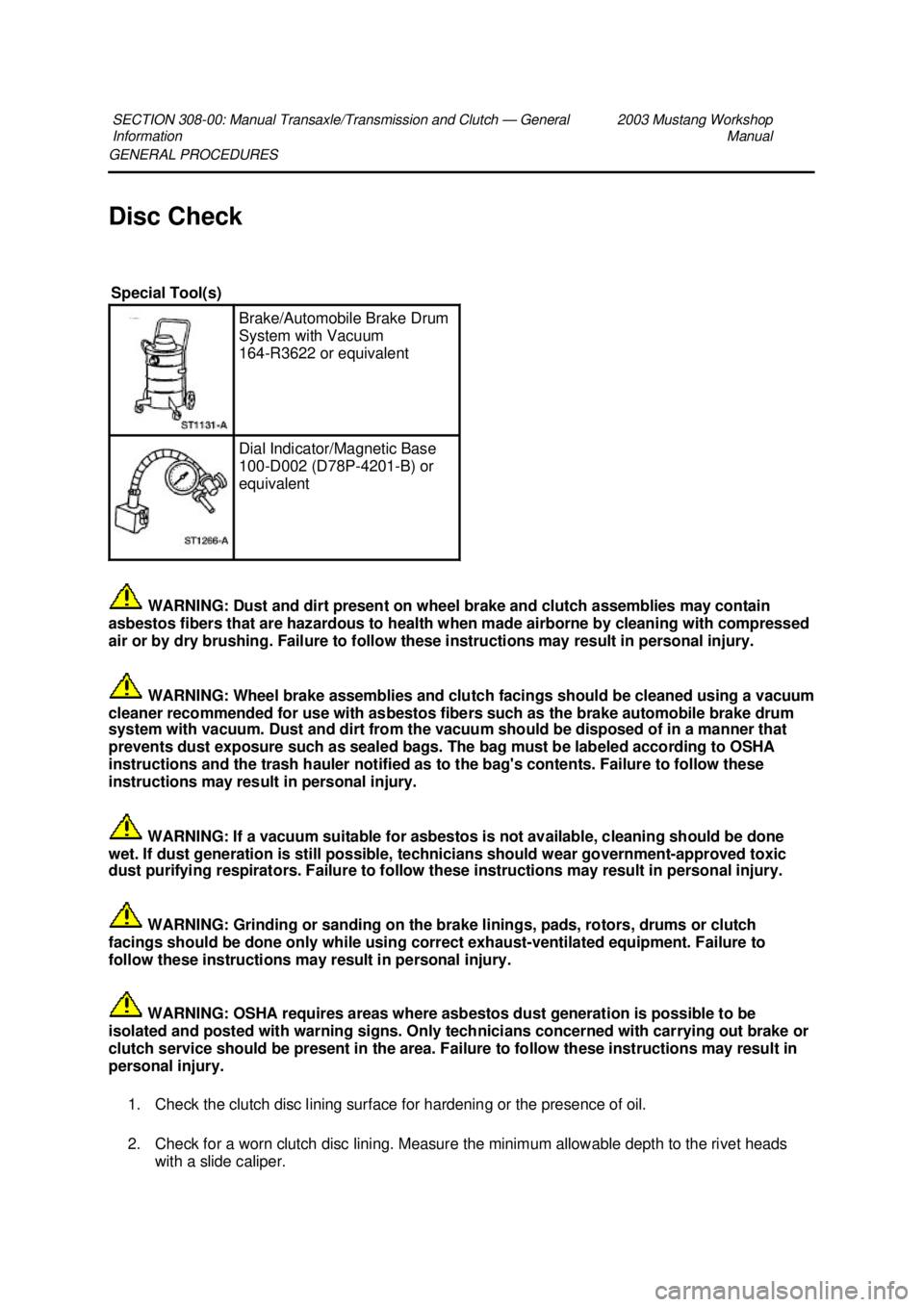
Manual Special Tool(s)
Brake/Automobile Brake Drum
System with Vacuum
164-
R3622 or equivalent Dial Indicator/Magnetic Base
100-
D002 (D78P-4201- B) or
equivalent �K�l�j . 1 �b�a
32003 Mustang Workshop Manual
18. 11. 2011file:///C:/Ford/2000 - 2004/tsocache/SHEF_2308/S3B~us~en~ ...