Page 160 of 256

FUSES AND RELAYS
Fuses
If electrical
components in the
vehicle are not
working, a fuse may
have blown. Blown
fuses are identified by a broken wire within the fuse.
Check the appropriate fuses before replacing any
electrical components.
Note:Always replace a fuse with one that has the
specified amperage rating. Using a fuse with a higher
amperage rating can cause severe wire damage and
could start a fire.
Standard fuse amperage rating and color
COLOR
Fuse
ratingMini
fusesStandard
fusesMaxi
fusesCartridge
maxi
fusesFuse
link
cartridge
2A Grey Grey—— —
3A Violet Violet—— —
4A Pink Pink—— —
5A Tan Tan—— —
7.5A Brown Brown—— —
10A Red Red—— —
15A Blue Blue—— —
20A Yellow Yellow Yellow Blue Blue
25A Natural Natural—— —
30A Green Green Green Pink Pink
40A——Orange Green Green
50A——Red Red Red
60A——Blue—Yellow
70A——Ta n—Brown
80A——Natural—Black
Passenger compartment fuse panel
The fuse panel is located below and to the left of
the steering wheel by the brake pedal. Remove the
panel cover to access the fuses.
15
Roadside Emergencies
160
Page 165 of 256

Fuse/Relay
LocationFuse Amp
RatingPower Distribution Box
Description
22—Not used
23—Not used
24 20A* A/C pressure
25—Not used
26 30A** PCM
27 20A** Daytime Running Lamps
(DRL) module, Foglamp
relay
28 25A CB Convertible top
29 Diode Convertible top circuit
breaker
* Mini Fuses ** Maxi Fuses
CHANGING THE TIRES
If you get a flat tire while driving, do not apply the
brake heavily. Instead, gradually decrease your
speed. Hold the steering wheel firmly and slowly
move to a safe place on the side of the road.
The use of tire sealants is not recommended and
may compromise the integrity of your tires. The use
of tire sealants may also affect your tire pressure
monitoring system (if equipped).
Temporary spare tire information
Your vehicle may have a temporary spare tire. The
temporary spare tire for your vehicle is labeled as
such. It is smaller than a regular tire and is designed
for emergency use only. Replace this tire with a
full-size tire as soon as possible.
Roadside Emergencies
165
Page 191 of 256
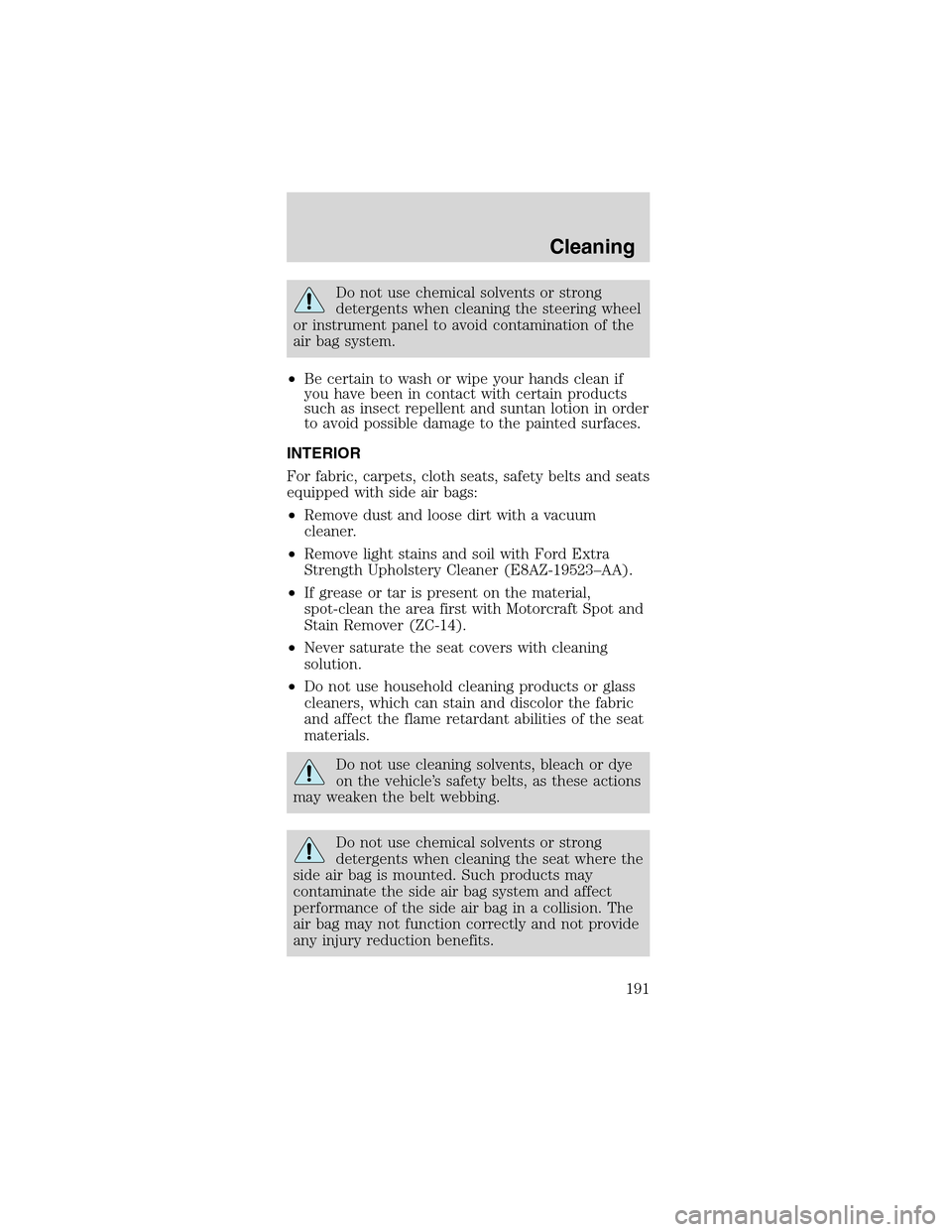
Do not use chemical solvents or strong
detergents when cleaning the steering wheel
or instrument panel to avoid contamination of the
air bag system.
•Be certain to wash or wipe your hands clean if
you have been in contact with certain products
such as insect repellent and suntan lotion in order
to avoid possible damage to the painted surfaces.
INTERIOR
For fabric, carpets, cloth seats, safety belts and seats
equipped with side air bags:
•Remove dust and loose dirt with a vacuum
cleaner.
•Remove light stains and soil with Ford Extra
Strength Upholstery Cleaner (E8AZ-19523–AA).
•If grease or tar is present on the material,
spot-clean the area first with Motorcraft Spot and
Stain Remover (ZC-14).
•Never saturate the seat covers with cleaning
solution.
•Do not use household cleaning products or glass
cleaners, which can stain and discolor the fabric
and affect the flame retardant abilities of the seat
materials.
Do not use cleaning solvents, bleach or dye
on the vehicle’s safety belts, as these actions
may weaken the belt webbing.
Do not use chemical solvents or strong
detergents when cleaning the seat where the
side air bag is mounted. Such products may
contaminate the side air bag system and affect
performance of the side air bag in a collision. The
air bag may not function correctly and not provide
any injury reduction benefits.
Cleaning
191
Page 197 of 256
IDENTIFYING COMPONENTS IN THE ENGINE
COMPARTMENT
3.8L OHV V6 engine
1. Engine oil filler cap
2. Engine oil dipstick
3. Brake fluid reservoir
4. Power distribution box
5. Windshield washer fluid reservoir
6. Battery
7. Power steering fluid reservoir
8. Engine coolant reservoir
9. Air filter assembly
10. Automatic transmission fluid dipstick
(if equipped)
6
1023
4
5
789
1
Maintenance and Specifications
197
Page 198 of 256
4.6L SOHC V8 engine
1. Engine oil dipstick
2. Brake fluid reservoir
3. Power distribution box
4. Windshield washer fluid reservoir
5. Battery
6. Engine coolant reservoir
7. Power steering fluid reservoir
8. Engine oil filler cap
9. Air filter assembly
10. Automatic transmission fluid dipstick
(if equipped)
Maintenance and Specifications
198
Page 225 of 256

If the vehicle’s powertrain system or its battery has
just been serviced, the on-board diagnostics system
is reset to a“not ready for I/M test”condition. To
ready the on-board diagnostics system for I/M
testing, a minimum of 30 minutes of city and
highway driving is necessary as described below:
•First, at least 10 minutes of driving on an
expressway or highway.
•Next, at least 20 minutes driving in stop-and-go,
city-type traffic with at least four idle periods.
Allow the vehicle to sit for at least eight hours
without starting the engine. Then, start the engine
and complete the above driving cycle. The engine
must warm up to its normal operating temperature.
Once started, do not turn off the engine until the
above driving cycle is complete.
CHECKING AND ADDING POWER STEERING
FLUID
Check the power steering fluid. Refer to the
scheduled maintenance guide for the service interval
schedules. If adding fluid is necessary, use only
MERCON�AT F.
If your vehicle is
equipped with the
3.8L V6 engine,check
the power steering
fluid level with the
engine at normal
operating temperature.
1. Start the engine and
let it run until it
reaches normal
operating temperature
(the engine coolant
temperature gauge
indicator will be near
the center of the
normal area between H
and C).
FILL
HOT
Maintenance and Specifications
225
Page 226 of 256
2. While the engine idles, turn the steering wheel
left and right several times.
3. Turn the engine off.
4. Check the fluid level on the dipstick. It should be
within the FULL HOT range. Do not add fluid if the
level is within this range.
5. If the fluid is low, add fluid in small amounts,
continuously checking the level until it reaches the
correct operating range. Be sure to put the cap back
on the reservoir.
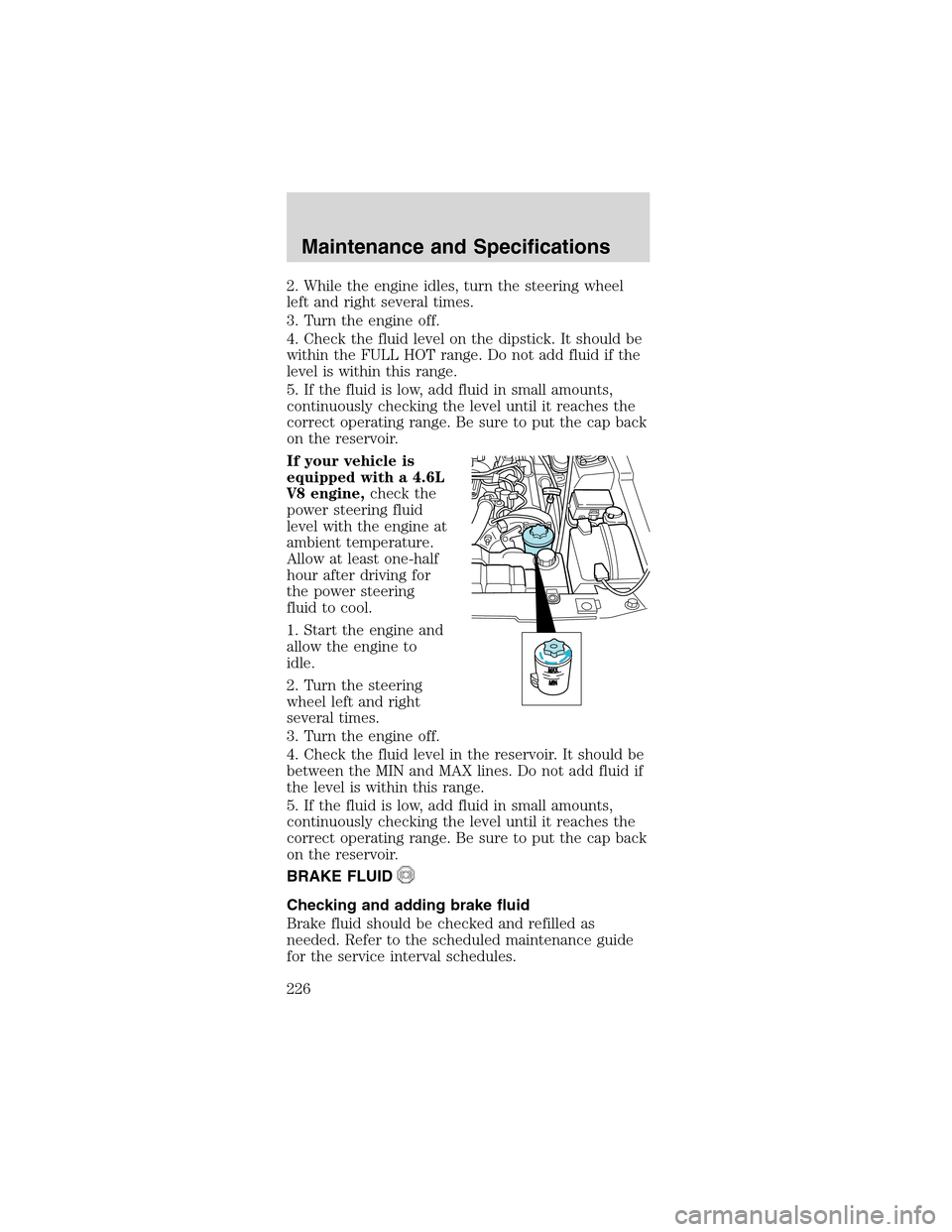
If your vehicle is
equipped with a 4.6L
V8 engine,check the
power steering fluid
level with the engine at
ambient temperature.
Allow at least one-half
hour after driving for
the power steering
fluid to cool.
1. Start the engine and
allow the engine to
idle.
2. Turn the steering
wheel left and right
several times.
3. Turn the engine off.
4. Check the fluid level in the reservoir. It should be
between the MIN and MAX lines. Do not add fluid if
the level is within this range.
5. If the fluid is low, add fluid in small amounts,
continuously checking the level until it reaches the
correct operating range. Be sure to put the cap back
on the reservoir.
BRAKE FLUID
Checking and adding brake fluid
Brake fluid should be checked and refilled as
needed. Refer to the scheduled maintenance guide
for the service interval schedules.
MAXMIN
Maintenance and Specifications
226
Page 238 of 256
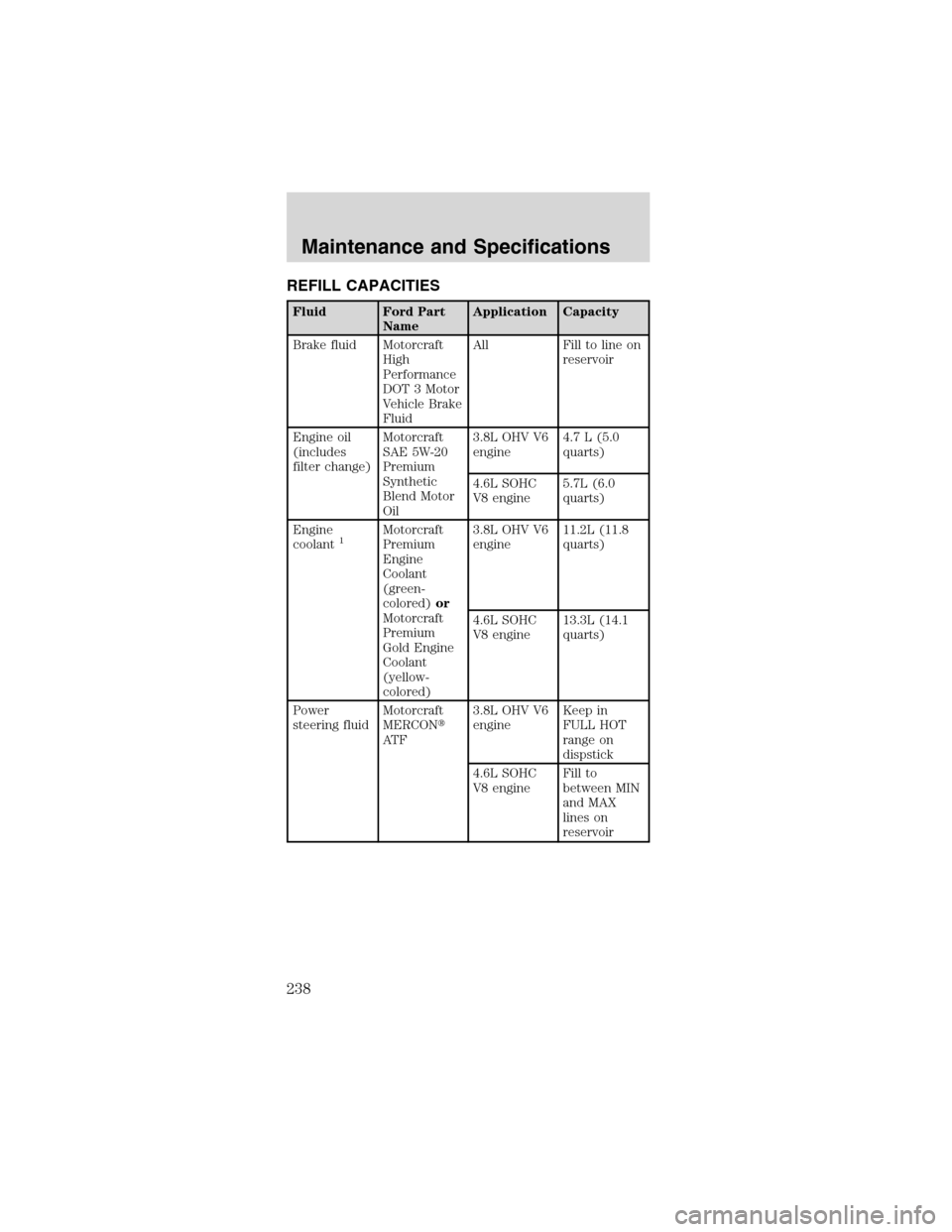
REFILL CAPACITIES
Fluid Ford Part
NameApplication Capacity
Brake fluid Motorcraft
High
Performance
DOT 3 Motor
Vehicle Brake
FluidAll Fill to line on
reservoir
Engine oil
(includes
filter change)Motorcraft
SAE 5W-20
Premium
Synthetic
Blend Motor
Oil3.8L OHV V6
engine4.7 L (5.0
quarts)
4.6L SOHC
V8 engine5.7L (6.0
quarts)
Engine
coolant
1Motorcraft
Premium
Engine
Coolant
(green-
colored)or
Motorcraft
Premium
Gold Engine
Coolant
(yellow-
colored)3.8L OHV V6
engine11.2L (11.8
quarts)
4.6L SOHC
V8 engine13.3L (14.1
quarts)
Power
steering fluidMotorcraft
MERCON�
AT F3.8L OHV V6
engineKeep in
FULL HOT
range on
dispstick
4.6L SOHC
V8 engineFill to
between MIN
and MAX
lines on
reservoir
Maintenance and Specifications
238