2003 FORD FOCUS belt
[x] Cancel search: beltPage 108 of 216

If you smell exhaust fumes inside your vehicle, have your dealer
inspect your vehicle immediately. Do not drive if you smell
exhaust fumes.
Make sure the corresponding lights illuminate or illuminate briefly. If a
light fails to illuminate, have the vehicle serviced.
•If the driver’s safety belt is fastened, the
light may not illuminate.
Important safety precautions
When the engine starts, the idle RPM runs faster to warm the engine. If
the engine idle speed does not slow down automatically, have the vehicle
checked.
Before starting the vehicle:
1. Make sure all occupants buckle their safety belts. For more
information on safety belts and their proper usage, refer to theSeating
and safety restraintschapter.
2. Make sure the headlamps and electrical accessories are off.
If starting a vehicle with an automatic transaxle:
•Make sure the parking brake is
set.
•Make sure the gearshift is in P
(Park).
Driving
108
Page 110 of 216
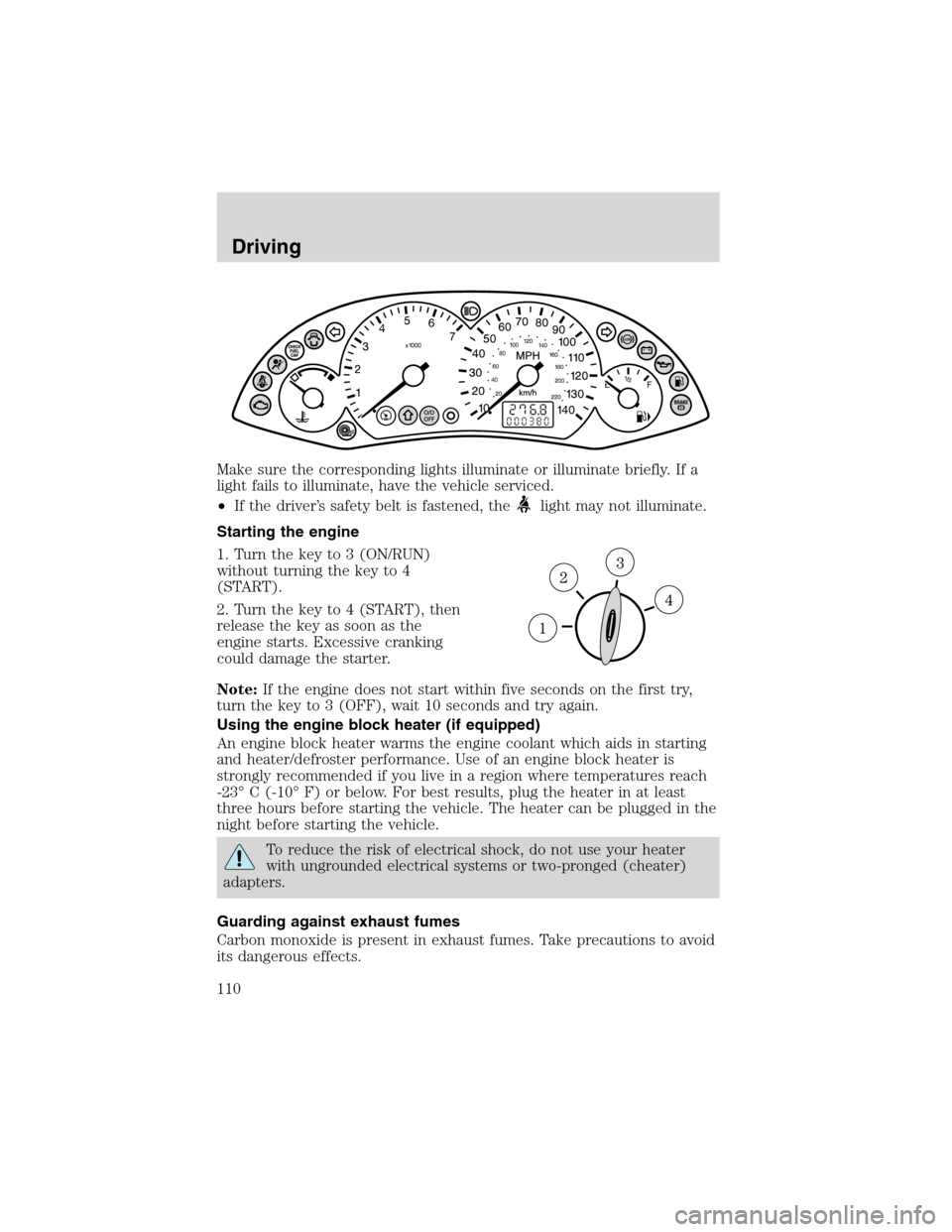
Make sure the corresponding lights illuminate or illuminate briefly. If a
light fails to illuminate, have the vehicle serviced.
•If the driver’s safety belt is fastened, the
light may not illuminate.
Starting the engine
1. Turn the key to 3 (ON/RUN)
without turning the key to 4
(START).
2. Turn the key to 4 (START), then
release the key as soon as the
engine starts. Excessive cranking
could damage the starter.
Note:If the engine does not start within five seconds on the first try,
turn the key to 3 (OFF), wait 10 seconds and try again.
Using the engine block heater (if equipped)
An engine block heater warms the engine coolant which aids in starting
and heater/defroster performance. Use of an engine block heater is
strongly recommended if you live in a region where temperatures reach
-23°C (-10°F) or below. For best results, plug the heater in at least
three hours before starting the vehicle. The heater can be plugged in the
night before starting the vehicle.
To reduce the risk of electrical shock, do not use your heater
with ungrounded electrical systems or two-pronged (cheater)
adapters.
Guarding against exhaust fumes
Carbon monoxide is present in exhaust fumes. Take precautions to avoid
its dangerous effects.
Driving
110
Page 141 of 216
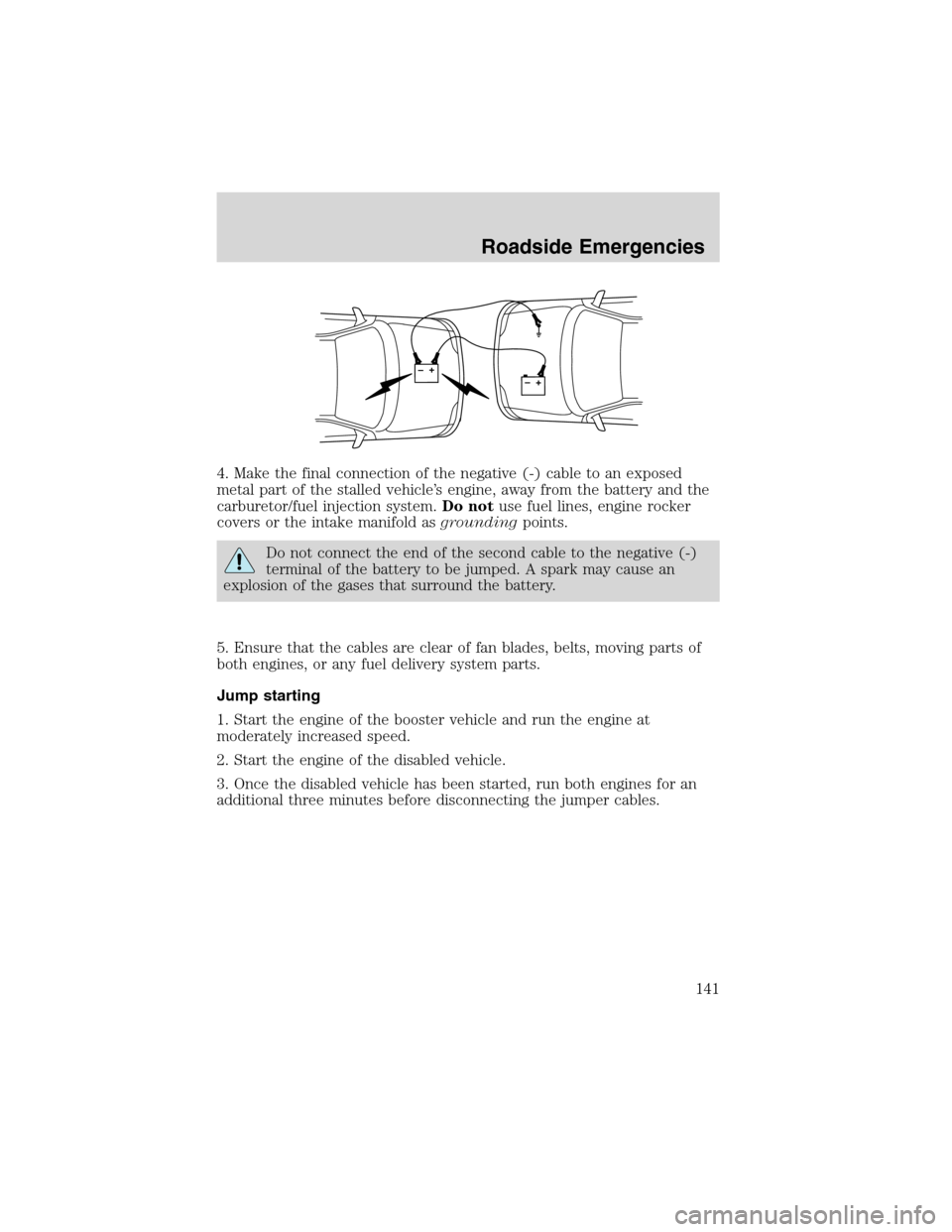
4. Make the final connection of the negative (-) cable to an exposed
metal part of the stalled vehicle’s engine, away from the battery and the
carburetor/fuel injection system.Do notuse fuel lines, engine rocker
covers or the intake manifold asgroundingpoints.
Do not connect the end of the second cable to the negative (-)
terminal of the battery to be jumped. A spark may cause an
explosion of the gases that surround the battery.
5. Ensure that the cables are clear of fan blades, belts, moving parts of
both engines, or any fuel delivery system parts.
Jump starting
1. Start the engine of the booster vehicle and run the engine at
moderately increased speed.
2. Start the engine of the disabled vehicle.
3. Once the disabled vehicle has been started, run both engines for an
additional three minutes before disconnecting the jumper cables.
+–+–
Roadside Emergencies
141
Page 144 of 216
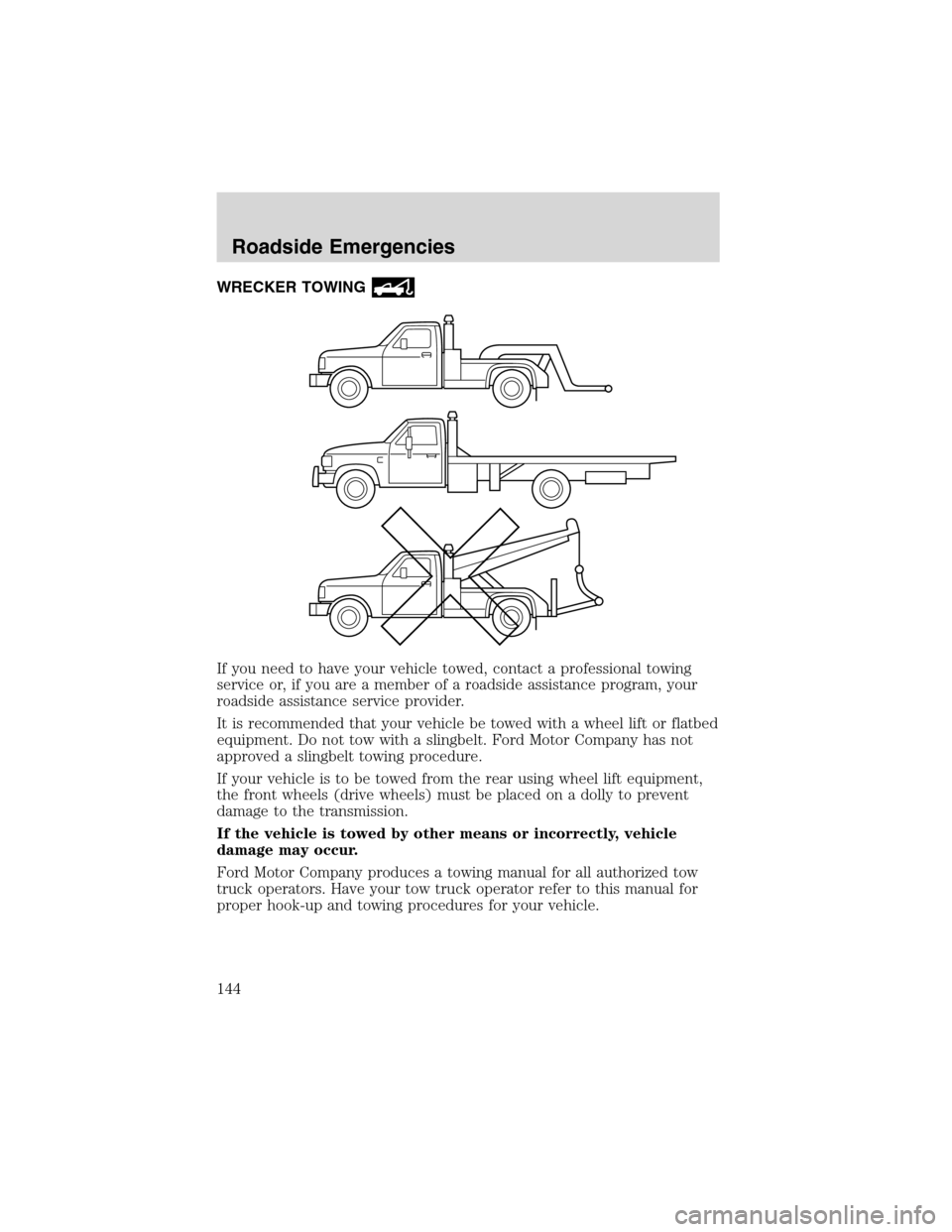
WRECKER TOWING
If you need to have your vehicle towed, contact a professional towing
service or, if you are a member of a roadside assistance program, your
roadside assistance service provider.
It is recommended that your vehicle be towed with a wheel lift or flatbed
equipment. Do not tow with a slingbelt. Ford Motor Company has not
approved a slingbelt towing procedure.
If your vehicle is to be towed from the rear using wheel lift equipment,
the front wheels (drive wheels) must be placed on a dolly to prevent
damage to the transmission.
If the vehicle is towed by other means or incorrectly, vehicle
damage may occur.
Ford Motor Company produces a towing manual for all authorized tow
truck operators. Have your tow truck operator refer to this manual for
proper hook-up and towing procedures for your vehicle.
Roadside Emergencies
144
Page 159 of 216
INTERIOR
For fabric, carpets, cloth seats, safety belts and seats equipped with side
air bags:
•Remove dust and loose dirt with a vacuum cleaner.
•Remove light stains and soil with Ford Extra Strength Upholstery
Cleaner (E8AZ-19523–AA).
•If grease or tar is present on the material, spot-clean the area first
with Motorcraft Spot and Stain Remover (ZC-14).
•Never saturate the seat covers with cleaning solution.
•Do not use household cleaning products or glass cleaners, which can
stain and discolor the fabric and affect the flame retardant abilities of
the seat materials.
Do not use cleaning solvents, bleach or dye on the vehicle’s
safety belts, as these actions may weaken the belt webbing.
Do not use chemical solvents or strong detergents when cleaning
the seat-mounted side air bag. Such products could contaminate
the side air bag system and affect performance of the side air bag in a
collision.
LEATHER SEATS (IF EQUIPPED)
Your leather seating surfaces have a clear, protective coating over the
leather.
•To clean, use a soft cloth with Motorcraft Deluxe Leather and Vinyl
Cleaner (ZC-11–A). Dry the area with a soft cloth.
•To help maintain its resiliency and color, use the Motorcraft Deluxe
Leather Care Kit (ZC-11–D), available from your authorized dealer.
•Do not use household cleaning products, alcohol solutions, solvents or
cleaners intended for rubber, vinyl and plastics, or oil/petroleum-based
leather conditioners. These products may cause premature wearing of
the clear, protective coating.
UNDERBODY
Flush the complete underside of your vehicle frequently. Keep body and
door drain holes free from packed dirt.
Cleaning
159
Page 194 of 216
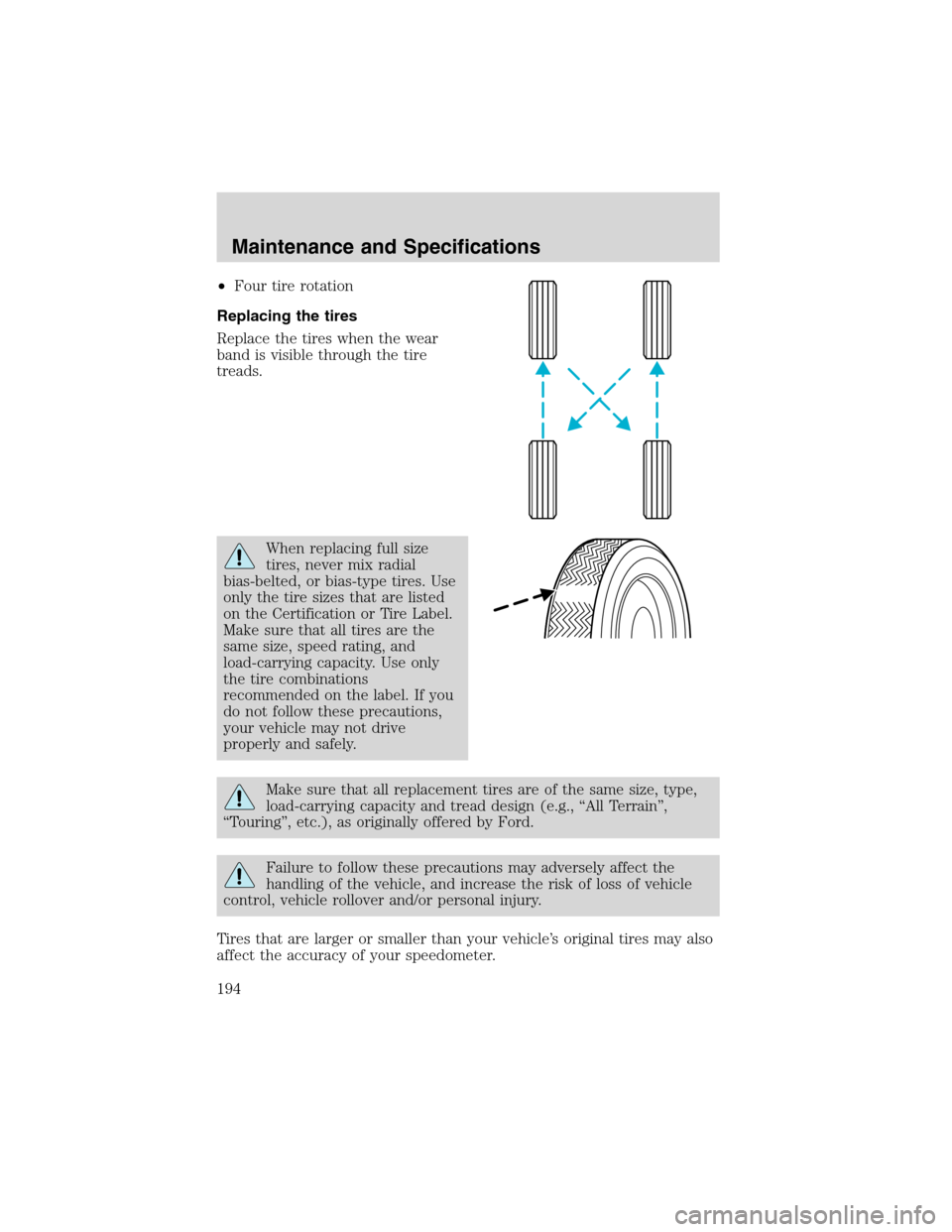
•Four tire rotation
Replacing the tires
Replace the tires when the wear
band is visible through the tire
treads.
When replacing full size
tires, never mix radial
bias-belted, or bias-type tires. Use
only the tire sizes that are listed
on the Certification or Tire Label.
Make sure that all tires are the
same size, speed rating, and
load-carrying capacity. Use only
the tire combinations
recommended on the label. If you
do not follow these precautions,
your vehicle may not drive
properly and safely.
Make sure that all replacement tires are of the same size, type,
load-carrying capacity and tread design (e.g.,“All Terrain”,
“Touring”, etc.), as originally offered by Ford.
Failure to follow these precautions may adversely affect the
handling of the vehicle, and increase the risk of loss of vehicle
control, vehicle rollover and/or personal injury.
Tires that are larger or smaller than your vehicle’s original tires may also
affect the accuracy of your speedometer.
Maintenance and Specifications
194
Page 208 of 216
Index
A
AdvanceTrac ..............................113
Air bag supplemental restraint
system ..............................89–90, 93
and child safety seats ..............91
description ..........................90, 93
disposal ......................................95
driver air bag ......................91, 94
indicator light ...........................93
operation .............................91, 94
passenger air bag ...............91, 94
side air bag ................................93
Air cleaner filter .......................196
Antifreeze (see Engine
coolant) .....................................172
Anti-lock brake system
(see Brakes) ..............................111
Anti-theft system ........................71
arming the system ....................71
disarming a triggered system ..71
Automatic transaxle
fluid, adding ............................189
fluid, checking ........................189
fluid, specification ..................200
Automatic transmission ............115
driving an automatic
overdrive .................................117
fluid, refill capacities ..............196
Axle
lubricant specifications ..........198
refill capacities ........................196
B
Battery .......................................170
acid, treating emergencies .....170
jumping a disabled battery ....138
maintenance-free ....................170replacement, specifications ...196
servicing ..................................170
BeltMinder ...................................84
Brakes ........................................111
anti-lock ...................................111
anti-lock brake system (ABS)
warning light ...........................111
fluid, checking and adding ....188
fluid, refill capacities ..............196
fluid, specifications .........198, 200
lubricant specifications ..198, 200
parking ....................................112
shift interlock ..........................115
C
Capacities for refilling fluids ....196
Cargo cover .................................60
Cell phone use ............................58
Certification Label ....................203
Child safety restraints ................96
child safety belts ......................96
Child safety seats ........................99
attaching with tether straps ..103
in front seat ............................101
in rear seat ..............................101
LATCH .....................................105
Cleaning your vehicle
engine compartment ..............155
instrument panel ....................158
interior .....................................159
plastic parts ............................158
washing ....................................154
waxing .....................................154
wheels ......................................155
wiper blades ............................158
Climate control (see Air
conditioning or Heating) ......35–36
Index
208
Page 211 of 216
instrument panel, dimming .....39
interior lamps ...........................42
Lane change indicator
(see Turn signal) ........................41
Liftgate ........................................59
Lights, warning and indicator ....10
anti-lock brakes (ABS) ..........111
Load limits .................................120
GAWR ......................................120
GVWR ......................................120
trailer towing ..........................120
Locks
childproof ..................................63
Lubricant specifications ...198, 200
M
Manual transaxle
lubricant specifications ..........200
Manual transmission .................119
fluid capacities ........................196
reverse .....................................119
Mirrors .........................................53
side view mirrors (power) .......53
Moon roof ....................................56
Motorcraft parts ................182, 196
O
Octane rating ............................181
Oil (see Engine oil) ..................166
P
Parking brake ............................112
Parts (see Motorcraft parts) ....196
Power distribution box
(see Fuses) ...............................131Power steering ..........................115
fluid, checking and adding ....188
fluid, refill capacity ................196
fluid, specifications .........198, 200
Power Windows ...........................52
R
Rear window defroster ...............37
Relays ........................................127
Remote entry system .................65
locking/unlocking doors ...........62
opening the trunk .....................66
Roadside assistance ..................125
S
Safety Belt Maintenance ............88
Safety belts (see Safety
restraints) ........................76, 79–83
Safety defects, reporting ..........153
Safety restraints ..............76, 79–83
belt minder ...............................84
extension assembly ..................88
for adults .............................80–82
for children .........................95–96
safety belt maintenance ...........88
warning light and chime ..........84
Safety seats for children ............99
Seat belts (see Safety
restraints) ....................................76
Seats ............................................72
child safety seats ......................99
Servicing your vehicle ..............161
Spare tire (see Changing the
Tire) ...........................................135
Spark plugs,
specifications .....................196, 200
Index
211