Page 177 of 216

How fail-safe cooling works
If the engine begins to overheat:
•The engine coolant temperature
gauge will move to the red (hot)
area.
•The“Multi-function warning light:
automatic transaxle/cooling
system”will illuminate (2.0L
Zetec engine only).
•The“Check Engine”indicator light will illuminate.
If the engine reaches a preset over-temperature condition, the engine
will automatically switch to alternating cylinder operation. Each disabled
cylinder acts as an air pump and cools the engine.
When this occurs the vehicle will still operate. However:
•The engine power will be limited.
•The air conditioning system will be disabled.
Continued operation will increase the engine temperature:
•The engine will completely shut down.
•Steering and braking effort will increase.
Once the engine temperature cools, the engine can be re-started. Take
your vehicle to a service facility as soon as possible to minimize engine
damage.
When fail-safe mode is activated
You have limited engine power when in the fail-safe mode, so drive the
vehicle with caution. The vehicle will not be able to maintain high speed
operation and the engine will run rough. Remember that the engine is
capable of completely shutting down automatically to prevent engine
damage, therefore:
1. Pull off the road as soon as safely possible and turn off the engine.
2. Arrange for the vehicle to be taken to a service facility.
3. If this is not possible, wait a short period for the engine to cool.
4. Check the coolant level and replenish if low.
Never remove the coolant reservoir cap while the engine is
running or hot.
Maintenance and Specifications
177
Page 181 of 216
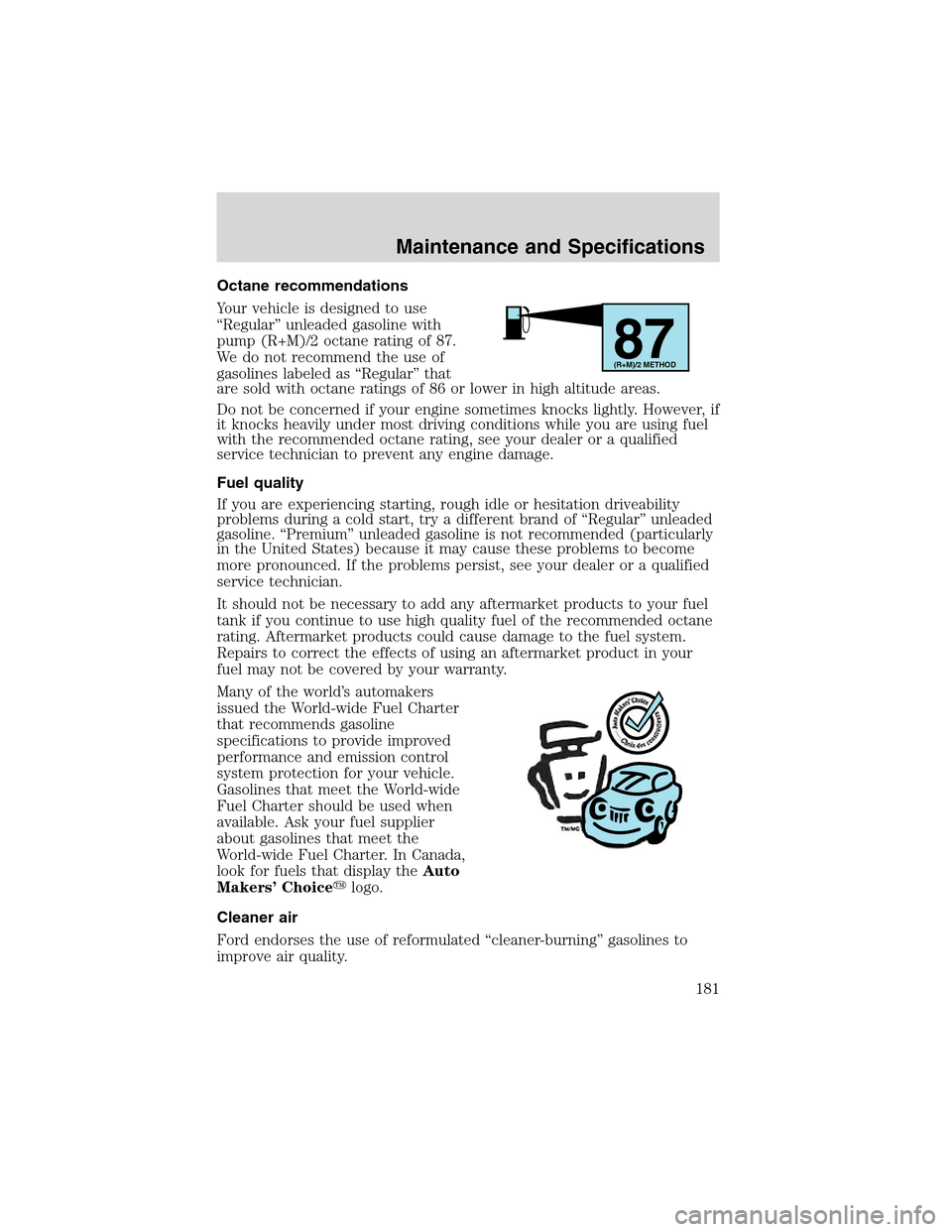
Octane recommendations
Your vehicle is designed to use
“Regular”unleaded gasoline with
pump (R+M)/2 octane rating of 87.
We do not recommend the use of
gasolines labeled as“Regular”that
are sold with octane ratings of 86 or lower in high altitude areas.
Do not be concerned if your engine sometimes knocks lightly. However, if
it knocks heavily under most driving conditions while you are using fuel
with the recommended octane rating, see your dealer or a qualified
service technician to prevent any engine damage.
Fuel quality
If you are experiencing starting, rough idle or hesitation driveability
problems during a cold start, try a different brand of“Regular”unleaded
gasoline.“Premium”unleaded gasoline is not recommended (particularly
in the United States) because it may cause these problems to become
more pronounced. If the problems persist, see your dealer or a qualified
service technician.
It should not be necessary to add any aftermarket products to your fuel
tank if you continue to use high quality fuel of the recommended octane
rating. Aftermarket products could cause damage to the fuel system.
Repairs to correct the effects of using an aftermarket product in your
fuel may not be covered by your warranty.
Many of the world’s automakers
issued the World-wide Fuel Charter
that recommends gasoline
specifications to provide improved
performance and emission control
system protection for your vehicle.
Gasolines that meet the World-wide
Fuel Charter should be used when
available. Ask your fuel supplier
about gasolines that meet the
World-wide Fuel Charter. In Canada,
look for fuels that display theAuto
Makers’Choice�logo.
Cleaner air
Ford endorses the use of reformulated“cleaner-burning”gasolines to
improve air quality.
87(R+M)/2 METHOD
Maintenance and Specifications
181
Page 184 of 216
Habits
•Smooth, moderate operation can yield up to 10% savings in fuel.
•Steady speeds without stopping will usually give the best fuel
economy.
•Idling for long periods of time (greater than one minute) may waste
fuel.
•Anticipate stopping; slowing down may eliminate the need to stop.
•Sudden or hard accelerations may reduce fuel economy.
•Slow down gradually.
•Driving at reasonable speeds (traveling at 88 km/h [55 mph] uses 15%
less fuel than traveling at 105 km/h [65 mph]).
•Revving the engine before turning it off may reduce fuel economy.
•Using the air conditioner or defroster may reduce fuel economy.
•You may want to turn off the speed control in hilly terrain if
unnecessary shifting between third and fourth gear occurs.
Unnecessary shifting of this type could result in reduced fuel
economy.
•Warming up a vehicle on cold mornings is not required and may
reduce fuel economy.
•Resting your foot on the brake pedal while driving may reduce fuel
economy.
•Combine errands and minimize stop-and-go driving.
Maintenance
•Keep tires properly inflated and use only recommended size.
•Operating a vehicle with the wheels out of alignment will reduce fuel
economy.
•Use recommended engine oil. Refer toLubricant specificationsin
this chapter.
•Perform all regularly scheduled maintenance items. Follow the
recommended maintenance schedule and owner maintenance checks
found in your vehicle scheduled maintenance guide.
Conditions
•Heavily loading a vehicle or towing a trailer may reduce fuel economy
at any speed.
•Carrying unnecessary weight may reduce fuel economy (approximately
0.4 km/L [1 mpg] is lost for every 180 kg [400 lb] of weight carried).
Maintenance and Specifications
184
Page 208 of 216
Index
A
AdvanceTrac ..............................113
Air bag supplemental restraint
system ..............................89–90, 93
and child safety seats ..............91
description ..........................90, 93
disposal ......................................95
driver air bag ......................91, 94
indicator light ...........................93
operation .............................91, 94
passenger air bag ...............91, 94
side air bag ................................93
Air cleaner filter .......................196
Antifreeze (see Engine
coolant) .....................................172
Anti-lock brake system
(see Brakes) ..............................111
Anti-theft system ........................71
arming the system ....................71
disarming a triggered system ..71
Automatic transaxle
fluid, adding ............................189
fluid, checking ........................189
fluid, specification ..................200
Automatic transmission ............115
driving an automatic
overdrive .................................117
fluid, refill capacities ..............196
Axle
lubricant specifications ..........198
refill capacities ........................196
B
Battery .......................................170
acid, treating emergencies .....170
jumping a disabled battery ....138
maintenance-free ....................170replacement, specifications ...196
servicing ..................................170
BeltMinder ...................................84
Brakes ........................................111
anti-lock ...................................111
anti-lock brake system (ABS)
warning light ...........................111
fluid, checking and adding ....188
fluid, refill capacities ..............196
fluid, specifications .........198, 200
lubricant specifications ..198, 200
parking ....................................112
shift interlock ..........................115
C
Capacities for refilling fluids ....196
Cargo cover .................................60
Cell phone use ............................58
Certification Label ....................203
Child safety restraints ................96
child safety belts ......................96
Child safety seats ........................99
attaching with tether straps ..103
in front seat ............................101
in rear seat ..............................101
LATCH .....................................105
Cleaning your vehicle
engine compartment ..............155
instrument panel ....................158
interior .....................................159
plastic parts ............................158
washing ....................................154
waxing .....................................154
wheels ......................................155
wiper blades ............................158
Climate control (see Air
conditioning or Heating) ......35–36
Index
208
Page:
< prev 1-8 9-16 17-24