2003 FORD F750 fuel
[x] Cancel search: fuelPage 200 of 248
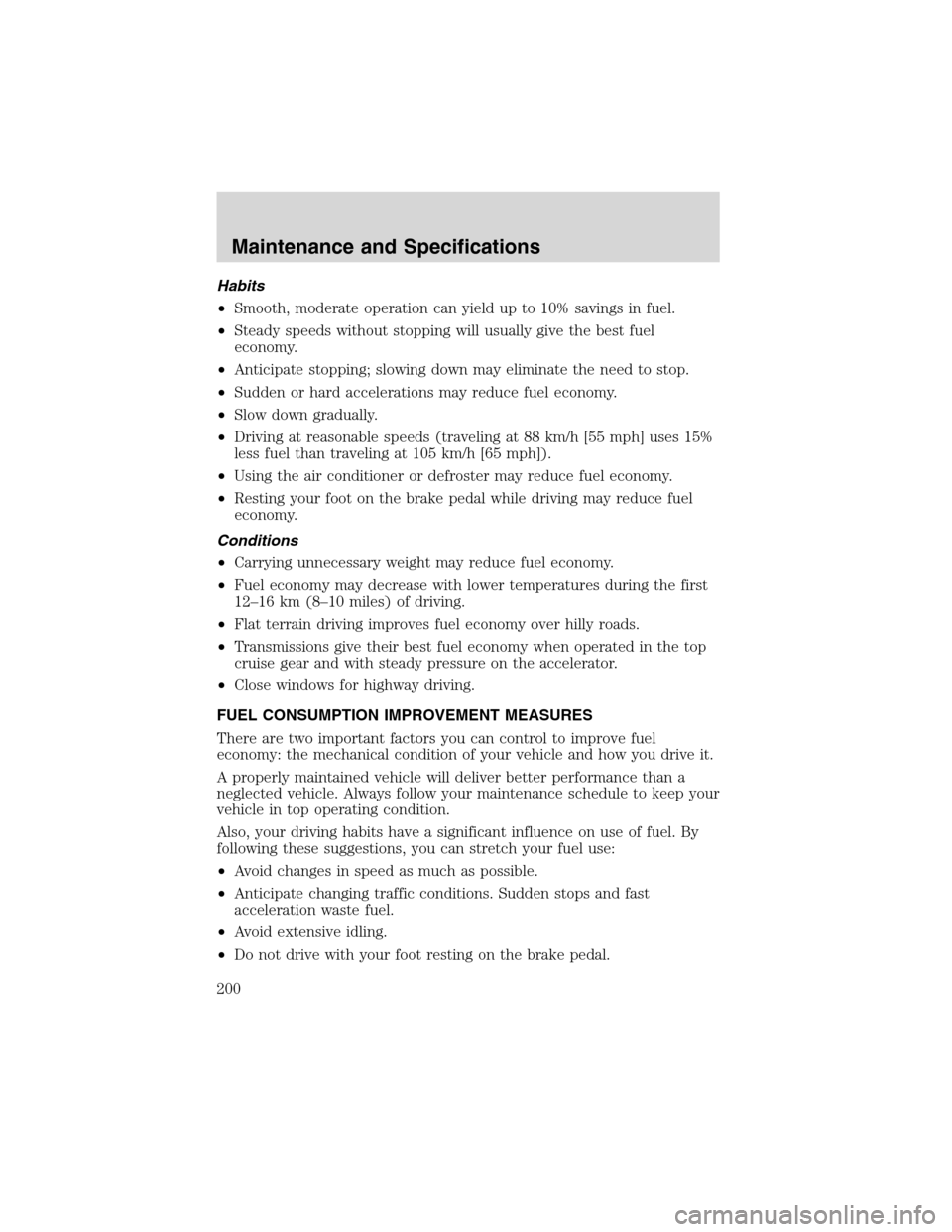
Habits
•Smooth, moderate operation can yield up to 10% savings in fuel.
•Steady speeds without stopping will usually give the best fuel
economy.
•Anticipate stopping; slowing down may eliminate the need to stop.
•Sudden or hard accelerations may reduce fuel economy.
•Slow down gradually.
•Driving at reasonable speeds (traveling at 88 km/h [55 mph] uses 15%
less fuel than traveling at 105 km/h [65 mph]).
•Using the air conditioner or defroster may reduce fuel economy.
•Resting your foot on the brake pedal while driving may reduce fuel
economy.
Conditions
•Carrying unnecessary weight may reduce fuel economy.
•Fuel economy may decrease with lower temperatures during the first
12–16 km (8–10 miles) of driving.
•Flat terrain driving improves fuel economy over hilly roads.
•Transmissions give their best fuel economy when operated in the top
cruise gear and with steady pressure on the accelerator.
•Close windows for highway driving.
FUEL CONSUMPTION IMPROVEMENT MEASURES
There are two important factors you can control to improve fuel
economy: the mechanical condition of your vehicle and how you drive it.
A properly maintained vehicle will deliver better performance than a
neglected vehicle. Always follow your maintenance schedule to keep your
vehicle in top operating condition.
Also, your driving habits have a significant influence on use of fuel. By
following these suggestions, you can stretch your fuel use:
•Avoid changes in speed as much as possible.
•Anticipate changing traffic conditions. Sudden stops and fast
acceleration waste fuel.
•Avoid extensive idling.
•Do not drive with your foot resting on the brake pedal.
Maintenance and Specifications
200
Page 217 of 248
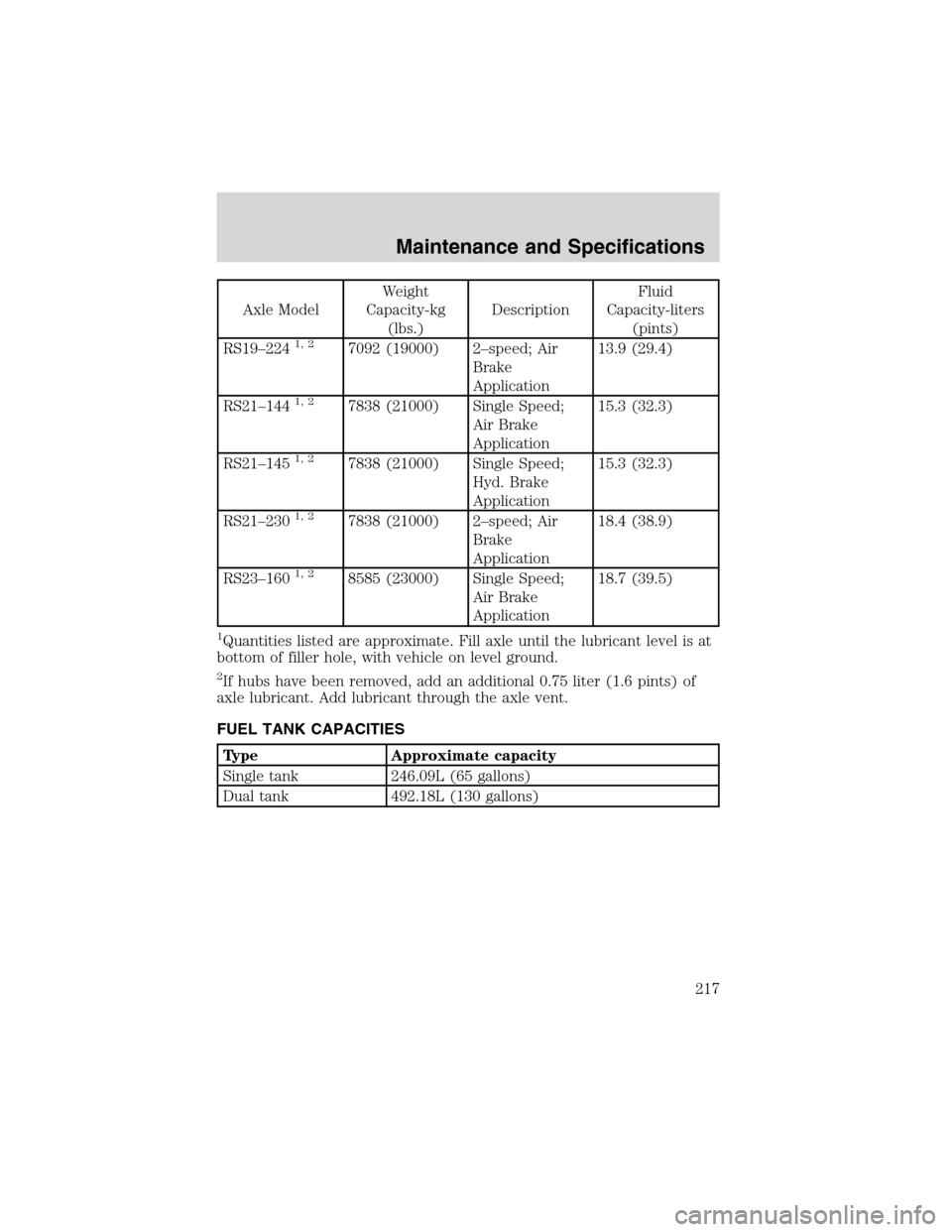
Axle ModelWeight
Capacity-kg
(lbs.)DescriptionFluid
Capacity-liters
(pints)
RS19–224
1, 27092 (19000) 2–speed; Air
Brake
Application13.9 (29.4)
RS21–144
1, 27838 (21000) Single Speed;
Air Brake
Application15.3 (32.3)
RS21–145
1, 27838 (21000) Single Speed;
Hyd. Brake
Application15.3 (32.3)
RS21–230
1, 27838 (21000) 2–speed; Air
Brake
Application18.4 (38.9)
RS23–160
1, 28585 (23000) Single Speed;
Air Brake
Application18.7 (39.5)
1Quantities listed are approximate. Fill axle until the lubricant level is at
bottom of filler hole, with vehicle on level ground.
2If hubs have been removed, add an additional 0.75 liter (1.6 pints) of
axle lubricant. Add lubricant through the axle vent.
FUEL TANK CAPACITIES
Type Approximate capacity
Single tank 246.09L (65 gallons)
Dual tank 492.18L (130 gallons)
Maintenance and Specifications
217
Page 219 of 248

Item Ford Part NameFord Part
NumberFord
Specification
Bushings, front
wheel bearings
(grease packed
type)and seals,
fuel shut-off
solenoid linkage,
air brake control
valve, linkage,
treadle hinge and
roller,
transmission and
transmission
cables, clutch
release bearing
hub,
transmission
shift lever pivot.Premium Long
Life GreaseXG-1-C or
XG-1-KESA-M1C75-B
Door
weatherstripsSilicone Lubricant F7AZ-19G208-BA
and
F5AZ-19553-AAESR-M13P4-A
Driveshaft
U-joints and slip
splines, power
steering gear
output shaft.High Temperature
4 x 4 Front Axle
and Wheel
Bearing GreaseE8TZ-19590-A ESA-M1C198-A
Spring leaves,
transmission
linkage pivots,
brake and clutch
pedal pivots and
clevises,
transmatic
detent stop,
starter motor.Motorcraft SAE
10W30 Super
Duty Motor OilXO-10W30-QSD WSS-M2C171-C
Maintenance and Specifications
219
Page 225 of 248

GENERAL MAINTENANCE INFORMATION
The Scheduled Maintenance Services listed in this section are required
because they are considered essential to the life and performance of
your vehicle.
Ford Motor Company recommends you perform the Owner Maintenance
Services listed in this section. These services are matters of day-to-day
care that are important to the proper operation of your vehicle. In
addition to the conditions described in the Owner Maintenance Checklist,
be alert for any unusual noise, vibration or other indication that your
vehicle may need service and attend to it promptly.
Use only recommended fuels, lubricants, fluids and service parts
conforming to Ford specifications. Motorcraft parts are designed and
built for best performance in your vehicle. Using these parts for
replacement is your assurance that Ford-Built quality stays in your
vehicle.
SCHEDULED MAINTENANCE
The maintenance or replacement of the emission control devices (or
systems) in your new Ford Motor Company vehicle (or engine) may be
performed at your expense. These services may be performed by any
automotive repair establishment or individual using automotive parts
equivalent to those with which your vehicle or engine was originally
equipped. If any parts other than Ford, Motorcraft, or Ford authorized,
remanufactured parts are used for maintenance replacements (or for the
service) of components effecting the emission control, the owner should
be assured that such parts are warranted by their manufacturer to be
equivalent to genuine Ford Motor Company Parts in performance and
durability. Please consult your warranty information booklet for complete
warranty information.
Authorized dealer maintenance
Your authorized dealer specializes in knowing all about Ford Motor
Company vehicles rather than knowing a little about all makes.
There are Ford or Ford of Canada dealer service shops ready to serve
you wherever you drive in the U.S. or Canada. They stock Ford and
Motorcraft parts, and Ford Chemicals and lubricants. You can be
confident that these meet the same exacting design and quality
standards as those used to build the vehicle originally. Dealer Service
Technicians have available training in the latest product developments
and service techniques.
General Maintenance Information
225
Page 226 of 248

OWNER MAINTENANCE
You can do much of the maintenance your vehicle requires yourself, if
you have the time and a reasonable amount of mechanical ability. If you
prefer to have this work done professionally, your authorized dealer
stands ready to help you.
All mechanical components and attachments are important in that they
could affect the performance of vital components and systems. If
replacement becomes necessary, they must be replaced with parts having
the same part number or with equivalent parts. Torque values of the
attaching parts must be used as specified during any reassembly
procedure to assure proper retention.
EMISSIONS CONTROL SYSTEM
To assure the emissions control systems operate effectively, you should
have the services listed in the maintenance schedule performed at the
specified time and km/mileage intervals. You should avoid running out of
fuel or turning off the ignition while the vehicle is in motion, especially
at high speeds.
Because of high engine compartment and exhaust system
temperatures resulting from emissions equipment, do not park,
idle or operate your vehicle in dry grass or other dry ground cover
where the possibility of ground fire exists.
Do not make unauthorized modifications to the engine or vehicle.
Modifications causing increased amounts of unburned fuel to reach the
exhaust system can significantly increase the temperature of the engine
compartment and/or the exhaust system.
Avoid driving your vehicle if it does not operate properly. If the engine
diesels (more than five seconds of engine run-on after shut-off), misfires,
surges, stalls or backfires, see your dealer. Be alert for fluid leakage,
odor, smoke, loss of oil pressure, or charge indicator or over temperature
warning.
Do NOT use diesel fuel blended with waste oil in engines equipped with
a CATALYTIC CONVERTER-MUFFLER. Waste lube oil blending in fuel
will plug the CATALYTIC CONVERTER-MUFFLER, resulting in a
significant loss of engine power.
General Maintenance Information
226
Page 233 of 248

Check every oil change
Oil change intervals are as
follows: Powerstroke - 10 000
; Caterpillar - 15 000 ;
Cummins - 15 000 (refer to
the Caterpillar and Cummins
service manuals for further
instructions and information)Engine system
Check the engine cooling system - hoses, clamps and
protection
Inspect the drive belts
Exhaust system
Inspect the entire exhaust system (including the inlet
pipe(s), muffler(s), outlet pipe(s), clamps and fasteners)
for holes, leakage, breakage, corrosive damage and
separation from other components. Adjust, service or
replace with the same or the equivalent part. (Also a noise
emission control service)
Suspension system
Lubricate the front and rear spring pins
Tighten the front and rear spring U-bolts to the specified
torque
Driveline and rear axle system
Lubricate the U-joints and the slip yoke
Brake system
Lube the air brake foot control valve, hinge and roller
Inspect the drum brake linings through the inspection
holes
Lubricate the brake camshafts (air brakes)
Lubricate the brake slack adjuster (air brakes)
Lubricate rear caliper slide rails (F650 SuperCrewzer
only)
Inspect the disc brake pads and the piston boots
(hydraulic brakes)
Clutch system
Lubricate the clutch release cross shaft and all linkages
Check the clutch fluid
Fuel system
Drain the accumulated water or sediment from the fuel
tank(s)
Steering system
Lubricate the steering shaft(s), U-joints and splines when
equipped with grease fittings
Lubricate the front axle spindle pins
Lubricate the steering linkage when equipped with grease
fittings
Grease the power steering gear output shaft
General Maintenance Information
233
Page 234 of 248

* Coolant protection checks should be made just prior to the onset of freezing weather,
where applicable. If coolant is dirty or rusty in appearance, the system should be
drained, flushed and refilled with the prescribed solution of cooling system fluid and
water. Use only permanent type coolant that meets Ford specifications ESE-M97B18-C.
See the engine manufacturer’s operating guide for supplimental corrosion inhibitor
specifications.
In addition to the items to be performed daily or at each oil change, the
following need to be completed as specified:
8 000KM / 5 000 MILES
•Initial change—change the lubricant in the manual shift transmission
–5 speed and 6 speed Eaton manual transmission. (Not required
when equipped with optional synthetic lubricant.)
32 000 KM / 20 000 MILES
•Replace the fuel filter.*
50 000 KM / 30 000 MILES
•Replace the engine spin-on coolant filter.*
•Repack and adjust the front wheel bearings—grease-filled hubs.
65 000 KM / 40 000 MILES
•Replace the fuel filter.*
80 000 KM / 50 000 MILES
•Disassemble the single check valve (SC-2) and the automatic drain
valve (DB–2)—clean and inspect the valve for wear and
deterioration.
100 000 KM / 60 000 MILES
•Replace the engine spin-on coolant filter.*
•Oil filled front hubs—drain oil, adjust bearings and refill the front
hubs with oil. (Not required when equipped with optional synthetic
lubricant.)
•Drain the oil, adjust the bearing and refill with axle lubricant—oil
filled hubs.
•Replace the fuel filter.*
•Change the manual transmission oil—Eaton 5 and 6 speeds only.
(Not required when equipped with optional synthetic lubricant.)
General Maintenance Information
234
Page 235 of 248

110 000 KM / 70 000 MILES
•Replace the engine spin-on coolant filter.*
•Replace the engine coolant.* See the engine manufacturer’s operating
guide for supplemental corrosion inhibitor specifications.
130 000 KM / 80 000 MILES
•Replace the fuel filter.*
150 000 KM / 90 000 MILES
•Replace the engine spin-on coolant filter*.
•Repack and adjust the front wheel bearings—grease-filled hubs.
•Change the lubricant in the manual shift transmission–7 speed
Spicer. (Not required when equipped with optional synthetic
lubricant.)
•Change the power steering fluid and filter.
160 000 KM / 100 000 MILES
•Disassemble the single check valve (SC-3) and the automatic drain
valve (DB–2)—clean and inspect the valves for wear and
deterioration.
•Lube the clutch release and the cross shaft lever.
•Replace the fuel filter.*
•Change the rear axle lubricant. (Not required when equipped with
optional synthetic lubricant.)
400 000 KM / 250 000 MILES
•Change the rear axle lubricant when equipped with optional synthetic
lubricant.
500 000 KM / 300 000 MILES
•Disassemble the air dryer, replace the desiccant and check the
mounting of the dryer to the vehicle (if equipped).
Please continue with these scheduled maintenance intervals for your
vehicle.
* Shown intervals are for Powerstroke engine only. Refer to Caterpillar
and Cummins Owner Manuals for intervals for their respective engines.
General Maintenance Information
235