2003 FORD F650 warning light
[x] Cancel search: warning lightPage 112 of 248

Excessive full throttle operation below peak torque RPM will shorten
engine life to overhaul and can cause serious engine damage. Operation
of the engine below peak torque RPM can occur during gear shifting due
to difference of gear ratios.
Engine shutdown system (if equipped)
This system is designed to help prevent engine damage that could result
from operating the engine during a prolonged period of low engine oil
pressure, high engine coolant temperature or low coolant level. If any of
these conditions occur, a warning light will illuminate and a chime will
sound warning the operator that the engine will shutdown in 30 seconds.
This is to allow time for the operator to move the vehicle off the road. If
additional time is required, the engine can be restarted and run each
time for approximately 30 seconds.
Do not attempt to use this restarting feature to drive the vehicle, serious
engine damage could result.
Exhaust fumes
Never idle the engine in closed areas. Never sit in a parked or
stopped vehicle for any amount of time with engine running.
If you ever smell exhaust fumes of any kind inside your vehicle,
have your dealer inspect and fix your vehicle immediately. Do
not drive if you smell exhaust fumes. These fumes are harmful and
could kill you.
In order to guard against fumes entering your vehicle, the exhaust
system and body ventilation system should be checked by a qualified
technician:
•Each time the vehicle is raised for service.
•Whenever a change in exhaust system noise is noted.
•Whenever the vehicle has been damaged by impact from another
vehicle, object or road obstruction.
In order to afford proper operation, all air inlet vents should be kept
clear of snow, leaves and other debris.
If you run the engine while stopped (idled) in an unconfined area, open
the windows at least 2.5 cm (one inch) and adjust the heating or air
conditioning to draw outside air into the vehicle as follows:
•If your vehicle has outside air control vents, open them fully.
Driving
112
Page 114 of 248

The sound of the pump operating may be heard by the driver, but this is
a normal characteristic of the system.
The reserve system provides reduced braking power, so the vehicle
should be operated under these conditions with caution, and only to seek
service repair and remove the vehicle from the roadway.
For Hydromax under normal operating conditions noise of the fluid
flowing through the booster may be heard whenever the brake is applied.
This condition is normal. Vehicle service is not required.
If braking performance or pedal response becomes very poor, even when
the pedal is strongly applied, this may indicate the presence of air in the
hydraulic system or fluid leakage. Stop the vehicle safely as soon as
possible and seek service immediately.
If the red BRAKE warning lamp in
the instrument cluster remains
illuminated after engine start up,
this indicates a system failure in the
master cylinder of the brake system. Stop the vehicle safely as soon as
possible and seek service immediately.
If the yellow BRAKE RESERVE
(E-motor) warning light remains on
while the engine is running, this
indicates inadequate hydraulic
booster pressure or reserve pump
system failure. Stop the vehicle safely as soon as possible and seek
service immediately.
Four-wheel anti-lock brake system (ABS)
A noise from the hydraulic pump motor and pulsation in the pedal may
be observed during ABS braking events. Pedal pulsation coupled with
noise while braking under panic conditions or on loose gravel, bumps,
wet or snowy roads is normal and indicates proper functioning of the
vehicle’s anti-lock brake system. If the vehicle has continuous vibration
or shudder in the steering wheel while braking, the vehicle should be
inspected by a qualified service technician.
BRAKE
Driving
114
Page 115 of 248
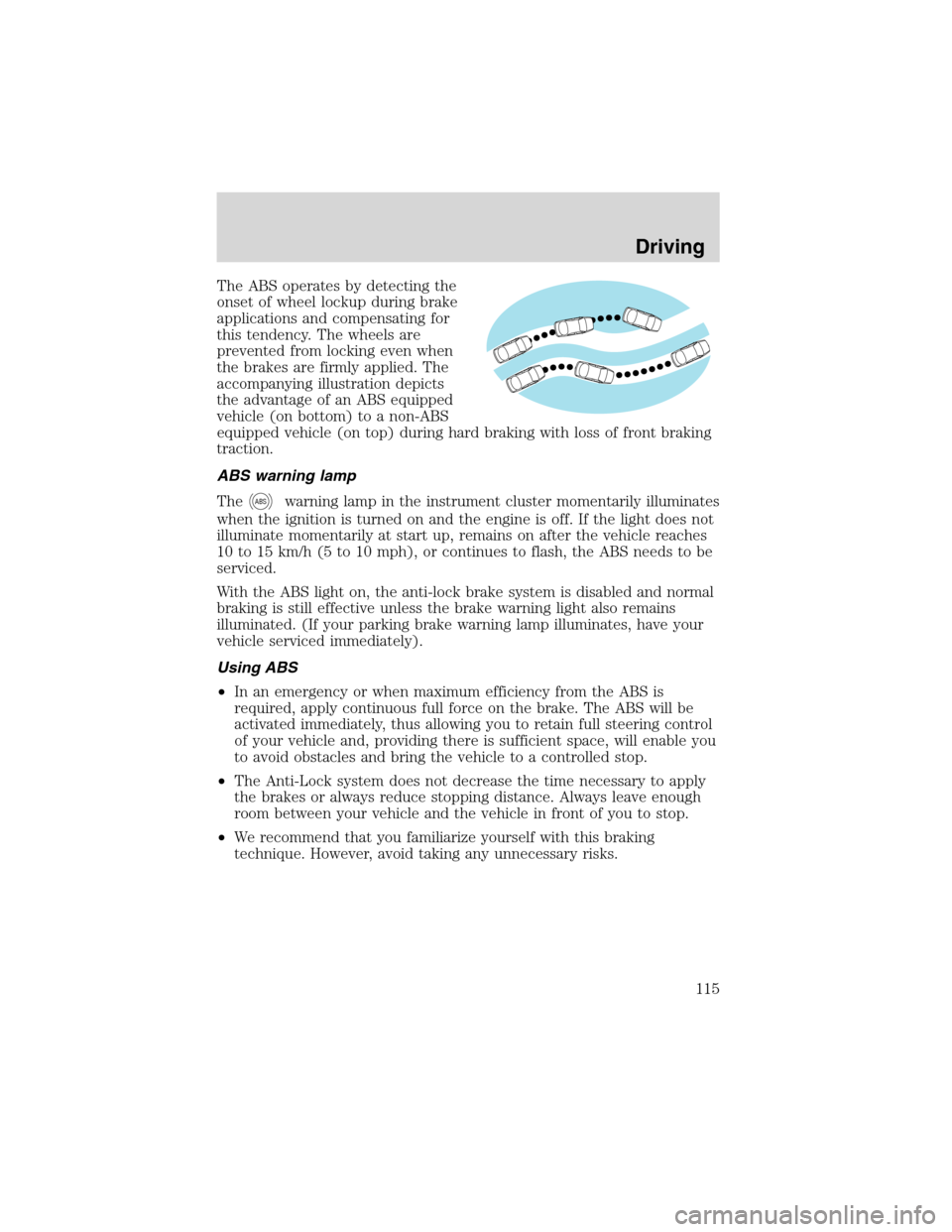
The ABS operates by detecting the
onset of wheel lockup during brake
applications and compensating for
this tendency. The wheels are
prevented from locking even when
the brakes are firmly applied. The
accompanying illustration depicts
the advantage of an ABS equipped
vehicle (on bottom) to a non-ABS
equipped vehicle (on top) during hard braking with loss of front braking
traction.
ABS warning lamp
The
ABSwarning lamp in the instrument cluster momentarily illuminates
when the ignition is turned on and the engine is off. If the light does not
illuminate momentarily at start up, remains on after the vehicle reaches
10 to 15 km/h (5 to 10 mph), or continues to flash, the ABS needs to be
serviced.
With the ABS light on, the anti-lock brake system is disabled and normal
braking is still effective unless the brake warning light also remains
illuminated. (If your parking brake warning lamp illuminates, have your
vehicle serviced immediately).
Using ABS
•In an emergency or when maximum efficiency from the ABS is
required, apply continuous full force on the brake. The ABS will be
activated immediately, thus allowing you to retain full steering control
of your vehicle and, providing there is sufficient space, will enable you
to avoid obstacles and bring the vehicle to a controlled stop.
•The Anti-Lock system does not decrease the time necessary to apply
the brakes or always reduce stopping distance. Always leave enough
room between your vehicle and the vehicle in front of you to stop.
•We recommend that you familiarize yourself with this braking
technique. However, avoid taking any unnecessary risks.
Driving
115
Page 120 of 248

Do not drive or continue to drive if the low air pressure buzzer
is sounding or the brake warning light is lit. These warnings
indicate that air pressure is not to normal operating level. Continued
use of the vehicle could result in loss of braking ability.
Avoid repeated light application of the brake pedal. This will
deplete air pressure faster and could result in loss of braking
capability.
Periodically check the air pressure
gauge while driving. Pressure should
range between approximately 724 to
930 kPa (105-135 psi). The air
compressor governor cut-in and
cut-out pressure settings are preset
at the factory and are not
adjustable.
When air pressure is insufficient
(below 414 kPa [60 psi]), a warning
light illuminates and a buzzer
sounds when the ignition is in the
ON position.
This condition may be caused by excessive brake applications depleting
the system air pressure. If this condition occurs, stop driving the vehicle
until the compressor has fully recharged the air system. Do not move the
vehicle in this condition because the brake system may be inoperative.
Select a gear ratio to help slow your vehicle before descending grades.
Supplement with brakes as required to safely slow the vehicle and avoid
overspeeding the engine.
Air chamber stroke indication
All Ford air chamber push rods have orange stroke indicator stripes that
alert the operator when the braking system requires adjustment or
repair. The orange stripe is painted on the air chamber push rod at the
slack adjuster readjustment stroke dimension.
Air brake inspection and adjustment should be performed by a qualified
service technician in accordance with the instructions in the Ford Truck
Service Manual.
0 30 12090 60
150AIR
PRESSUREPSI
Driving
120
Page 153 of 248

The fuses are coded as follows:
Fuse/Relay
LocationFuse Amp
RatingPassenger Compartment Fuse
Panel Description
1 20A Horn
2 15A Turn/Hazard lamps
3 20A Cigar lighter
4 10A Diagnostic connectors
5 15A Back-up lamps, Daytime Running
Lamps (DRL) relays, Blend door
actuator, Heated seat module
(SuperCrewzer only), On/Off fan
clutch (SuperCrewzer only),
Warning chime module
(SuperCrewzer and Ambulance)
6—Not used
7—Not used
8 5A Radio, GEM
9 5A Switch Illumination (headlamp,
power windows, power door
locks), Power window relay,
Trailer hook-up lamps
(SuperCrewzer only)
10—Not used
11 30A Wiper motor, Washer pump relay
12 10A Stoplamp switch (hydraulic brake
vehicles only)
13 20A Radio, Cluster, 7.3L Power Stroke
Powertrain Control Module
(PCM), Keep Alive Memory
14 10A Interior lamps, Running board
lamps (SuperCrewzer only)
Roadside Emergencies
153
Page 211 of 248

Tires are one of the weaker weight carrying components of the
vehicle. Do not overload the vehicle beyond safe load carrying
capacity.
Avoid hammering rim with steel hammers.
Never run the engine with one wheel off the ground.
Failure to retighten wheel lug nuts as required could allow the
wheel to come off while the vehicle is in motion, possibly causing
loss of vehicle control and collision. Loose wheel studs may also cause
shimmy and vibration.
Use of aftermarket wheel assemblies is not recommended; they
may be incompatible with your vehicle and may result in
equipment failure and possible injury. Replacement with used wheels is
not advised; they may have been treated harshly or have high mileage
and could fail without warning.
A wheel or tire of the wrong size or type may adversely affect
such things as load carrying capacity, wheel and bearing life,
brake cooling, speedometer/odometer calibration, stopping ability,
headlight aim, bumper height, vehicle ground clearance and tire or tire
chain clearance to the body and chassis.
Maintenance and Specifications
211
Page 243 of 248

A
Air cleaner filter .......................206
Air conditioning
manual heating and air
conditioning system .................57
Audio system
(see Radio) ................20, 25, 32, 40
Automatic transmission ............132
Auxiliary power point .................73
B
Battery .......................................184
jumping a disabled battery ....165
voltage gauge ............................17
BeltMinder ...................................96
Brakes ................................113, 119
anti-lock ...................114–115, 121
anti-lock brake system
(ABS) warning light ...11–12, 115
brake warning light ............11–12
fluid, checking and adding ....203
parking ....................116, 118, 122
pedals (see Power
adjustable foot pedals) ............73
trailer .......................................124
C
CD-6 disc .....................................40
CD-single premium .....................32
Child safety restraints ..............101
child safety belts ....................101
Child safety seats ......................104
attaching with tether straps ..108
in front seat ............................106
in rear seat ..............................106
tether anchorage hardware ...108Cleaning your vehicle
engine compartment ..............175
exterior ....................................177
instrument panel ....................176
interior .....................................176
plastic parts ............................176
washing ....................................174
waxing .....................................174
wheels ......................................175
woodtone trim ........................176
Climate control (see Air
conditioning or Heating) ......56–57
Clock ..........................23, 29, 36, 44
Clutch ........................................202
fluid ..........................................202
Compass, electronic ....................70
calibration .................................72
set zone adjustment .................71
Console
overhead ....................................70
Controls
power seat .................................89
Coolant ......................................186
refill capacities ........................190
Cruise control
(see Speed control) ....................76
Customer Assistance ................150
Getting assistance outside
the U.S. and Canada ..............171
Getting roadside assistance ...150
Getting the service
you need .................................166
Ordering additional
owner’s literature ...................172
The Dispute Settlement
Board .......................................168
Index
243
Page 244 of 248

D
Daytime running lamps
(see Lamps) ................................61
Driving under special
conditions
through water .........................148
E
Emergencies, roadside
jump-starting ..........................165
Emission control system ..........226
Engine
check engine/service engine
soon light ....................................9
cleaning ...................................175
coolant .....................................186
Engine block heater .................110
Engine fan .................................192
Engine oil ..................................180
checking and adding ..............180
oil pressure gauge ....................17
recommendations ...................181
Exhaust fumes ..........................112
F
Foglamps .....................................62
Fuel ............................................192
calculating fuel
economy ..........................198, 200
choosing the right fuel ...........193
filling your vehicle
with fuel ..................................192
filter, specifications ........194–196
gauge .........................................18
improving fuel
economy ..........................198, 200safety information relating
to automotive fuels ................192
Fuses ..................................151–152
G
Gas mileage
(see Fuel economy) .........198, 200
Gauges .........................................15
battery voltage gauge ...............17
engine coolant temperature
gauge .........................................16
engine oil pressure gauge ........16
fuel gauge ..................................18
odometer ...................................18
speedometer .............................18
tachometer ................................19
trip odometer ............................19
H
Hazard flashers .........................150
Headlamps ...................................61
aiming ........................................62
daytime running lights .............61
flash to pass ..............................61
high beam ...........................14, 61
turning on and off ....................61
warning chime ..........................15
Heating
heater only system ...................56
heating and air conditioning
system .......................................57
I
Ignition
removing the key ....................145
Infant seats
(see Safety seats) .....................104
Index
244