2003 FORD F650 manual transmission
[x] Cancel search: manual transmissionPage 204 of 248
Brake fluid is toxic. If brake fluid contacts the eyes, flush eyes
with running water for 15 minutes. Seek medical attention if
irritation persists. If taken internally, drink water and induce vomiting.
Seek medical attention immediately.
If you use a brake fluid that is not DOT 3, you will cause
permanent damage to your brakes.
Do not let the reservoir for the master cylinder run dry. This
may cause the brakes to fail.
AVOID MIXING LUBRICANTS
In some cases, different brands of lubricants are not compatible with
each other and deteriorate when mixed. It is best to stick with one brand
during a maintenance interval.
TRANSMISSION FLUID
Always dispose of used automotive fluids in a responsible manner.
Follow your community’s standards for disposing of these types of fluids.
Call your recycling center to find out about recycling automotive fluids.
Automatic transmission fluid
Refer to your Allison Automatic Transmission Operator’s Manual for
scheduled intervals for transmission fluid checks and changes. Your
transmission does not consume fluid. However, the fluid level should be
checked if the transmission is not working properly, i.e., if the
transmission slips or shifts slowly or if you notice some sign of fluid
leakage.
Transmission fluid level should be checked by your dealer or a qualified
service technician.
If you must add transmission fluid, make sure the correct type of fluid is
being used. The type of fluid used is indicated in your Allison Automatic
Transmission Operator’s Manual.
Use of a non-approved automatic transmission fluid may cause
internal transmission component damage.
Manual transmission fluid
Refer to your general maintenance information section for transmission
fluid level checks and fluid change intervals.
Maintenance and Specifications
204
Page 205 of 248

Your manual transmission may be filled with an optional synthetic fluid
which allows the use of extended service intervals. A tag on the filler
plug will identify the use of the synthetic fluid.
Use only fluid that meets Ford specifications (refer toLubricant
specificationsin this chapter.
Use of a non-approved transmission fluid may cause internal
transmission component damage.
For location of the transmission filler plug, refer to your transmission
operator’s manual orTransmission refill capacitiesin this chapter.
Check your transmission fluid level using the following procedure:
1. Park the vehicle on level ground.
2. Set the parking brake and shift into 1 (First) and turn the engine off.
3. Clean any dirt from around the filler plug.
4. Remove the filler plug and inspect the fluid level.
5. The fluid level should be up to the bottom of the filler plug opening.
6. If necessary, add enough fluid through the filler plug opening so that
the fluid level is at the bottom of the opening.
7. Clean and install the filler plug securely.
Drain and refill your transmission fluid using the following procedure:
1. Drain the transmission while the fluid is warm.
2. Park the vehicle on level ground.
3. Set the parking brake and shift into 1 (First) and turn the engine off.
4. Clean any dirt from around the filler and drain plugs.
5. Remove the filler and drain plugs and drain the fluid into a suitable
container. Dispose all used automotive fluids in a responsible manner
following your local authorized standards.
6. Clean and install the drain plug securely.
7. Add enough fluid through the filler plug opening so that the fluid level
is up to the bottom of the opening.
8. Clean and install the filler plug securely.
REAR AXLE LUBRICANT
Refer to your general maintenance information section for rear axle
lubricant level checks and lubricant change intervals.
Your rear axle may be filled with an optional synthetic lubricant which
allows the use of extended service intervals. A tag on the filler plug will
identify the use of the synthetic lubricant.
Maintenance and Specifications
205
Page 206 of 248

Use only a lubricant that meets Ford specifications (refer toLubricant
specificationsin thischapter).
Use of a non-approved rear axle lubricant may cause internal axle
component damage.
Check your rear axle lubricant level using the following procedure:
1. Park the vehicle on level ground.
2. Set the parking brake and shift into N (Neutral) (automatic
transmission) or 1 (First) (manual transmission) and turn the engine off.
3. Clean any dirt from around the rear axle filler plug.
4. Remove the filler plug and inspect the lubricant level.
5. The lubricant level should be up to the bottom of the filler plug
opening.
6. If necessary, add enough lubricant through the filler plug opening so
that the lubricant level is at the bottom of the opening.
7. Clean and install the filler plug securely.
Drain and refill your rear axle lubricant using the following procedure:
1. Drain the rear axle while the lubricant is warm.
2. Park the vehicle on level ground.
3. Set the parking brake and shift into N (Neutral) (automatic
transmission) or 1 (First) (manual transmission) and turn the engine off.
4. Clean any dirt from around the rear axle filler and drain plugs.
5. Remove the filler and drain plugs and drain the lubricant into a
suitable container. Dispose all used automotive fluids in a responsible
manner following your local authorized standards.
6. Clean and install the drain plug securely.
7. Add enough lubricant through the filler plug opening so that the
lubricant level is up to the bottom of the opening.
8. Clean and install the filler plug securely.
AIR FILTER
When to service
Your vehicle is equipped with an air filter restriction gauge to determine
when to replace the air filter element. It is not possible to determine the
need for service by visually inspecting the air filter.
Maintenance and Specifications
206
Page 208 of 248
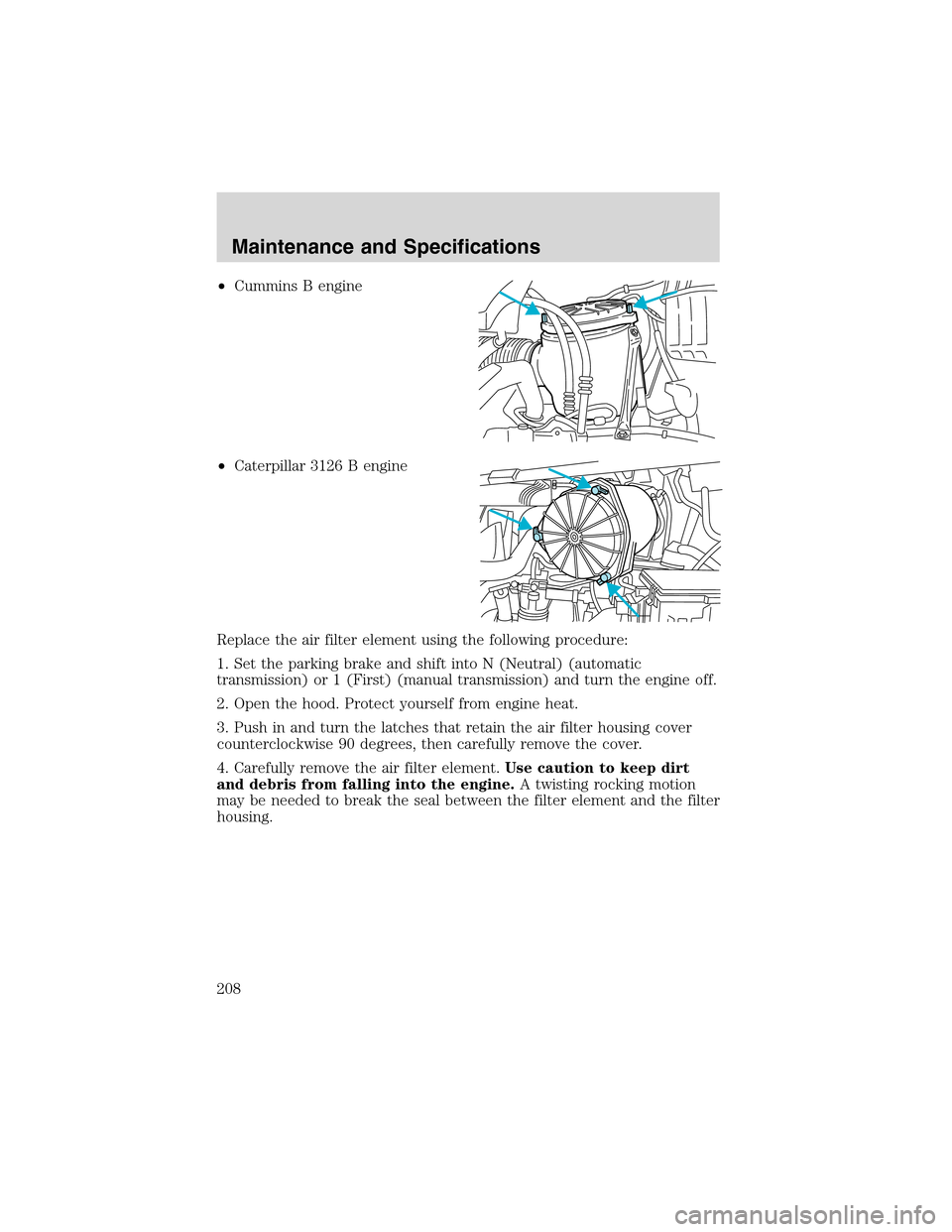
•Cummins B engine
•Caterpillar 3126 B engine
Replace the air filter element using the following procedure:
1. Set the parking brake and shift into N (Neutral) (automatic
transmission) or 1 (First) (manual transmission) and turn the engine off.
2. Open the hood. Protect yourself from engine heat.
3. Push in and turn the latches that retain the air filter housing cover
counterclockwise 90 degrees, then carefully remove the cover.
4. Carefully remove the air filter element.Use caution to keep dirt
and debris from falling into the engine.A twisting rocking motion
may be needed to break the seal between the filter element and the filter
housing.
Maintenance and Specifications
208
Page 220 of 248
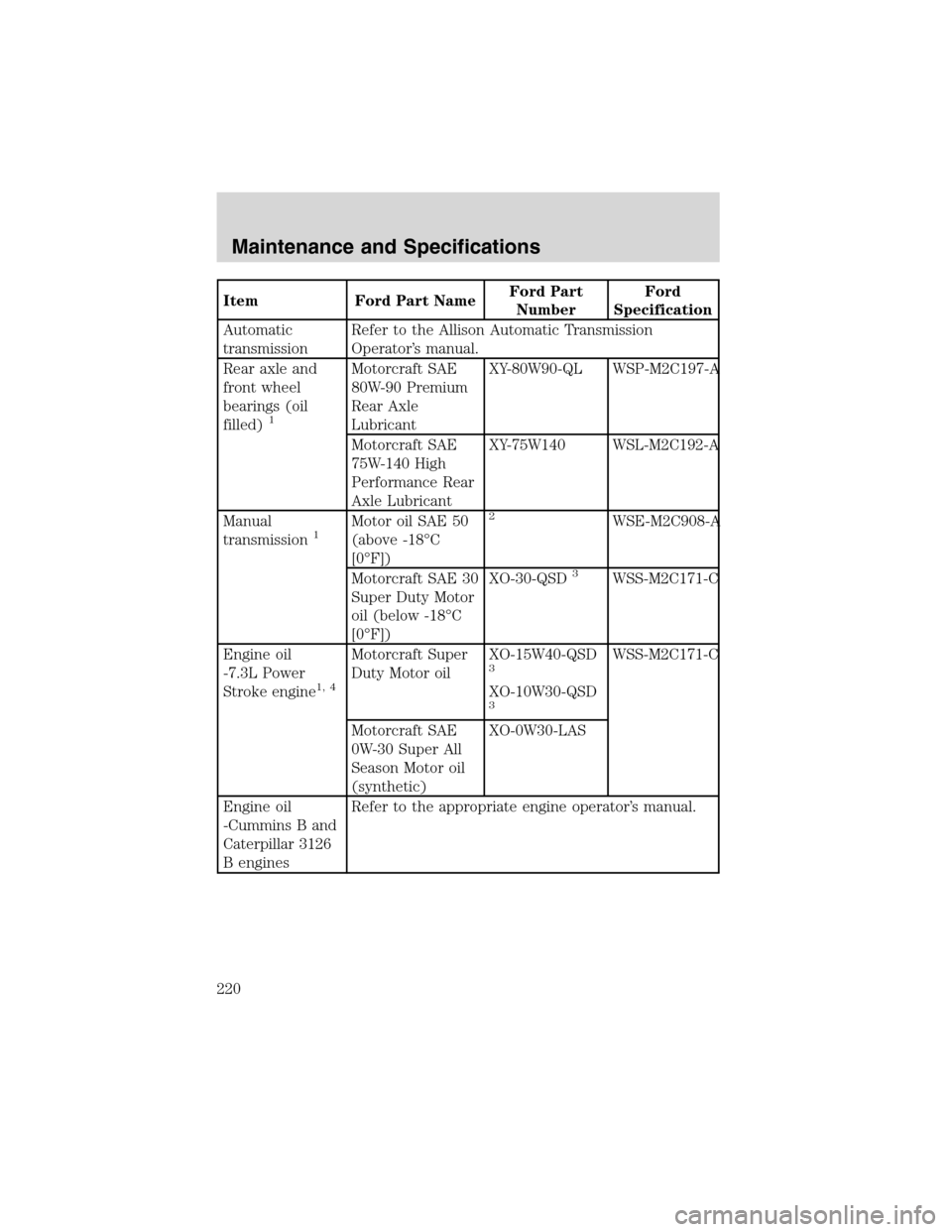
Item Ford Part NameFord Part
NumberFord
Specification
Automatic
transmissionRefer to the Allison Automatic Transmission
Operator’s manual.
Rear axle and
front wheel
bearings (oil
filled)
1
Motorcraft SAE
80W-90 Premium
Rear Axle
LubricantXY-80W90-QL WSP-M2C197-A
Motorcraft SAE
75W-140 High
Performance Rear
Axle LubricantXY-75W140 WSL-M2C192-A
Manual
transmission
1Motor oil SAE 50
(above -18°C
[0°F])2WSE-M2C908-A
Motorcraft SAE 30
Super Duty Motor
oil (below -18°C
[0°F])XO-30-QSD
3WSS-M2C171-C
Engine oil
-7.3L Power
Stroke engine
1, 4
Motorcraft Super
Duty Motor oilXO-15W40-QSD3
XO-10W30-QSD3
WSS-M2C171-C
Motorcraft SAE
0W-30 Super All
Season Motor oil
(synthetic)XO-0W30-LAS
Engine oil
-Cummins B and
Caterpillar 3126
B enginesRefer to the appropriate engine operator’s manual.
Maintenance and Specifications
220
Page 229 of 248

SCHEDULED MAINTENANCE SERVICES
Maintenance service adjustments must conform to specifications
contained in this manual, and those shown on the Important Engine
Information Decal. The following services are to be performed at
scheduled intervals because they are considered essential to the life and
performance of your vehicle. Ford recommends that you perform
maintenance on all designated items to achieve best vehicle operation.
Scheduled maintenance beyond 160 930 km (100 000 miles) should be
continued as before 160 930 km (100 000 miles).
SPECIAL OPERATING CONDITIONS
If your driving habitsfrequentlyinclude one or more the following
conditions:
•Short trips oflessthan 16 km (ten miles) when outside temperatures
remain below freezing.
•Operating duringhot weatherin stop-and-go“rush hour”traffic.
•Operating in severe dust conditions.
•Extensive idling, or low speed operation such as door-to-door delivery
service.
•High speed operation with a fully loaded vehicle (max. GVW).
•Snowplowing.
Perform the following:
•Change engine oil and oil filter every three months, 8 000 km (5 000
miles) or 125 hours of engine service.
•If operating in severe dust conditions, replace the air cleaner filter
more often than regular intervals as determined by the air filter
restriction indicator. Make sure that the air filter restriction indicator
is in good working order.
•Lube the manual transmission and the rear axle every 48 279 km
(30 000 miles) or 6 months, whichever comes first.
•See the Allison, Cummins and Caterpillar Operator’s Manual.
AIR BRAKE ADJUSTMENT
Failure to maintain proper air brake adjustment can result in
reduction or loss of braking ability.
Air brake inspection and adjustment should be performed by a qualified
service technician in accordance with the instructions in the Ford Truck
Service Manual.
General Maintenance Information
229
Page 232 of 248

Daily Owner Checks Engine system
Check the air filter restriction indicator
Check the engine oil
Inspect the coolant level - for Powerstroke
engine (for Caterpillar and Cummins engines,
refer to the Owner’s Manual)
Brake system
Drain the air brake system reservoir - manual
valve
Check the air brake system reservoir
automatic drain valve operation
Transmission system
Visually check the automatic transmission for
fluid leakage
Steering system
Check the power steering pump fluid level and
check the system for leaks
Check the entire vehicle for evidence of fluid
leaks
U.S. Department of Transportation,
Federal Highway Administration
requirements (ensure that the entire
system is functioning properly)
Check the service brakes
Check the parking brake
Check the steering mechanism
Check the lighting devices and reflectors
Check the tires
Check the horn
Check the windshield wipers
Check the rear vision mirrors
Check the wheels and rims
Check the emergency equipment
General Maintenance Information
232
Page 234 of 248

* Coolant protection checks should be made just prior to the onset of freezing weather,
where applicable. If coolant is dirty or rusty in appearance, the system should be
drained, flushed and refilled with the prescribed solution of cooling system fluid and
water. Use only permanent type coolant that meets Ford specifications ESE-M97B18-C.
See the engine manufacturer’s operating guide for supplimental corrosion inhibitor
specifications.
In addition to the items to be performed daily or at each oil change, the
following need to be completed as specified:
8 000KM / 5 000 MILES
•Initial change—change the lubricant in the manual shift transmission
–5 speed and 6 speed Eaton manual transmission. (Not required
when equipped with optional synthetic lubricant.)
32 000 KM / 20 000 MILES
•Replace the fuel filter.*
50 000 KM / 30 000 MILES
•Replace the engine spin-on coolant filter.*
•Repack and adjust the front wheel bearings—grease-filled hubs.
65 000 KM / 40 000 MILES
•Replace the fuel filter.*
80 000 KM / 50 000 MILES
•Disassemble the single check valve (SC-2) and the automatic drain
valve (DB–2)—clean and inspect the valve for wear and
deterioration.
100 000 KM / 60 000 MILES
•Replace the engine spin-on coolant filter.*
•Oil filled front hubs—drain oil, adjust bearings and refill the front
hubs with oil. (Not required when equipped with optional synthetic
lubricant.)
•Drain the oil, adjust the bearing and refill with axle lubricant—oil
filled hubs.
•Replace the fuel filter.*
•Change the manual transmission oil—Eaton 5 and 6 speeds only.
(Not required when equipped with optional synthetic lubricant.)
General Maintenance Information
234