2003 FORD F250 wheel
[x] Cancel search: wheelPage 142 of 280
Avoid sudden braking as well. Although a 4WD vehicle may accelerate
better than a two-wheel drive vehicle in snow and ice, it won’t stop any
faster, because as in other vehicles, braking occurs at all four wheels. Do
not become overconfident as to road conditions.
Make sure you allow sufficient distance between you and other vehicles
for stopping. Drive slower than usual and consider using one of the lower
gears. In emergency stopping situations, avoid locking of the wheels. Use
a“squeeze”technique, push on the brake pedal with a steadily increasing
force which allows the wheels to brake yet continue to roll so that you
may steer in the direction you want to travel. If you lock the wheels,
release the brake pedal and repeat the squeeze technique. If your vehicle
is equipped with a Four Wheel Anti-Lock Brake System (ABS), apply the
brake steadily. Do not“pump”the brakes. Refer to theBrakessection of
this chapter for additional information on the operation of the anti-lock
brake system.
Never drive with chains on the front tires of 4WD vehicles without also
putting them on the rear tires. This could cause the rear to slide and
swing around during braking.
Tires, Replacement Requirements
Do not use a size and type of tire and wheel other than that
originally provided by Ford Motor Company because it can affect
the safety and performance of your vehicle, which could result in an
increased risk of loss of vehicle control, vehicle rollover, and/or serious
personal injury or death.
Make sure all tires and wheels on the vehicle are of the same size, type,
tread design, brand and load-carrying capacity. If you have questions
regarding tire replacement, see an authorized Ford or Lincoln/Mercury
dealer.
If you nevertheless decide to equip your 4WD for off-road use with tires
larger than what Ford Motor Company recommends, you should not use
these tires for highway driving.
If you use any tire/wheel combination not recommended by Ford Motor
Company, it may adversely affect vehicle handling and could cause
steering, suspension, axle or transfer case failure as well as the increased
risk of loss of vehicle control.
Do not use“aftermarket lift kits”or other suspension modifications,
whether or not they are used with larger tires and wheels.
These“aftermarket lift kits”could adversely affect the vehicle’s handling
characteristics, which could lead to loss of vehicle control or rollover and
serious injury.
2003 F250/350/450/550(f23)
Owners Guide (post-2002-fmt)
USA English(fus)
Driving
142
Page 144 of 280
Failure to maintain your vehicle properly may void the warranty, increase
your repair cost, reduce vehicle performance and operational capabilities
and adversely affect driver and passenger safety. Frequent inspection of
vehicle chassis components is recommended if the vehicle is subjected to
heavy off-road usage.
POWER TAKE OFF (PTO) CAPABILITY (IF EQUIPPED)
Some vehicles are equipped with Power Take Off (PTO) capability. These
vehicles have a special transmission case, internal components and
calibration for PTO usage.
The PTO can be used during mobile and stationary
continuous/intermittent applications.
Gasoline engine:
PTO operation is disabled while the vehicle is in Overdrive (the TCIL will
not be illuminated), in N (Neutral), during engine cranking. Transmission
upshift and downshift schedules will be reduced by about 15% and will
have a firmer shift feel during PTO mobile applications.
The PTO cannot be disabled while the transmission is in D (Drive)
(Overdrive position with Overdrive canceled), 2 (Second) or 1 (First).
Refer to theBody Builder’s Layout Bookfor recommended electrical
installation.
Diesel engine:
The Auxiliary Powertrain Control Module (APCM) will elevate the engine
speed to 1,200 RPM when in PTO mode. PTO operation will be disabled
in stationary drive idle conditions. For more information on the APCM
and PTO operation with the Diesel engine, refer to the APCM manual
supplied with your vehicle.
DRIVING THROUGH WATER
If driving through deep or standing water is unavoidable, proceed very
slowly especially if the depth is not known. Never drive through water
that is higher than the bottom of the hubs (for trucks) or the bottom of
the wheel rims (for cars). Traction or brake capability may be limited
and your vehicle may stall. Water may also enter your engine’s air intake
and severely damage your engine.
Once through the water, always dry the brakes by moving your vehicle
slowly while applying light pressure on the brake pedal. Wet brakes do
not stop the vehicle as quickly as dry brakes.Driving through deep
water where the transmission vent tube is submerged may allow
water into the transmission and cause internal transmission
damage.
2003 F250/350/450/550(f23)
Owners Guide (post-2002-fmt)
USA English(fus)
Driving
144
Page 146 of 280
Always ensure that the weight of occupants, cargo and equipment is
within the weight limitations, including both gross vehicle weight and
front and rear gross axle weight rating limits.
Note:Do not exceed the GVWR or the GAWR specified on the
certification label.
Exceeding any vehicle weight rating limitation could result in
serious damage to the vehicle, loss of vehicle control, vehicle
rollover, and/or personal injury.
Do not use replacement tires with lower load carrying capacities than the
originals because they may lower the vehicle’s GVWR and GAWR
limitations. Replacement tires with a higher limit than the originals do
not increase the GVWR and GAWR limitations.
Special loading instructions for owners of pickup trucks and
utility-type vehicles
For important information regarding safe operation of this type
of vehicle, see thePreparing to drive your vehiclesection in
this chapter.
Loaded vehicles may handle differently than unloaded vehicles.
Extra precautions, such as slower speeds and increased stopping
distance, should be taken when driving a heavily loaded vehicle.
Your vehicle can haul more cargo and people than most passenger cars.
Depending upon the type and placement of the load, hauling cargo and
people may raise the center of gravity of the vehicle.
Calculating the load your vehicle can carry/tow
1. Use the appropriate maximum GCWR chart (in theTrailer Towing
section in this chapter) for your type of engine and rear axle ratio.
2. Weigh your vehicle without cargo. To obtain correct weights, take your
vehicle to a shipping company or an inspection station for trucks.
3. Subtract your loaded weight from the maximum GCWR in the chart.
This is the maximum trailer weight your vehicle can tow. It must be
below the maximum trailer weight shown in the chart.
TRAILER TOWING
Your vehicle may tow a Conventional/Class IV trailer or fifth wheel trailer
provided the maximum trailer weight is less than or equal to the
maximum trailer weight listed for your engine and rear axle ratio on the
following charts.
2003 F250/350/450/550(f23)
Owners Guide (post-2002-fmt)
USA English(fus)
Driving
146
Page 147 of 280
2nd unit bodies are not included in maximum trailer weight ratings. The
weight of the additional“body”must be subtracted from the maximum
trailer weight.
Your vehicle’s load capacity is designated by weight, not by volume, so
you cannot necessarily use all available space when loading a vehicle.
Towing a trailer places an additional load on your vehicle’s engine,
transmission, axle, brakes, tires and suspension. Inspect these
components carefully prior to and after any towing operation. The
following trailer towing charts apply to vehicles equipped with gasoline
engines; for Diesel engines, refer to the Diesel supplement.
Note:Do not exceed the GVWR or the GAWR specified on the
certification label.
Towing trailers beyond the maximum recommended gross trailer
weight exceeds the limit of the vehicle and could result in
engine damage, transmission damage, structural damage, loss of vehicle
control, vehicle rollover and personal injury.
Refer toTransmission temperature gaugein theInstrument cluster
chapter for transmission fluid temperature information.
F-250 Regular Cab Pickup
Engine Rear axle
ratioMaximum GCWR -
kg (lbs.)Maximum
trailer weight -
kg (lbs.)
4x2 with manual transmission
5.4L 3.73 6123 (13500) 3537 (7800)
5.4L 4.10 6804 (15000) 4217 (9300)
6.8L 3.73 7484 (16500) 4807 (10600)
6.8L
(without
fifth wheel)4.30 9072 (20000) 5670 (12500)
6.8L (with
fifth wheel)4.30 9072 (20000) 6394 (14100)
2003 F250/350/450/550(f23)
Owners Guide (post-2002-fmt)
USA English(fus)
Driving
147
Page 148 of 280
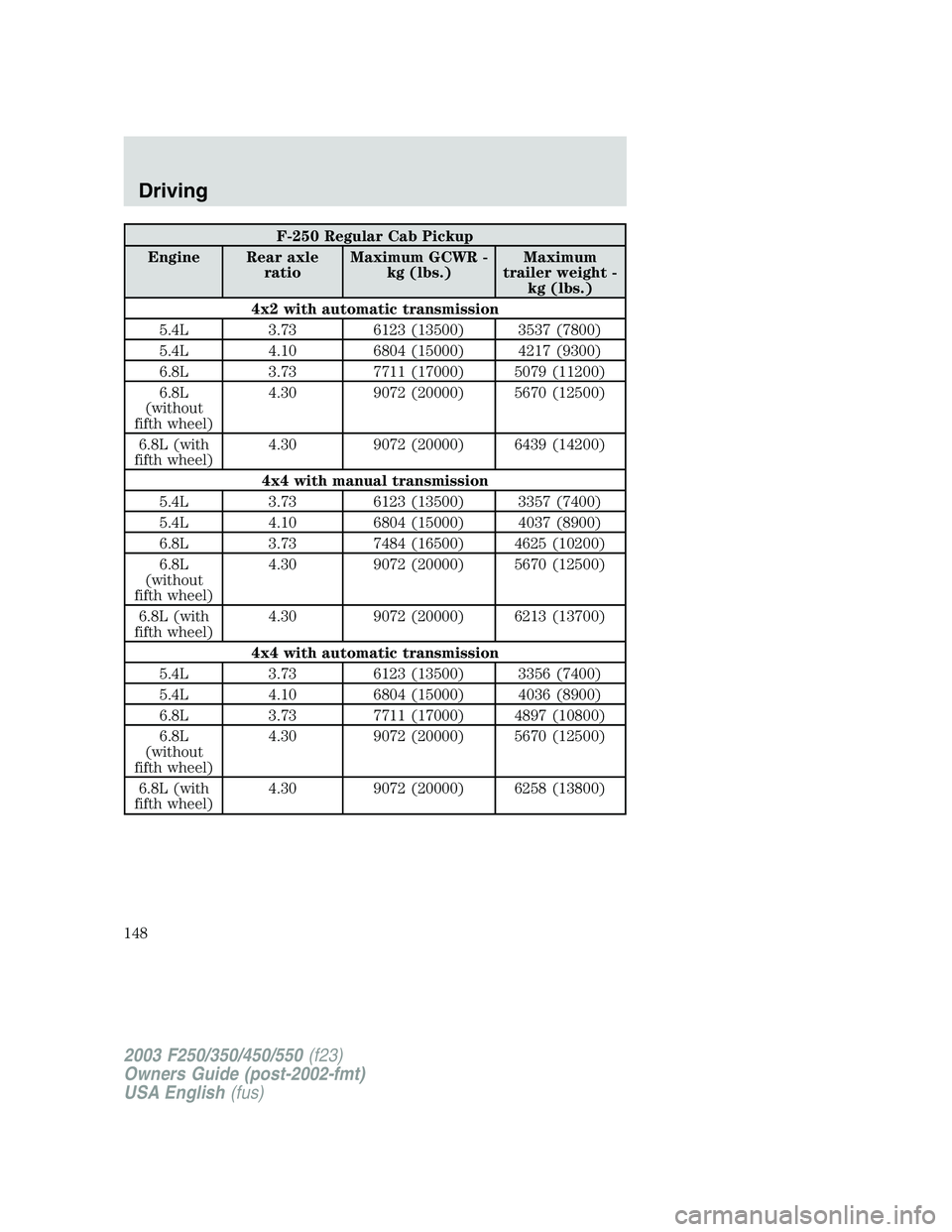
F-250 Regular Cab Pickup
Engine Rear axle
ratioMaximum GCWR -
kg (lbs.)Maximum
trailer weight -
kg (lbs.)
4x2 with automatic transmission
5.4L 3.73 6123 (13500) 3537 (7800)
5.4L 4.10 6804 (15000) 4217 (9300)
6.8L 3.73 7711 (17000) 5079 (11200)
6.8L
(without
fifth wheel)4.30 9072 (20000) 5670 (12500)
6.8L (with
fifth wheel)4.30 9072 (20000) 6439 (14200)
4x4 with manual transmission
5.4L 3.73 6123 (13500) 3357 (7400)
5.4L 4.10 6804 (15000) 4037 (8900)
6.8L 3.73 7484 (16500) 4625 (10200)
6.8L
(without
fifth wheel)4.30 9072 (20000) 5670 (12500)
6.8L (with
fifth wheel)4.30 9072 (20000) 6213 (13700)
4x4 with automatic transmission
5.4L 3.73 6123 (13500) 3356 (7400)
5.4L 4.10 6804 (15000) 4036 (8900)
6.8L 3.73 7711 (17000) 4897 (10800)
6.8L
(without
fifth wheel)4.30 9072 (20000) 5670 (12500)
6.8L (with
fifth wheel)4.30 9072 (20000) 6258 (13800)
2003 F250/350/450/550(f23)
Owners Guide (post-2002-fmt)
USA English(fus)
Driving
148
Page 149 of 280
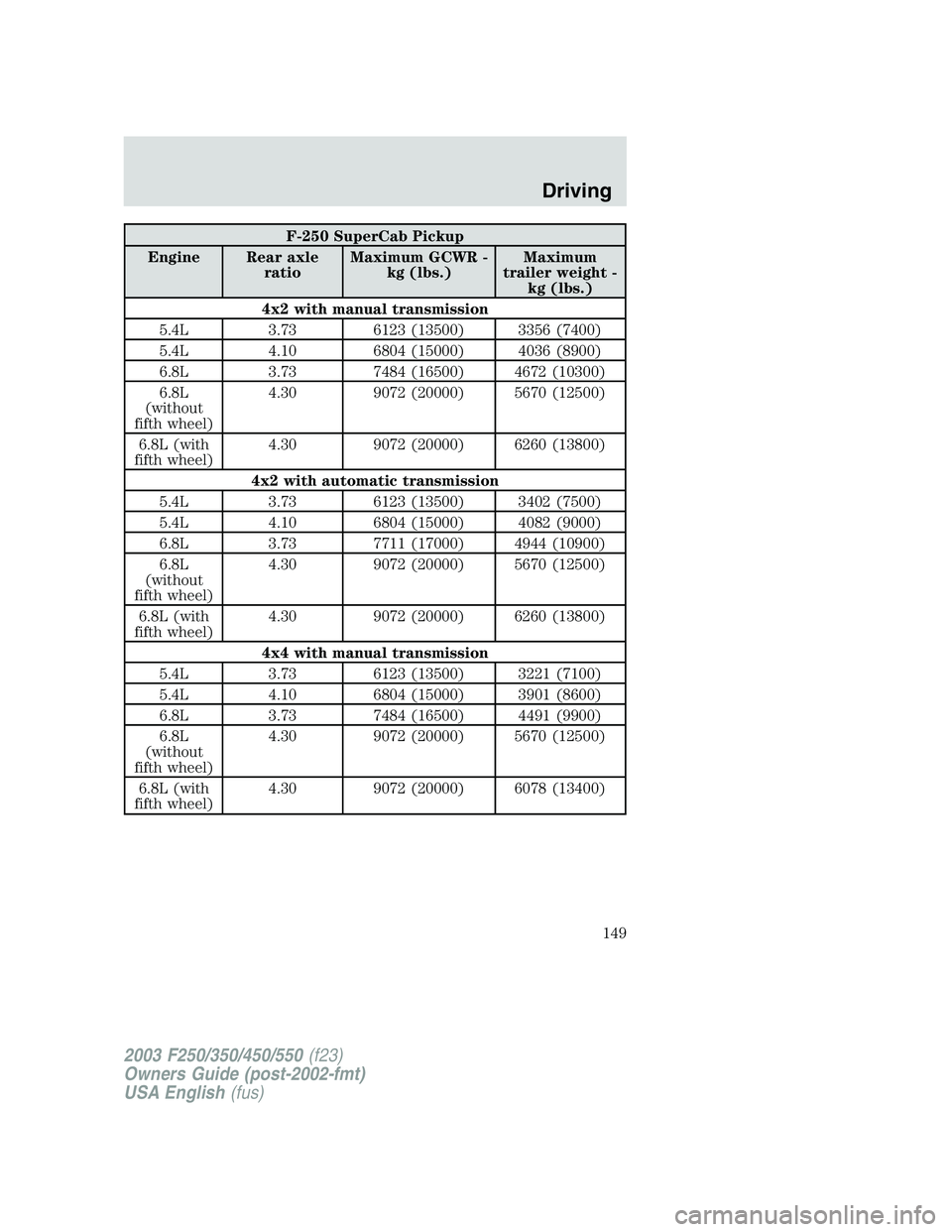
F-250 SuperCab Pickup
Engine Rear axle
ratioMaximum GCWR -
kg (lbs.)Maximum
trailer weight -
kg (lbs.)
4x2 with manual transmission
5.4L 3.73 6123 (13500) 3356 (7400)
5.4L 4.10 6804 (15000) 4036 (8900)
6.8L 3.73 7484 (16500) 4672 (10300)
6.8L
(without
fifth wheel)4.30 9072 (20000) 5670 (12500)
6.8L (with
fifth wheel)4.30 9072 (20000) 6260 (13800)
4x2 with automatic transmission
5.4L 3.73 6123 (13500) 3402 (7500)
5.4L 4.10 6804 (15000) 4082 (9000)
6.8L 3.73 7711 (17000) 4944 (10900)
6.8L
(without
fifth wheel)4.30 9072 (20000) 5670 (12500)
6.8L (with
fifth wheel)4.30 9072 (20000) 6260 (13800)
4x4 with manual transmission
5.4L 3.73 6123 (13500) 3221 (7100)
5.4L 4.10 6804 (15000) 3901 (8600)
6.8L 3.73 7484 (16500) 4491 (9900)
6.8L
(without
fifth wheel)4.30 9072 (20000) 5670 (12500)
6.8L (with
fifth wheel)4.30 9072 (20000) 6078 (13400)
2003 F250/350/450/550(f23)
Owners Guide (post-2002-fmt)
USA English(fus)
Driving
149
Page 150 of 280
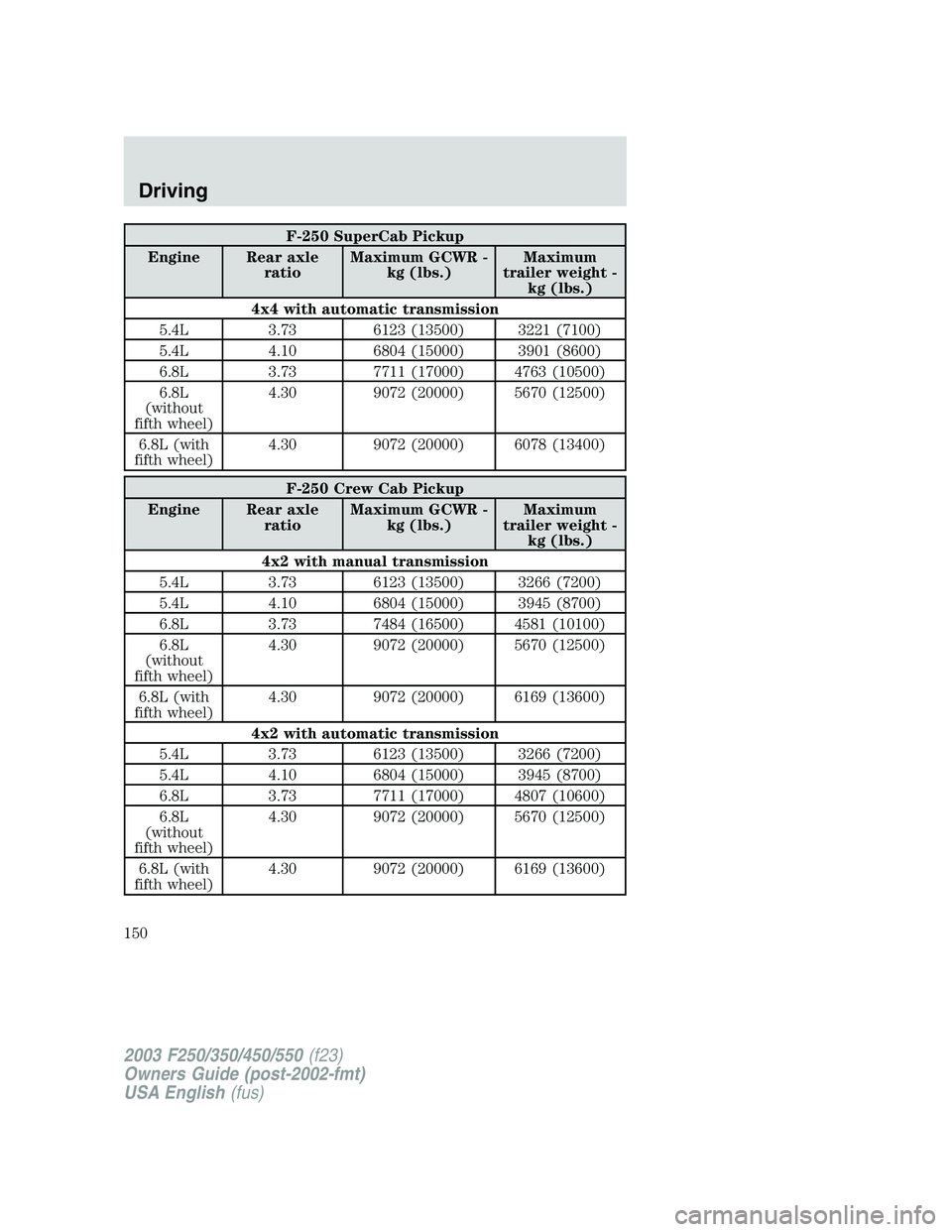
F-250 SuperCab Pickup
Engine Rear axle
ratioMaximum GCWR -
kg (lbs.)Maximum
trailer weight -
kg (lbs.)
4x4 with automatic transmission
5.4L 3.73 6123 (13500) 3221 (7100)
5.4L 4.10 6804 (15000) 3901 (8600)
6.8L 3.73 7711 (17000) 4763 (10500)
6.8L
(without
fifth wheel)4.30 9072 (20000) 5670 (12500)
6.8L (with
fifth wheel)4.30 9072 (20000) 6078 (13400)
F-250 Crew Cab Pickup
Engine Rear axle
ratioMaximum GCWR -
kg (lbs.)Maximum
trailer weight -
kg (lbs.)
4x2 with manual transmission
5.4L 3.73 6123 (13500) 3266 (7200)
5.4L 4.10 6804 (15000) 3945 (8700)
6.8L 3.73 7484 (16500) 4581 (10100)
6.8L
(without
fifth wheel)4.30 9072 (20000) 5670 (12500)
6.8L (with
fifth wheel)4.30 9072 (20000) 6169 (13600)
4x2 with automatic transmission
5.4L 3.73 6123 (13500) 3266 (7200)
5.4L 4.10 6804 (15000) 3945 (8700)
6.8L 3.73 7711 (17000) 4807 (10600)
6.8L
(without
fifth wheel)4.30 9072 (20000) 5670 (12500)
6.8L (with
fifth wheel)4.30 9072 (20000) 6169 (13600)
2003 F250/350/450/550(f23)
Owners Guide (post-2002-fmt)
USA English(fus)
Driving
150
Page 151 of 280
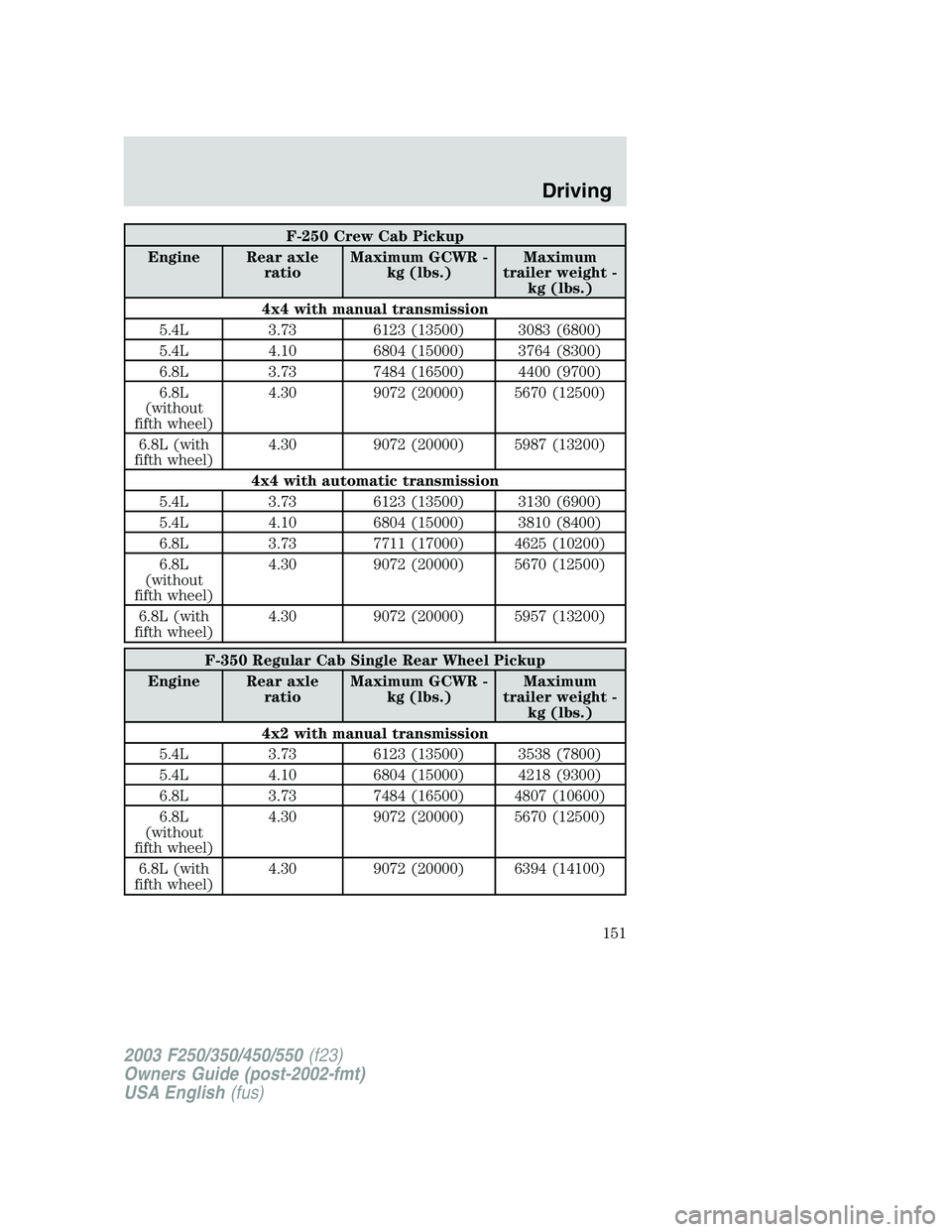
F-250 Crew Cab Pickup
Engine Rear axle
ratioMaximum GCWR -
kg (lbs.)Maximum
trailer weight -
kg (lbs.)
4x4 with manual transmission
5.4L 3.73 6123 (13500) 3083 (6800)
5.4L 4.10 6804 (15000) 3764 (8300)
6.8L 3.73 7484 (16500) 4400 (9700)
6.8L
(without
fifth wheel)4.30 9072 (20000) 5670 (12500)
6.8L (with
fifth wheel)4.30 9072 (20000) 5987 (13200)
4x4 with automatic transmission
5.4L 3.73 6123 (13500) 3130 (6900)
5.4L 4.10 6804 (15000) 3810 (8400)
6.8L 3.73 7711 (17000) 4625 (10200)
6.8L
(without
fifth wheel)4.30 9072 (20000) 5670 (12500)
6.8L (with
fifth wheel)4.30 9072 (20000) 5957 (13200)
F-350 Regular Cab Single Rear Wheel Pickup
Engine Rear axle
ratioMaximum GCWR -
kg (lbs.)Maximum
trailer weight -
kg (lbs.)
4x2 with manual transmission
5.4L 3.73 6123 (13500) 3538 (7800)
5.4L 4.10 6804 (15000) 4218 (9300)
6.8L 3.73 7484 (16500) 4807 (10600)
6.8L
(without
fifth wheel)4.30 9072 (20000) 5670 (12500)
6.8L (with
fifth wheel)4.30 9072 (20000) 6394 (14100)
2003 F250/350/450/550(f23)
Owners Guide (post-2002-fmt)
USA English(fus)
Driving
151