Page 4 of 18
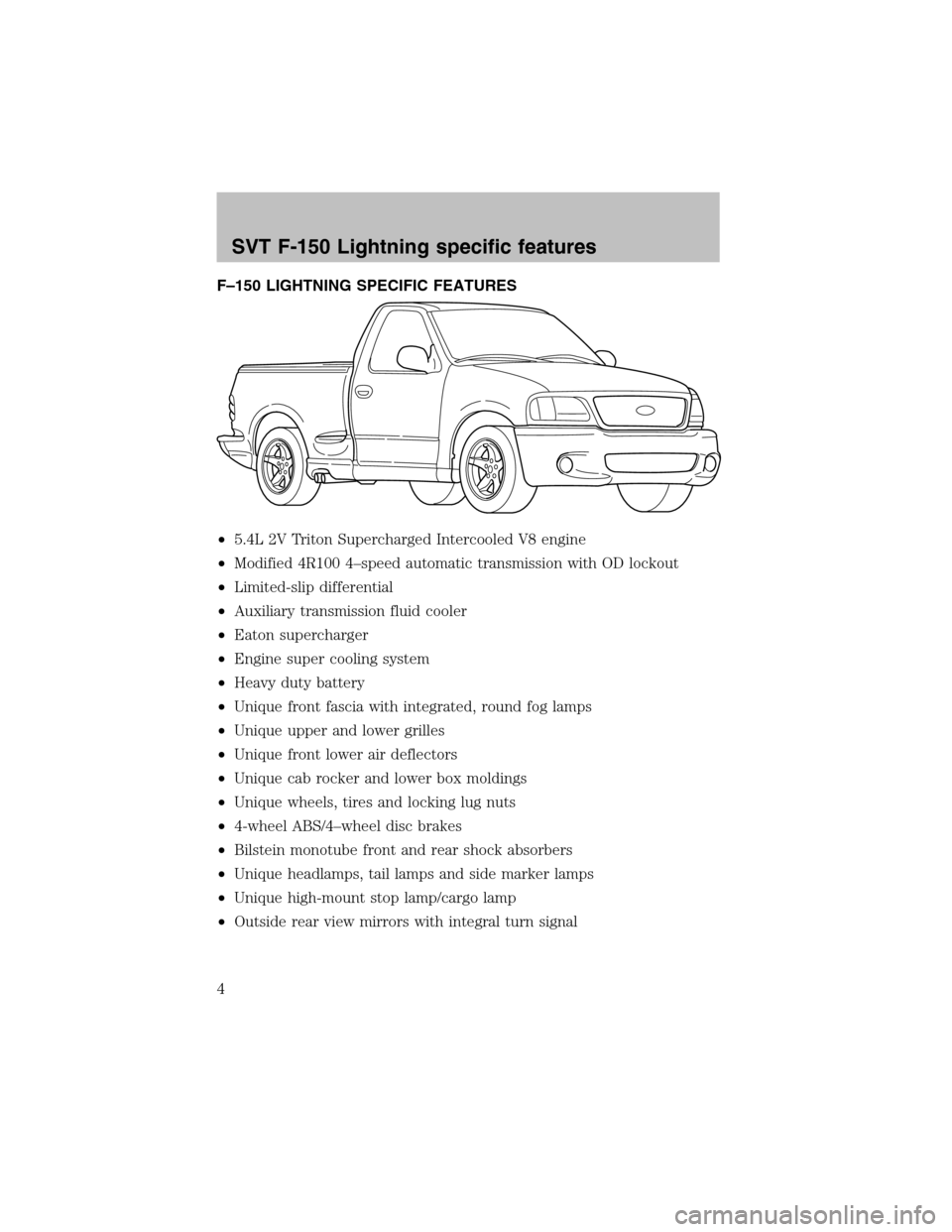
F–150 LIGHTNING SPECIFIC FEATURES
•5.4L 2V Triton Supercharged Intercooled V8 engine
•Modified 4R100 4–speed automatic transmission with OD lockout
•Limited-slip differential
•Auxiliary transmission fluid cooler
•Eaton supercharger
•Engine super cooling system
•Heavy duty battery
•Unique front fascia with integrated, round fog lamps
•Unique upper and lower grilles
•Unique front lower air deflectors
•Unique cab rocker and lower box moldings
•Unique wheels, tires and locking lug nuts
•4-wheel ABS/4–wheel disc brakes
•Bilstein monotube front and rear shock absorbers
•Unique headlamps, tail lamps and side marker lamps
•Unique high-mount stop lamp/cargo lamp
•Outside rear view mirrors with integral turn signal
SVT F-150 Lightning specific features
4
Page 7 of 18
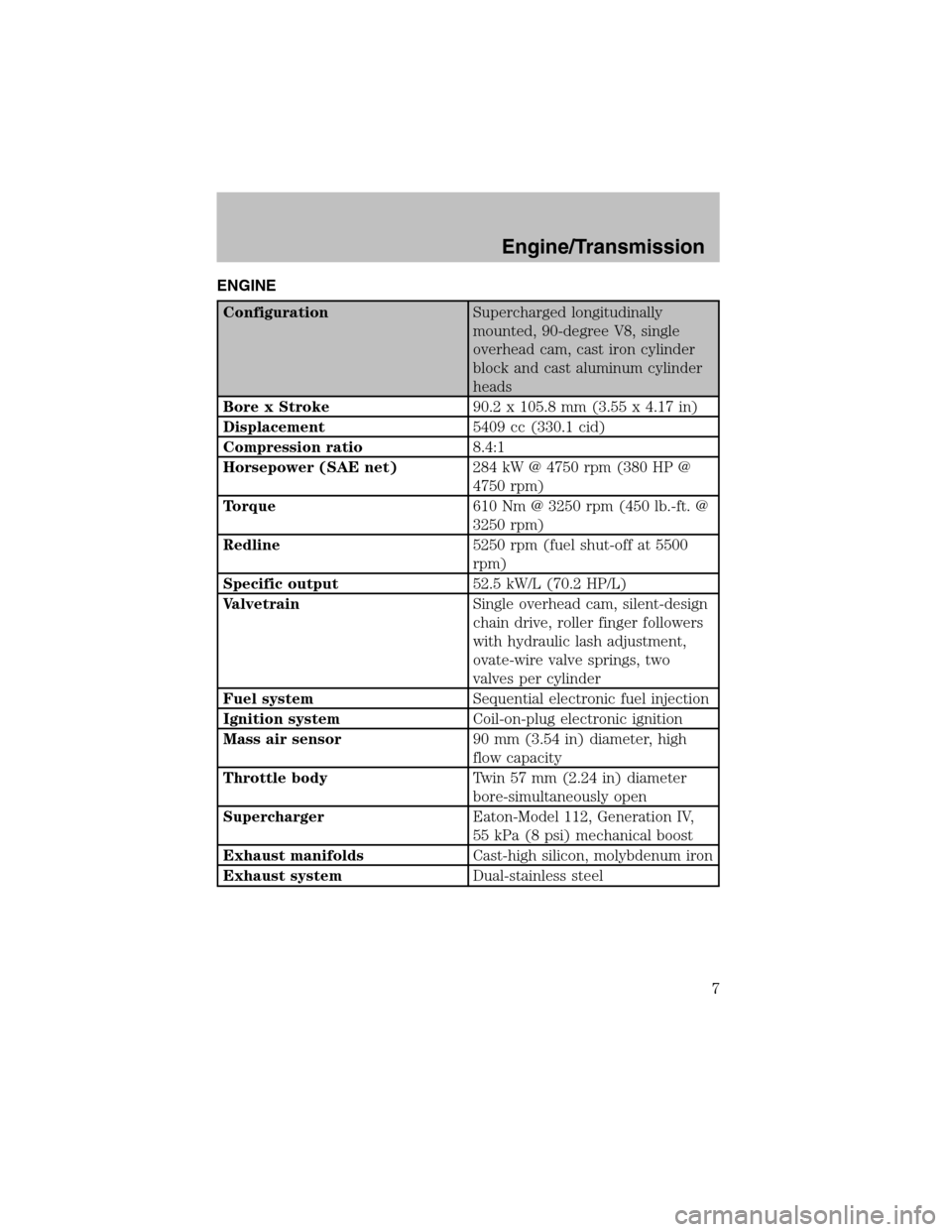
ENGINE
ConfigurationSupercharged longitudinally
mounted, 90-degree V8, single
overhead cam, cast iron cylinder
block and cast aluminum cylinder
heads
Bore x Stroke90.2 x 105.8 mm (3.55 x 4.17 in)
Displacement5409 cc (330.1 cid)
Compression ratio8.4:1
Horsepower (SAE net)284 kW @ 4750 rpm (380 HP @
4750 rpm)
Torque610 Nm @ 3250 rpm (450 lb.-ft. @
3250 rpm)
Redline5250 rpm (fuel shut-off at 5500
rpm)
Specific output52.5 kW/L (70.2 HP/L)
ValvetrainSingle overhead cam, silent-design
chain drive, roller finger followers
with hydraulic lash adjustment,
ovate-wire valve springs, two
valves per cylinder
Fuel systemSequential electronic fuel injection
Ignition systemCoil-on-plug electronic ignition
Mass air sensor90 mm (3.54 in) diameter, high
flow capacity
Throttle bodyTwin 57 mm (2.24 in) diameter
bore-simultaneously open
SuperchargerEaton-Model 112, Generation IV,
55 kPa (8 psi) mechanical boost
Exhaust manifoldsCast-high silicon, molybdenum iron
Exhaust systemDual-stainless steel
Engine/Transmission
7
Page 8 of 18
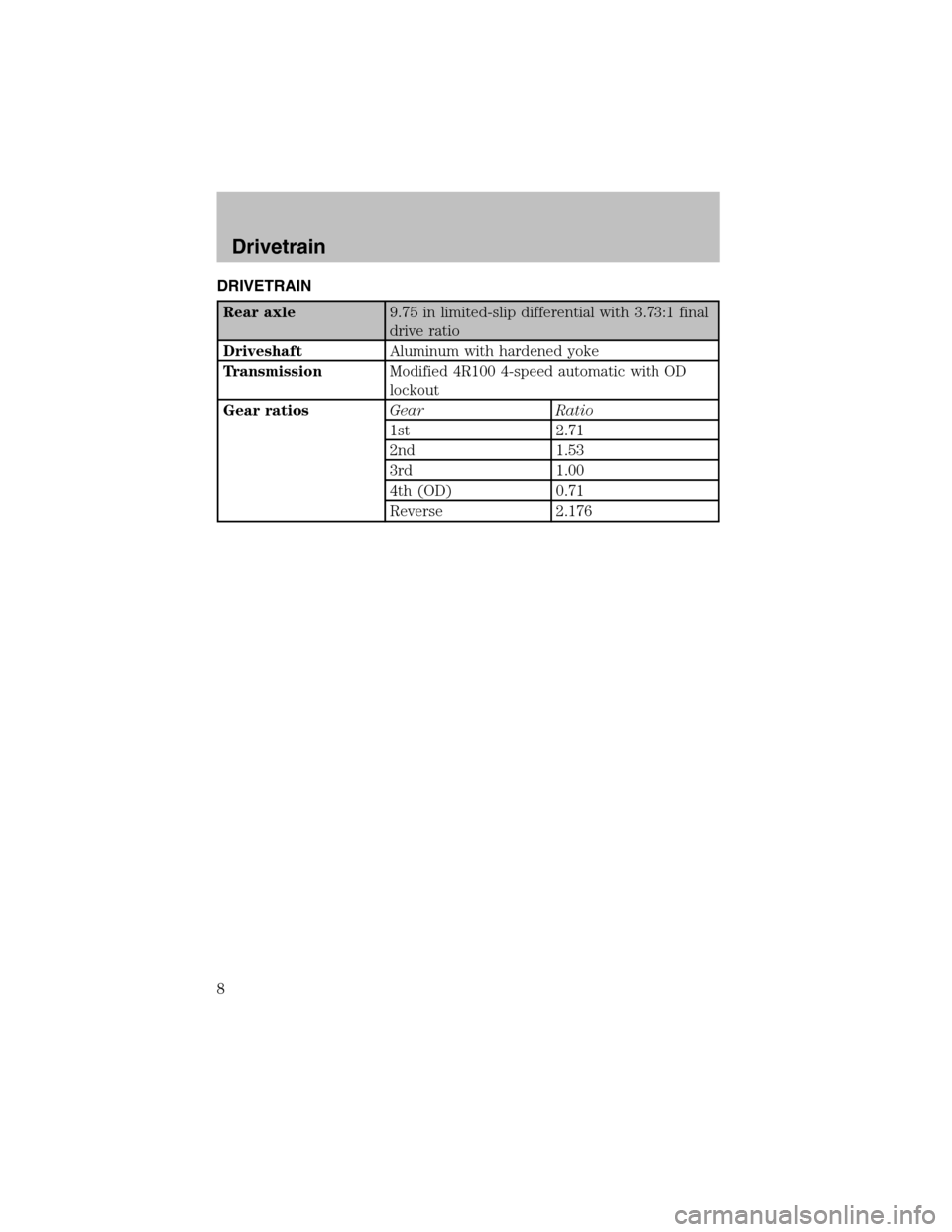
DRIVETRAIN
Rear axle9.75 in limited-slip differential with 3.73:1 final
drive ratio
DriveshaftAluminum with hardened yoke
TransmissionModified 4R100 4-speed automatic with OD
lockout
Gear ratiosGear Ratio
1st 2.71
2nd 1.53
3rd 1.00
4th (OD) 0.71
Reverse 2.176
Drivetrain
8
Page 13 of 18
ATTACHING SAFETY SEATS WITH LATCH (LOWER ANCHORS
AND TETHERS FOR CHILDREN) ATTACHMENTS FOR CHILD SEAT
ANCHORS (IF EQUIPPED)
Some child safety seats have two rigid or webbing mounted attachments
that connect to two anchors at certain seating positions in your vehicle.
This type of child seat eliminates the need to use seat belts to attach the
child seat. For forward-facing child seats, the tether strap must also be
attached to the proper tether anchor. SeeAttaching safety seats with
tether strapsin this chapter.
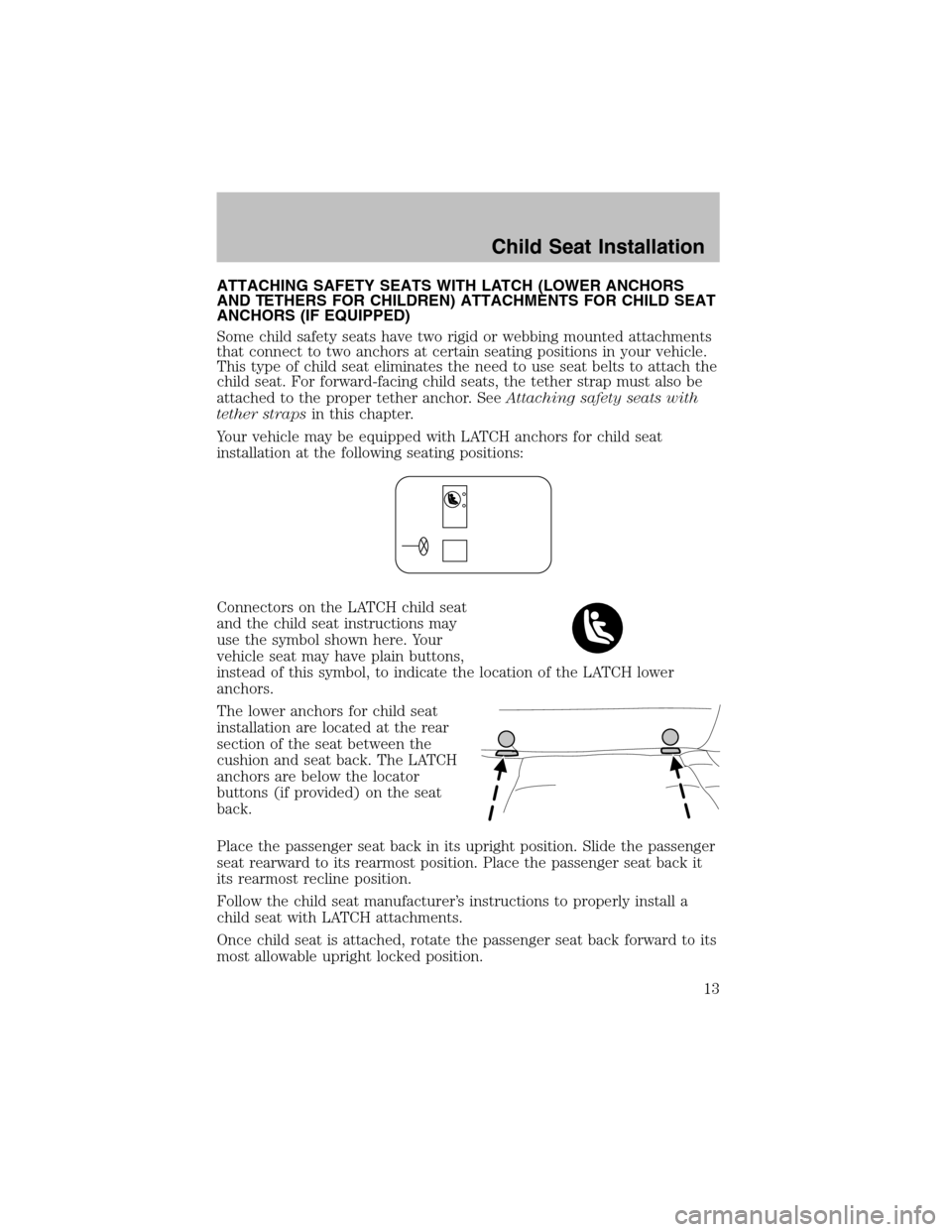
Your vehicle may be equipped with LATCH anchors for child seat
installation at the following seating positions:
Connectors on the LATCH child seat
and the child seat instructions may
use the symbol shown here. Your
vehicle seat may have plain buttons,
instead of this symbol, to indicate the location of the LATCH lower
anchors.
The lower anchors for child seat
installation are located at the rear
section of the seat between the
cushion and seat back. The LATCH
anchors are below the locator
buttons (if provided) on the seat
back.
Place the passenger seat back in its upright position. Slide the passenger
seat rearward to its rearmost position. Place the passenger seat back it
its rearmost recline position.
Follow the child seat manufacturer’s instructions to properly install a
child seat with LATCH attachments.
Once child seat is attached, rotate the passenger seat back forward to its
most allowable upright locked position.
Child Seat Installation
13