2003 FORD F150 heater
[x] Cancel search: heaterPage 38 of 280
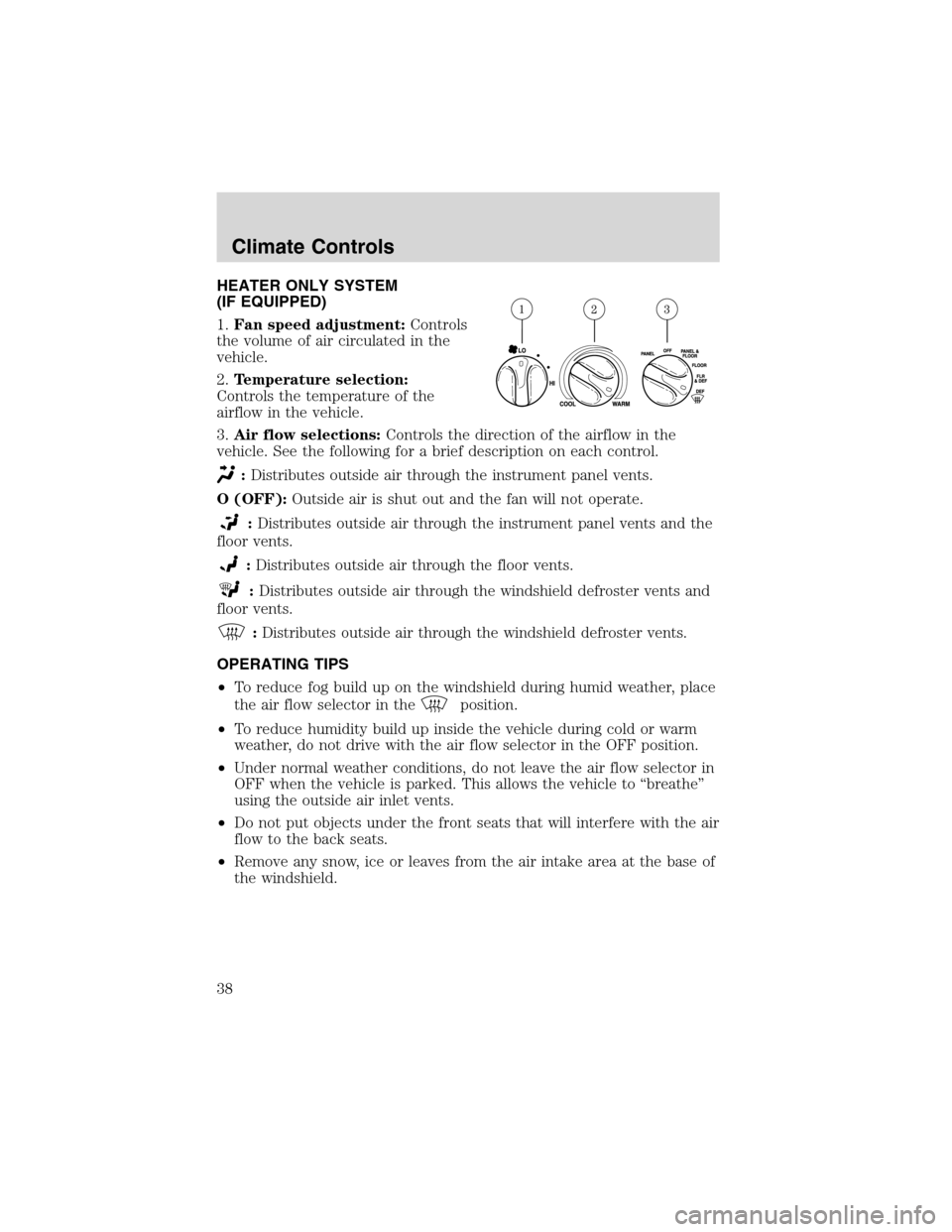
HEATER ONLY SYSTEM
(IF EQUIPPED)
1.Fan speed adjustment:Controls
the volume of air circulated in the
vehicle.
2.Temperature selection:
Controls the temperature of the
airflow in the vehicle.
3.Air flow selections:Controls the direction of the airflow in the
vehicle. See the following for a brief description on each control.
:Distributes outside air through the instrument panel vents.
O (OFF):Outside air is shut out and the fan will not operate.
:Distributes outside air through the instrument panel vents and the
floor vents.
:Distributes outside air through the floor vents.
:Distributes outside air through the windshield defroster vents and
floor vents.
:Distributes outside air through the windshield defroster vents.
OPERATING TIPS
•To reduce fog build up on the windshield during humid weather, place
the air flow selector in the
position.
•To reduce humidity build up inside the vehicle during cold or warm
weather, do not drive with the air flow selector in the OFF position.
•Under normal weather conditions, do not leave the air flow selector in
OFF when the vehicle is parked. This allows the vehicle to“breathe”
using the outside air inlet vents.
•Do not put objects under the front seats that will interfere with the air
flow to the back seats.
•Remove any snow, ice or leaves from the air intake area at the base of
the windshield.
Climate Controls
38
Page 139 of 280
Make sure the corresponding lights illuminate or illuminate briefly. If a
light fails to illuminate, have the vehicle serviced.
•If the driver’s safety belt is fastened, the
light may not illuminate.
Starting the engine
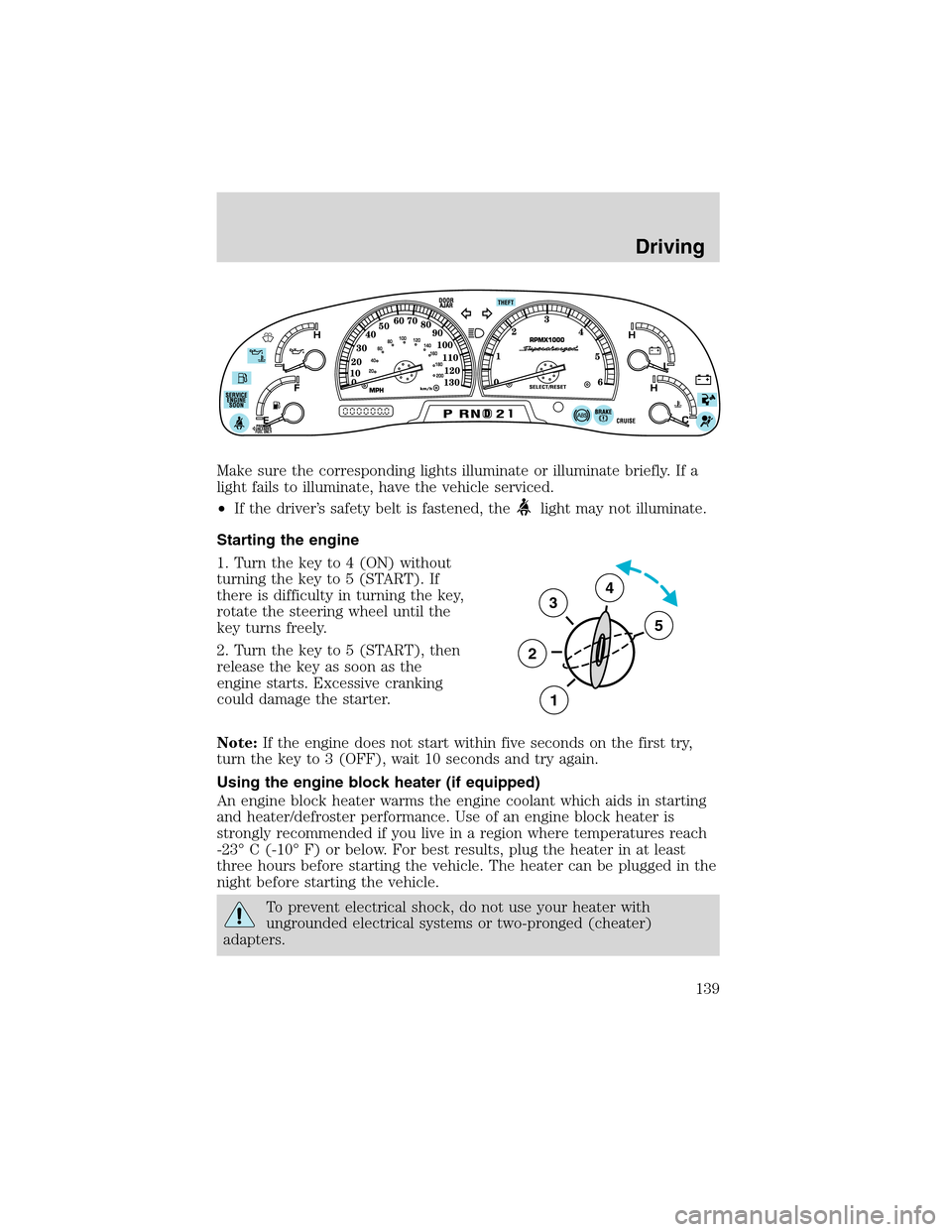
1. Turn the key to 4 (ON) without
turning the key to 5 (START). If
there is difficulty in turning the key,
rotate the steering wheel until the
key turns freely.
2. Turn the key to 5 (START), then
release the key as soon as the
engine starts. Excessive cranking
could damage the starter.
Note:If the engine does not start within five seconds on the first try,
turn the key to 3 (OFF), wait 10 seconds and try again.
Using the engine block heater (if equipped)
An engine block heater warms the engine coolant which aids in starting
and heater/defroster performance. Use of an engine block heater is
strongly recommended if you live in a region where temperatures reach
-23°C (-10°F) or below. For best results, plug the heater in at least
three hours before starting the vehicle. The heater can be plugged in the
night before starting the vehicle.
To prevent electrical shock, do not use your heater with
ungrounded electrical systems or two-pronged (cheater)
adapters.
3
2
1
5
4
Driving
139
Page 192 of 280
Preparing your vehicle
When the battery is disconnected or a new battery is installed, the
transmission must relearn its shift strategy. As a result, the transmission
may have firm and/or soft shifts. This operation is considered normal and
will not affect function or durability of the transmission. Over time, the
adaptive learning process will fully update transmission operation.
1.Use only a 12–volt supply to start your vehicle.
2. Do not disconnect the battery of the disabled vehicle as this could
damage the vehicle’s electrical system.
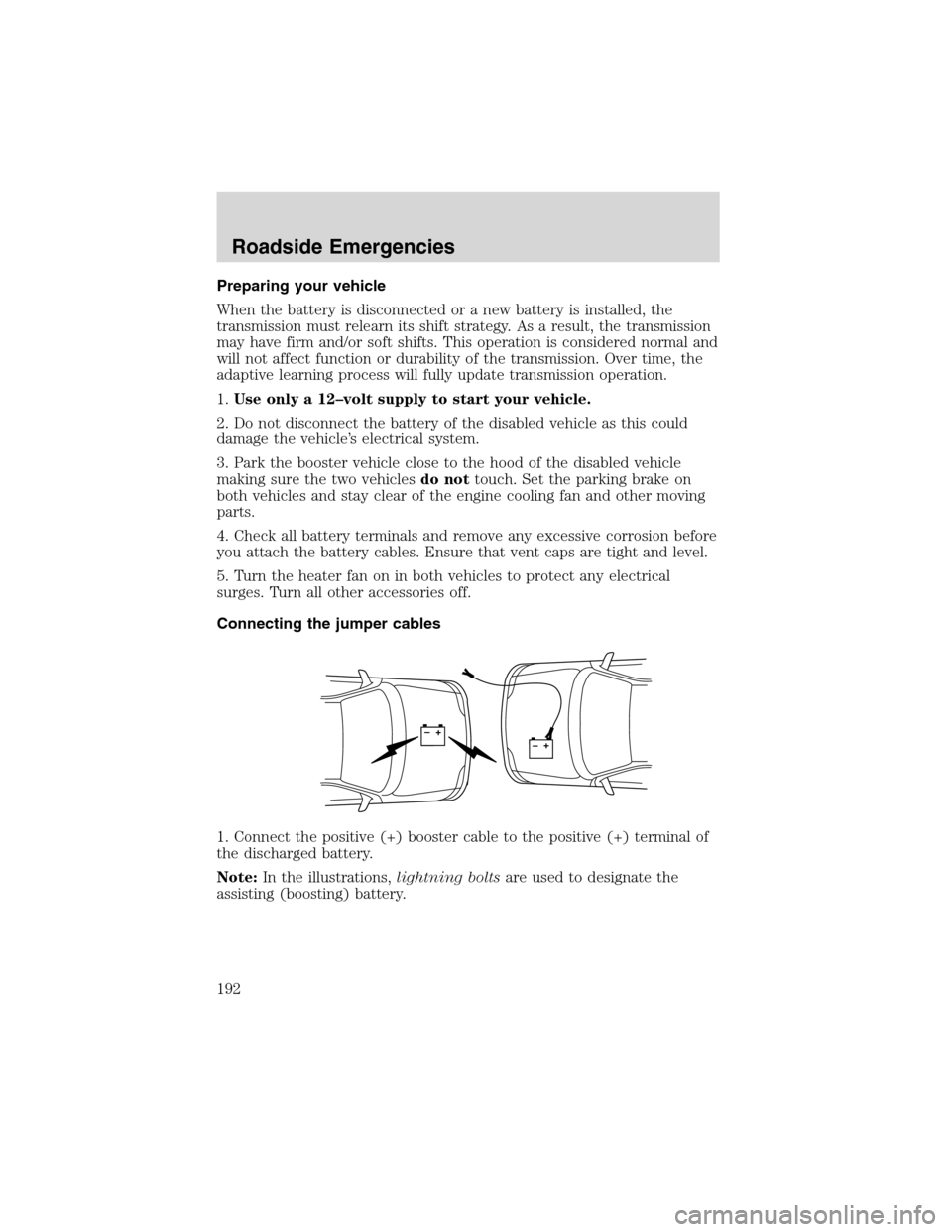
3. Park the booster vehicle close to the hood of the disabled vehicle
making sure the two vehiclesdo nottouch. Set the parking brake on
both vehicles and stay clear of the engine cooling fan and other moving
parts.
4. Check all battery terminals and remove any excessive corrosion before
you attach the battery cables. Ensure that vent caps are tight and level.
5. Turn the heater fan on in both vehicles to protect any electrical
surges. Turn all other accessories off.
Connecting the jumper cables
1. Connect the positive (+) booster cable to the positive (+) terminal of
the discharged battery.
Note:In the illustrations,lightning boltsare used to designate the
assisting (boosting) battery.
+–+–
Roadside Emergencies
192
Page 270 of 280
Dash trim (wood grain)
Engine block heaters
Manual sliding rear window
Power sliding rear window
Remote start system
Tire step
Travel equipment
Cargo cage (SuperCrew only)
Bed mount bike carrier
Bed tent
Fog lights
Hitch mount bike carrier
Inside mirror with compass display
Inside mirror with compass and temperature display
Off road lights
Outside signal mirror (available only with power mirrors)
Pickup box rails
Retractable bed hooks
Running boards (molded, diamond plate, tubular and stirrup step)
Seatback organizer
Speed control
Towing mirrors
Trailer hitch (Class III)
Trailer hitch bars and balls
Trailer hitch wiring adaptor
Trailer swivel hitch
Protection and appearance equipment
Bed mat/bedliner tailgate covers
Bed mats
Bedliners
Bull bar (chrome & black)
Accessories
270
Page 274 of 280
Cleaning your vehicle
engine compartment ..............209
exterior ....................................214
instrument panel ....................212
interior .....................................212
interior trim ............................212
plastic parts ............................211
washing ....................................208
waxing .....................................208
wheels ......................................209
wiper blades ............................211
Climate control (see Air
conditioning or Heating) ............41
Clutch
fluid ..........................................244
operation while driving ..........146
recommended shift speeds ....147
Compass, electronic ..............57, 61
calibration .................................58
set zone adjustment .................58
Console ........................................59
overhead ..............................55–56
Coolant
checking and adding ..............227
refill capacities ................231, 256
specifications ..................259, 262
Cruise control (see
Speed control) ............................63
Customer Assistance ................174
Ford accessories for
your vehicle ............................215
Ford Extended Service
Plan ..........................................200
Getting assistance outside
the U.S. and Canada ..............204
Getting roadside assistance ...174
Getting the service
you need .................................198
Ordering additional
owner’s literature ...................205The Dispute Settlement
Board .......................................201
Utilizing the Mediation/
Arbitration Program ...............204
D
Daytime running lamps
(see Lamps) ................................45
Dipstick
automatic transmission
fluid ..........................................245
engine oil .................................221
Doors
lubricant specifications ..........259
Driveline universal joint
and slip yoke .............................249
Driving under special
conditions ..................146, 154, 157
sand .........................................156
snow and ice ...........................158
through water .................156, 161
E
Emergencies, roadside
jump-starting ..........................191
Emission control system ..........241
Engine ........................................262
cleaning ...................................209
coolant .....................................227
fail-safe coolant ......................232
idle speed control ...................225
lubrication
specifications ..................259, 262
refill capacities ........................256
service points ..................218–220
starting after a collision .........175
Engine block heater .................139
Engine oil ..................................221
Index
274