2003 FORD EXPLORER SPORT wheel
[x] Cancel search: wheelPage 111 of 200
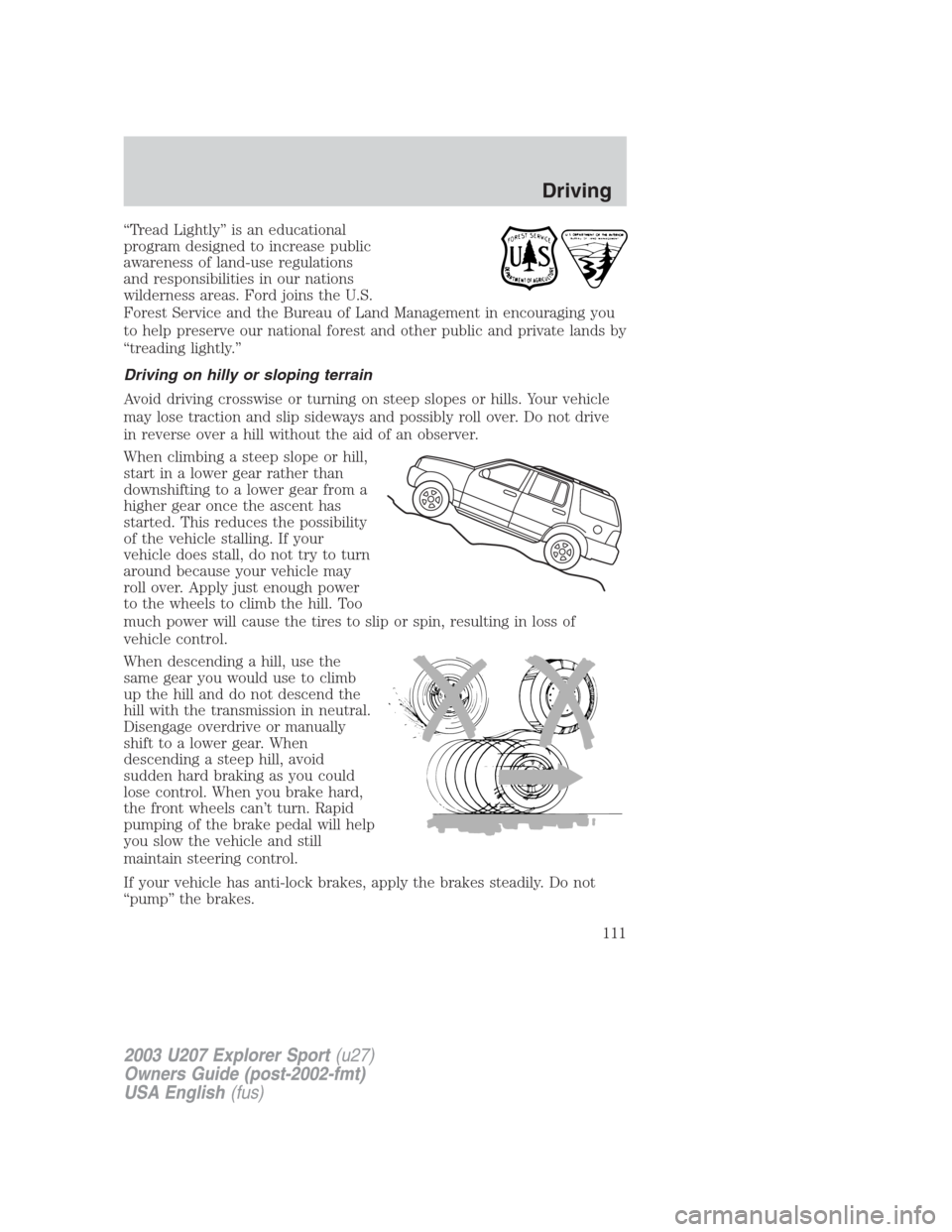
“Tread Lightly” is an educational
program designed to increase public
awareness of land-use regulations
and responsibilities in our nations
wilderness areas. Ford joins the U.S.
Forest Service and the Bureau of Land Management in encouraging you
to help preserve our national forest and other public and private lands by
“treading lightly.”
Driving on hilly or sloping terrain
Avoid driving crosswise or turning on steep slopes or hills. Your vehicle
may lose traction and slip sideways and possibly roll over. Do not drive
in reverse over a hill without the aid of an observer.
When climbing a steep slope or hill,
start in a lower gear rather than
downshifting to a lower gear from a
higher gear once the ascent has
started. This reduces the possibility
of the vehicle stalling. If your
vehicle does stall, do not try to turn
around because your vehicle may
roll over. Apply just enough power
to the wheels to climb the hill. Too
much power will cause the tires to slip or spin, resulting in loss of
vehicle control.
When descending a hill, use the
same gear you would use to climb
up the hill and do not descend the
hill with the transmission in neutral.
Disengage overdrive or manually
shift to a lower gear. When
descending a steep hill, avoid
sudden hard braking as you could
lose control. When you brake hard,
the front wheels can’t turn. Rapid
pumping of the brake pedal will help
you slow the vehicle and still
maintain steering control.
If your vehicle has anti-lock brakes, apply the brakes steadily. Do not
“pump” the brakes.
2003 U207 Explorer Sport(u27)
Owners Guide (post-2002-fmt)
USA English(fus)
Driving
111
Page 112 of 200
Driving on snow and ice
4WD vehicles can skid like any other vehicle. If you start to skid while
driving on a snowy or icy road, turn the steering wheel in the direction
of the slide until you regain control. Although a 4WD vehicle may
accelerate better than a two-wheel drive vehicle in snow and ice, it won’t
stop any faster.
Don’t press hard on the accelerator or brake pedal or make quick
steering changes while on snow or ice. Apply the accelerator slowly and
steadily when starting from a full stop. If your vehicle is equipped with
ABS, apply the brake steadily. Do not “pump” the brakes. Refer to the
Brakessection of this chapter for additional information on the
operation of the anti-lock brake system. If your vehicle is not equipped
with ABS, use a “squeeze” braking technique. Push on the brake pedal
with a steadily increasing force which allows the wheels to brake yet
continue to roll so that you may steer in the direction you want to travel.
If you lock the wheels, release the brake pedal and repeat the squeeze
technique.
Never drive with chains on the front tires of 4WD vehicles without also
putting them on the rear tires. This could cause the rear to slide and
swing around during braking.
Maintenance and Modifications
Ford strongly recommends that you do not add or remove steering or
suspension parts (such as lift kits or stabilizer bars) or by using
replacement parts not equivalent to the original factory equipment. Do
not use aftermarket “lift kits” or other suspension modifications. These
could adversely affect the vehicle’s handling characteristics, which could
lead to loss of vehicle control or roll over and serious injury. Frequent
inspection of vehicle chassis components is recommended if the vehicle
is subjected to heavy off-road usage.
DRIVING THROUGH WATER
If driving through deep or standing water is unavoidable, proceed very
slowly especially if the depth is not known. Never drive through water
that is higher than the bottom of the hubs (for trucks) or the bottom of
the wheel rims (for cars). Traction or brake capability may be limited
and your vehicle may stall. Water may also enter your engine’s air intake
and severely damage your engine.
Once through the water, always dry the brakes by moving your vehicle
slowly while applying light pressure on the brake pedal. Wet brakes do
not stop the vehicle as quickly as dry brakes.Driving through deep
2003 U207 Explorer Sport(u27)
Owners Guide (post-2002-fmt)
USA English(fus)
Driving
112
Page 118 of 200
Never connect any trailer lighting to the vehicle’s taillamp circuits,
because it may damage the electrical system resulting in fire.
Contact your local Ford dealership for assistance in proper trailer tow
wiring installation. Additional electrical equipment may be required.
Using a step bumper
The rear bumper is equipped with an integral hitch and requires only a
ball with a 19 mm (3/4 inch) shank diameter. The bumper has a 1,590 kg
(3,500 lb.) trailer weight and 159 kg (350 lb.) tongue weight capability.
Use a frame-mounted weight distributing hitch for trailers over 1,590 kg
(3,500 lb).
Driving while you tow
When towing a trailer:
•Turn off your speed control. The speed control may shut off
automatically when you are towing on long, steep grades.
•Consult your local motor vehicle speed regulations for towing a trailer.
•Use a lower gear when towing up or down steep hills.
•Anticipate stops and brake gradually.
Servicing after towing
If you tow a trailer for long distances, your vehicle will require more
frequent service intervals. Refer to your scheduled maintenance guide for
more information.
Trailer towing tips
•Practice turning, stopping and backing up before starting on a trip to
get the feel of the vehicle/trailer combination. When turning, make
wider turns so the trailer wheels will clear curbs and other obstacles.
•Allow more distance for stopping with a trailer attached.
•The trailer tongue weight should be no more than 10–15% of the
loaded trailer weight.
•After you have traveled 80 km (50 miles), thoroughly check your
hitch, electrical connections and trailer wheel lug nuts.
•When stopped in traffic for long periods of time in hot weather, place
the gearshift in P (Park) (automatic transmissions) or N (Neutral)
(manual transmissions). This aids engine cooling and air conditioner
efficiency.
2003 U207 Explorer Sport(u27)
Owners Guide (post-2002-fmt)
USA English(fus)
Driving
118
Page 119 of 200
•Vehicles with trailers should not be parked on a grade. If you must
park on a grade, place wheel chocks under the trailer’s wheels.
Launching or retrieving a boat
When backing down a ramp during boat launching or retrieval:
•do not allow the static water level to rise above the bottom edge of
the rear bumper.
•do not allow waves to break higher than 15 cm (6 inches) above the
bottom edge of the rear bumper.
Exceeding these limits may allow water to enter critical vehicle
components, adversely affecting driveability, emissions, reliability and
causing internal transmission damage. Replace the rear axle lubricant
any time the axle has been submerged in water.
Disconnect the wiring to the trailer before backing the trailer into the
water. Reconnect the wiring to the trailer after the trailer is removed
from the water.
RECREATIONAL TOWING (ALL WHEELS ON THE GROUND)
Follow these guidelines for your specific powertrain combination to tow
your vehicle with all four wheels on the ground (such as behind a
recreational vehicle).
These guidelines are designed to ensure that your transmission is not
damaged due to insufficient lubrication.
All vehicles equipped with a manual transmission:
Before you have your vehicle towed:
•Release the parking brake.
•Move the gearshift to the neutral position.
•Turn the key in the ignition to the OFF/UNLOCKED position.
•The maximum recommended speed is 88 km/h (55 mph).
•The maximum recommended distance is unlimited.
4x2 vehicles with an automatic transmission and 4x4 vehicles
with an automatic transmission but without the Neutral tow kit
accessory:
•Release parking brake.
•Place the transmission in N (Neutral).
•Maximum speed is 56 km/h (35 mph).
2003 U207 Explorer Sport(u27)
Owners Guide (post-2002-fmt)
USA English(fus)
Driving
119
Page 120 of 200
•Maximum distance is 80 km (50 miles).
If a distance of 80 km (50 miles) or a speed of 56 km/h (35 mph) must
be exceeded, you must disconnect the front (on 4x4 vehicles) and rear
driveshafts. Ford recommends the driveshaft(s) be removed/installed
only by a qualified technician. See your local dealer for driveshaft
removal/installation.
Improper removal/installation of the driveshaft can cause
transmission fluid loss, damage to the driveshaft and internal
transmission components.
4x4 vehicles with automatic transmission and the Neutral tow kit
accessory:
•Release the parking brake.
•Place transmission in N (Neutral).
•Engage the neutral tow.
On vehicles equipped with 4WD, an accessory is available that allows you
to tow your vehicle, with unlimited mileage (maximum speed of 88 km/h
[55 mph]) behind another vehicle, with all the wheels on the ground.
Contact your dealer for more details. Do not tow your vehicle with all
wheels on the ground more than 80 km (50 miles) (with a maximum
speed of 56 km/h [35 mph]) unless you install the neutral tow kit as
vehicle damage may occur.
2003 U207 Explorer Sport(u27)
Owners Guide (post-2002-fmt)
USA English(fus)
Driving
120
Page 122 of 200
Canadian customers who need to obtain reimbursement information, call
1–800–665–2006.
Roadside coverage beyond basic warranty
In the United States, you may purchase additional roadside assistance
coverage beyond this period through the Ford Auto Club by contacting
your Ford or Lincoln Mercury dealer.
Similarly in Canada, for uninterrupted Roadside Assistance coverage, you
may purchase extended coverage prior to your Basic Warranty’s Roadside
Assistance expiring. For more information and enrollment, contact
1–877–294–2582 or visit our website at www.ford.ca.
HAZARD FLASHER
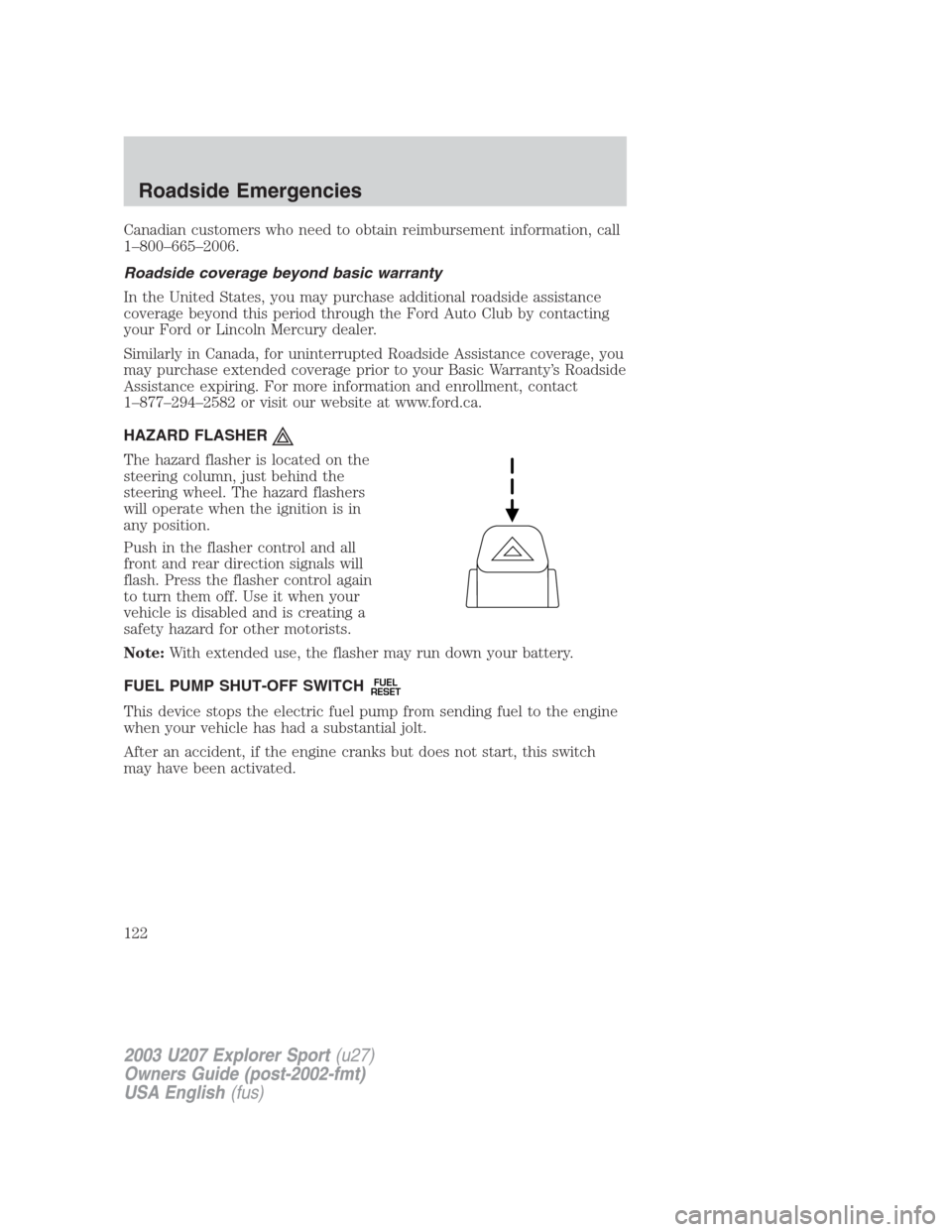
The hazard flasher is located on the
steering column, just behind the
steering wheel. The hazard flashers
will operate when the ignition is in
any position.
Push in the flasher control and all
front and rear direction signals will
flash. Press the flasher control again
to turn them off. Use it when your
vehicle is disabled and is creating a
safety hazard for other motorists.
Note:With extended use, the flasher may run down your battery.
FUEL PUMP SHUT-OFF SWITCH
FUEL
RESET
This device stops the electric fuel pump from sending fuel to the engine
when your vehicle has had a substantial jolt.
After an accident, if the engine cranks but does not start, this switch
may have been activated.
2003 U207 Explorer Sport(u27)
Owners Guide (post-2002-fmt)
USA English(fus)
Roadside Emergencies
122
Page 130 of 200
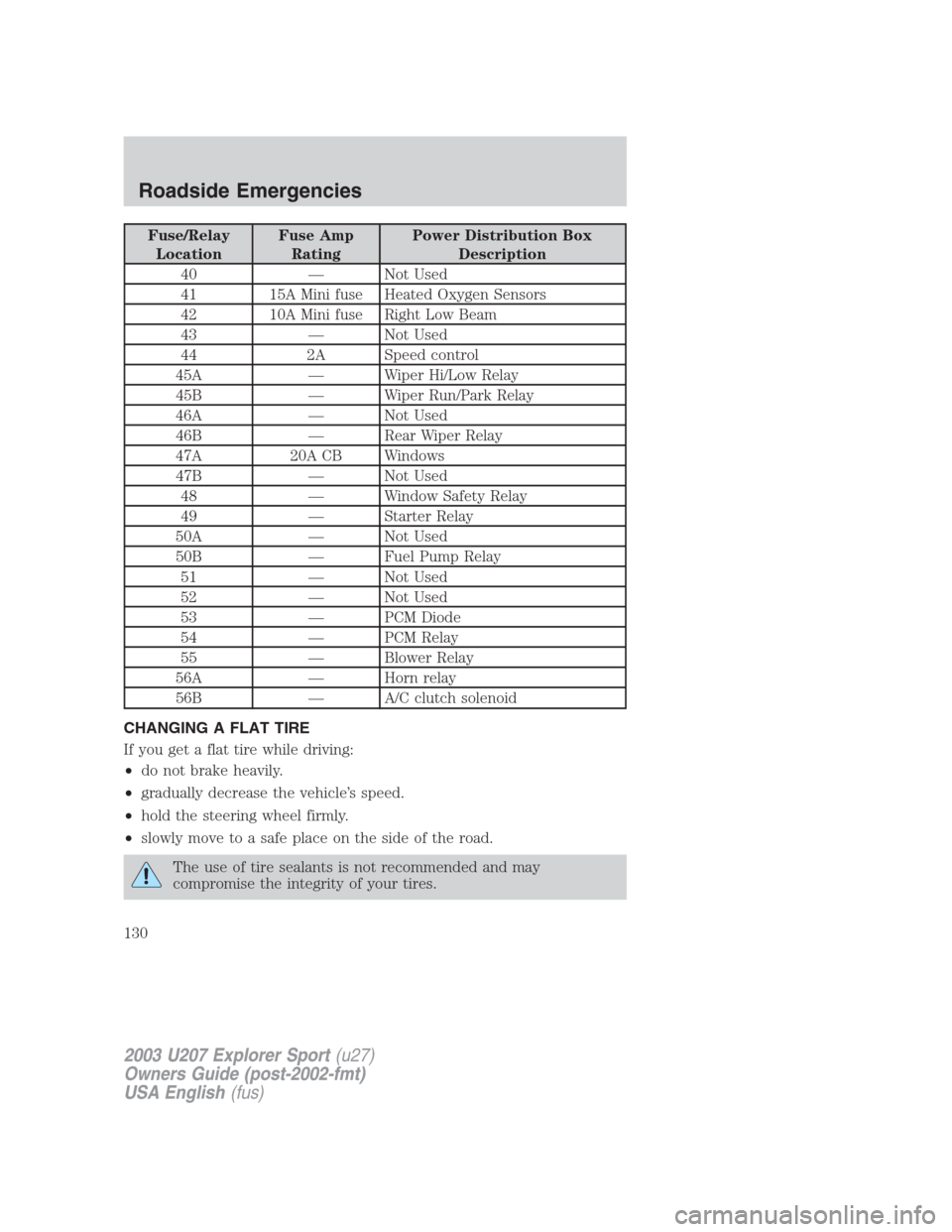
Fuse/Relay
LocationFuse Amp
RatingPower Distribution Box
Description
40 — Not Used
41 15A Mini fuse Heated Oxygen Sensors
42 10A Mini fuse Right Low Beam
43 — Not Used
44 2A Speed control
45A — Wiper Hi/Low Relay
45B — Wiper Run/Park Relay
46A — Not Used
46B — Rear Wiper Relay
47A 20A CB Windows
47B — Not Used
48 — Window Safety Relay
49 — Starter Relay
50A — Not Used
50B — Fuel Pump Relay
51 — Not Used
52 — Not Used
53 — PCM Diode
54 — PCM Relay
55 — Blower Relay
56A — Horn relay
56B — A/C clutch solenoid
CHANGING A FLAT TIRE
If you get a flat tire while driving:
•do not brake heavily.
•gradually decrease the vehicle’s speed.
•hold the steering wheel firmly.
•slowly move to a safe place on the side of the road.
The use of tire sealants is not recommended and may
compromise the integrity of your tires.
2003 U207 Explorer Sport(u27)
Owners Guide (post-2002-fmt)
USA English(fus)
Roadside Emergencies
130
Page 132 of 200
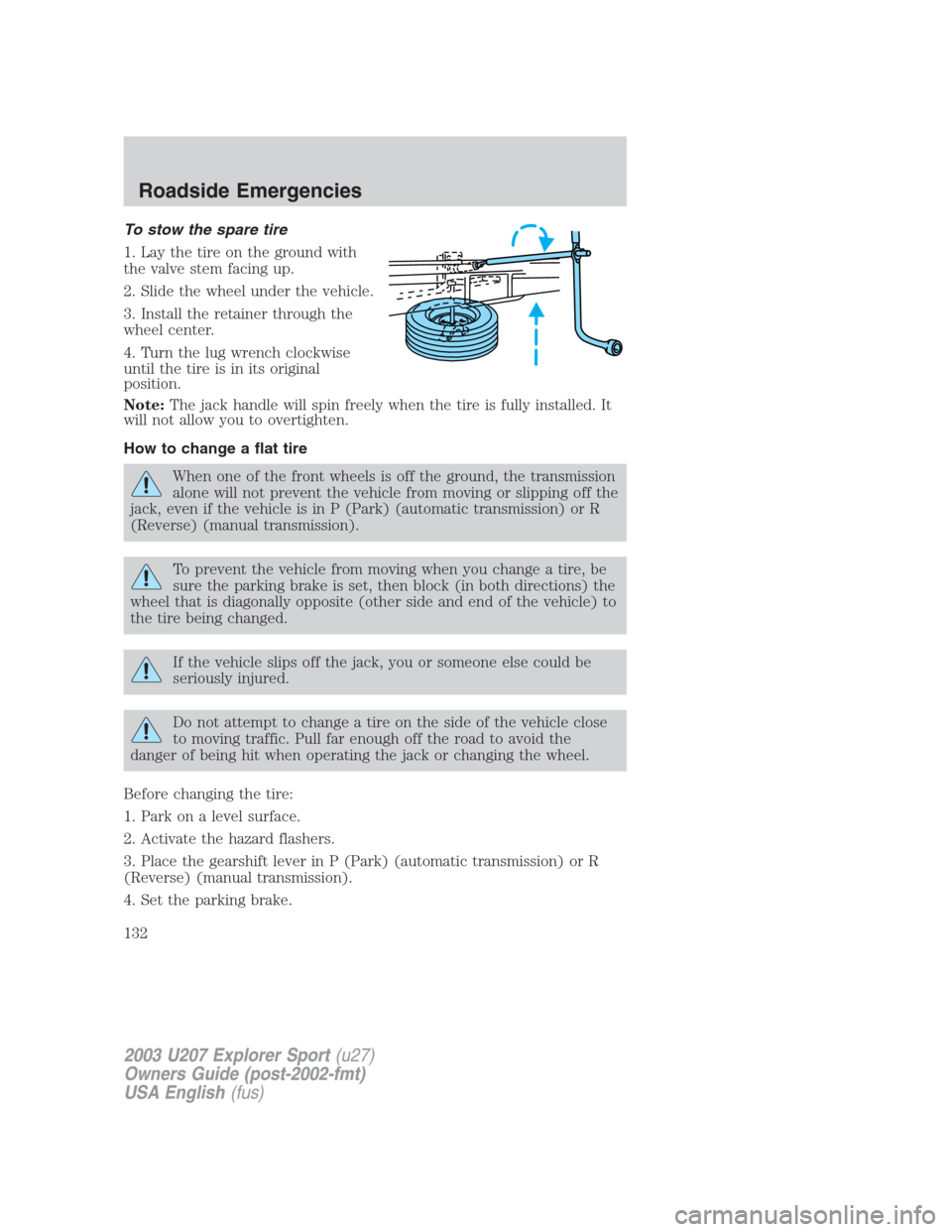
To stow the spare tire
1. Lay the tire on the ground with
the valve stem facing up.
2. Slide the wheel under the vehicle.
3. Install the retainer through the
wheel center.
4. Turn the lug wrench clockwise
until the tire is in its original
position.
Note:The jack handle will spin freely when the tire is fully installed. It
will not allow you to overtighten.
How to change a flat tire
When one of the front wheels is off the ground, the transmission
alone will not prevent the vehicle from moving or slipping off the
jack, even if the vehicle is in P (Park) (automatic transmission) or R
(Reverse) (manual transmission).
To prevent the vehicle from moving when you change a tire, be
sure the parking brake is set, then block (in both directions) the
wheel that is diagonally opposite (other side and end of the vehicle) to
the tire being changed.
If the vehicle slips off the jack, you or someone else could be
seriously injured.
Do not attempt to change a tire on the side of the vehicle close
to moving traffic. Pull far enough off the road to avoid the
danger of being hit when operating the jack or changing the wheel.
Before changing the tire:
1. Park on a level surface.
2. Activate the hazard flashers.
3. Place the gearshift lever in P (Park) (automatic transmission) or R
(Reverse) (manual transmission).
4. Set the parking brake.
2003 U207 Explorer Sport(u27)
Owners Guide (post-2002-fmt)
USA English(fus)
Roadside Emergencies
132