2003 FORD EXPLORER SPORT tires
[x] Cancel search: tiresPage 114 of 200
The Safety Certification Label, located on the driver’s door pillar, lists
vehicle weight rating limitations. Before adding any additional equipment,
refer to these limitations.
Always ensure that the weight of occupants, cargo and equipment is
within the weight limitations, including both gross vehicle weight and
front and rear gross axle weight rating limits.
Note:Do not exceed the GVWR or the GAWR specified on the
certification label.
Exceeding any vehicle weight rating limitation could result in
serious damage to the vehicle, loss of vehicle control, vehicle
rollover, and/or personal injury.
Do not use replacement tires with lower load carrying capacities than the
originals because they may lower the vehicle’s GVWR and GAWR
limitations. Replacement tires with a higher limit than the originals do
not increase the GVWR and GAWR limitations.
Special loading instructions for owners of pickup trucks and
utility-type vehicles
For important information regarding safe operation of this type
of vehicle, see thePreparing to drive your vehiclesection in
this chapter.
Loaded vehicles may handle differently than unloaded vehicles.
Extra precautions, such as slower speeds and increased stopping
distance, should be taken when driving a heavily loaded vehicle.
Your vehicle can haul more cargo and people than most passenger cars.
Depending upon the type and placement of the load, hauling cargo and
people may raise the center of gravity of the vehicle.
Calculating the load your vehicle can carry/tow
1. Use the appropriate maximum GCWR chart (in theTrailer Towing
section in this chapter) for your type of engine and rear axle ratio.
2. Weigh your vehicle without cargo. To obtain correct weights, take your
vehicle to a shipping company or an inspection station for trucks.
3. Subtract your loaded weight from the maximum GCWR in the chart.
This is the maximum trailer weight your vehicle can tow. It must be
below the maximum trailer weight shown in the chart.
2003 U207 Explorer Sport(u27)
Owners Guide (post-2002-fmt)
USA English(fus)
Driving
114
Page 115 of 200
TRAILER TOWING
Trailer towing puts additional loads on your vehicle’s engine,
transmission, axle, brakes, tires and suspension. For your safety and to
maximize vehicle performance, be sure to use the proper equipment
while towing.
Follow these guidelines to ensure safe towing:
•Stay within your vehicle’s load limits.
•Thoroughly prepare your vehicle for towing. Refer toPreparing to
towin this chapter.
•Use extra caution when driving with a trailer. Refer toDriving while
you towin this chapter.
•Service your vehicle more frequently if you tow a trailer. Refer to the
severe duty schedule in the scheduled maintenance guide.
•Do not tow a trailer until your vehicle has been driven at least 800 km
(500 miles).
•Refer to the instructions included with towing accessories for the
proper installation and adjustment specifications.
Do not exceed the maximum loads listed on the Safety Compliance
Certification label. For load specification terms found on the label, refer
toVehicle loadingin this chapter. Remember to figure in the tongue
load of your loaded vehicle when figuring the total weight. Tongue load
should not exceed 10% of the loaded trailer.
4x2 w/automatic transmission
EngineRear
axle
ratioMaximum
GCWR - kg
(lbs.)Trailer Weight
Range
(0-Maximum)
- kg (lbs.)Maximum
frontal area of
trailer - m
2
(ft2)
4.0L
SOHCAll 4127 (9100) 0-2286
(0-5040)4.64 (50)
Notes:For high altitude operation, reduce GCW by 2% per 300 meters
(1000 ft) elevation. For definition of terms and instructions on
calculating your vehicle’s load, refer toVehicle loadingin this chapter.
Towing a trailer over 1588 kg (3500 lbs.) requires a weight distributing
hitch.
2003 U207 Explorer Sport(u27)
Owners Guide (post-2002-fmt)
USA English(fus)
Driving
115
Page 130 of 200
Fuse/Relay
LocationFuse Amp
RatingPower Distribution Box
Description
40 — Not Used
41 15A Mini fuse Heated Oxygen Sensors
42 10A Mini fuse Right Low Beam
43 — Not Used
44 2A Speed control
45A — Wiper Hi/Low Relay
45B — Wiper Run/Park Relay
46A — Not Used
46B — Rear Wiper Relay
47A 20A CB Windows
47B — Not Used
48 — Window Safety Relay
49 — Starter Relay
50A — Not Used
50B — Fuel Pump Relay
51 — Not Used
52 — Not Used
53 — PCM Diode
54 — PCM Relay
55 — Blower Relay
56A — Horn relay
56B — A/C clutch solenoid
CHANGING A FLAT TIRE
If you get a flat tire while driving:
•do not brake heavily.
•gradually decrease the vehicle’s speed.
•hold the steering wheel firmly.
•slowly move to a safe place on the side of the road.
The use of tire sealants is not recommended and may
compromise the integrity of your tires.
2003 U207 Explorer Sport(u27)
Owners Guide (post-2002-fmt)
USA English(fus)
Roadside Emergencies
130
Page 180 of 200
INFORMATION ABOUT UNIFORM TIRE QUALITY GRADING
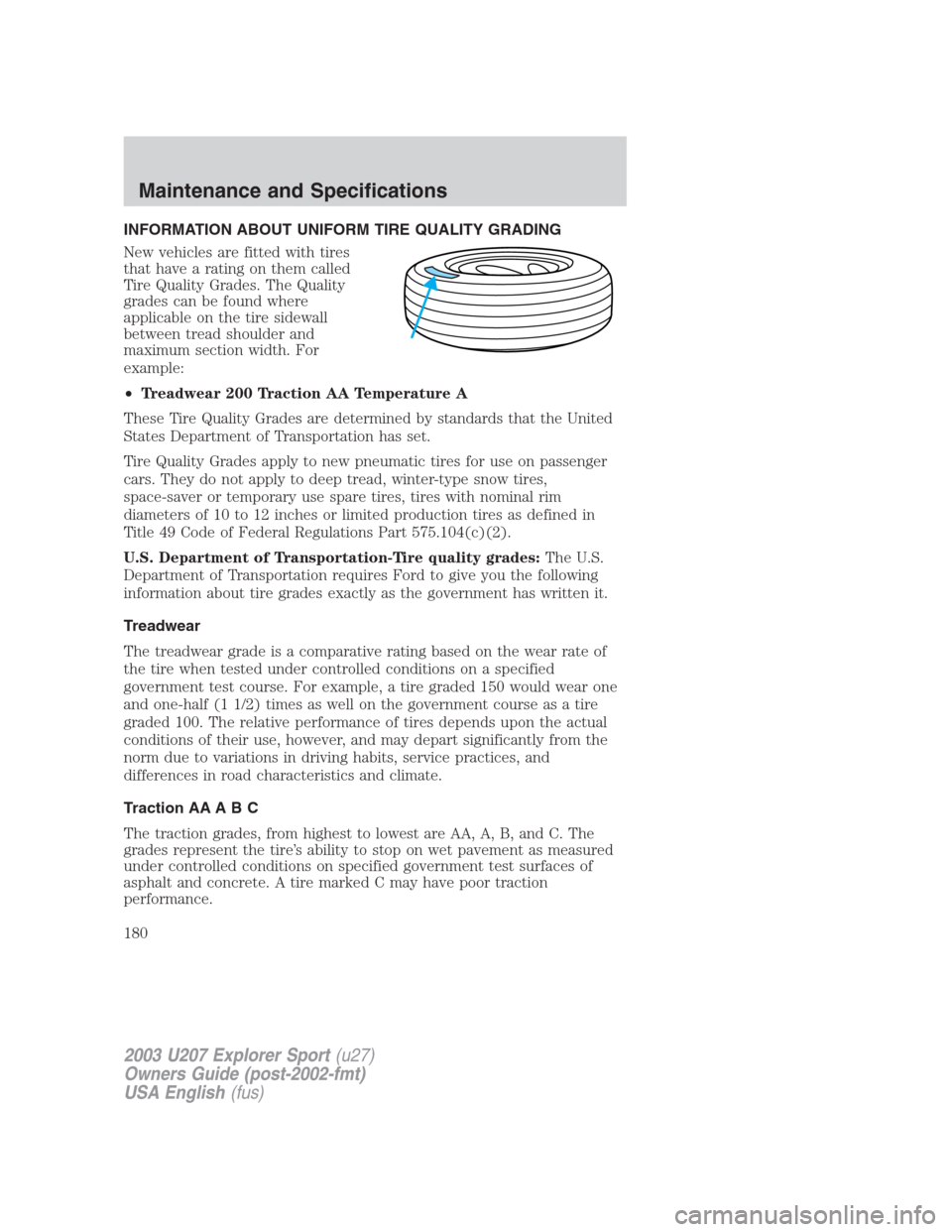
New vehicles are fitted with tires
that have a rating on them called
Tire Quality Grades. The Quality
grades can be found where
applicable on the tire sidewall
between tread shoulder and
maximum section width. For
example:
•Treadwear 200 Traction AA Temperature A
These Tire Quality Grades are determined by standards that the United
States Department of Transportation has set.
Tire Quality Grades apply to new pneumatic tires for use on passenger
cars. They do not apply to deep tread, winter-type snow tires,
space-saver or temporary use spare tires, tires with nominal rim
diameters of 10 to 12 inches or limited production tires as defined in
Title 49 Code of Federal Regulations Part 575.104(c)(2).
U.S. Department of Transportation-Tire quality grades:The U.S.
Department of Transportation requires Ford to give you the following
information about tire grades exactly as the government has written it.
Treadwear
The treadwear grade is a comparative rating based on the wear rate of
the tire when tested under controlled conditions on a specified
government test course. For example, a tire graded 150 would wear one
and one-half (1 1/2) times as well on the government course as a tire
graded 100. The relative performance of tires depends upon the actual
conditions of their use, however, and may depart significantly from the
norm due to variations in driving habits, service practices, and
differences in road characteristics and climate.
Traction AA A B C
The traction grades, from highest to lowest are AA, A, B, and C. The
grades represent the tire’s ability to stop on wet pavement as measured
under controlled conditions on specified government test surfaces of
asphalt and concrete. A tire marked C may have poor traction
performance.
2003 U207 Explorer Sport(u27)
Owners Guide (post-2002-fmt)
USA English(fus)
Maintenance and Specifications
180
Page 181 of 200
The traction grade assigned to this tire is based on
straight-ahead braking traction tests, and does not include
acceleration, cornering, hydroplaning or peak traction characteristics.
Temperature A B C
The temperature grades are A (the highest), B and C, representing the
tire’s resistance to the generation of heat and its ability to dissipate heat
when tested under controlled conditions on a specified indoor laboratory
test wheel. Sustained high temperature can cause the material of the tire
to degenerate and reduce tire life, and excessive temperature can lead to
sudden tire failure. The grade C corresponds to a level of performance
which all passenger car tires must meet under the Federal Motor Vehicle
Safety Standard No. 109. Grades B and A represent higher levels of
performance on the laboratory test wheel than the minimum required by
law.
The temperature grade for this tire is established for a tire that
is properly inflated and not overloaded. Excessive speed,
underinflation, or excessive loading, either separately or in
combination, can cause heat buildup and possible tire failure.
SERVICING YOUR TIRES
Checking the tire pressure
•Use an accurate tire gauge.
•Check the pressure when the tires are cold, after the vehicle has been
parked for at least one hour or has been driven less than 5 km
(3 miles).
•Adjust tire pressure to recommended specifications found on the
Certifications Label.
•Check tires for proper air pressure monthly. Check spare tire for
proper air pressure every six months.
Improperly inflated tires can affect vehicle handling and can fail
suddenly, possibly resulting in loss of vehicle control, vehicle
rollover and/or personal injury.
2003 U207 Explorer Sport(u27)
Owners Guide (post-2002-fmt)
USA English(fus)
Maintenance and Specifications
181
Page 182 of 200
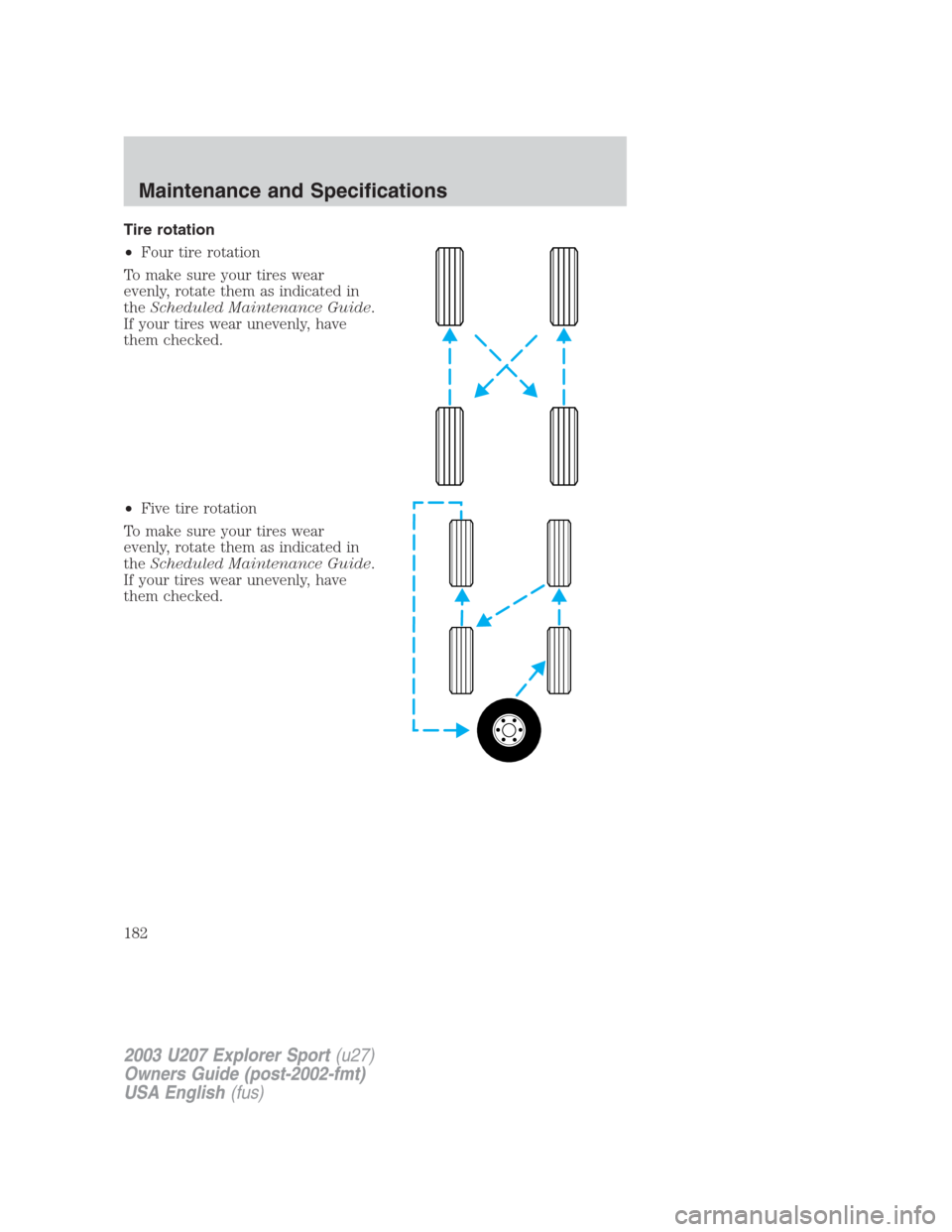
Tire rotation
•Four tire rotation
To make sure your tires wear
evenly, rotate them as indicated in
theScheduled Maintenance Guide.
If your tires wear unevenly, have
them checked.
•Five tire rotation
To make sure your tires wear
evenly, rotate them as indicated in
theScheduled Maintenance Guide.
If your tires wear unevenly, have
them checked.
2003 U207 Explorer Sport(u27)
Owners Guide (post-2002-fmt)
USA English(fus)
Maintenance and Specifications
182
Page 183 of 200
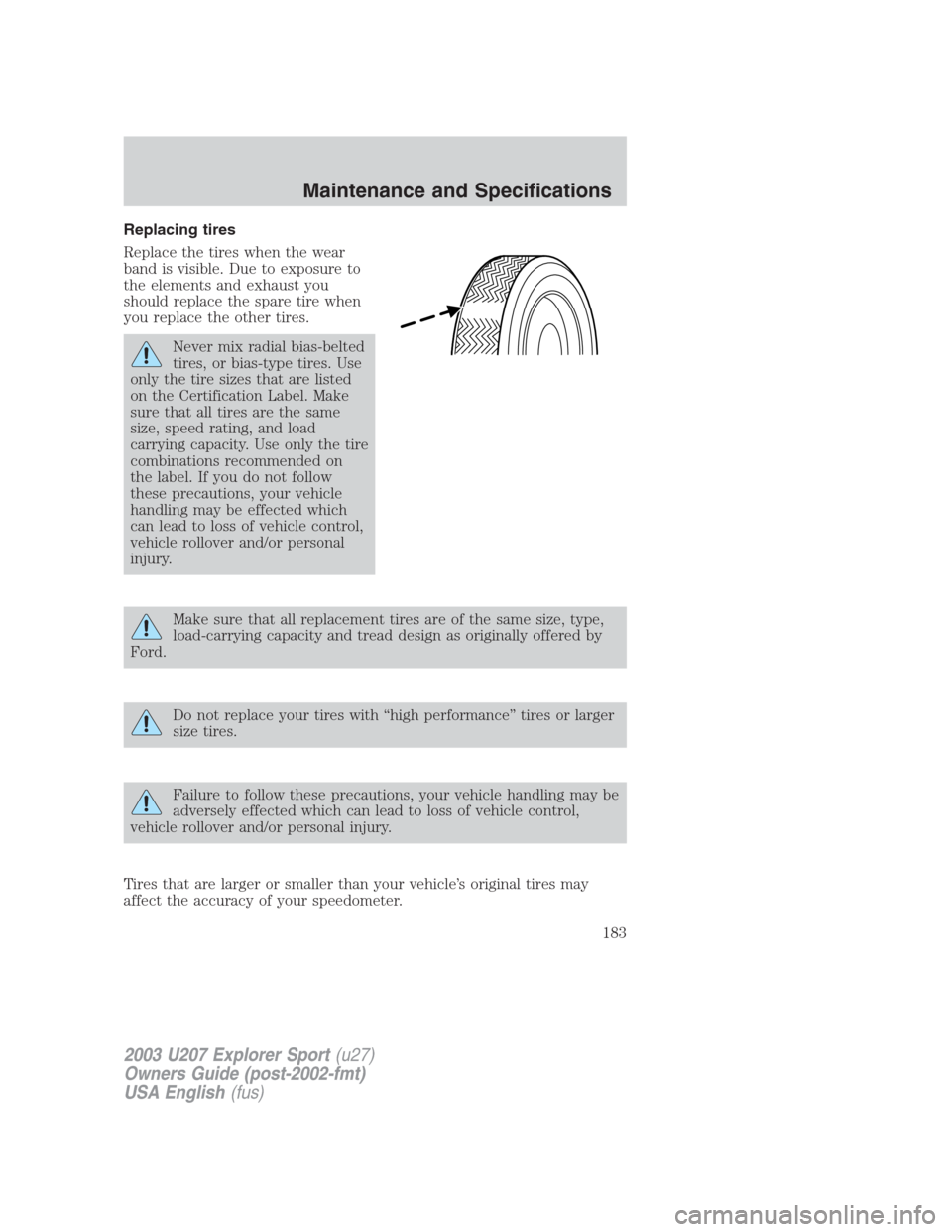
Replacing tires
Replace the tires when the wear
band is visible. Due to exposure to
the elements and exhaust you
should replace the spare tire when
you replace the other tires.
Never mix radial bias-belted
tires, or bias-type tires. Use
only the tire sizes that are listed
on the Certification Label. Make
sure that all tires are the same
size, speed rating, and load
carrying capacity. Use only the tire
combinations recommended on
the label. If you do not follow
these precautions, your vehicle
handling may be effected which
can lead to loss of vehicle control,
vehicle rollover and/or personal
injury.
Make sure that all replacement tires are of the same size, type,
load-carrying capacity and tread design as originally offered by
Ford.
Do not replace your tires with “high performance” tires or larger
size tires.
Failure to follow these precautions, your vehicle handling may be
adversely effected which can lead to loss of vehicle control,
vehicle rollover and/or personal injury.
Tires that are larger or smaller than your vehicle’s original tires may
affect the accuracy of your speedometer.
2003 U207 Explorer Sport(u27)
Owners Guide (post-2002-fmt)
USA English(fus)
Maintenance and Specifications
183
Page 184 of 200
SNOW TIRES AND TRACTION DEVICES
Snow tires must be the same size and grade as the original tires.
Your tires have all-weather treads to provide traction in the rain and
snow. In some climate, using snow tires or traction devices may be
necessary. For Motor Company offers tire cables as a Ford approved
accessory and recommends use of these or SAE class “S” cables. See
your dealer for more information.
Follow these guidelines:
•Do not use tire cables or chains with P255/70R16 size tires.
•Cables or chains should only be used on the rear wheels.
•If you need to use chains, it is recommended that steel wheels (of the
same size and specification) be used, as chains may chip aluminum
wheels.
•Install cables or chains securely, verifying that they do not touch any
wiring, brake lines or fuel lines.
•Avoid overloading your vehicle.
•Do not use cables or chains on dry roads.
•Do not exceed 48 km/h (30 mph).
•Drive cautiously.
Remove the cables or chains when they are no longer needed.
MOTORCRAFT PART NUMBERS
Component 4.0L SOHC V6 engine
Air filter element FA-1744
Fuel filter FG-1036
Battery BXT-65-650
Oil filter FL-820S
PCV valve EV-243
Spark plugs* AGSF-22PP
* Refer to Vehicle Emissions Control Information (VECI) decal for spark
plug gap information.
2003 U207 Explorer Sport(u27)
Owners Guide (post-2002-fmt)
USA English(fus)
Maintenance and Specifications
184