2003 FORD EXPLORER air conditioning
[x] Cancel search: air conditioningPage 1 of 272

Introduction 4
Instrument Cluster 10
Warning and control lights 10
Gauges 14
Entertainment Systems 17
AM/FM stereo with CD 17
AM/FM stereo cassette with CD 21
Climate Controls 27
Manual heating and air conditioning 27
Electronic automatic temperature control 28
Rear passenger climate control 31
Lights 33
Driver Controls 42
Windshield wiper/washer control 42
Power windows 48
Mirrors 49
Speed control (Cruise control) 50
Message center 62
Locks and Security 77
Keys 77
Locks 77
Anti-theft system 79
Seating and Safety Restraints 91
Seating 91
Safety restraints 101
Air bags 113
Child restraints 121
Table of Contents
1
Page 27 of 272
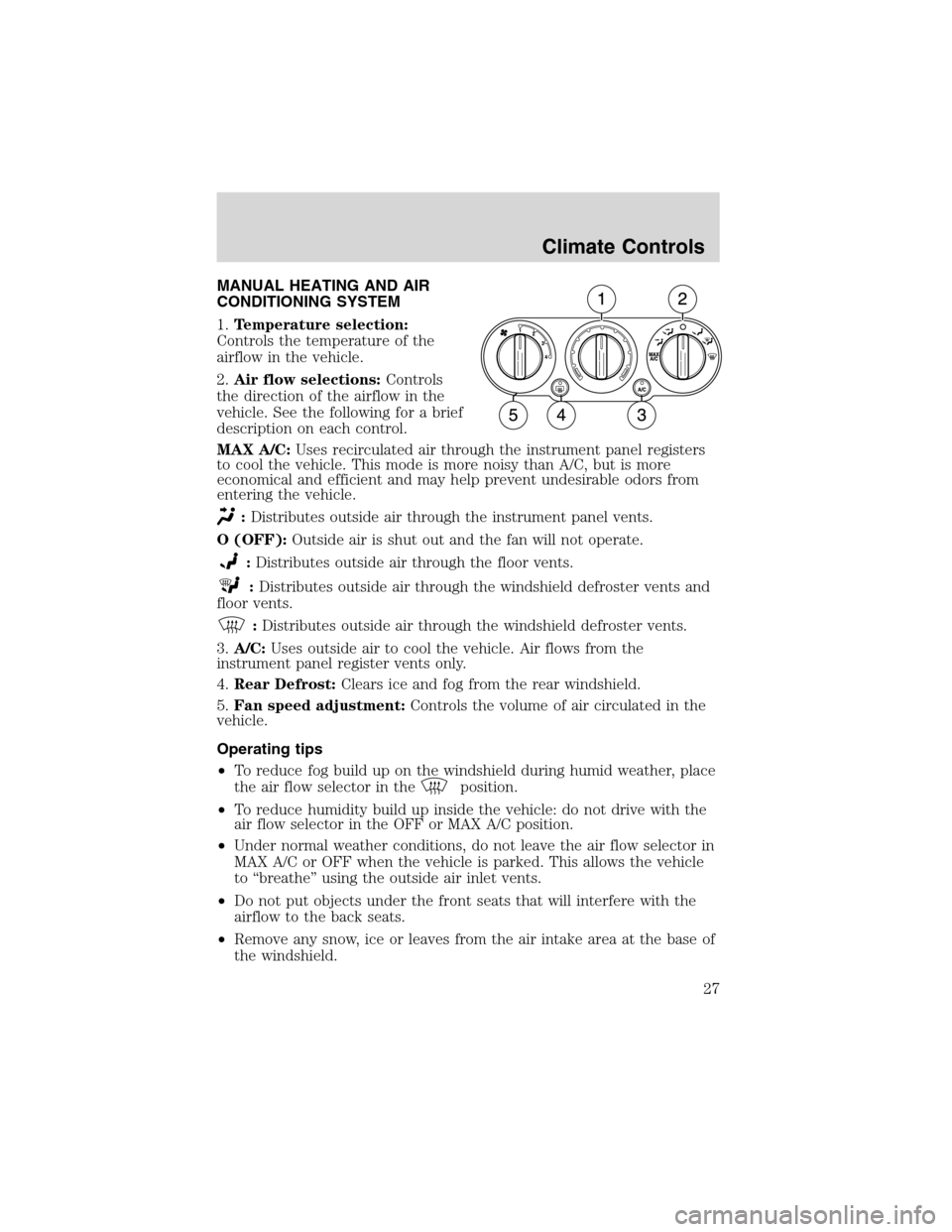
MANUAL HEATING AND AIR
CONDITIONING SYSTEM
1.Temperature selection:
Controls the temperature of the
airflow in the vehicle.
2.Air flow selections:Controls
the direction of the airflow in the
vehicle. See the following for a brief
description on each control.
MAX A/C:Uses recirculated air through the instrument panel registers
to cool the vehicle. This mode is more noisy than A/C, but is more
economical and efficient and may help prevent undesirable odors from
entering the vehicle.
:Distributes outside air through the instrument panel vents.
O (OFF):Outside air is shut out and the fan will not operate.
:Distributes outside air through the floor vents.
:Distributes outside air through the windshield defroster vents and
floor vents.
:Distributes outside air through the windshield defroster vents.
3.A/C:Uses outside air to cool the vehicle. Air flows from the
instrument panel register vents only.
4.Rear Defrost:Clears ice and fog from the rear windshield.
5.Fan speed adjustment:Controls the volume of air circulated in the
vehicle.
Operating tips
•To reduce fog build up on the windshield during humid weather, place
the air flow selector in the
position.
•To reduce humidity build up inside the vehicle: do not drive with the
air flow selector in the OFF or MAX A/C position.
•Under normal weather conditions, do not leave the air flow selector in
MAX A/C or OFF when the vehicle is parked. This allows the vehicle
to“breathe”using the outside air inlet vents.
•Do not put objects under the front seats that will interfere with the
airflow to the back seats.
•Remove any snow, ice or leaves from the air intake area at the base of
the windshield.
Climate Controls
27
Page 61 of 272

3. Locate compass sensor mounted
at base of mirror.
4. Press the button on the top of
the compass module until ZONE
appears in the instrument cluster
display.
5. Release pressure on the button and then slowly press it down again.
6. Continue to press until ZONE
appears in the instrument cluster
display, then release. The display
should show the current zone
number.
7. Press until the desired zone
number appears. The display will flash and then return to normal
operation. The zone is now updated.
Compass calibration adjustment
Perform this adjustment in an open area free from steel structures and
high voltage lines:
For optimum calibration, turn off all electrical accessories (heater/air
conditioning, wipers, etc.) and make sure all vehicle doors are shut.
1. Start the vehicle.
2. Locate compass sensor mounted at base of mirror.
3. Press the button on the top of
the compass module until ZONE
appears in the instrument cluster
display. Continue to hold down until
ZONE disappears and CAL is
displayed (approximately eight
seconds) and release.
4. Drive the vehicle slowly (less than 5 km/h [3 mph]) in circles until
CAL indicator turns off (4–5 complete circles).
5. The compass is now calibrated.
Driver Controls
61
Page 63 of 272
Compass display
The compass reading may be affected when you drive near large
buildings, bridges, power lines and powerful broadcast antenna. Magnetic
or metallic objects placed in, on or near the vehicle may also affect
compass accuracy.
Usually, when something affects the compass readings, the compass will
correct itself after a few days of operating your vehicle in normal
conditions. If the compass still appears to be inaccurate, a manual
calibration may be necessary. Refer toCompass zone/calibration
adjustment.
Most geographic areas (zones) have a magnetic north compass point that
varies slightly from the northerly direction on maps. This variation is four
degrees between adjacent zones and will become noticeable as the
vehicle crosses multiple zones. A correct zone setting will eliminate this
error. Refer toCompass zone/calibration adjustment.
Compass zone/calibration adjustment
Perform this adjustment in an open area free from steel structures and
high voltage lines.
For optimum calibration, turn off all electrical accessories (heater/air
conditioning, wipers, etc.) and make sure all vehicle doors are shut.
1. Turn ignition to the ON position.
2. Start the engine.
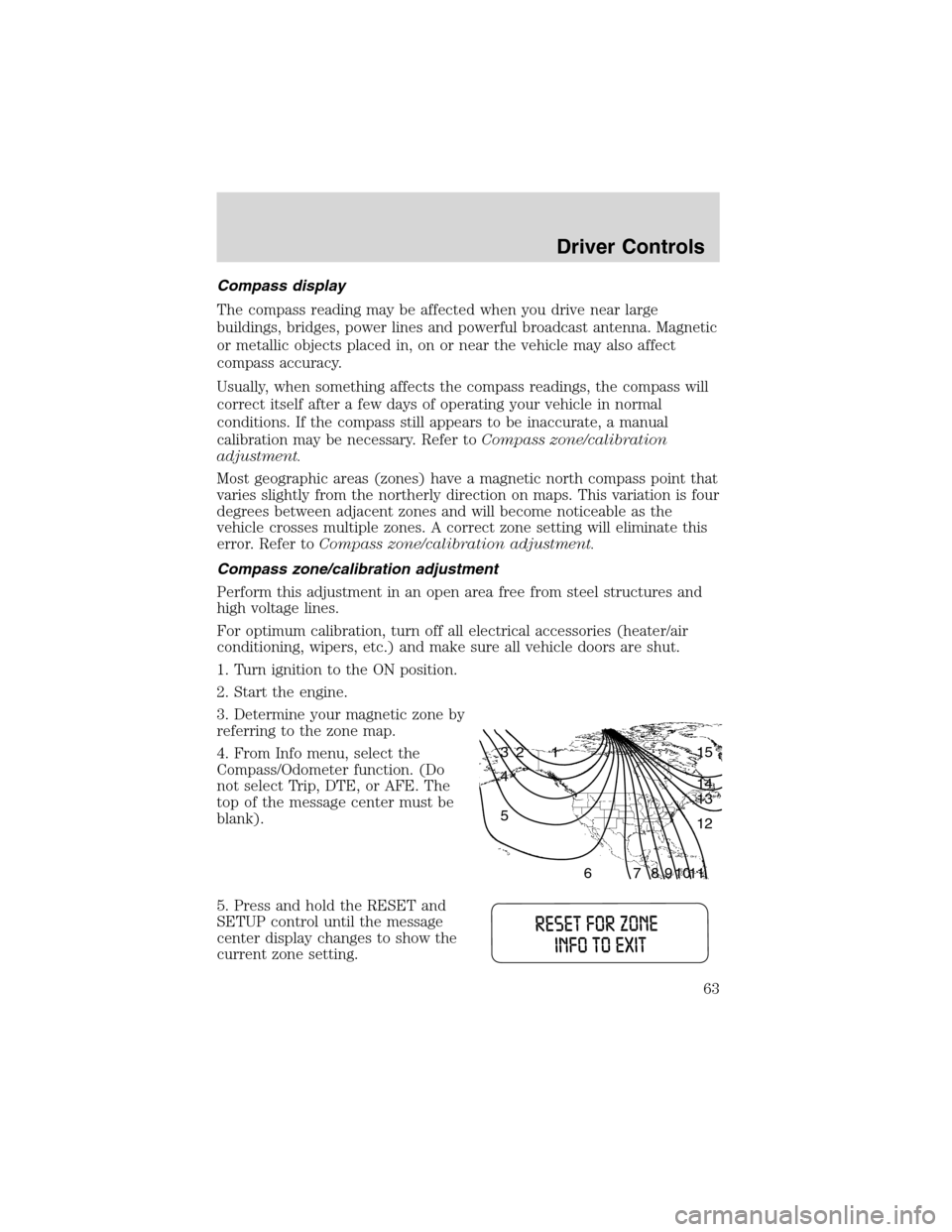
3. Determine your magnetic zone by
referring to the zone map.
4. From Info menu, select the
Compass/Odometer function. (Do
not select Trip, DTE, or AFE. The
top of the message center must be
blank).
5. Press and hold the RESET and
SETUP control until the message
center display changes to show the
current zone setting.
1 2 3
4
5
6 7 8 9 101112 13 14 15
Driver Controls
63
Page 137 of 272
2. When the engine starts, release the key, then gradually release the
accelerator pedal as the engine speeds up. If the engine still fails to start,
repeat Step 1.
Using the engine block heater (if equipped)
An engine block heater warms the engine coolant which aids in starting
and heater/defroster performance. Use of an engine block heater is
strongly recommended if you live in a region where temperatures reach
-23°C (-10°F) or below. For best results, plug the heater in at least
three hours before starting the vehicle. The heater can be plugged in the
night before starting the vehicle.
To prevent electrical shock, do not use your heater with
ungrounded electrical systems or two-pronged (cheater)
adapters.
Guarding against exhaust fumes
Carbon monoxide is present in exhaust fumes. Take precautions to avoid
its dangerous effects.
If you smell exhaust fumes inside your vehicle, have your dealer
inspect your vehicle immediately. Do not drive if you smell
exhaust fumes.
Important ventilating information
If the engine is idling while the vehicle is stopped for a long period of
time, open the windows at least 2.5 cm (one inch) or adjust the heating
or air conditioning to bring in fresh air.
BRAKES
Occasional brake noise is normal. If a metal-to-metal, continuous grinding
or continuous squeal sound is present, the brake linings may be worn-out
and should be inspected by a qualified service technician. If the vehicle
has continuous vibration or shudder in the steering wheel while braking,
the vehicle should be inspected by a qualified service technician.
Four-wheel anti-lock brake system (ABS)
Your vehicle is equipped with an Anti-lock Braking System (ABS). This
system helps you maintain steering control during emergency stops by
keeping the brakes from locking. Noise from the ABS pump motor and
Driving
137
Page 234 of 272
What you should know about fail-safe cooling
(4.6L V8 engine only)
If the engine coolant supply is depleted, this feature allows the vehicle to
be driven temporarily before incremental component damage is incurred.
The“fail-safe”distance depends on ambient temperatures, vehicle load
and terrain.
How fail-safe cooling works
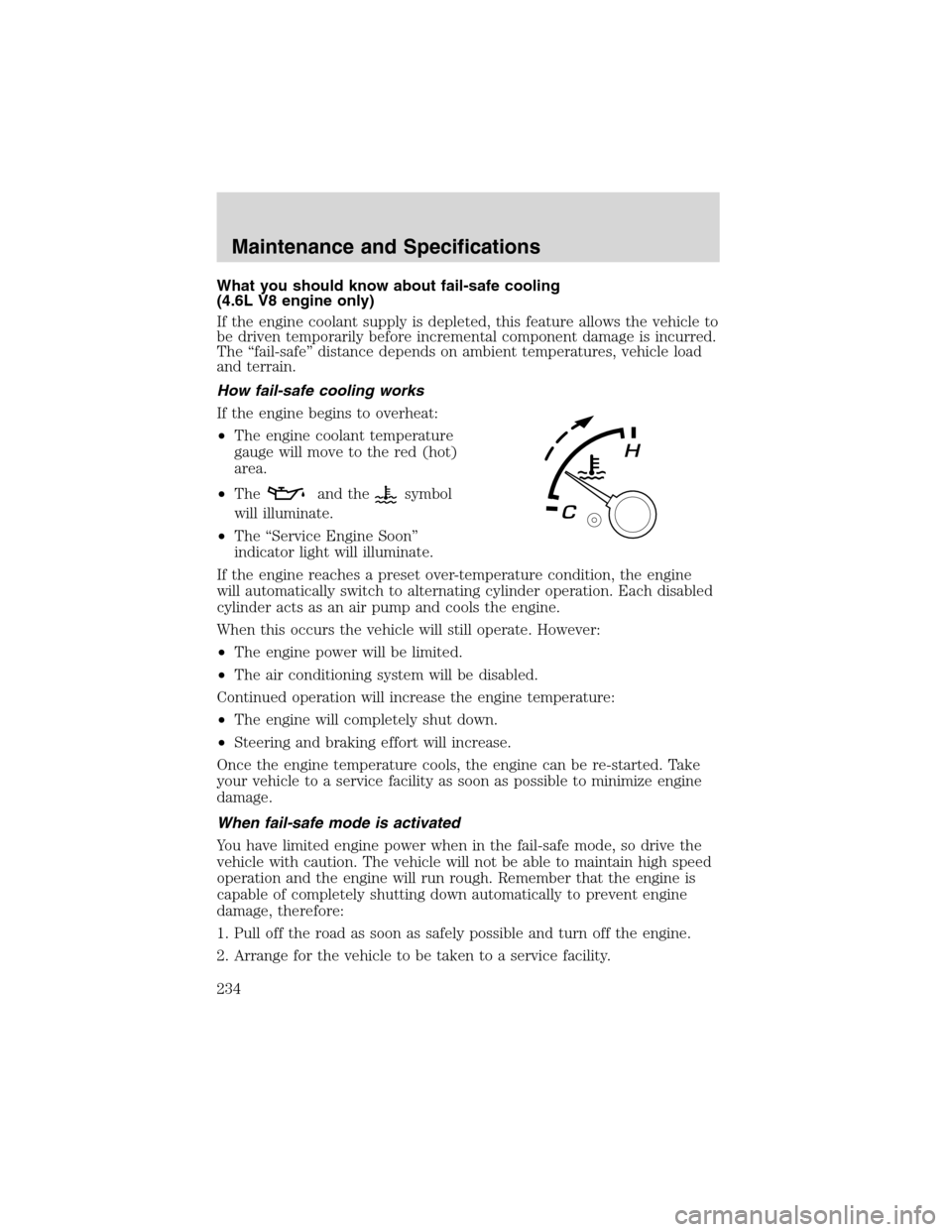
If the engine begins to overheat:
•The engine coolant temperature
gauge will move to the red (hot)
area.
•The
and thesymbol
will illuminate.
•The“Service Engine Soon”
indicator light will illuminate.
If the engine reaches a preset over-temperature condition, the engine
will automatically switch to alternating cylinder operation. Each disabled
cylinder acts as an air pump and cools the engine.
When this occurs the vehicle will still operate. However:
•The engine power will be limited.
•The air conditioning system will be disabled.
Continued operation will increase the engine temperature:
•The engine will completely shut down.
•Steering and braking effort will increase.
Once the engine temperature cools, the engine can be re-started. Take
your vehicle to a service facility as soon as possible to minimize engine
damage.
When fail-safe mode is activated
You have limited engine power when in the fail-safe mode, so drive the
vehicle with caution. The vehicle will not be able to maintain high speed
operation and the engine will run rough. Remember that the engine is
capable of completely shutting down automatically to prevent engine
damage, therefore:
1. Pull off the road as soon as safely possible and turn off the engine.
2. Arrange for the vehicle to be taken to a service facility.
Maintenance and Specifications
234
Page 267 of 272
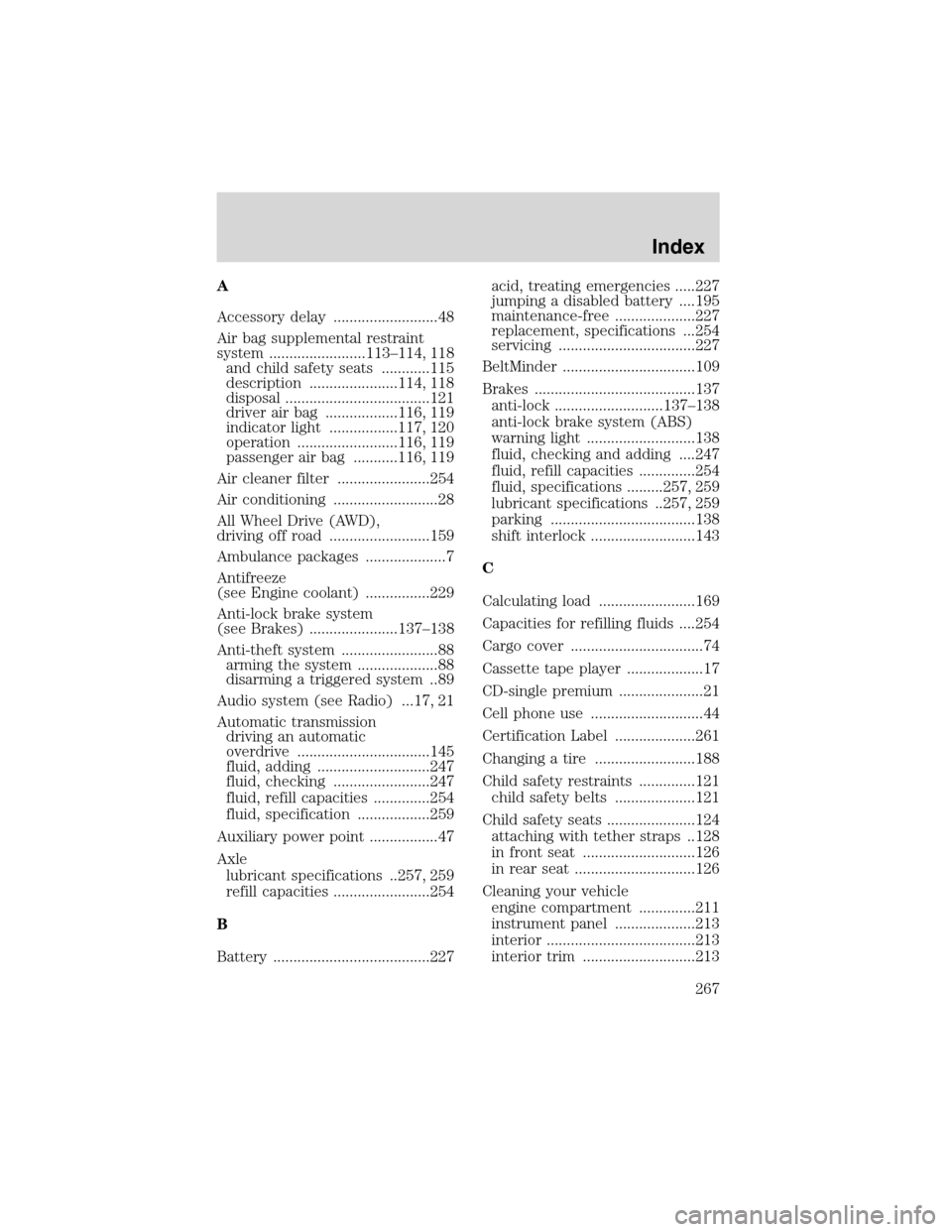
A
Accessory delay ..........................48
Air bag supplemental restraint
system ........................113–114, 118
and child safety seats ............115
description ......................114, 118
disposal ....................................121
driver air bag ..................116, 119
indicator light .................117, 120
operation .........................116, 119
passenger air bag ...........116, 119
Air cleaner filter .......................254
Air conditioning ..........................28
All Wheel Drive (AWD),
driving off road .........................159
Ambulance packages ....................7
Antifreeze
(see Engine coolant) ................229
Anti-lock brake system
(see Brakes) ......................137–138
Anti-theft system ........................88
arming the system ....................88
disarming a triggered system ..89
Audio system (see Radio) ...17, 21
Automatic transmission
driving an automatic
overdrive .................................145
fluid, adding ............................247
fluid, checking ........................247
fluid, refill capacities ..............254
fluid, specification ..................259
Auxiliary power point .................47
Axle
lubricant specifications ..257, 259
refill capacities ........................254
B
Battery .......................................227acid, treating emergencies .....227
jumping a disabled battery ....195
maintenance-free ....................227
replacement, specifications ...254
servicing ..................................227
BeltMinder .................................109
Brakes ........................................137
anti-lock ...........................137–138
anti-lock brake system (ABS)
warning light ...........................138
fluid, checking and adding ....247
fluid, refill capacities ..............254
fluid, specifications .........257, 259
lubricant specifications ..257, 259
parking ....................................138
shift interlock ..........................143
C
Calculating load ........................169
Capacities for refilling fluids ....254
Cargo cover .................................74
Cassette tape player ...................17
CD-single premium .....................21
Cell phone use ............................44
Certification Label ....................261
Changing a tire .........................188
Child safety restraints ..............121
child safety belts ....................121
Child safety seats ......................124
attaching with tether straps ..128
in front seat ............................126
in rear seat ..............................126
Cleaning your vehicle
engine compartment ..............211
instrument panel ....................213
interior .....................................213
interior trim ............................213
Index
267
Page 268 of 272
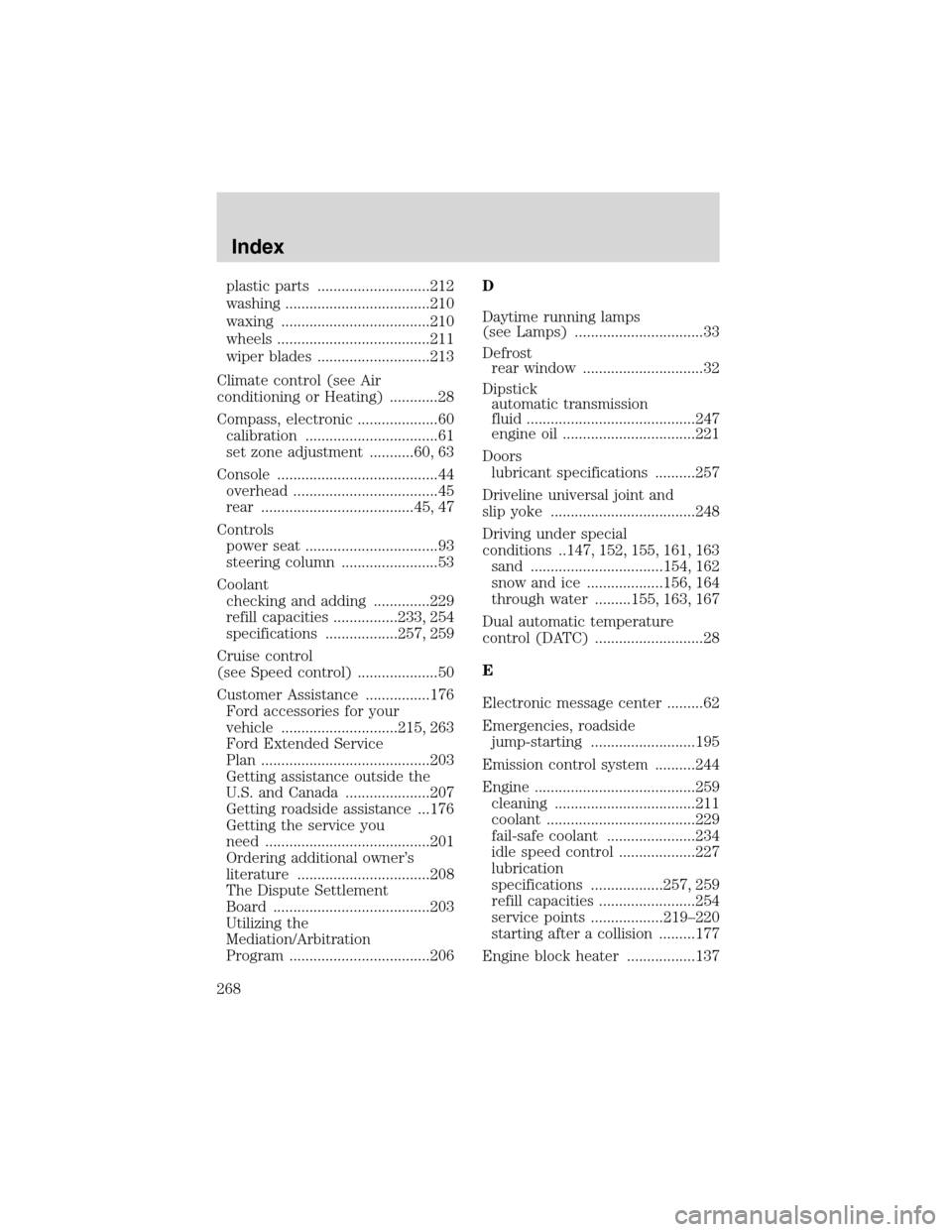
plastic parts ............................212
washing ....................................210
waxing .....................................210
wheels ......................................211
wiper blades ............................213
Climate control (see Air
conditioning or Heating) ............28
Compass, electronic ....................60
calibration .................................61
set zone adjustment ...........60, 63
Console ........................................44
overhead ....................................45
rear ......................................45, 47
Controls
power seat .................................93
steering column ........................53
Coolant
checking and adding ..............229
refill capacities ................233, 254
specifications ..................257, 259
Cruise control
(see Speed control) ....................50
Customer Assistance ................176
Ford accessories for your
vehicle .............................215, 263
Ford Extended Service
Plan ..........................................203
Getting assistance outside the
U.S. and Canada .....................207
Getting roadside assistance ...176
Getting the service you
need .........................................201
Ordering additional owner’s
literature .................................208
The Dispute Settlement
Board .......................................203
Utilizing the
Mediation/Arbitration
Program ...................................206D
Daytime running lamps
(see Lamps) ................................33
Defrost
rear window ..............................32
Dipstick
automatic transmission
fluid ..........................................247
engine oil .................................221
Doors
lubricant specifications ..........257
Driveline universal joint and
slip yoke ....................................248
Driving under special
conditions ..147, 152, 155, 161, 163
sand .................................154, 162
snow and ice ...................156, 164
through water .........155, 163, 167
Dual automatic temperature
control (DATC) ...........................28
E
Electronic message center .........62
Emergencies, roadside
jump-starting ..........................195
Emission control system ..........244
Engine ........................................259
cleaning ...................................211
coolant .....................................229
fail-safe coolant ......................234
idle speed control ...................227
lubrication
specifications ..................257, 259
refill capacities ........................254
service points ..................219–220
starting after a collision .........177
Engine block heater .................137
Index
268