Page 188 of 272
The relays are coded as follows:
Fuse/Relay Location Description
Relay 64 AdvanceTrac�relay
Relay 65 Open
Relay 66 Open
CHANGING THE TIRES
If you get a flat tire while driving:
•do not brake heavily.
•gradually decrease the vehicle’s speed.
•hold the steering wheel firmly.
•slowly move to a safe place on the side of the road.
The use of tire sealants is not recommended and may
compromise the integrity of your tires. The use of tire sealants
may also affect your tire pressure monitoring system (if equipped).
If your vehicle is equipped with a tire pressure monitoring
system, refer toTire Pressure Monitoring System (if
equipped)in theMaintenance and specificationssection for
important information. If the tire pressure monitor sensor becomes
damaged, it will no longer function.
Spare tire information
The spare tire can be used as a spare or a regular tire and is identical to
the other tires on your vehicle.
If your vehicle is equipped with AWD, a spare tire of a different
size than the road tires should not be used. Such a tire could
make the vehicle difficult to control as well as result in damage to
driveline components.
Roadside Emergencies
188
Page 252 of 272
Do not replace your tires with“high performance”tires or larger
size tires.
Failure to follow these precautions, your vehicle handling may be
adversely effected which can lead to loss of vehicle control,
vehicle rollover and/or personal injury.
Tires that are larger or smaller than your vehicle’s original tires may
affect the accuracy of your speedometer.
Tire pressure monitoring system (TPMS) (if equipped)
The tire pressure monitoring system provides the driver with a warning
message indicating when tire pressure is severely low or high. This
system is a supplement to normal tire maintenance including regular
manual inspections. The device will inform the operator of severe low or
high inflation pressures, but may not illuminate for less severe
discrepancies in inflation pressure.
The system uses radio-frequency pressure sensors to monitor the tire
pressure on all tires including the spare. The sensors transmit the tire
pressure readings to the receiver module located in the vehicle. The
receiver module then transmits the status to the message center. For
more tire warning information, refer to theMessage Centerin the
Driver controlschapter.
This device complies with part 15 of the FCC rules and with RS-210 of
Industry Canada. Operation is subject to the following two conditions:
(1) This device may not cause harmful interference, and (2) This device
must accept any interference received, including interference that may
cause undesired operation.
The tire pressure monitoring system is NOT a substitute for
manually checking tire pressure. The tire pressure should be
checked periodically (at least monthly) using a tire gauge, see
Checking the tire pressurein this chapter. Failure to properly
maintain your tire pressure could increase the risk of tire failure, loss
of control, vehicle rollover and personal injury.
Maintenance and Specifications
252
Page 253 of 272
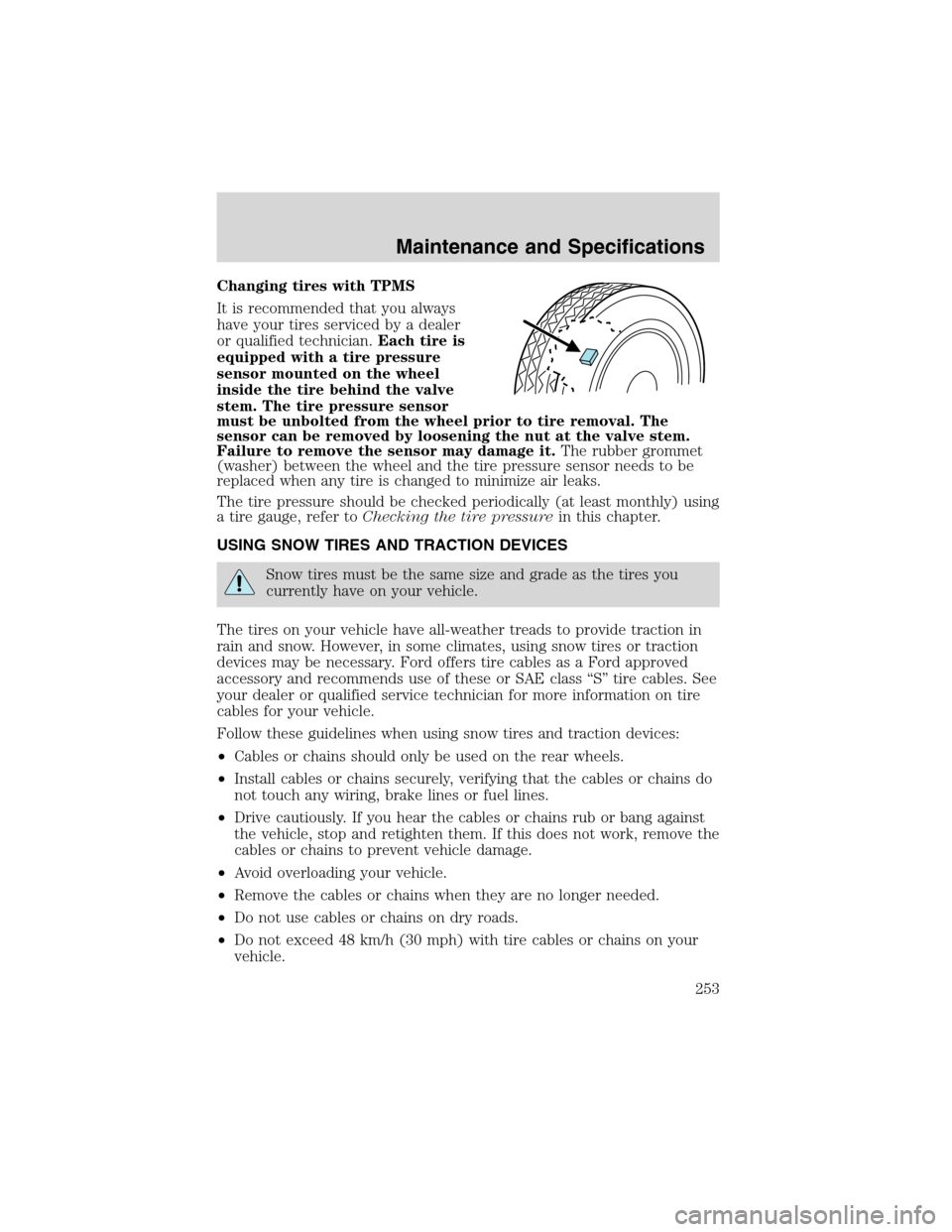
Changing tires with TPMS
It is recommended that you always
have your tires serviced by a dealer
or qualified technician.Each tire is
equipped with a tire pressure
sensor mounted on the wheel
inside the tire behind the valve
stem. The tire pressure sensor
must be unbolted from the wheel prior to tire removal. The
sensor can be removed by loosening the nut at the valve stem.
Failure to remove the sensor may damage it.The rubber grommet
(washer) between the wheel and the tire pressure sensor needs to be
replaced when any tire is changed to minimize air leaks.
The tire pressure should be checked periodically (at least monthly) using
a tire gauge, refer toChecking the tire pressurein this chapter.
USING SNOW TIRES AND TRACTION DEVICES
Snow tires must be the same size and grade as the tires you
currently have on your vehicle.
The tires on your vehicle have all-weather treads to provide traction in
rain and snow. However, in some climates, using snow tires or traction
devices may be necessary. Ford offers tire cables as a Ford approved
accessory and recommends use of these or SAE class“S”tire cables. See
your dealer or qualified service technician for more information on tire
cables for your vehicle.
Follow these guidelines when using snow tires and traction devices:
•Cables or chains should only be used on the rear wheels.
•Install cables or chains securely, verifying that the cables or chains do
not touch any wiring, brake lines or fuel lines.
•Drive cautiously. If you hear the cables or chains rub or bang against
the vehicle, stop and retighten them. If this does not work, remove the
cables or chains to prevent vehicle damage.
•Avoid overloading your vehicle.
•Remove the cables or chains when they are no longer needed.
•Do not use cables or chains on dry roads.
•Do not exceed 48 km/h (30 mph) with tire cables or chains on your
vehicle.
Maintenance and Specifications
253
Page:
< prev 1-8 9-16 17-24