Page 172 of 272
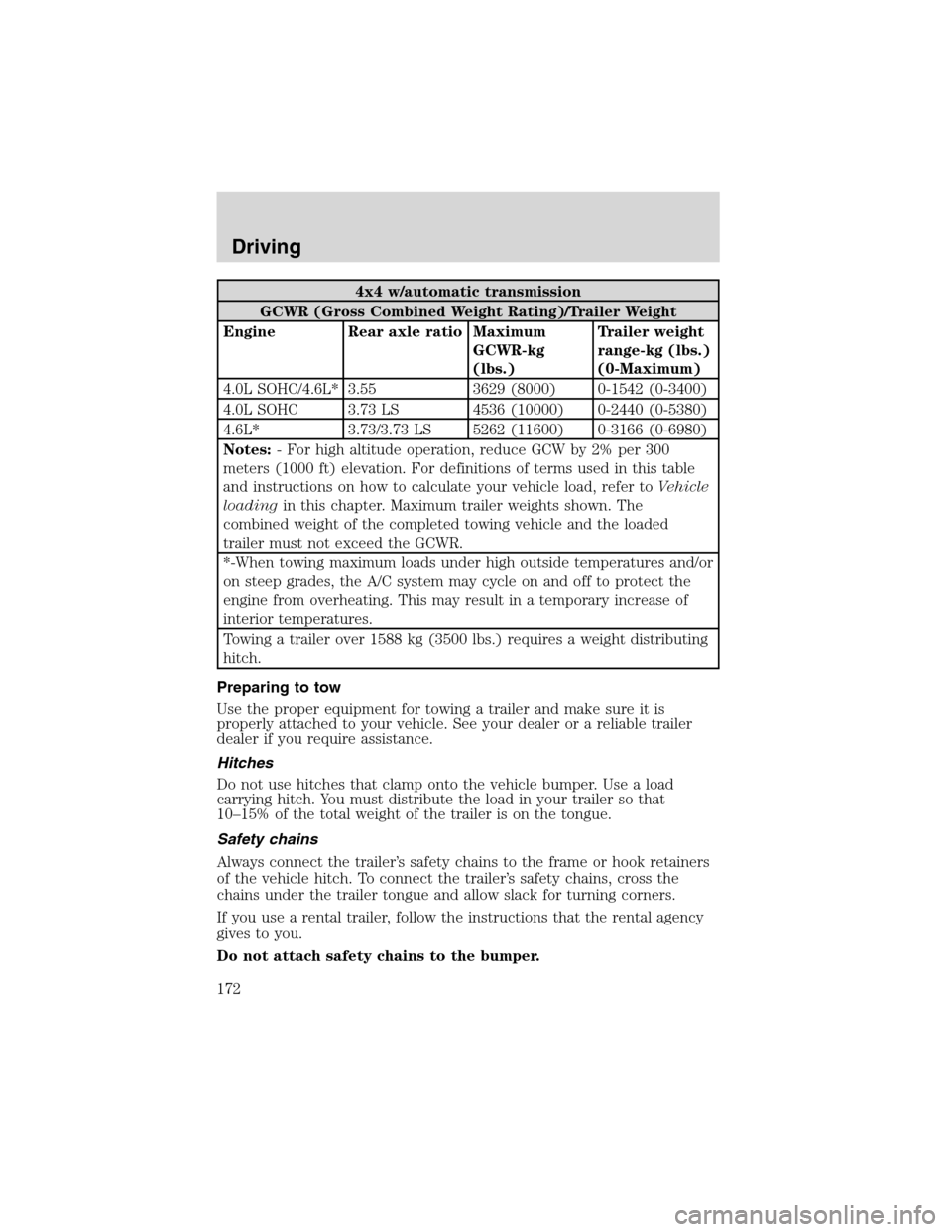
4x4 w/automatic transmission
GCWR (Gross Combined Weight Rating)/Trailer Weight
Engine Rear axle ratio Maximum
GCWR-kg
(lbs.)Trailer weight
range-kg (lbs.)
(0-Maximum)
4.0L SOHC/4.6L* 3.55 3629 (8000) 0-1542 (0-3400)
4.0L SOHC 3.73 LS 4536 (10000) 0-2440 (0-5380)
4.6L* 3.73/3.73 LS 5262 (11600) 0-3166 (0-6980)
Notes:- For high altitude operation, reduce GCW by 2% per 300
meters (1000 ft) elevation. For definitions of terms used in this table
and instructions on how to calculate your vehicle load, refer toVehicle
loadingin this chapter. Maximum trailer weights shown. The
combined weight of the completed towing vehicle and the loaded
trailer must not exceed the GCWR.
*-When towing maximum loads under high outside temperatures and/or
on steep grades, the A/C system may cycle on and off to protect the
engine from overheating. This may result in a temporary increase of
interior temperatures.
Towing a trailer over 1588 kg (3500 lbs.) requires a weight distributing
hitch.
Preparing to tow
Use the proper equipment for towing a trailer and make sure it is
properly attached to your vehicle. See your dealer or a reliable trailer
dealer if you require assistance.
Hitches
Do not use hitches that clamp onto the vehicle bumper. Use a load
carrying hitch. You must distribute the load in your trailer so that
10–15% of the total weight of the trailer is on the tongue.
Safety chains
Always connect the trailer’s safety chains to the frame or hook retainers
of the vehicle hitch. To connect the trailer’s safety chains, cross the
chains under the trailer tongue and allow slack for turning corners.
If you use a rental trailer, follow the instructions that the rental agency
gives to you.
Do not attach safety chains to the bumper.
Driving
172
Page 173 of 272
Trailer brakes
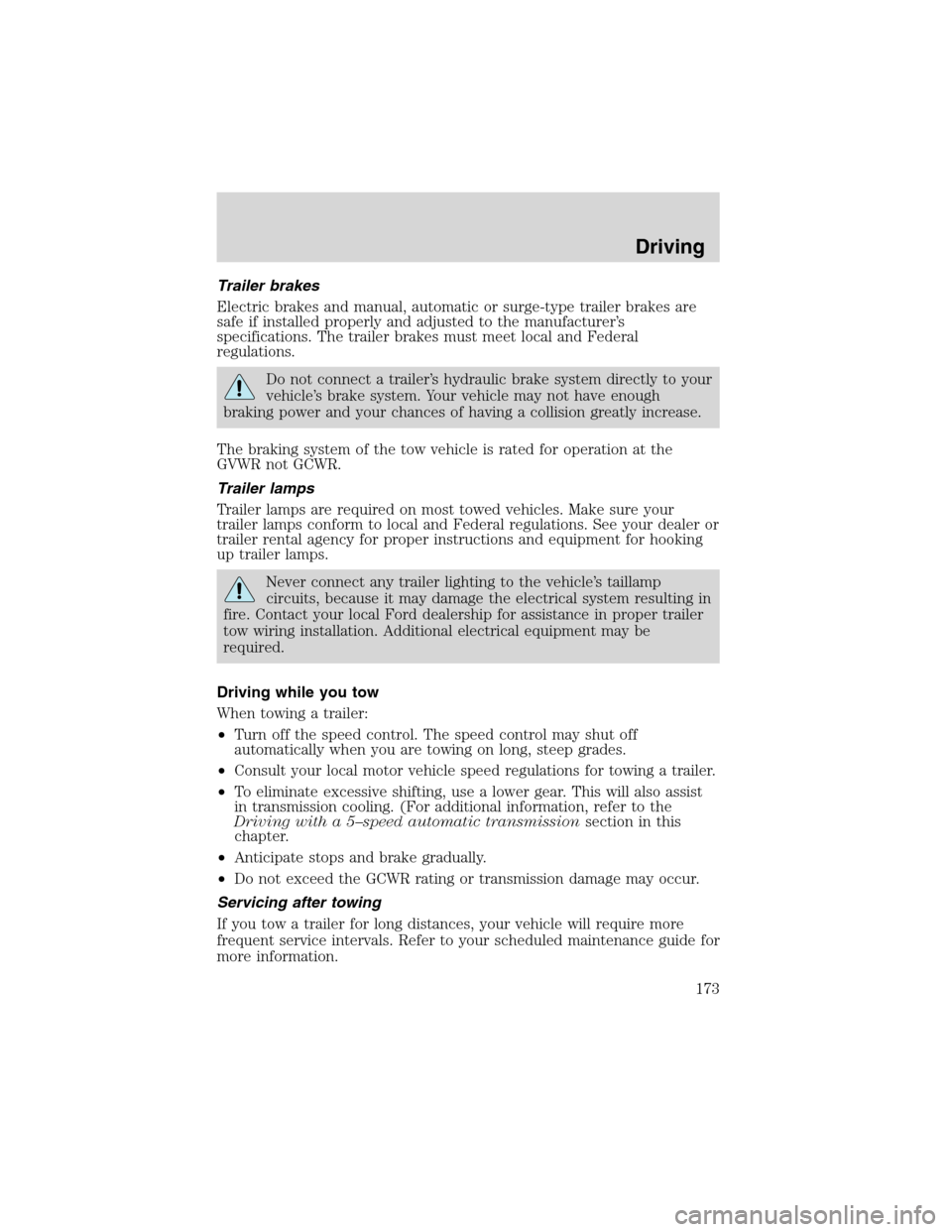
Electric brakes and manual, automatic or surge-type trailer brakes are
safe if installed properly and adjusted to the manufacturer’s
specifications. The trailer brakes must meet local and Federal
regulations.
Do not connect a trailer’s hydraulic brake system directly to your
vehicle’s brake system. Your vehicle may not have enough
braking power and your chances of having a collision greatly increase.
The braking system of the tow vehicle is rated for operation at the
GVWR not GCWR.
Trailer lamps
Trailer lamps are required on most towed vehicles. Make sure your
trailer lamps conform to local and Federal regulations. See your dealer or
trailer rental agency for proper instructions and equipment for hooking
up trailer lamps.
Never connect any trailer lighting to the vehicle’s taillamp
circuits, because it may damage the electrical system resulting in
fire. Contact your local Ford dealership for assistance in proper trailer
tow wiring installation. Additional electrical equipment may be
required.
Driving while you tow
When towing a trailer:
•Turn off the speed control. The speed control may shut off
automatically when you are towing on long, steep grades.
•Consult your local motor vehicle speed regulations for towing a trailer.
•To eliminate excessive shifting, use a lower gear. This will also assist
in transmission cooling. (For additional information, refer to the
Driving with a 5–speed automatic transmissionsection in this
chapter.
•Anticipate stops and brake gradually.
•Do not exceed the GCWR rating or transmission damage may occur.
Servicing after towing
If you tow a trailer for long distances, your vehicle will require more
frequent service intervals. Refer to your scheduled maintenance guide for
more information.
Driving
173
Page 174 of 272
Trailer towing tips
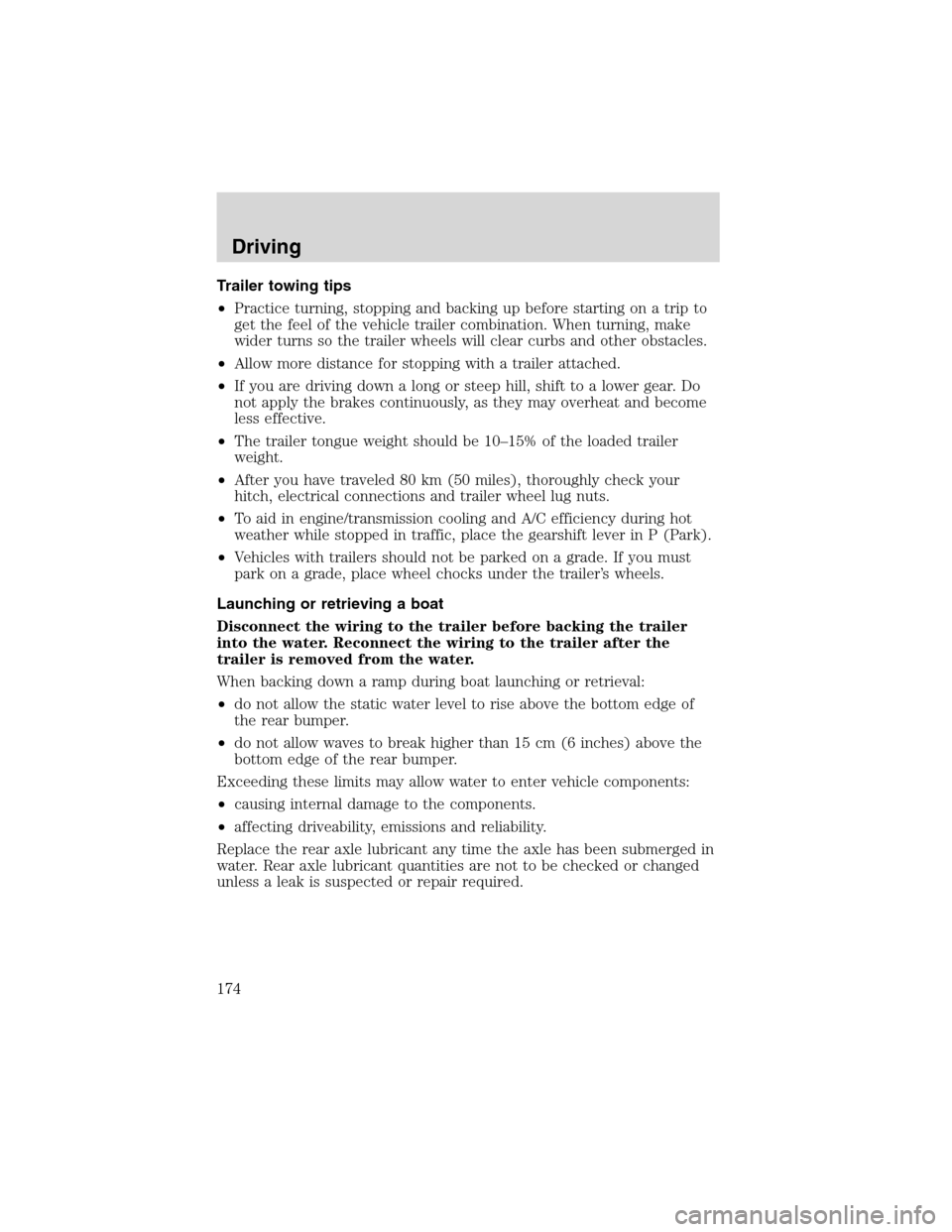
•Practice turning, stopping and backing up before starting on a trip to
get the feel of the vehicle trailer combination. When turning, make
wider turns so the trailer wheels will clear curbs and other obstacles.
•Allow more distance for stopping with a trailer attached.
•If you are driving down a long or steep hill, shift to a lower gear. Do
not apply the brakes continuously, as they may overheat and become
less effective.
•The trailer tongue weight should be 10–15% of the loaded trailer
weight.
•After you have traveled 80 km (50 miles), thoroughly check your
hitch, electrical connections and trailer wheel lug nuts.
•To aid in engine/transmission cooling and A/C efficiency during hot
weather while stopped in traffic, place the gearshift lever in P (Park).
•Vehicles with trailers should not be parked on a grade. If you must
park on a grade, place wheel chocks under the trailer’s wheels.
Launching or retrieving a boat
Disconnect the wiring to the trailer before backing the trailer
into the water. Reconnect the wiring to the trailer after the
trailer is removed from the water.
When backing down a ramp during boat launching or retrieval:
•do not allow the static water level to rise above the bottom edge of
the rear bumper.
•do not allow waves to break higher than 15 cm (6 inches) above the
bottom edge of the rear bumper.
Exceeding these limits may allow water to enter vehicle components:
•causing internal damage to the components.
•affecting driveability, emissions and reliability.
Replace the rear axle lubricant any time the axle has been submerged in
water. Rear axle lubricant quantities are not to be checked or changed
unless a leak is suspected or repair required.
Driving
174
Page 181 of 272
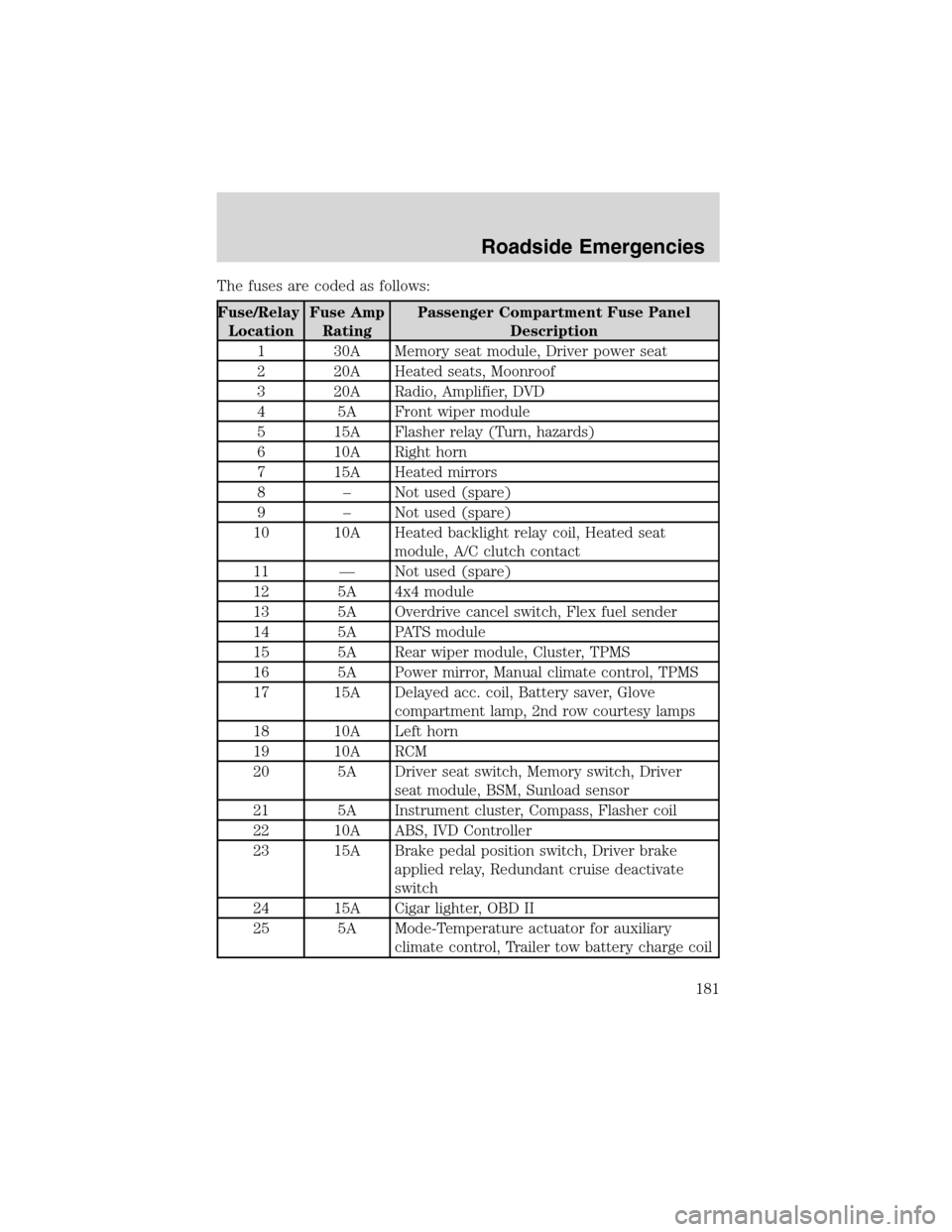
The fuses are coded as follows:
Fuse/Relay
LocationFuse Amp
RatingPassenger Compartment Fuse Panel
Description
1 30A Memory seat module, Driver power seat
2 20A Heated seats, Moonroof
3 20A Radio, Amplifier, DVD
4 5A Front wiper module
5 15A Flasher relay (Turn, hazards)
6 10A Right horn
7 15A Heated mirrors
8–Not used (spare)
9–Not used (spare)
10 10A Heated backlight relay coil, Heated seat
module, A/C clutch contact
11—Not used (spare)
12 5A 4x4 module
13 5A Overdrive cancel switch, Flex fuel sender
14 5A PATS module
15 5A Rear wiper module, Cluster, TPMS
16 5A Power mirror, Manual climate control, TPMS
17 15A Delayed acc. coil, Battery saver, Glove
compartment lamp, 2nd row courtesy lamps
18 10A Left horn
19 10A RCM
20 5A Driver seat switch, Memory switch, Driver
seat module, BSM, Sunload sensor
21 5A Instrument cluster, Compass, Flasher coil
22 10A ABS, IVD Controller
23 15A Brake pedal position switch, Driver brake
applied relay, Redundant cruise deactivate
switch
24 15A Cigar lighter, OBD II
25 5A Mode-Temperature actuator for auxiliary
climate control, Trailer tow battery charge coil
Roadside Emergencies
181
Page 184 of 272
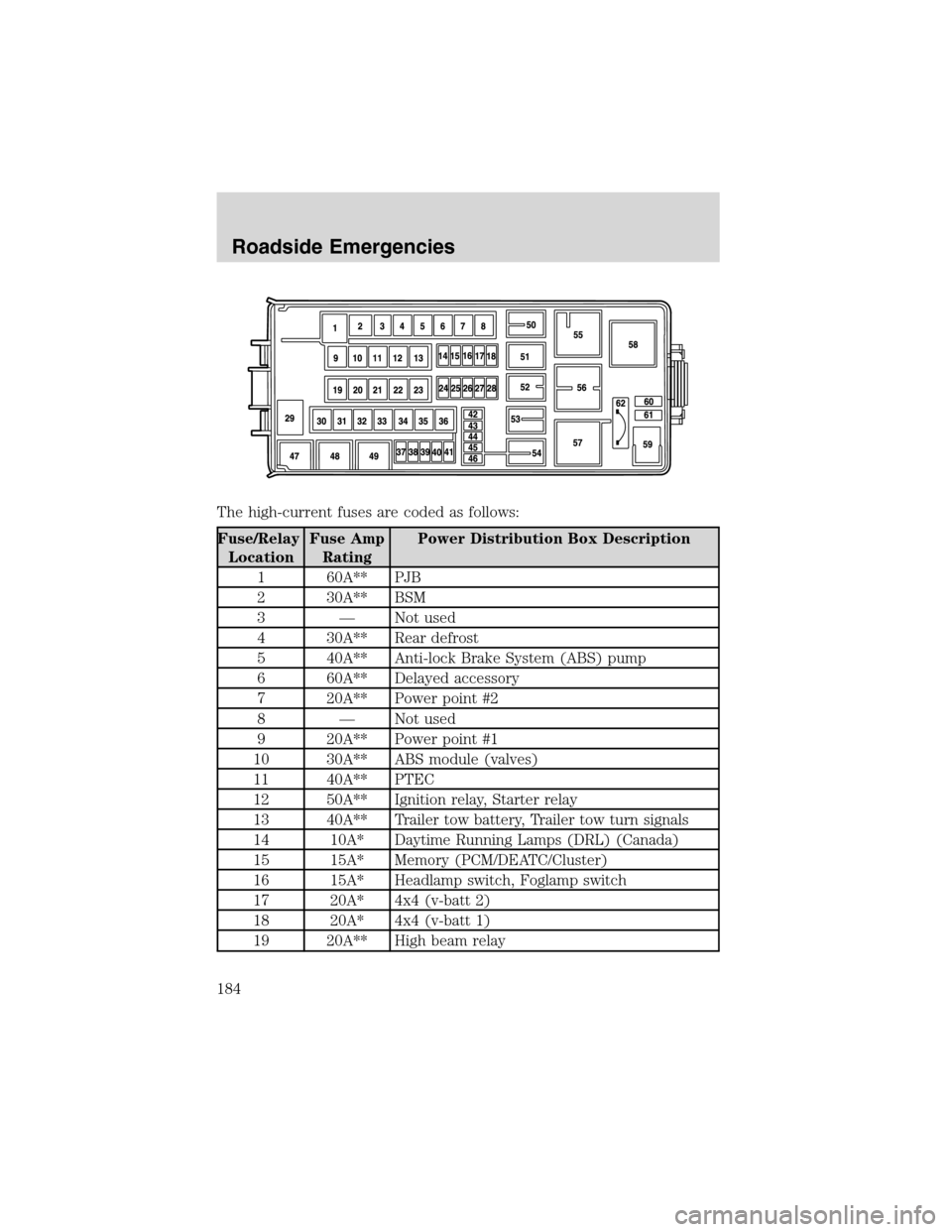
The high-current fuses are coded as follows:
Fuse/Relay
LocationFuse Amp
RatingPower Distribution Box Description
1 60A** PJB
2 30A** BSM
3—Not used
4 30A** Rear defrost
5 40A** Anti-lock Brake System (ABS) pump
6 60A** Delayed accessory
7 20A** Power point #2
8—Not used
9 20A** Power point #1
10 30A** ABS module (valves)
11 40A** PTEC
12 50A** Ignition relay, Starter relay
13 40A** Trailer tow battery, Trailer tow turn signals
14 10A* Daytime Running Lamps (DRL) (Canada)
15 15A* Memory (PCM/DEATC/Cluster)
16 15A* Headlamp switch, Foglamp switch
17 20A* 4x4 (v-batt 2)
18 20A* 4x4 (v-batt 1)
19 20A** High beam relay
Roadside Emergencies
184
Page 185 of 272
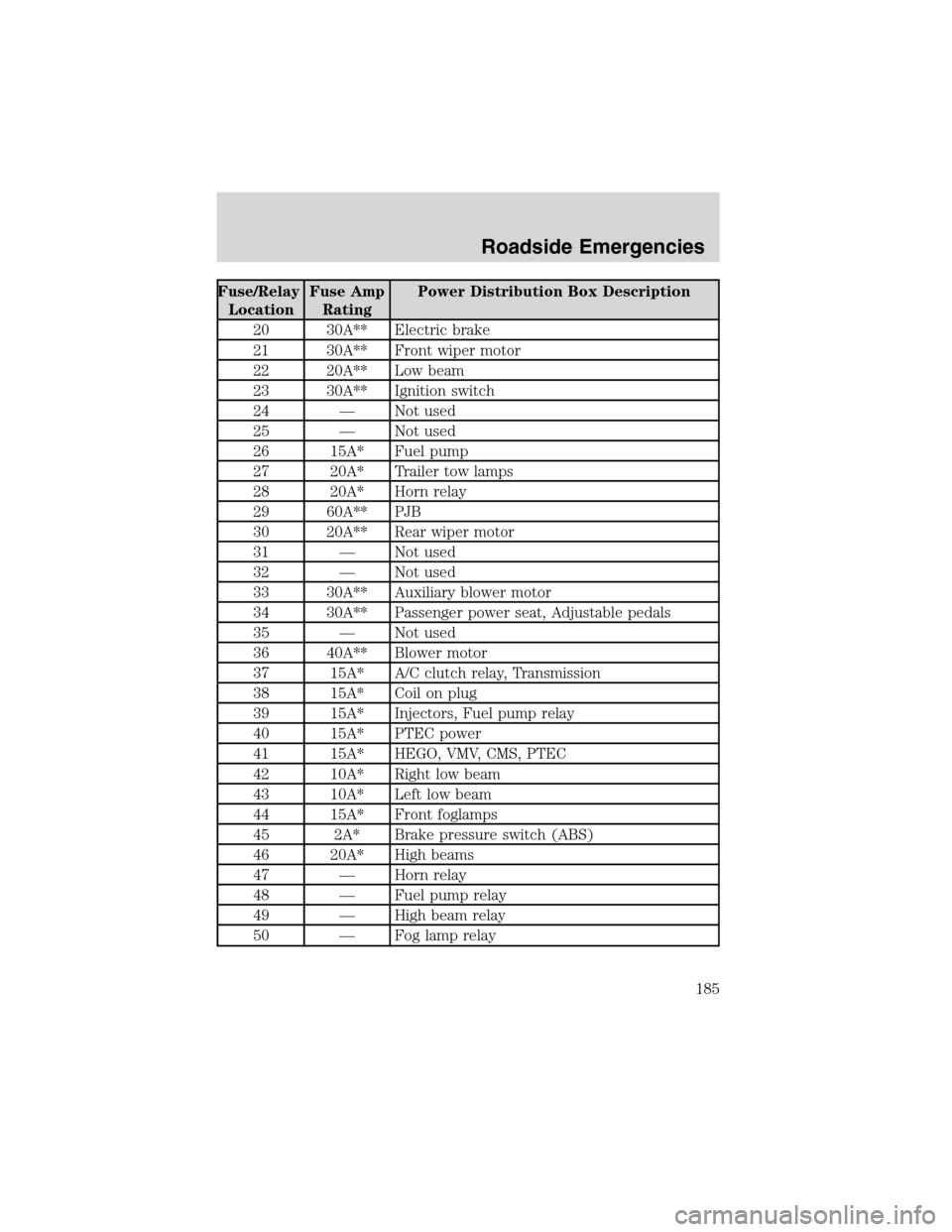
Fuse/Relay
LocationFuse Amp
RatingPower Distribution Box Description
20 30A** Electric brake
21 30A** Front wiper motor
22 20A** Low beam
23 30A** Ignition switch
24—Not used
25—Not used
26 15A* Fuel pump
27 20A* Trailer tow lamps
28 20A* Horn relay
29 60A** PJB
30 20A** Rear wiper motor
31—Not used
32—Not used
33 30A** Auxiliary blower motor
34 30A** Passenger power seat, Adjustable pedals
35—Not used
36 40A** Blower motor
37 15A* A/C clutch relay, Transmission
38 15A* Coil on plug
39 15A* Injectors, Fuel pump relay
40 15A* PTEC power
41 15A* HEGO, VMV, CMS, PTEC
42 10A* Right low beam
43 10A* Left low beam
44 15A* Front foglamps
45 2A* Brake pressure switch (ABS)
46 20A* High beams
47—Horn relay
48—Fuel pump relay
49—High beam relay
50—Fog lamp relay
Roadside Emergencies
185
Page 186 of 272
Fuse/Relay
LocationFuse Amp
RatingPower Distribution Box Description
51—DRL relay (Canada)/AdvanceTrac�relay
(U.S.)
52—A/C clutch relay
53—Trailer tow right turn relay
54—Trailer tow left turn relay
55—Blower motor relay
56—Starter relay
57—PTEC relay
58—Ignition relay
59—Driver brake applied relay (vehicles equipped
with AdvanceTrac�only)
60—PCM diode
61—A/C clutch diode
62 30A CB Power windows circuit breaker
* Mini Fuses ** Maxi Cartridge Fuses
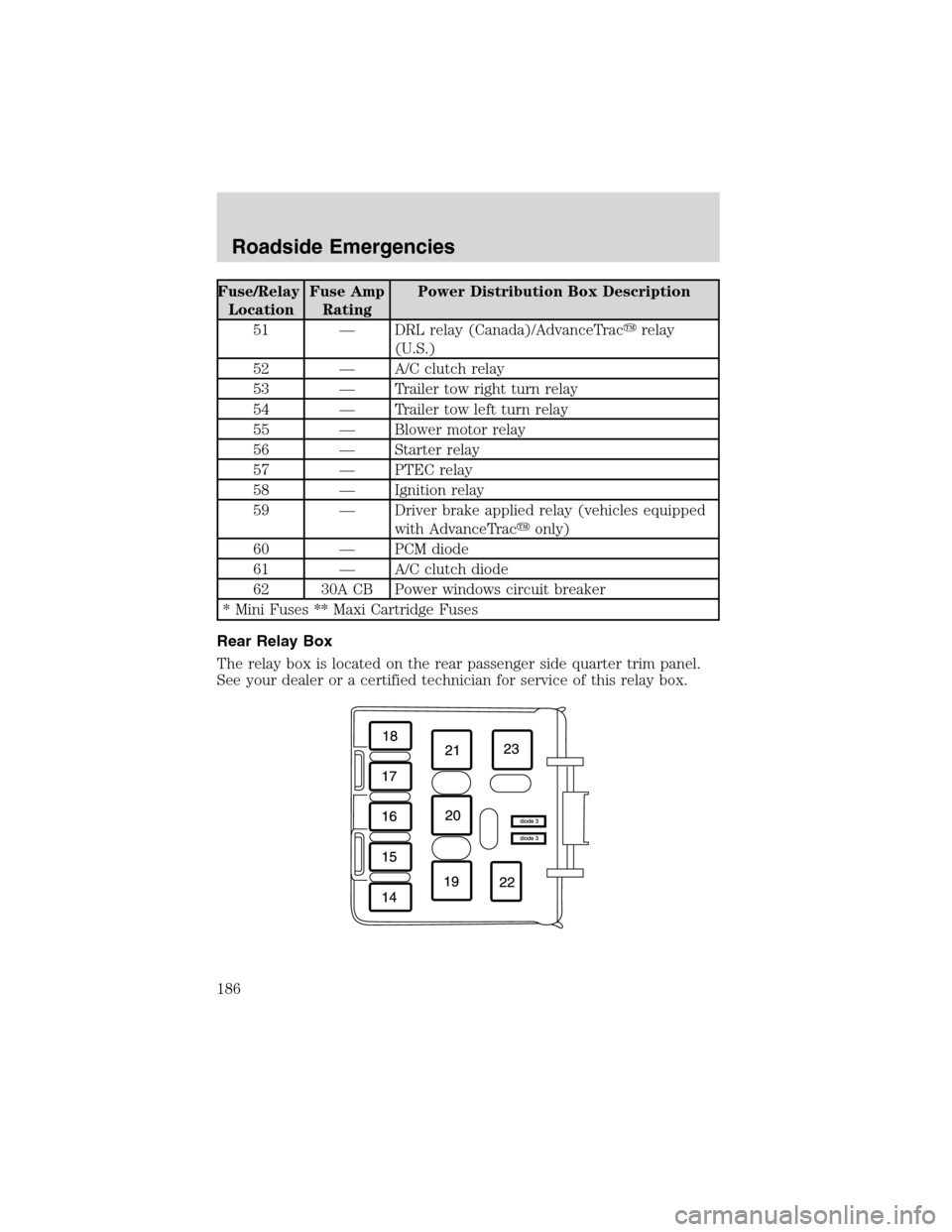
Rear Relay Box
The relay box is located on the rear passenger side quarter trim panel.
See your dealer or a certified technician for service of this relay box.
Roadside Emergencies
186
Page 187 of 272
The relays are coded as follows:
Fuse/Relay Location Description
Relay 14 Not used
Relay 15 Trailer tow back- up lamps
Relay 16 Not used
Relay 17 Not used
Relay 18 Not used
Relay 19 Trailer tow park lamps
Relay 20 Trailer tow battery charge
Relay 21 Not used
Relay 22 Approach lamps
Relay 23 Not used
Diode 3 Not used
Diode 4 Not used
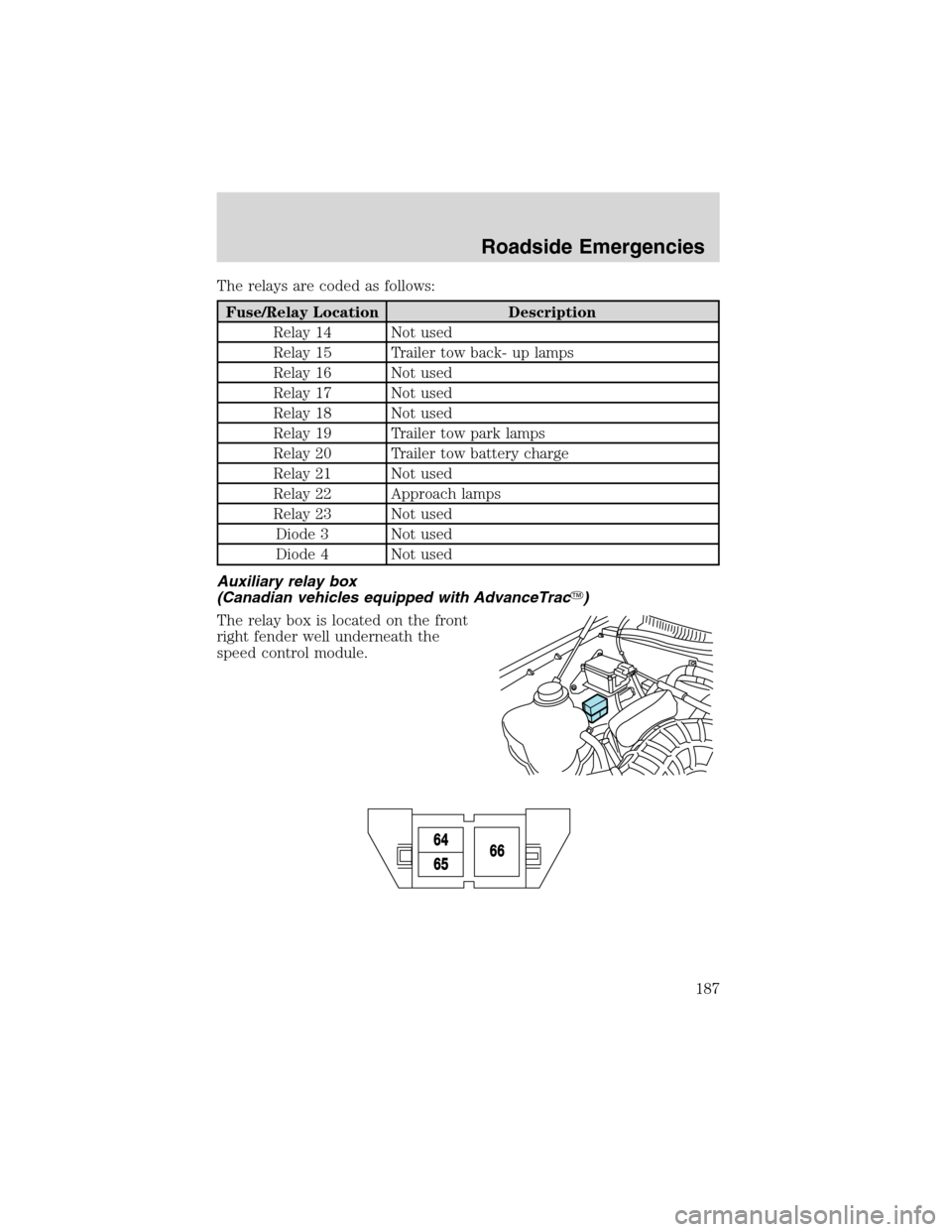
Auxiliary relay box
(Canadian vehicles equipped with AdvanceTrac�)
The relay box is located on the front
right fender well underneath the
speed control module.
Roadside Emergencies
187