2003 FORD EXPEDITION parking brake
[x] Cancel search: parking brakePage 273 of 320
When lifting a plastic-cased battery, excessive pressure on the
end walls could cause acid to flow through the vent caps,
resulting in personal injury and/or damage to the vehicle or battery.
Lift the battery with a battery carrier or with your hands on opposite
corners.
Keep batteries out of reach of children. Batteries contain sulfuric
acid. Avoid contact with skin, eyes or clothing. Shield your eyes
when working near the battery to protect against possible splashing of
acid solution. In case of acid contact with skin or eyes, flush
immediately with water for a minimum of 15 minutes and get prompt
medical attention. If acid is swallowed, call a physician immediately.
Battery posts, terminals and related accessories contain lead and
lead compounds.Wash hands after handling.
For information on transmission operation after the battery has been
disconnected see“Shift strategy”in the driving section.
To account for customer driving habits and conditions, your automatic
transmission (4R70W) electronically controls the shift quality by using an
adaptive learning strategy. The adaptive learning strategy is maintained
by power from the battery. When the battery is disconnected or a new
battery is installed, the transmission must relearn its adaptive strategy.
Optimal shifting will resume within a few hundred kilometers (miles) of
operation.
If the shift quality does not improve within a few hundred
kilometers (miles) of operation, or if the downshifts and other
throttle conditions do not function normally or after a long
deceleration period, see your dealer or a qualified service
technician as soon as possible.
Because your vehicle’s engine is also electronically controlled by a
computer, some control conditions are maintained by power from the
battery. When the battery is disconnected or a new battery is installed,
the engine must relearn its idle and fuel trim strategy for optimum
driveability and performance. To begin this process:
1. With the vehicle at a complete stop, set the parking brake.
2. Put the gearshift in P (Park), turn off all accessories and start the
engine.
Maintenance and Specifications
273
Page 291 of 320
2. Visually inspect the fluid level.
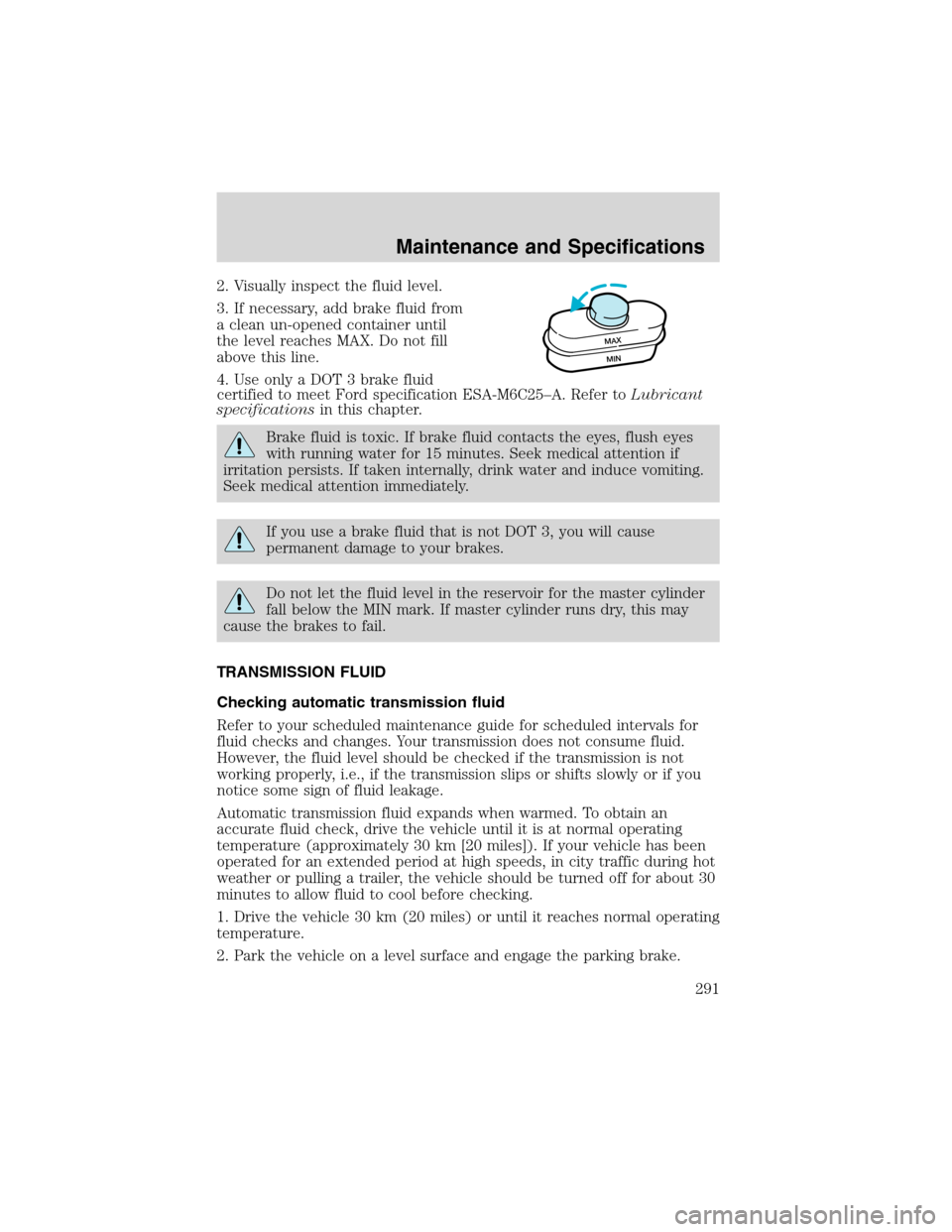
3. If necessary, add brake fluid from
a clean un-opened container until
the level reaches MAX. Do not fill
above this line.
4. Use only a DOT 3 brake fluid
certified to meet Ford specification ESA-M6C25–A. Refer toLubricant
specificationsin this chapter.
Brake fluid is toxic. If brake fluid contacts the eyes, flush eyes
with running water for 15 minutes. Seek medical attention if
irritation persists. If taken internally, drink water and induce vomiting.
Seek medical attention immediately.
If you use a brake fluid that is not DOT 3, you will cause
permanent damage to your brakes.
Do not let the fluid level in the reservoir for the master cylinder
fall below the MIN mark. If master cylinder runs dry, this may
cause the brakes to fail.
TRANSMISSION FLUID
Checking automatic transmission fluid
Refer to your scheduled maintenance guide for scheduled intervals for
fluid checks and changes. Your transmission does not consume fluid.
However, the fluid level should be checked if the transmission is not
working properly, i.e., if the transmission slips or shifts slowly or if you
notice some sign of fluid leakage.
Automatic transmission fluid expands when warmed. To obtain an
accurate fluid check, drive the vehicle until it is at normal operating
temperature (approximately 30 km [20 miles]). If your vehicle has been
operated for an extended period at high speeds, in city traffic during hot
weather or pulling a trailer, the vehicle should be turned off for about 30
minutes to allow fluid to cool before checking.
1. Drive the vehicle 30 km (20 miles) or until it reaches normal operating
temperature.
2. Park the vehicle on a level surface and engage the parking brake.
MAX
MIN
Maintenance and Specifications
291
Page 292 of 320
3. With the parking brake engaged and your foot on the brake pedal,
start the engine and move the gearshift lever through all of the gear
ranges. Allow sufficient time for each gear to engage.
4. Latch the gearshift lever in P (Park) and leave the engine running.
5. Remove the dipstick, wiping it clean with a clean, dry lint free rag. If
necessary, refer toIdentifying components in the engine compartment
in this chapter for the location of the dipstick.
6. Install the dipstick making sure it is fully seated in the filler tube.
7. Remove the dipstick and inspect the fluid level. The fluid should be in
the designated area for normal operating temperature or ambient
temperature.
Low fluid level
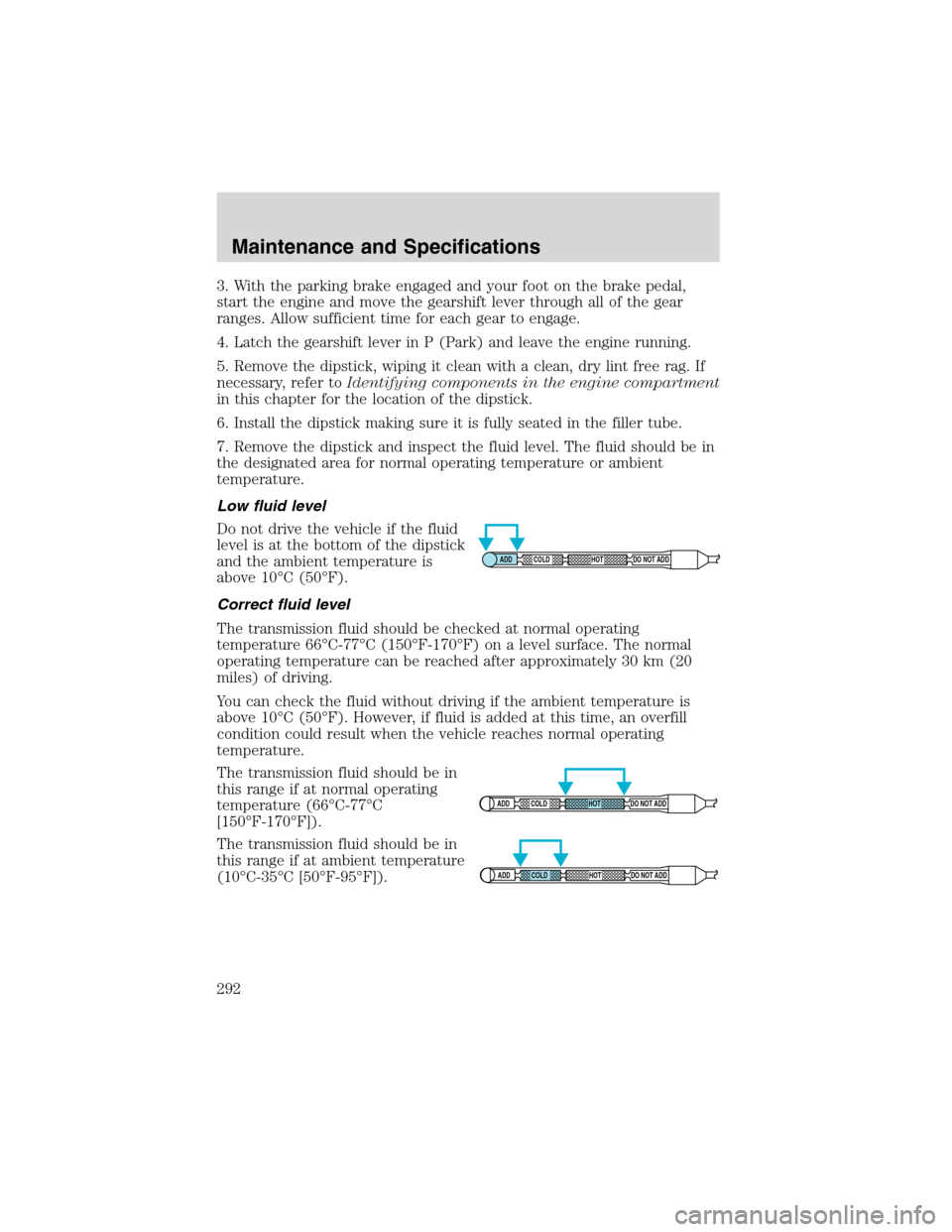
Do not drive the vehicle if the fluid
level is at the bottom of the dipstick
and the ambient temperature is
above 10°C (50°F).
Correct fluid level
The transmission fluid should be checked at normal operating
temperature 66°C-77°C (150°F-170°F) on a level surface. The normal
operating temperature can be reached after approximately 30 km (20
miles) of driving.
You can check the fluid without driving if the ambient temperature is
above 10°C (50°F). However, if fluid is added at this time, an overfill
condition could result when the vehicle reaches normal operating
temperature.
The transmission fluid should be in
this range if at normal operating
temperature (66°C-77°C
[150°F-170°F]).
The transmission fluid should be in
this range if at ambient temperature
(10°C-35°C [50°F-95°F]).
ADD COLD HOT DO NOT ADD
ADD COLD HOT DO NOT ADD
ADD COLD HOT DO NOT ADD
Maintenance and Specifications
292
Page 313 of 320
A
ABS (see Brakes) .....................195
Accessory delay ........................100
Air bag supplemental
restraint system ........168–169, 173
and child safety seats ............170
description ......................169, 173
disposal ....................................176
driver air bag ..................171, 174
indicator light ...........12, 172, 176
operation .........................171, 174
passenger air bag ...........171, 174
Air cleaner filter .......293–294, 300
Air conditioning ..........................72
auxiliary heater and air
conditioner ................................78
manual heating and air
conditioning system .................69
Air suspension
warning light .............................14
Antifreeze
(see Engine coolant) ................274
Anti-lock brake system
(see Brakes) ......................195–196
Armrests ....................................142
Audio system
(see Radio) ................19, 27, 37–38
Automatic transmission
driving an automatic
overdrive .................................203
fluid, adding ............................291
fluid, checking ........................291
fluid, refill capacities ..............300
fluid, specification ..................305
Auxiliary power point .................97Axle
lubricant
specifications ..................303, 305
refill capacities ........................300
B
Battery .......................................272
acid, treating emergencies .....272
charging system warning
light ............................................12
jumping a disabled battery ....241
maintenance-free ....................272
replacement, specifications ...300
servicing ..................................272
voltage gauge ............................16
BeltMinder .................................164
Brakes ........................................195
anti-lock ...........................195–196
anti-lock brake system
(ABS) warning light .........11, 196
brake warning light ..................11
fluid, checking and adding ....290
fluid, refill capacities ..............300
fluid, specifications .........303, 305
lubricant
specifications ..................303, 305
parking ....................................196
pedals (see Power
adjustable foot pedals) ..102, 125
shift interlock ..................202, 206
Break-in period .............................6
Bulbs ............................................86
C
Capacities for refilling fluids ....300
CD-6 disc .....................................38
CD-single premium ...............19, 27
Certification Label ....................307
Index
313
Page 317 of 320
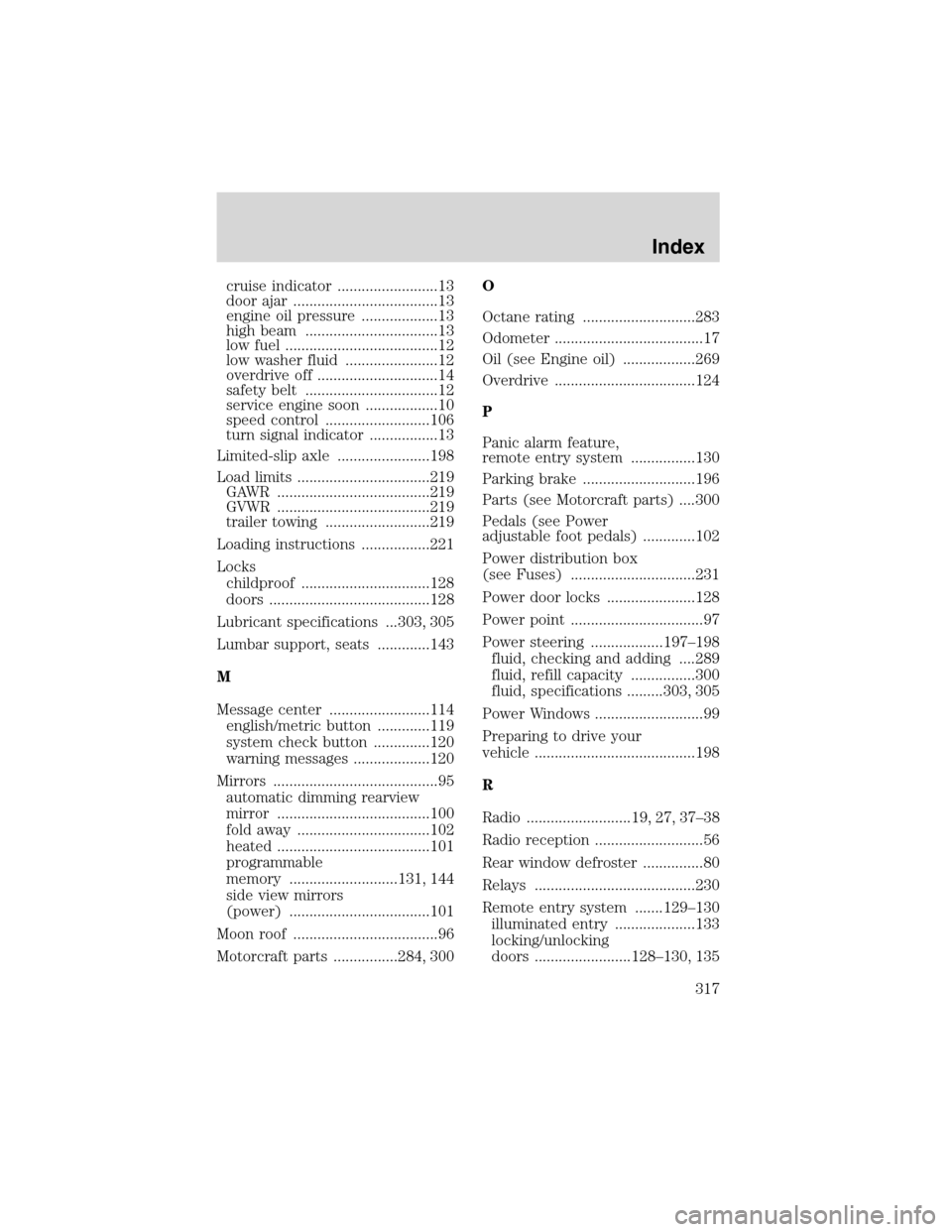
cruise indicator .........................13
door ajar ....................................13
engine oil pressure ...................13
high beam .................................13
low fuel ......................................12
low washer fluid .......................12
overdrive off ..............................14
safety belt .................................12
service engine soon ..................10
speed control ..........................106
turn signal indicator .................13
Limited-slip axle .......................198
Load limits .................................219
GAWR ......................................219
GVWR ......................................219
trailer towing ..........................219
Loading instructions .................221
Locks
childproof ................................128
doors ........................................128
Lubricant specifications ...303, 305
Lumbar support, seats .............143
M
Message center .........................114
english/metric button .............119
system check button ..............120
warning messages ...................120
Mirrors .........................................95
automatic dimming rearview
mirror ......................................100
fold away .................................102
heated ......................................101
programmable
memory ...........................131, 144
side view mirrors
(power) ...................................101
Moon roof ....................................96
Motorcraft parts ................284, 300O
Octane rating ............................283
Odometer .....................................17
Oil (see Engine oil) ..................269
Overdrive ...................................124
P
Panic alarm feature,
remote entry system ................130
Parking brake ............................196
Parts (see Motorcraft parts) ....300
Pedals (see Power
adjustable foot pedals) .............102
Power distribution box
(see Fuses) ...............................231
Power door locks ......................128
Power point .................................97
Power steering ..................197–198
fluid, checking and adding ....289
fluid, refill capacity ................300
fluid, specifications .........303, 305
Power Windows ...........................99
Preparing to drive your
vehicle ........................................198
R
Radio ..........................19, 27, 37–38
Radio reception ...........................56
Rear window defroster ...............80
Relays ........................................230
Remote entry system .......129–130
illuminated entry ....................133
locking/unlocking
doors ........................128–130, 135
Index
317