2003 FORD ESCORT instrument cluster
[x] Cancel search: instrument clusterPage 73 of 184

Determining if the system is operational
The SRS uses a readiness light in the instrument cluster or a tone to
indicate the condition of the system. Refer toAir bag readinesssection
in theInstrument clusterchapter. Routine maintenance of the air bag is
not required.
A difficulty with the systemis indicated by one or more of the following:
•The readiness light will either
flash or stay lit.
•The readiness light will not
illuminate immediately after
ignition is turned on.
•A series of five beeps will be heard. The tone pattern will repeat
periodically until the problemand/or light are repaired.
If any of these things happen, even intermittently, have the SRS serviced
at your dealership or by a qualified technician immediately. Unless
serviced, the systemmay not function properly in the event of a
collision.
Disposal of air bags and air bag equipped vehicles
See your local dealership or qualified technician. Air bags MUST BE
disposed of by qualified personnel.
SAFETY RESTRAINTS FOR CHILDREN
See the following sections for directions on how to properly use safety
restraints for children. Also seeAir bag supplemental restraint system
(SRS)in this chapter for special instructions about using air bags.
Important child restraint precautions
You are required by law to use safety restraints for children in the U.S.
and Canada. If small children (generally children who are four years old
or younger and who weigh 18 kg [40 lbs] or less) ride in your vehicle,
you must put them in safety seats made especially for children. Check
your local and state or provincial laws for specific requirements
regarding the safety of children in your vehicle. When possible, always
place children under age 12 in the rear seat of your vehicle. Accident
statistics suggest that children are safer when properly restrained in the
rear seating positions than in the front seating position.
Seating and Safety Restraints
73
Page 90 of 184
•The anti-lock systemdoes not reduce stopping distance. Always leave
enough roombetween your vehicle and the vehicle in front of you to
stop.
•We recommend that you familiarize yourself with this braking
technique. However, avoid taking any unnecessary risks.
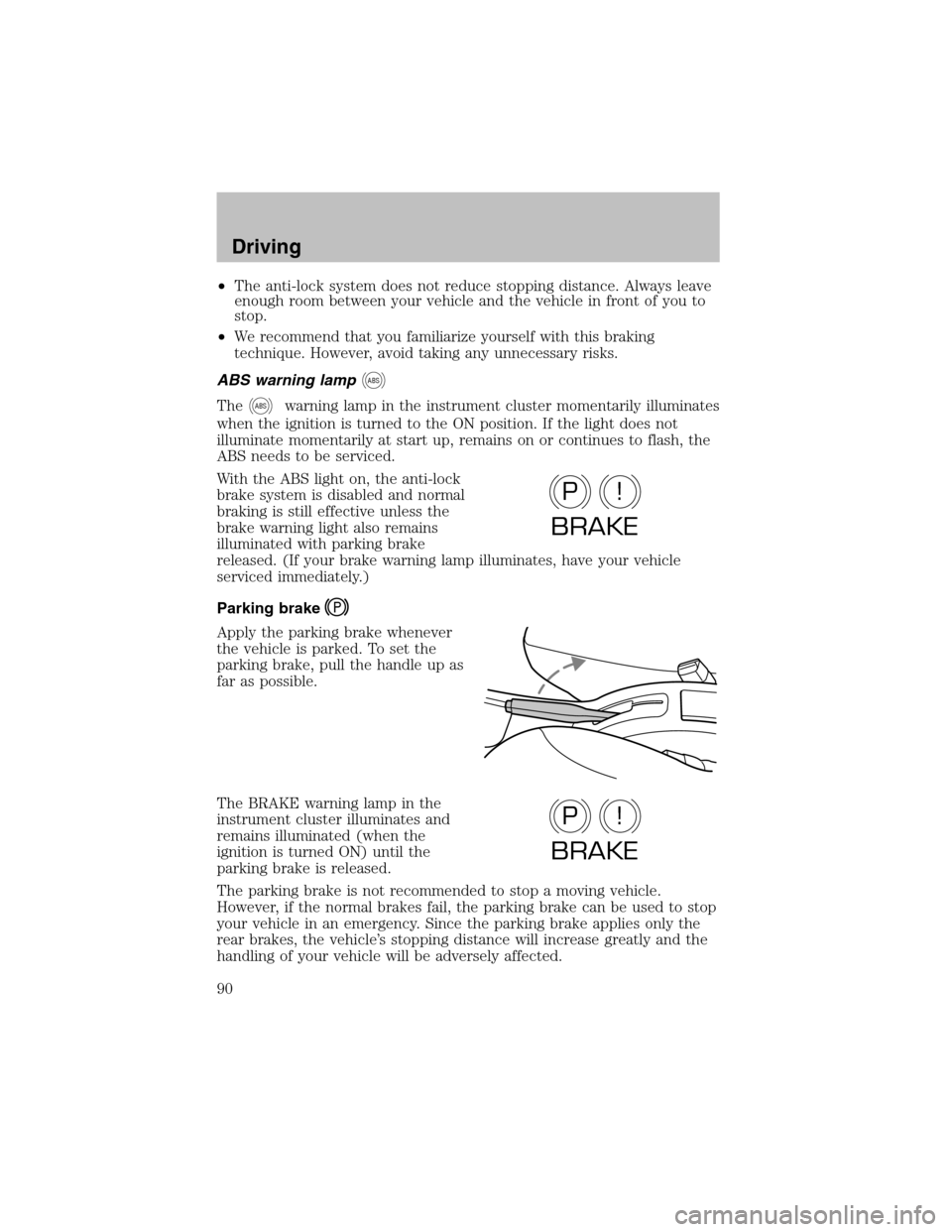
ABS warning lamp
ABS
TheABSwarning lamp in the instrument cluster momentarily illuminates
when the ignition is turned to the ON position. If the light does not
illuminate momentarily at start up, remains on or continues to flash, the
ABS needs to be serviced.
With the ABS light on, the anti-lock
brake systemis disabled and normal
braking is still effective unless the
brake warning light also remains
illuminated with parking brake
released. (If your brake warning lamp illuminates, have your vehicle
serviced immediately.)
Parking brake
Apply the parking brake whenever
the vehicle is parked. To set the
parking brake, pull the handle up as
far as possible.
The BRAKE warning lamp in the
instrument cluster illuminates and
remains illuminated (when the
ignition is turned ON) until the
parking brake is released.
The parking brake is not recommended to stop a moving vehicle.
However, if the normal brakes fail, the parking brake can be used to stop
your vehicle in an emergency. Since the parking brake applies only the
rear brakes, the vehicle’s stopping distance will increase greatly and the
handling of your vehicle will be adversely affected.
P!
BRAKE
P!
BRAKE
Driving
90
Page 107 of 184

Passenger compartment fuse panel
The fuses are coded as follows:
Fuse/Relay
LocationFuse Amp
RatingPassenger Compartment Fuse
Panel Description
DRL 10A Daytime Running Lamps (DRL)
HAZARD 15A Hazard flasher
ROOM 10A Engine controls, RAP system,
Radio, Shift lock, Courtesy lamps,
Starting system, Warning chime,
Instrument cluster
ENGINE 15A Electronic automatic transaxle,
Ignition system, Constant control
relay module (PCM relay)
RADIO 5A Power mirrors, Radio, RAP system
DOOR LOCK 30A Power door locks
HORN 15A Horn, Shift lock
AIR COND 15A A/C-heater, ABS
METER 10A Backup lamps, Engine coolant
level switch, Instrument cluster,
Rear window defrost, Shift lock,
Warning chime, Turn signal switch
(DRL) (DOOR LK)
STOP
HAZARD HORN
TAIL
ROOM(AIR COND) (SUN ROOF)
ENGINE METER(ASC)
RADIO
WIPER
–P. Window (C.B.)
(FOG) CIGAR
(AUDIO)
AIR BAGFUEL INJ
HEATER
–
Roadside Emergencies
107
Page 109 of 184

The high-current fuses are coded as follows.
Fuse/Relay
LocationFuse Amp
RatingPower Distribution Box
Description
FUEL INJ. 30A* Air bags, Constant control relay
module (PCM relay), Generator
DEFOG 30A* Rear window defrost
MAIN 100A* Overall circuit protection
BTN 40A* Hazard, Stop, Door lock, Tail,
Roomand Horn fuses of the I/P
fuse panel
ABS 60A* Anti-lock Brake System(ABS)
main relay
COOLING FAN 40A* Constant control relay module
(cooling fan)
OBD-II 10A* Data Link Connector (DLC),
Instrument cluster
FUEL PUMP 20A** Constant control relay module
(fuel pump)
HEAD RH 10A** Headlamps
HEAD LH 10A** Headlamps
* Fuse Link Cartridge **Fuse
USE THE DESIGNATED FUSES ONLY
FUEL INJ
30A
DEFOG
30A
MAIN
100A
COOLING FAN
40A (ABS)
60A BTN
40A
HEADLAMP
RELAY
FUEL PUMP 20AOBD-II 10A
HEAD RH 10A HEAD LH 10A
Roadside Emergencies
109
Page 133 of 184
•Do not use abrasives, as they may cause scratches.
•Do not use fuel, kerosene, or paint thinner to clean any parts.
•Wiper blades can be cleaned with isopropyl (rubbing) alcohol or
windshield washer solution. Be sure to replace wiper blades when they
appear worn or do not function properly.
INSTRUMENT PANEL AND CLUSTER LENS
Clean the instrument panel with a damp cloth, then dry with a dry cloth.
•Avoid cleaners or polish that increase the gloss of the upper portion of
the instrument panel. The dull finish in this area helps protect the
driver fromundesirable windshield reflection.
Do not use chemical solvents or strong detergents when cleaning
the steering wheel or instrument panel to avoid contamination of
the air bag system.
•Be certain to wash or wipe your hands clean if you have been in
contact with certain products such as insect repellent and suntan
lotion in order to avoid possible damage to the painted surfaces.
INTERIOR
For fabric, carpets, cloth seats and safety belts:
•Remove dust and loose dirt with a vacuum cleaner.
•Remove light stains and soil with Ford Extra Strength Upholstery
Cleaner (E8AZ-19523–AA).
•If grease or tar is present on the material, spot-clean the area first
with Motorcraft Spot and Stain Remover (ZC-14).
•Never saturate the seat covers with cleaning solution.
•Do not use household cleaning products or glass cleaners, which can
stain and discolor the fabric and affect the flame retardant abilities of
the seat materials.
Do not use cleaning solvents, bleach or dye on the vehicle’s
seatbelts, as these actions may weaken the belt webbing.
Cleaning
133
Page 155 of 184

Cleaner air
Ford endorses the use of reformulated “cleaner-burning” gasolines to
improve air quality.
Running out of fuel
Avoid running out of fuel because this situation may have an adverse
affect on powertrain components.
If you have run out of fuel:
•You may need to cycle the ignition from OFF to ON several times after
refueling, to allow the fuel systemto pump the fuel fromthe tank to
the engine.
•Your “Service Engine Soon” indicator may come on. For more
information on the “Service Engine Soon” indicator, refer to the
Instrument clusterchapter.
Fuel Filter
For fuel filter replacement, see your dealer or a qualified service
technician. Refer to the scheduled maintenance guide for the appropriate
intervals for changing the fuel filter.
Replace the fuel filter with an authorized Motorcraft part. The
customer warranty may be void for any damage to the fuel system
if an authorized Motorcraft fuel filter is not used.
ESSENTIALS OF GOOD FUEL ECONOMY
Measuring techniques
Your best source of information about actual fuel economy is you, the
driver. You must gather information as accurately and consistently as
possible. Fuel expense, frequency of fill-ups or fuel gauge readings are
NOT accurate as a measure of fuel economy. We do not recommend
taking fuel economy measurements during the first 1,600 km (1,000
miles) of driving (engine break-in period). You will get a more accurate
measurement after 3,000 km–5,000 km (2,000 miles-3,000 miles).
Filling the tank
The advertised fuel capacity of the fuel tank on your vehicle is equal to
the rated refill capacity of the fuel tank as listed in theRefill capacities
section of this chapter.
The advertised capacity is the amount of the indicated capacity and the
empty reserve combined. Indicated capacity is the difference in the
Maintenance and Specifications
155
Page 159 of 184
•Do not turn off the ignition while your vehicle is moving, especially at
high speeds.
•Have the items listed in your scheduled maintenance guide performed
according to the specified schedule.
The scheduled maintenance items listed in the scheduled maintenance
guide are essential to the life and performance of your vehicle and to its
emissions system.
If other than Ford, Motorcraft or Ford-authorized parts are used for
maintenance replacements or for service of components affecting
emission control, such non-Ford parts should be equivalent to genuine
Ford Motor Company parts in performance and durability.
Do not park, idle, or drive your vehicle in dry grass or other dry
ground cover. The emission system heats up the engine
compartment and exhaust system, which can start a fire.
Illumination of the “Service Engine Soon” light, charging system warning
light or the temperature warning light, fluid leaks, strange odors, smoke
or loss of engine power, could indicate that the emission control system
is not working properly.
Exhaust leaks may result in entry of harmful and potentially
lethal fumes into the passenger compartment.
Do not make any unauthorized changes to your vehicle or engine. By
law, vehicle owners and anyone who manufactures, repairs, services,
sells, leases, trades vehicles, or supervises a fleet of vehicles are not
permitted to intentionally remove an emission control device or prevent
it from working. Information about your vehicle’s emission system is on
the Vehicle Emission Control Information Decal located on or near the
engine. This decal identifies engine displacement and gives some tune up
specifications.
Please consult yourWarranty Guidefor complete emission warranty
information.
Readiness for Inspection/Maintenance (I/M) testing
In some localities, it may be a legal requirement to pass an I/M test of
the on-board diagnostics system. If your “Check Engine/Service Engine
Soon” light is on, refer to the description in theWarning lights and
chimessection of theInstrument clusterchapter. Your vehicle may not
pass the I/M test with the “Check Engine/Service Engine Soon” light on.
Maintenance and Specifications
159
Page 181 of 184

choosing the right fuel ...........153
comparisons with EPA fuel
economy estimates .................158
detergent in fuel .....................155
filling your vehicle with
fuel ...........................151, 153, 155
filter, specifications ........155, 169
fuel pump shut-off switch .....104
improving fuel economy ........155
octane rating ...................154, 172
quality ......................................154
running out of fuel .................155
safety information relating to
automotive fuels .....................151
Fuses ..................................105, 107
G
Gas cap (see Fuel cap) ............153
Gas mileage
(see Fuel economy) .................155
Gauges .........................................12
GAWR (Gross Axle Weight
Rating) .........................................99
definition ...................................99
driving with a heavy load ........99
location ......................................99
GVWR (Gross Vehicle Weight
Rating) .........................................99
calculating .................................99
definition ...................................99
driving with a heavy load ........99
location ......................................99
H
Hazard flashers .........................104
Head restraints ...........................58
Headlamps ...................................33
aiming ..................................34–36bulb specifications ....................37
flash to pass ..............................34
high beam.................................33
replacing bulbs .........................38
turning on and off ....................33
Heating
heater only system...................28
heating and air conditioning
system.......................................29
Hood ..........................................138
I
Ignition .................................84, 172
Infant seats (see Safety seats) ..76
Inspection/maintenance (I/M)
testing ........................................159
Instrument panel
cleaning ...................................133
cluster ........................................10
lighting up panel and
interior .......................................34
J
Jack ............................................110
positioning ...............................110
storage .....................................110
Jump-starting your vehicle ......114
K
Keys
positions of the ignition ...........84
L
Lamps
bulb replacement
specifications chart ..................37
Index
181