2003 FORD ESCAPE brake
[x] Cancel search: brakePage 210 of 240
during hot weather or pulling a trailer, the vehicle should be
turned off for about 30 minutes to allow fluid to cool before
checking.
1. Drive the vehicle 30 km (20 miles) or until it reaches normal operating
temperature.
2. Park the vehicle on a level surface and engage the parking brake.
3. With the parking brake engaged and your foot on the brake pedal,
start the engine and move the gearshift lever through all of the gear
ranges. Allow sufficient time for each gear to engage.
4. Latch the gearshift lever in P (Park) and leave the engine running.
5. Remove the dipstick, wiping it clean with a clean, dry lint free rag. If
necessary, refer toIdentifying components in the engine compartment
in this chapter for the location of the dipstick.
6. Install the dipstick making sure it is fully seated in the filler tube.
7. Remove the dipstick and inspect the fluid level. The fluid should be in
the crosshatch zone for normal operating temperature.
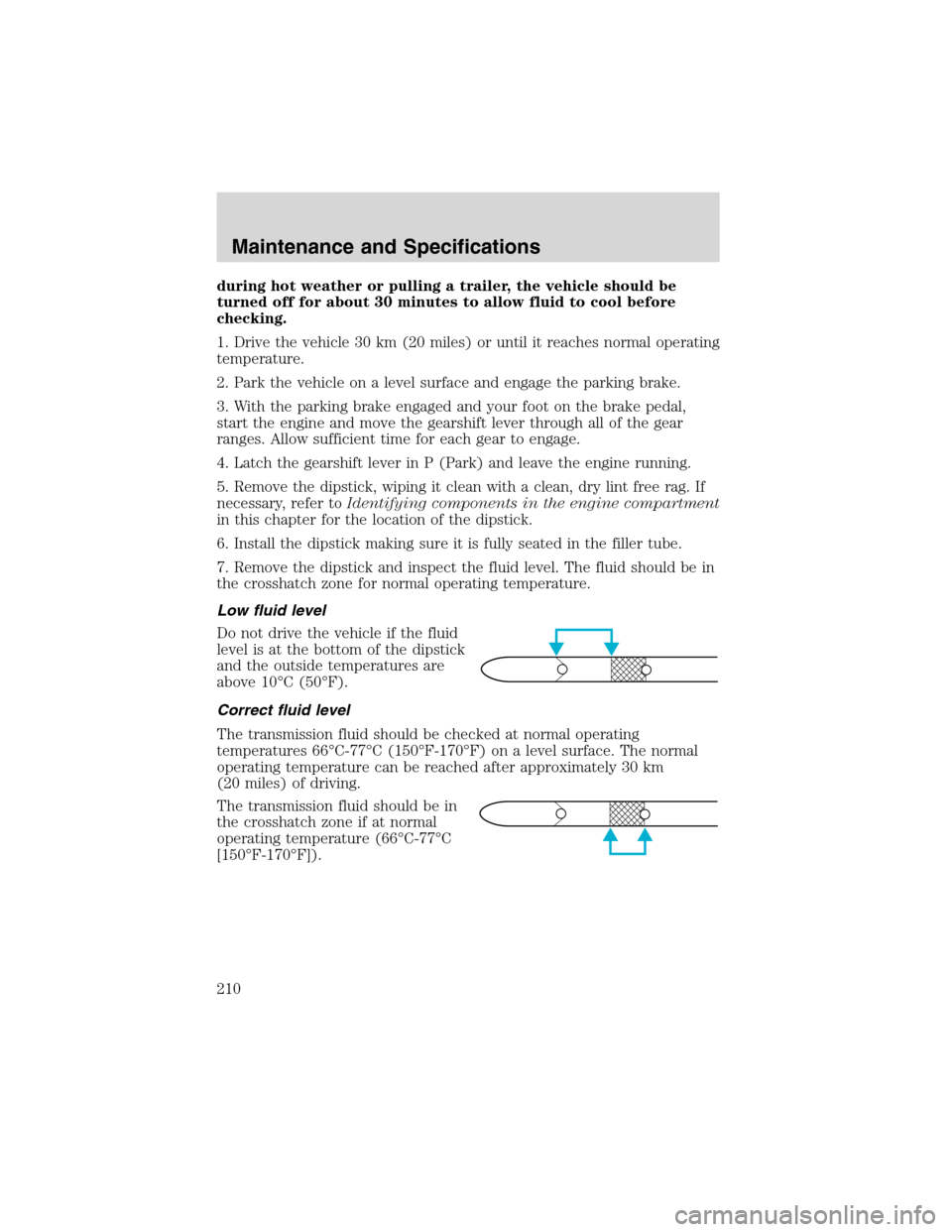
Low fluid level
Do not drive the vehicle if the fluid
level is at the bottom of the dipstick
and the outside temperatures are
above 10°C (50°F).
Correct fluid level
The transmission fluid should be checked at normal operating
temperatures 66°C-77°C (150°F-170°F) on a level surface. The normal
operating temperature can be reached after approximately 30 km
(20 miles) of driving.
The transmission fluid should be in
the crosshatch zone if at normal
operating temperature (66°C-77°C
[150°F-170°F]).
Maintenance and Specifications
210
Page 211 of 240
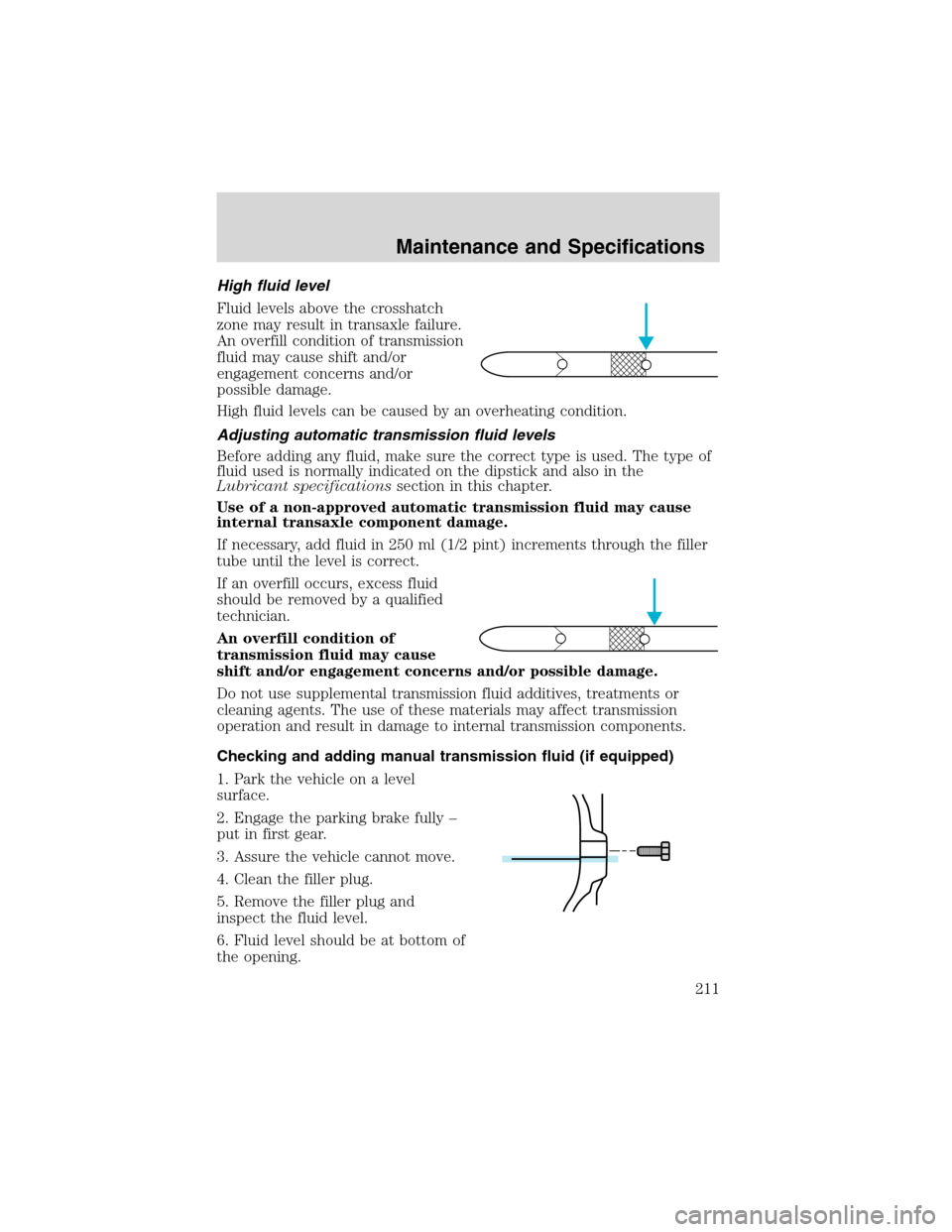
High fluid level
Fluid levels above the crosshatch
zone may result in transaxle failure.
An overfill condition of transmission
fluid may cause shift and/or
engagement concerns and/or
possible damage.
High fluid levels can be caused by an overheating condition.
Adjusting automatic transmission fluid levels
Before adding any fluid, make sure the correct type is used. The type of
fluid used is normally indicated on the dipstick and also in the
Lubricant specificationssection in this chapter.
Use of a non-approved automatic transmission fluid may cause
internal transaxle component damage.
If necessary, add fluid in 250 ml (1/2 pint) increments through the filler
tube until the level is correct.
If an overfill occurs, excess fluid
should be removed by a qualified
technician.
An overfill condition of
transmission fluid may cause
shift and/or engagement concerns and/or possible damage.
Do not use supplemental transmission fluid additives, treatments or
cleaning agents. The use of these materials may affect transmission
operation and result in damage to internal transmission components.
Checking and adding manual transmission fluid (if equipped)
1. Park the vehicle on a level
surface.
2. Engage the parking brake fully–
put in first gear.
3. Assure the vehicle cannot move.
4. Clean the filler plug.
5. Remove the filler plug and
inspect the fluid level.
6. Fluid level should be at bottom of
the opening.
Maintenance and Specifications
211
Page 212 of 240
7. Add enough fluid through the filler opening so that the fluid level is at
the bottom of the opening.
8. Install and tighten the fill plug securely.
Use only fluid that meets Ford specifications. Refer to theRefill
capacitiesin this chapter.
CLUTCH FLUID (IF EQUIPPED)
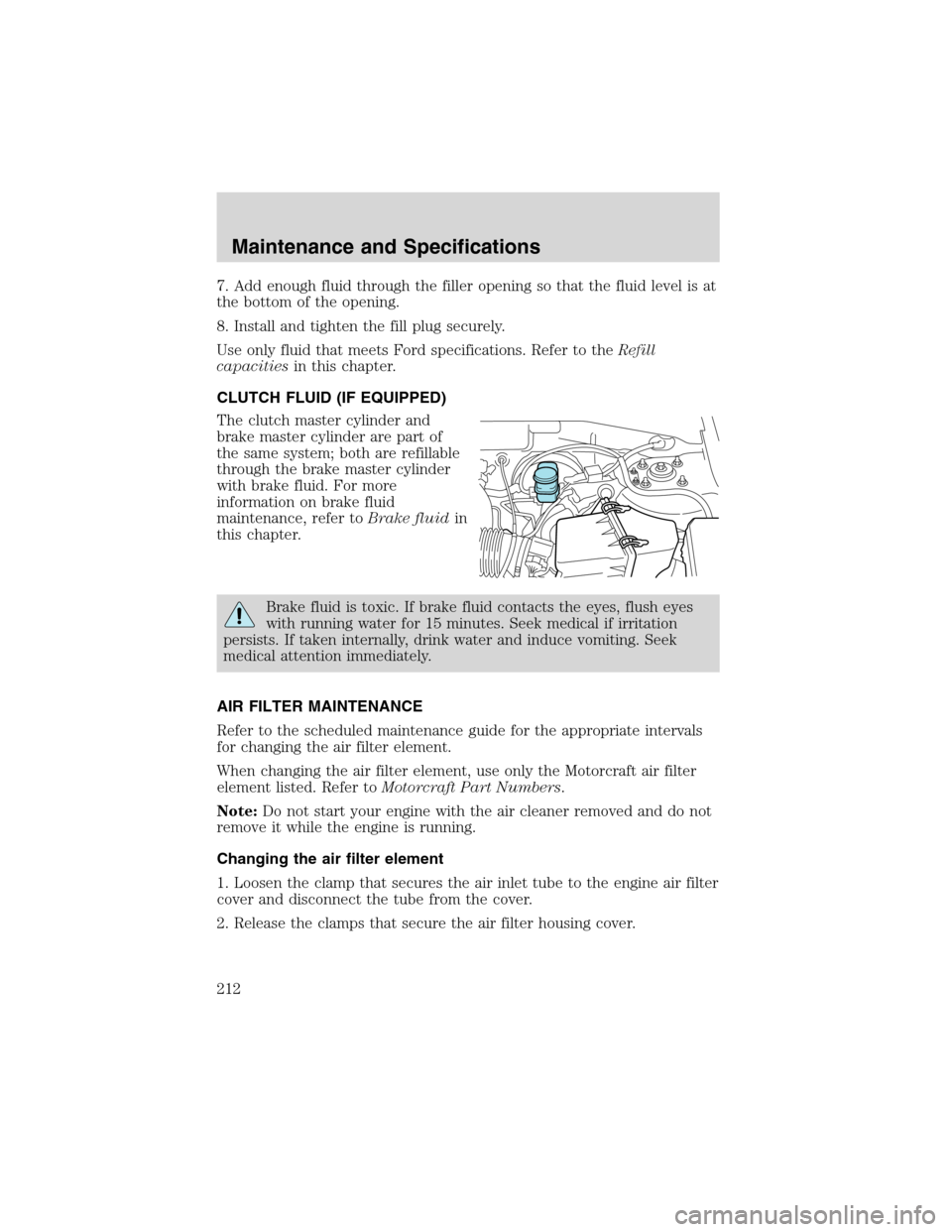
The clutch master cylinder and
brake master cylinder are part of
the same system; both are refillable
through the brake master cylinder
with brake fluid. For more
information on brake fluid
maintenance, refer toBrake fluidin
this chapter.
Brake fluid is toxic. If brake fluid contacts the eyes, flush eyes
with running water for 15 minutes. Seek medical if irritation
persists. If taken internally, drink water and induce vomiting. Seek
medical attention immediately.
AIR FILTER MAINTENANCE
Refer to the scheduled maintenance guide for the appropriate intervals
for changing the air filter element.
When changing the air filter element, use only the Motorcraft air filter
element listed. Refer toMotorcraft Part Numbers.
Note:Do not start your engine with the air cleaner removed and do not
remove it while the engine is running.
Changing the air filter element
1. Loosen the clamp that secures the air inlet tube to the engine air filter
cover and disconnect the tube from the cover.
2. Release the clamps that secure the air filter housing cover.
Maintenance and Specifications
212
Page 217 of 240
Failure to follow these precautions, your vehicle handling may be
adversely effected which can lead to loss of vehicle control,
vehicle rollover and/or personal injury.
Tires that are larger or smaller than your vehicle’s original tires may also
affect the accuracy of your speedometer.
USING SNOW TIRES AND TRACTION DEVICES
Snow tires must be the same size and grade as the tires you
currently have on your vehicle.
The tires on your vehicle have all-weather treads to provide traction in
rain and snow. However, in some climates, using snow tires or traction
devices may be necessary.
Follow these guidelines when using snow tires and traction devices:
•SAE class“S”cable should be used only on front axle for P235/70R16
tires. With P225/70R15 and P215/70R16 tires, SAE class“S”cables can
be used on both the front and rear wheels.
•Install cables or chains securely, verifying that the cables or chains do
not touch any wiring, brake lines or fuel lines.
•Drive cautiously. If you hear the cables or chains rub or bang against
the vehicle, stop and retighten them. If this does not work, remove the
cables or chains to prevent vehicle damage.
•Avoid overloading your vehicle.
•Remove the cables or chains when they are no longer needed.
•Do not use cables or chains on dry roads.
•Do not exceed 48 km/h (30 mph) with tire cables or chains on your
vehicle.
Consult your dealer for information on other Ford approved methods of
traction control.
Maintenance and Specifications
217
Page 218 of 240

MOTORCRAFT PART NUMBERS
Component 2.0L DOHC I4
Zetec engine3.0L DOHC V6 Duratec
engine
Air filter element
1FA-1683 FA-1683
Fuel filter FG-800-A FG-800-A
Battery BXT-96R BXT-40R
Oil filter FL-400S FL-820-S
PCV valve EV-244 EV-243
Spark plugs
2AZFS-32FE3AGSF-32W
1Failure to use the correct air filter element may result in severe engine
damage. The customer warranty may be voided for any damage to the
engine if the correct air filter element is not used.
2Refer to Vehicle Emissions Control Information (VECI) decal for spark
plug gap information.
3If a spark plug is to be removed for inspection, it must be reinstalled in
the same cylinder. If a spark plug needs to be replaced, use only spark
plugs with the service part number suffix letter as shown on the engine
decal.
REFILL CAPACITIES
Fluid Ford Part
NameApplication Capacity
Brake fluid
(clutch fluid, if
equipped)Motorcraft High
Performance
DOT 3 Motor
Vehicle Brake
FluidAll Fill to line on
reservoir
Engine oil
(including filter
change)Motorcraft SAE
5W-20 Premium
Synthetic Blend
Motor Oil2.0L I4 Zetec
engine4.25L
(4.5 quarts)
3.0L V6 Duratec
engine5.2L
(5.5 quarts)
Fuel tank N/A 2.0L I4 Zetec
engine61L
(16 gallons)
3.0L V6 Duratec
engine61L
(16 gallons)
Maintenance and Specifications
218
Page 221 of 240
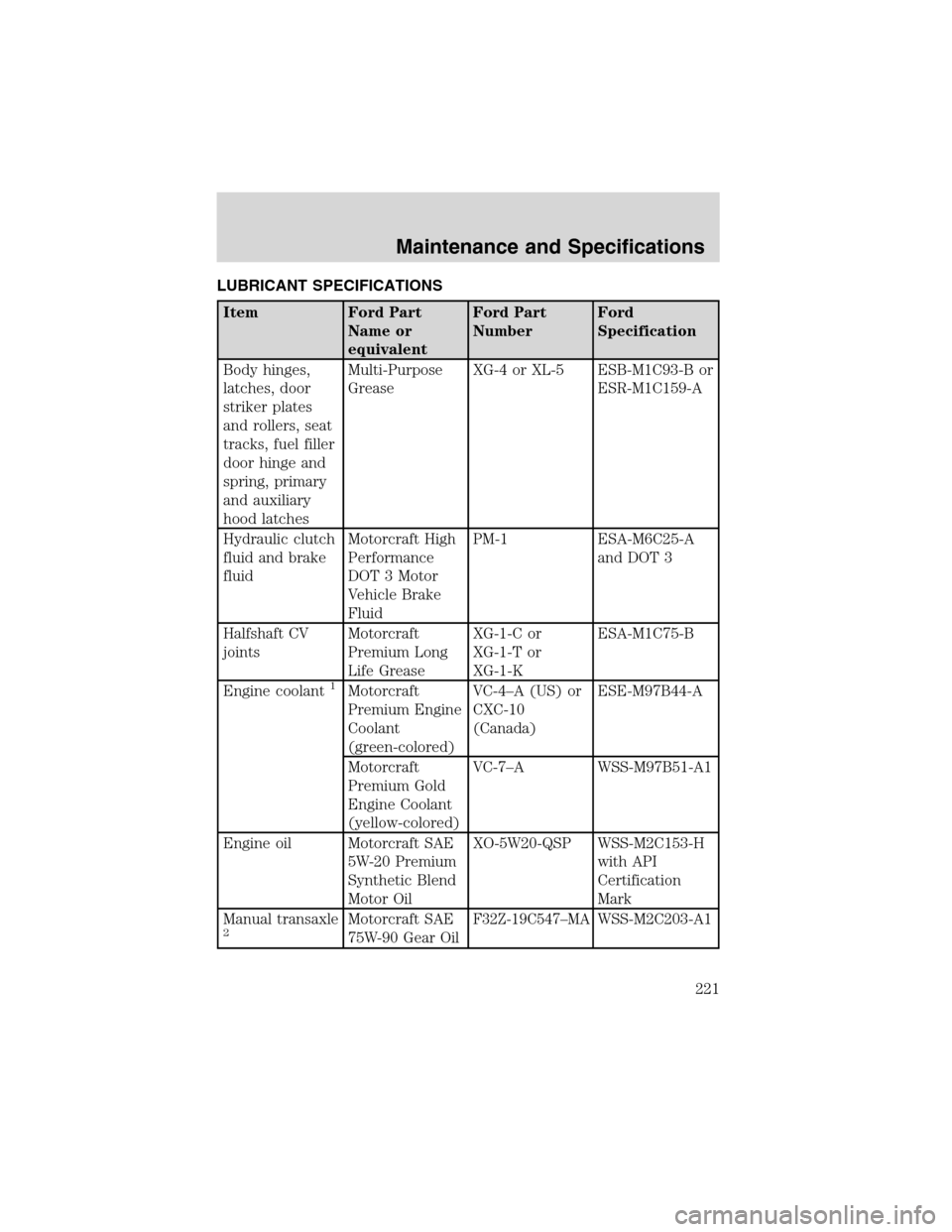
LUBRICANT SPECIFICATIONS
Item Ford Part
Name or
equivalentFord Part
NumberFord
Specification
Body hinges,
latches, door
striker plates
and rollers, seat
tracks, fuel filler
door hinge and
spring, primary
and auxiliary
hood latchesMulti-Purpose
GreaseXG-4 or XL-5 ESB-M1C93-B or
ESR-M1C159-A
Hydraulic clutch
fluid and brake
fluidMotorcraft High
Performance
DOT 3 Motor
Vehicle Brake
FluidPM-1 ESA-M6C25-A
and DOT 3
Halfshaft CV
jointsMotorcraft
Premium Long
Life GreaseXG-1-C or
XG-1-T or
XG-1-KESA-M1C75-B
Engine coolant
1Motorcraft
Premium Engine
Coolant
(green-colored)VC-4–A (US) or
CXC-10
(Canada)ESE-M97B44-A
Motorcraft
Premium Gold
Engine Coolant
(yellow-colored)VC-7–A WSS-M97B51-A1
Engine oil Motorcraft SAE
5W-20 Premium
Synthetic Blend
Motor OilXO-5W20-QSP WSS-M2C153-H
with API
Certification
Mark
Manual transaxle
2Motorcraft SAE
75W-90 Gear OilF32Z-19C547–MAWSS-M2C203-A1
Maintenance and Specifications
221
Page 226 of 240
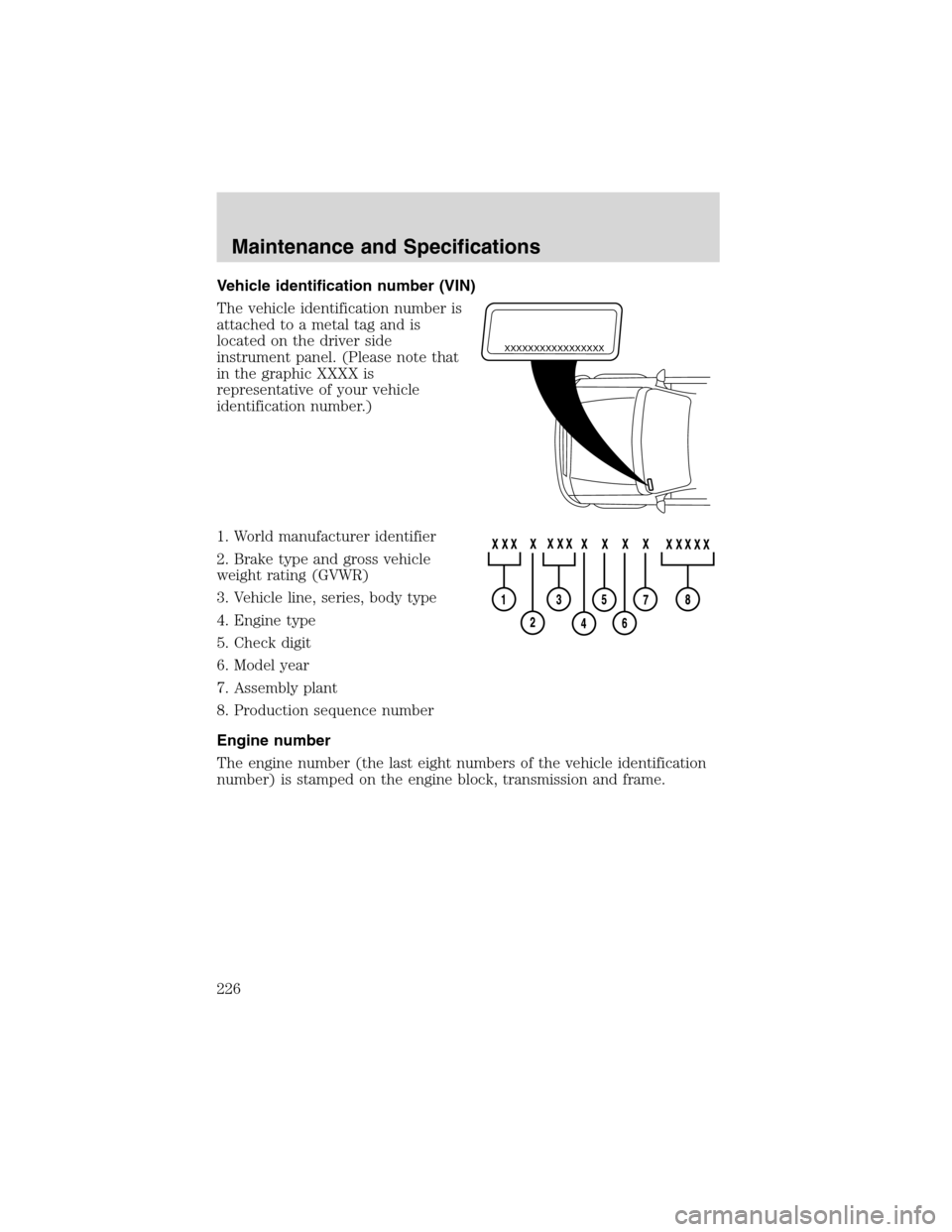
Vehicle identification number (VIN)
The vehicle identification number is
attached to a metal tag and is
located on the driver side
instrument panel. (Please note that
in the graphic XXXX is
representative of your vehicle
identification number.)
1. World manufacturer identifier
2. Brake type and gross vehicle
weight rating (GVWR)
3. Vehicle line, series, body type
4. Engine type
5. Check digit
6. Model year
7. Assembly plant
8. Production sequence number
Engine number
The engine number (the last eight numbers of the vehicle identification
number) is stamped on the engine block, transmission and frame.
XXXXXXXXXXXXXXXXX
Maintenance and Specifications
226
Page 231 of 240
A
Air bag supplemental restraint
system ....................................95, 99
and child safety seats ..............97
description ..........................95, 99
disposal ....................................101
driver air bag ....................97, 100
indicator light ...................98, 101
operation ...........................97, 100
passenger air bag .............97, 100
side air bag ................................99
Air cleaner filter ...............212, 218
All Wheel Drive (AWD),
driving off road .........................128
Ambulance packages ....................7
Antifreeze (see Engine
coolant) .....................................194
Anti-lock brake system
(see Brakes) ..............................118
Anti-theft system ........................72
arming the system ....................72
disarming a triggered system ..73
Audio system
(see Radio) ................15, 18, 22, 26
Automatic transaxle
fluid, adding ............................209
fluid, checking ........................209
Automatic transmission
driving an automatic
overdrive .................................122
fluid, refill capacities ..............218
fluid, specification ..................223
Auxiliary power point .................47
Axle
lubricant specifications ..221, 223
refill capacities ........................218
B
Battery .......................................192acid, treating emergencies .....192
jumping a disabled battery ....159
maintenance-free ....................192
replacement, specifications ...218
servicing ..................................192
BeltMinder ...................................90
Brakes ........................................118
anti-lock ...................................118
anti-lock brake system (ABS)
warning light ...........................118
fluid, checking and adding ....209
fluid, refill capacities ..............218
fluid, specifications .........221, 223
lubricant specifications ..221, 223
parking ....................................119
shift interlock ..........................120
Bulbs ............................................38
C
Calculating load ........................141
Capacities for refilling fluids ....218
Cargo area shade ........................54
Cassette tape player .............15, 22
CD-single premium ...............18, 26
Cell phone use ............................52
Certification Label ....................225
Changing a tire .........................154
Child safety restraints ..............102
child safety belts ....................102
Child safety seats ......................105
attaching with tether straps ..109
in front seat ............................107
in rear seat ..............................107
Cleaning your vehicle
engine compartment ..............178
instrument panel ....................180
interior .....................................181
Index
231