Page 215 of 240
Safety Standard No. 109. Grades B and A represent higher levels of
performance on the laboratory test wheel than the minimum required by
law.
The temperature grade for this tire is established for a tire that
is properly inflated and not overloaded. Excessive speed,
underinflation, or excessive loading, either separately or in
combination, can cause heat buildup and possible tire failure.
SERVICING YOUR TIRES
Checking the tire pressure
•Use an accurate tire pressure gauge.
•Check the tire pressure when tires are cold, after the vehicle has been
parked for at least one hour or has been driven less than 5 km (3
miles).
•Adjust tire pressure to recommended specifications found on the
Certification Label. Tire pressure information can also be found on the
Tire Information label located on the inside of the fuel filler door.
Improperly inflated tires can affect vehicle handling and can fail
suddenly, possibly resulting in loss of vehicle control, vehicle
rollover and/or personal injury.
Tire rotation
Because your vehicle’s tires perform different jobs, they often wear
differently. To make sure your tires wear evenly and last longer, rotate
them as indicated in the scheduled maintenance guide. If you notice that
the tires wear unevenly, have them checked.
Maintenance and Specifications
215
Page 216 of 240
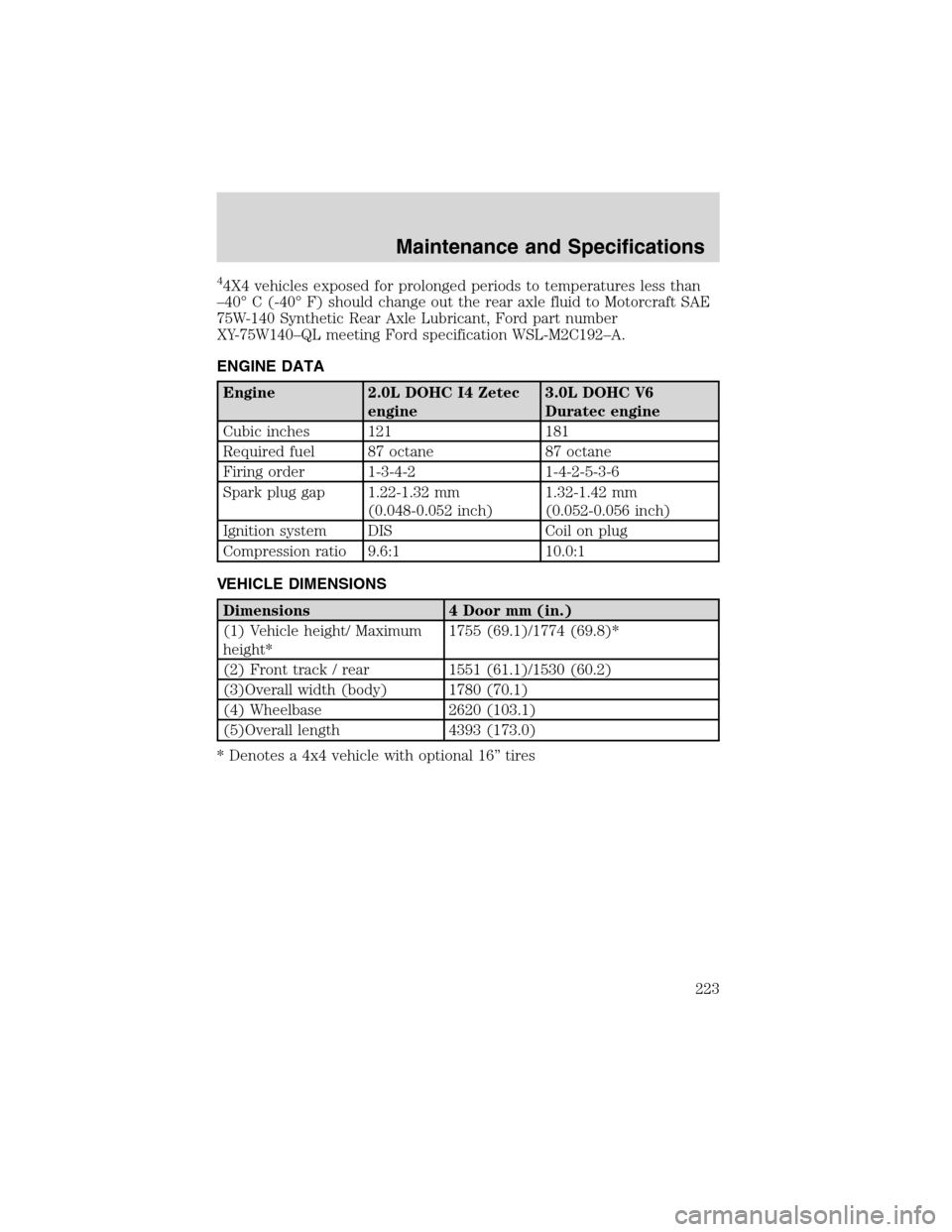
•Four tire rotation
Replacing the tires
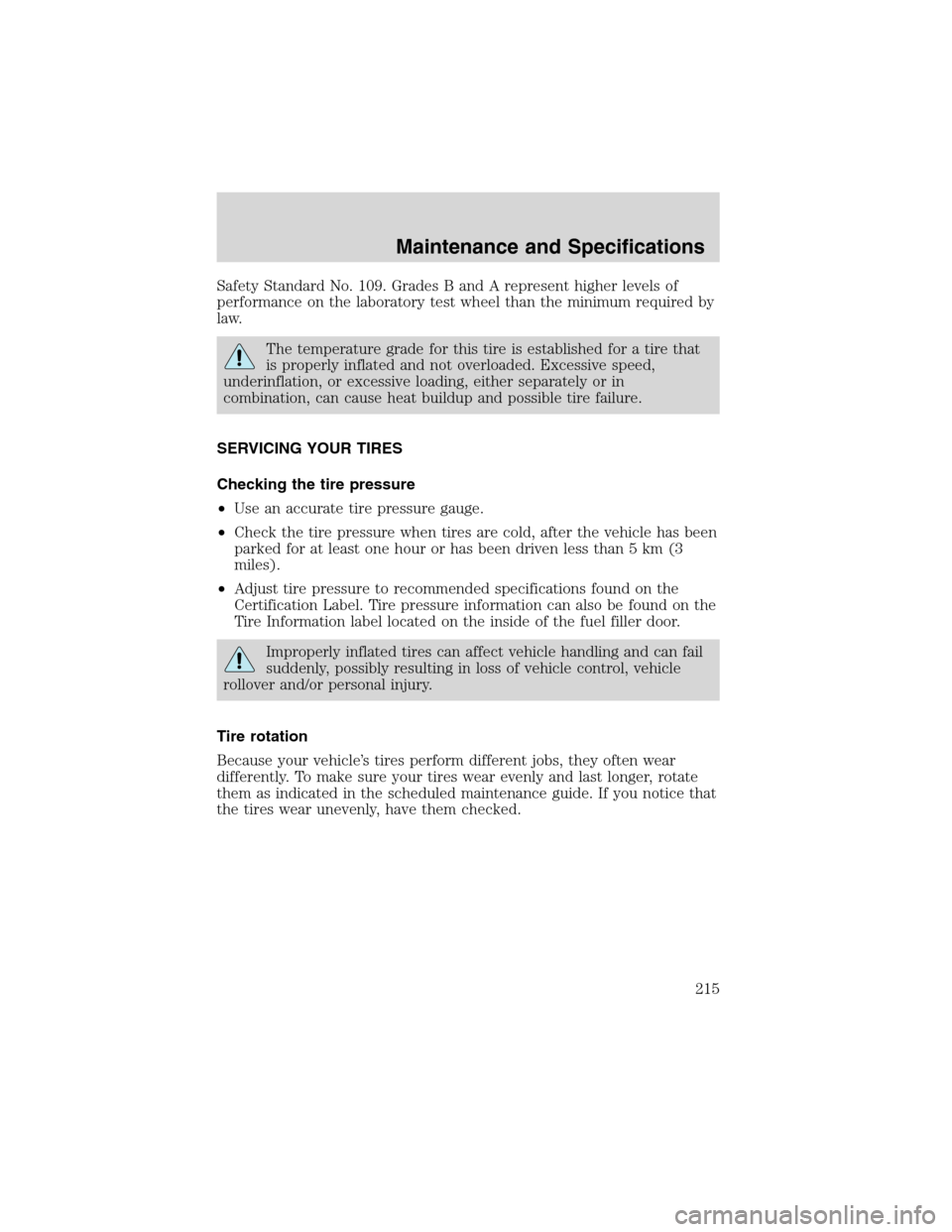
Replace the tires when the wear
band is visible through the tire
treads. Due to exposure to the
elements and exhaust you should
replace the spare tire when you
replace the other tires.
When replacing full size tires, never mix radial bias-belted, or
bias-type tires. Use only the tire sizes that are listed on the
Certification Label. Make sure that all tires are the same size, speed
rating, and load-carrying capacity. Use only the tire combinations
recommended on the label. If you do not follow these precautions,
your vehicle handling may be affected which can lead to loss of vehicle
control, vehicle rollover and/or personal injury.
Make sure that all replacement tires are of the same size, type,
speed rating, load-carrying capacity and tread design (e.g.,“All
Terrain”,“Touring”, etc.), as originally offered by Ford.
Do not replace your tires with“high performance”tires or larger
size tires.
Maintenance and Specifications
216
Page 217 of 240
Failure to follow these precautions, your vehicle handling may be
adversely effected which can lead to loss of vehicle control,
vehicle rollover and/or personal injury.
Tires that are larger or smaller than your vehicle’s original tires may also
affect the accuracy of your speedometer.
USING SNOW TIRES AND TRACTION DEVICES
Snow tires must be the same size and grade as the tires you
currently have on your vehicle.
The tires on your vehicle have all-weather treads to provide traction in
rain and snow. However, in some climates, using snow tires or traction
devices may be necessary.
Follow these guidelines when using snow tires and traction devices:
•SAE class“S”cable should be used only on front axle for P235/70R16
tires. With P225/70R15 and P215/70R16 tires, SAE class“S”cables can
be used on both the front and rear wheels.
•Install cables or chains securely, verifying that the cables or chains do
not touch any wiring, brake lines or fuel lines.
•Drive cautiously. If you hear the cables or chains rub or bang against
the vehicle, stop and retighten them. If this does not work, remove the
cables or chains to prevent vehicle damage.
•Avoid overloading your vehicle.
•Remove the cables or chains when they are no longer needed.
•Do not use cables or chains on dry roads.
•Do not exceed 48 km/h (30 mph) with tire cables or chains on your
vehicle.
Consult your dealer for information on other Ford approved methods of
traction control.
Maintenance and Specifications
217
Page 223 of 240
44X4 vehicles exposed for prolonged periods to temperatures less than
–40°C (-40°F) should change out the rear axle fluid to Motorcraft SAE
75W-140 Synthetic Rear Axle Lubricant, Ford part number
XY-75W140–QL meeting Ford specification WSL-M2C192–A.
ENGINE DATA
Engine 2.0L DOHC I4 Zetec
engine3.0L DOHC V6
Duratec engine
Cubic inches 121 181
Required fuel 87 octane 87 octane
Firing order 1-3-4-2 1-4-2-5-3-6
Spark plug gap 1.22-1.32 mm
(0.048-0.052 inch)1.32-1.42 mm
(0.052-0.056 inch)
Ignition system DIS Coil on plug
Compression ratio 9.6:1 10.0:1
VEHICLE DIMENSIONS
Dimensions 4 Door mm (in.)
(1) Vehicle height/ Maximum
height*1755 (69.1)/1774 (69.8)*
(2) Front track / rear 1551 (61.1)/1530 (60.2)
(3)Overall width (body) 1780 (70.1)
(4) Wheelbase 2620 (103.1)
(5)Overall length 4393 (173.0)
* Denotes a 4x4 vehicle with optional 16”tires
Maintenance and Specifications
223
Page 235 of 240

Preparing to drive your
vehicle ........................................119
R
Radio ..........................15, 18, 22, 26
Rear window defroster ...............32
Relays ........................................147
Remote entry system
illuminated entry ......................69
locking/unlocking doors ...........63
Reverse sensing system ...........137
Roof rack .....................................55
S
Safety belts (see Safety
restraints) ..............................84–88
Safety defects, reporting ..........176
Safety restraints ....................84–88
belt minder ...............................90
cleaning the safety belts ..........94
extension assembly ..................89
for adults .............................85–87
for children .............................102
lap belt ......................................89
warning light and chime ..........90
Safety seats for children ..........105
Seat belts (see Safety
restraints) ....................................84
Seats ............................................74
child safety seats ....................105
heated ........................................76
Servicing your vehicle ..............183
Snowplowing .................................7
Spare tire (see Changing the
Tire) ...........................................154Spark plugs, specifications ......218,
223
Special notice
ambulance conversions ..............7
utility-type vehicles ....................7
Specification chart,
lubricants ...........................221, 223
Speed control ..............................49
Starting your vehicle .......114–115,
117
jump starting ..........................159
Steering wheel
tilting .........................................45
T
Temperature control
(see Climate control) .................30
Tires ...........................154, 213–215
changing ..........................154–155
checking the pressure ............215
replacing ..................................216
rotating ....................................215
snow tires and chains ............217
tire grades ...............................214
treadwear ................................214
Towing .......................................141
recreational towing .................145
trailer towing ..........................141
wrecker ....................................165
Transaxle
fluid, checking and adding
(manual) .................................211
manual operation ....................125
Transmission .............................120
fluid, checking and adding
(automatic) .............................209
fluid, refill capacities ..............218
lubricant specifications ..221, 223
Index
235
Page:
< prev 1-8 9-16 17-24