2003 FORD E SERIES air condition
[x] Cancel search: air conditionPage 202 of 232

emission control, such non-Ford parts should be equivalent to genuine
Ford Motor Company parts in performance and durability.
Do not park, idle, or drive your vehicle in dry grass or other dry
ground cover. The emission system heats up the engine
compartment and exhaust system, which can start a fire.
Illumination of the“Service Engine Soon”light, charging system warning
light or the temperature warning light, fluid leaks, strange odors, smoke
or loss of engine power, could indicate that the emission control system
is not working properly.
Exhaust leaks may result in entry of harmful and potentially
lethal fumes into the passenger compartment.
Do not make any unauthorized changes to your vehicle or engine. By
law, vehicle owners and anyone who manufactures, repairs, services,
sells, leases, trades vehicles, or supervises a fleet of vehicles are not
permitted to intentionally remove an emission control device or prevent
it from working. Information about your vehicle’s emission system is on
the Vehicle Emission Control Information Decal located on or near the
engine. This decal identifies engine displacement and gives some tune up
specifications.
Please consult yourWarranty Guidefor complete emission warranty
information.
Readiness for Inspection/Maintenance (I/M) testing
In some localities, it may be a legal requirement to pass an I/M test of
the on-board diagnostics system. If your“Check Engine/Service Engine
Soon”light is on, refer to the description in theWarning lights and
chimessection of theInstrument clusterchapter. Your vehicle may not
pass the I/M test with the“Check Engine/Service Engine Soon”light on.
If the vehicle’s powertrain system or its battery has just been serviced,
the on-board diagnostics system is reset to a“not ready for I/M test”
condition. To ready the on-board diagnostics system for I/M testing, a
minimum of 30 minutes of city and highway driving is necessary as
described below:
•First, at least 10 minutes of driving on an expressway or highway.
•Next, at least 20 minutes driving in stop-and-go, city-type traffic with
at least four idle periods.
Allow the vehicle to sit for at least eight hours without starting the
engine. Then, start the engine and complete the above driving cycle. The
Maintenance and Specifications
202
Page 206 of 232

Adjusting automatic transmission fluid levels
Before adding any fluid, make sure the correct type is used. The type of
fluid used is normally indicated on the dipstick and also in the
Lubricant specificationssection in this chapter.
Use of a non-approved automatic transmission fluid may cause
internal transmission component damage.
If necessary, add fluid in 250 ml (1/2 pint) increments through the filler
tube until the level is correct.
If an overfill occurs, excess fluid
should be removed by a qualified
technician.
An overfill condition of
transmission fluid may cause shift and/or engagement concerns
and/or possible damage.
Do not use supplemental transmission fluid additives, treatments or
cleaning agents. The use of these materials may affect transmission
operation and result in damage to internal transmission components.
AIR FILTER MAINTENANCE
Refer to the scheduled maintenance guide for the appropriate intervals
for changing the air filter element.
When changing the air filter element, use only the Motorcraft air filter
element listed. Refer toMotorcraft Part Numbers.
Note:Do not start your engine with the air cleaner removed and do not
remove it while the engine is running.
Changing the air filter element
1. Disconnect the fresh air inlet tube
from the radiator support.
2. Loosen the clamp that secures
the two halves of the air filter
housing together.
Maintenance and Specifications
206
Page 207 of 232

3. Carefully separate the two halves
of the air filter housing.
4. Remove the air filter element
from the housing.
5. Install a new air filter element. Be careful not to crimp the filter
element edges between the air filter housing. This could cause filter
damage and allow unfiltered air to enter the engine if not properly
seated.
6. Replace the two halves of the air filter housing and secure the clamp.
7. Connect the fresh air inlet tube to the radiator support.
INFORMATION ABOUT UNIFORM TIRE QUALITY GRADING
New vehicles are fitted with tires
that have a rating on them called
Tire Quality Grades. The Quality
grades can be found where
applicable on the tire sidewall
between tread shoulder and
maximum section width. For
example:
•Treadwear 200 Traction AA Temperature A
These Tire Quality Grades are determined by standards that the United
States Department of Transportation has set.
Tire Quality Grades apply to new pneumatic tires for use on passenger
cars. They do not apply to deep tread, winter-type snow tires,
space-saver or temporary use spare tires, tires with nominal rim
diameters of 10 to 12 inches or limited production tires as defined in
Title 49 Code of Federal Regulations Part 575.104(c)(2).
U.S. Department of Transportation-Tire quality grades:The U.S.
Department of Transportation requires Ford to give you the following
information about tire grades exactly as the government has written it.
Treadwear
The treadwear grade is a comparative rating based on the wear rate of
the tire when tested under controlled conditions on a specified
Maintenance and Specifications
207
Page 228 of 232

wiper blades ............................172
Climate control (see Air
conditioning or Heating) ......50, 52
Compass, electronic ....................63
calibration .................................64
set zone adjustment .................64
Console
overhead ....................................62
Controls
power seat .................................76
Coolant
checking and adding ..............187
refill capacities ................191, 213
specifications ..................217, 220
Cruise control (see Speed
control) ........................................67
Customer Assistance ................137
Ford accessories for your
vehicle .....................................174
Ford Extended Service
Plan ..........................................163
Getting assistance outside
the U.S. and Canada ..............167
Getting roadside assistance ...137
Getting the service you
need .........................................161
Ordering additional owner’s
literature .................................168
The Dispute Settlement
Board .......................................164
Utilizing the
Mediation/Arbitration
Program ...................................166
D
Daytime running lamps
(see Lamps) ................................53Dipstick
automatic transmission
fluid ..........................................204
engine oil .................................179
Doors
lubricant specifications ..........217
Driveline universal joint and
slip yoke ....................................204
Driving under special
conditions ..................................121
through water .........................121
E
Emergencies, roadside
jump-starting ..........................155
Emission control system ..........201
Engine ........................................220
cleaning ...................................171
coolant .....................................187
diesel ...........................................6
fail-safe coolant ......................192
idle speed control ...................182
lubrication specifications ......217,
220
refill capacities ........................213
service points ..........................177
starting after a collision .........139
Engine block heater .................114
Engine oil ..................................179
checking and adding ..............179
dipstick ....................................179
filter, specifications ........181, 212
recommendations ...................181
refill capacities ........................213
specifications ..................217, 220
Exhaust fumes ..........................114
F
Fail safe cooling ........................192
Index
228
Page 229 of 232
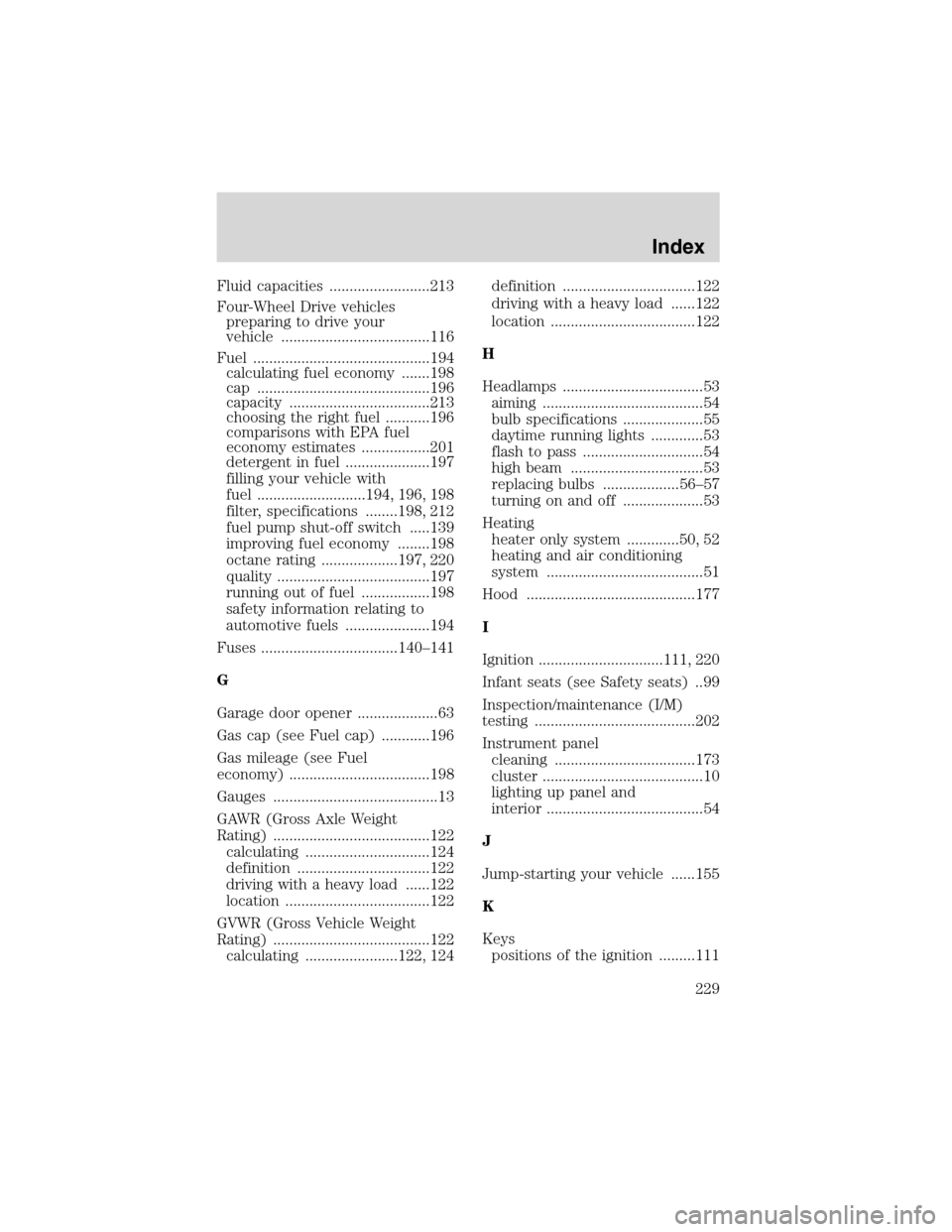
Fluid capacities .........................213
Four-Wheel Drive vehicles
preparing to drive your
vehicle .....................................116
Fuel ............................................194
calculating fuel economy .......198
cap ...........................................196
capacity ...................................213
choosing the right fuel ...........196
comparisons with EPA fuel
economy estimates .................201
detergent in fuel .....................197
filling your vehicle with
fuel ...........................194, 196, 198
filter, specifications ........198, 212
fuel pump shut-off switch .....139
improving fuel economy ........198
octane rating ...................197, 220
quality ......................................197
running out of fuel .................198
safety information relating to
automotive fuels .....................194
Fuses ..................................140–141
G
Garage door opener ....................63
Gas cap (see Fuel cap) ............196
Gas mileage (see Fuel
economy) ...................................198
Gauges .........................................13
GAWR (Gross Axle Weight
Rating) .......................................122
calculating ...............................124
definition .................................122
driving with a heavy load ......122
location ....................................122
GVWR (Gross Vehicle Weight
Rating) .......................................122
calculating .......................122, 124definition .................................122
driving with a heavy load ......122
location ....................................122
H
Headlamps ...................................53
aiming ........................................54
bulb specifications ....................55
daytime running lights .............53
flash to pass ..............................54
high beam .................................53
replacing bulbs ...................56–57
turning on and off ....................53
Heating
heater only system .............50, 52
heating and air conditioning
system .......................................51
Hood ..........................................177
I
Ignition ...............................111, 220
Infant seats (see Safety seats) ..99
Inspection/maintenance (I/M)
testing ........................................202
Instrument panel
cleaning ...................................173
cluster ........................................10
lighting up panel and
interior .......................................54
J
Jump-starting your vehicle ......155
K
Keys
positions of the ignition .........111
Index
229