Page 159 of 248
Safety chains
Always connect the trailer’s safety chains to the frame or hook retainers
of the vehicle hitch. To connect the trailer’s safety chains, cross the
chains under the trailer tongue and allow slack for turning corners.
If you use a rental trailer, follow the instructions that the rental agency
gives to you.
Do not attach safety chains to the bumper.
Trailer brakes
Electric brakes and manual, automatic or surge-type trailer brakes are
safe if installed properly and adjusted to the manufacturer’s
specifications. The trailer brakes must meet local and Federal
regulations.
Do not connect a trailer’s hydraulic brake system directly to your
vehicle’s brake system. Your vehicle may not have enough
braking power and your chances of having a collision greatly increase.
The braking system of the tow vehicle is rated for operation at the
GVWR not GCWR.
Trailer lamps
Trailer lamps are required on most towed vehicles. Make sure your
trailer lamps conform to local and Federal regulations. See your dealer or
trailer rental agency for proper instructions and equipment for hooking
up trailer lamps.
Driving while you tow
When towing a trailer:
•Turn off the speed control. The speed control may shut off
automatically when you are towing on long, steep grades.
•Consult your local motor vehicle speed regulations for towing a trailer.
•To eliminate excessive shifting, use a lower gear. This will also assist
in transmission cooling. (For additional information, refer to the
Understanding the positions of the 4–speed automatic
transmissionsection in this chapter.
•Anticipate stops and brake gradually.
•Do not exceed the GCWR rating or transmission damage may occur.
Servicing after towing
If you tow a trailer for long distances, your vehicle will require more
frequent service intervals. Refer to your scheduled maintenance guide for
more information.
2003 Crown Victoria(cro)
Owners Guide (post-2002-fmt)
USA English(fus)
Driving
159
Page 176 of 248
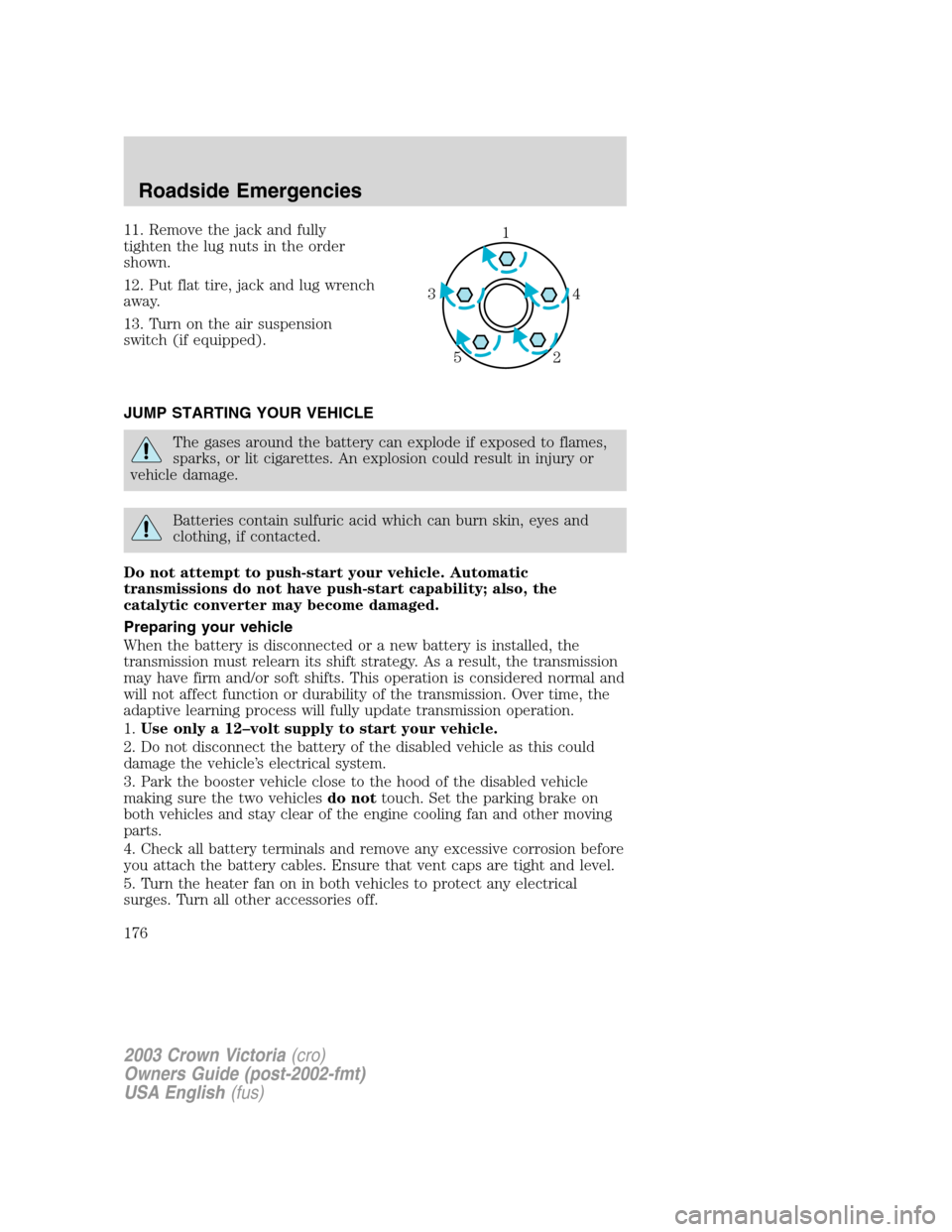
11. Remove the jack and fully
tighten the lug nuts in the order
shown.
12. Put flat tire, jack and lug wrench
away.
13. Turn on the air suspension
switch (if equipped).
JUMP STARTING YOUR VEHICLE
The gases around the battery can explode if exposed to flames,
sparks, or lit cigarettes. An explosion could result in injury or
vehicle damage.
Batteries contain sulfuric acid which can burn skin, eyes and
clothing, if contacted.
Do not attempt to push-start your vehicle. Automatic
transmissions do not have push-start capability; also, the
catalytic converter may become damaged.
Preparing your vehicle
When the battery is disconnected or a new battery is installed, the
transmission must relearn its shift strategy. As a result, the transmission
may have firm and/or soft shifts. This operation is considered normal and
will not affect function or durability of the transmission. Over time, the
adaptive learning process will fully update transmission operation.
1.Use only a 12–volt supply to start your vehicle.
2. Do not disconnect the battery of the disabled vehicle as this could
damage the vehicle’s electrical system.
3. Park the booster vehicle close to the hood of the disabled vehicle
making sure the two vehiclesdo nottouch. Set the parking brake on
both vehicles and stay clear of the engine cooling fan and other moving
parts.
4. Check all battery terminals and remove any excessive corrosion before
you attach the battery cables. Ensure that vent caps are tight and level.
5. Turn the heater fan on in both vehicles to protect any electrical
surges. Turn all other accessories off.
1
4 3
2 5
2003 Crown Victoria(cro)
Owners Guide (post-2002-fmt)
USA English(fus)
Roadside Emergencies
176
Page 199 of 248
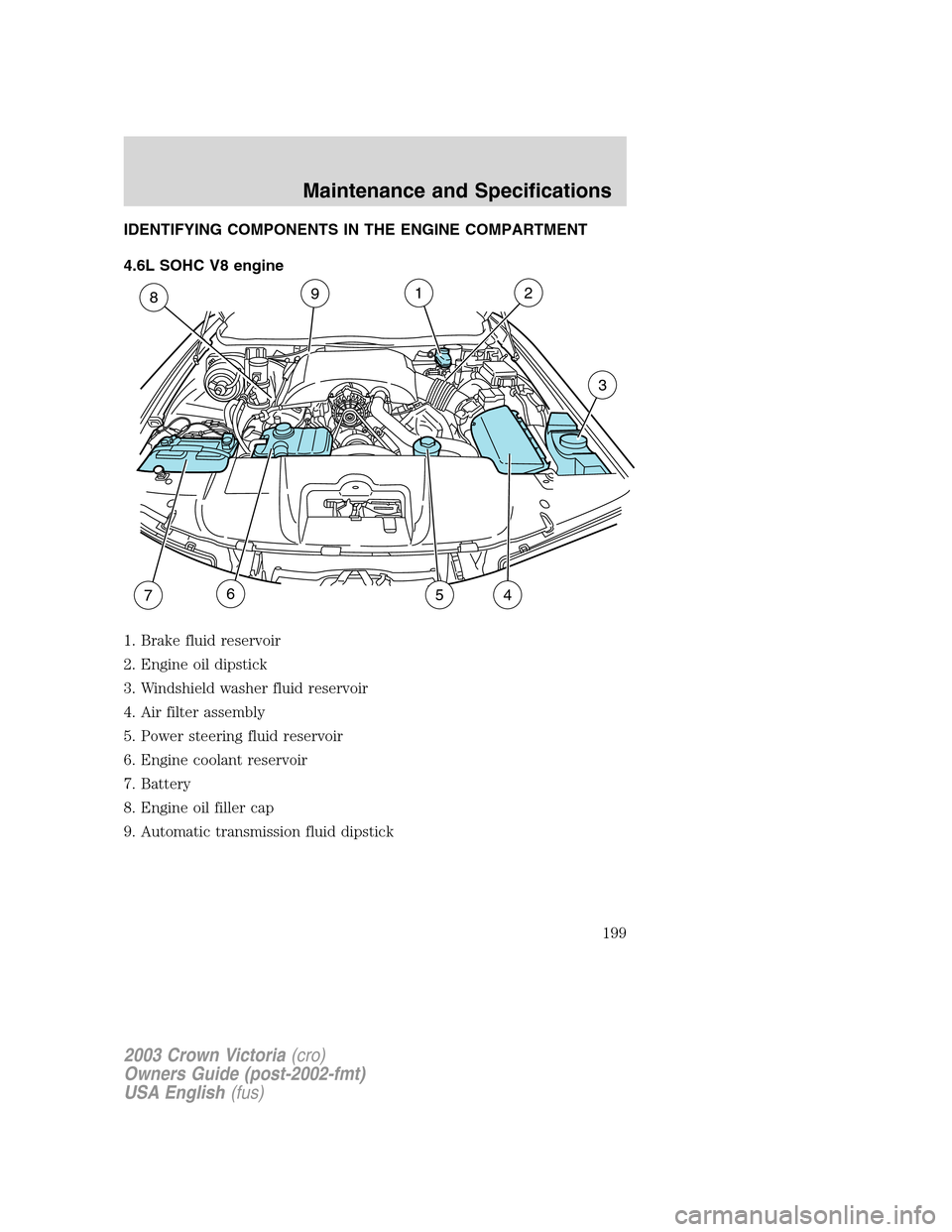
IDENTIFYING COMPONENTS IN THE ENGINE COMPARTMENT
4.6L SOHC V8 engine
1. Brake fluid reservoir
2. Engine oil dipstick
3. Windshield washer fluid reservoir
4. Air filter assembly
5. Power steering fluid reservoir
6. Engine coolant reservoir
7. Battery
8. Engine oil filler cap
9. Automatic transmission fluid dipstick
918
5476
3
2
2003 Crown Victoria(cro)
Owners Guide (post-2002-fmt)
USA English(fus)
Maintenance and Specifications
199
Page 222 of 248
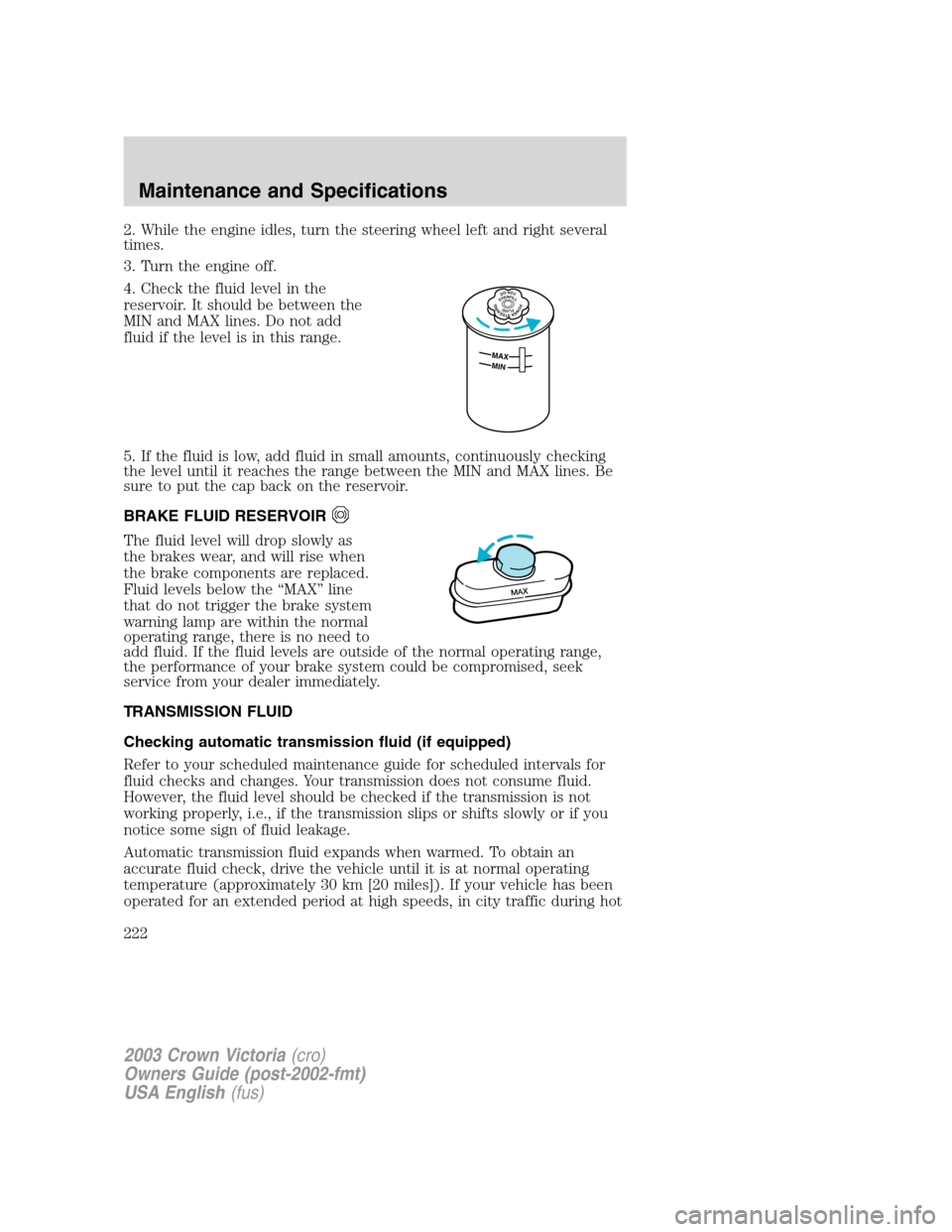
2. While the engine idles, turn the steering wheel left and right several
times.
3. Turn the engine off.
4. Check the fluid level in the
reservoir. It should be between the
MIN and MAX lines. Do not add
fluid if the level is in this range.
5. If the fluid is low, add fluid in small amounts, continuously checking
the level until it reaches the range between the MIN and MAX lines. Be
sure to put the cap back on the reservoir.
BRAKE FLUID RESERVOIR
The fluid level will drop slowly as
the brakes wear, and will rise when
the brake components are replaced.
Fluid levels below the“MAX”line
that do not trigger the brake system
warning lamp are within the normal
operating range, there is no need to
add fluid. If the fluid levels are outside of the normal operating range,
the performance of your brake system could be compromised, seek
service from your dealer immediately.
TRANSMISSION FLUID
Checking automatic transmission fluid (if equipped)
Refer to your scheduled maintenance guide for scheduled intervals for
fluid checks and changes. Your transmission does not consume fluid.
However, the fluid level should be checked if the transmission is not
working properly, i.e., if the transmission slips or shifts slowly or if you
notice some sign of fluid leakage.
Automatic transmission fluid expands when warmed. To obtain an
accurate fluid check, drive the vehicle until it is at normal operating
temperature (approximately 30 km [20 miles]). If your vehicle has been
operated for an extended period at high speeds, in city traffic during hot
DONOTOVERFILLPOWERSTEERINGFLUID
MAX
MIN
MAX
2003 Crown Victoria(cro)
Owners Guide (post-2002-fmt)
USA English(fus)
Maintenance and Specifications
222
Page 224 of 248
![FORD CROWN VICTORIA 2003 2.G Owners Manual The transmission fluid should be in
this range if at normal operating
temperature (66°C-77°C
[150°F-170°F]).
The transmission fluid should be in
this range if at ambient temperature
(10°C-35°C [](/manual-img/11/4779/w960_4779-223.png "FORD CROWN VICTORIA 2003 2.G Owners Manual The transmission fluid should be in
this range if at normal operating
temperature (66°C-77°C
[150°F-170°F]).
The transmission fluid should be in
this range if at ambient temperature
(10°C-35°C [")
The transmission fluid should be in
this range if at normal operating
temperature (66°C-77°C
[150°F-170°F]).
The transmission fluid should be in
this range if at ambient temperature
(10°C-35°C [50°F-95°F]).
High fluid level
Fluid levels above the safe range
may result in transmission failure.
An overfill condition of transmission
fluid may cause shift and/or
engagement concerns and/or
possible damage.
High fluid levels can be caused by
an overheating condition.
Adjusting automatic transmission fluid levels
Before adding any fluid, make sure the correct type is used. The type of
fluid used is normally indicated on the dipstick and also in the
Lubricant specificationssection in this chapter.
Use of a non-approved automatic transmission fluid may cause
internal transmission component damage.
If necessary, add fluid in 250 ml (1/2 pint) increments through the filler
tube until the level is correct.
DON’T ADD
DON’T ADD
DON’T ADD
2003 Crown Victoria(cro)
Owners Guide (post-2002-fmt)
USA English(fus)
Maintenance and Specifications
224
Page 231 of 248
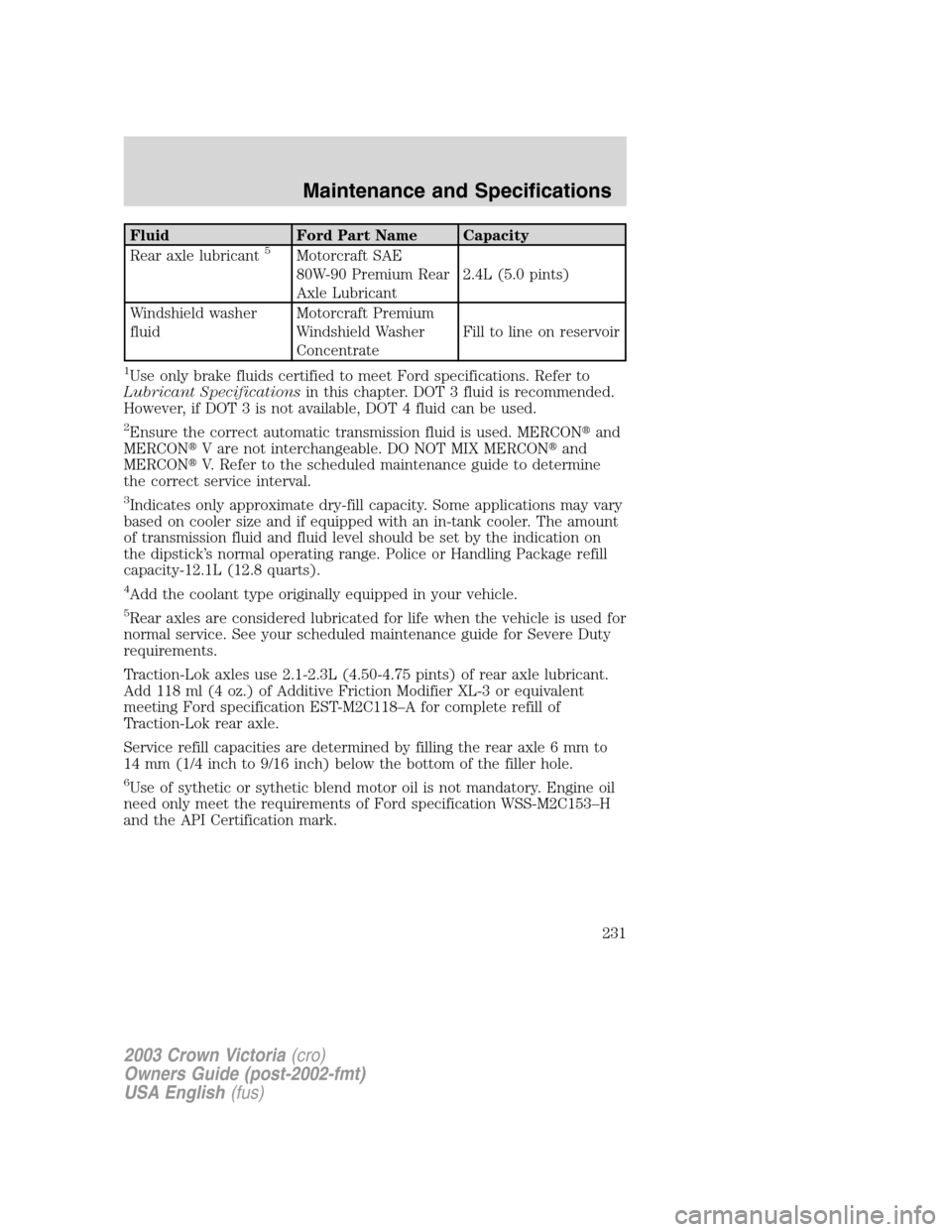
Fluid Ford Part Name Capacity
Rear axle lubricant5Motorcraft SAE
80W-90 Premium Rear
Axle Lubricant2.4L (5.0 pints)
Windshield washer
fluidMotorcraft Premium
Windshield Washer
ConcentrateFill to line on reservoir
1Use only brake fluids certified to meet Ford specifications. Refer to
Lubricant Specificationsin this chapter. DOT 3 fluid is recommended.
However, if DOT 3 is not available, DOT 4 fluid can be used.
2Ensure the correct automatic transmission fluid is used. MERCON�and
MERCON�V are not interchangeable. DO NOT MIX MERCON�and
MERCON�V. Refer to the scheduled maintenance guide to determine
the correct service interval.
3Indicates only approximate dry-fill capacity. Some applications may vary
based on cooler size and if equipped with an in-tank cooler. The amount
of transmission fluid and fluid level should be set by the indication on
the dipstick’s normal operating range. Police or Handling Package refill
capacity-12.1L (12.8 quarts).
4Add the coolant type originally equipped in your vehicle.
5Rear axles are considered lubricated for life when the vehicle is used for
normal service. See your scheduled maintenance guide for Severe Duty
requirements.
Traction-Lok axles use 2.1-2.3L (4.50-4.75 pints) of rear axle lubricant.
Add 118 ml (4 oz.) of Additive Friction Modifier XL-3 or equivalent
meeting Ford specification EST-M2C118–A for complete refill of
Traction-Lok rear axle.
Service refill capacities are determined by filling the rear axle 6 mm to
14 mm (1/4 inch to 9/16 inch) below the bottom of the filler hole.
6Use of sythetic or sythetic blend motor oil is not mandatory. Engine oil
need only meet the requirements of Ford specification WSS-M2C153–H
and the API Certification mark.
2003 Crown Victoria(cro)
Owners Guide (post-2002-fmt)
USA English(fus)
Maintenance and Specifications
231
Page 232 of 248
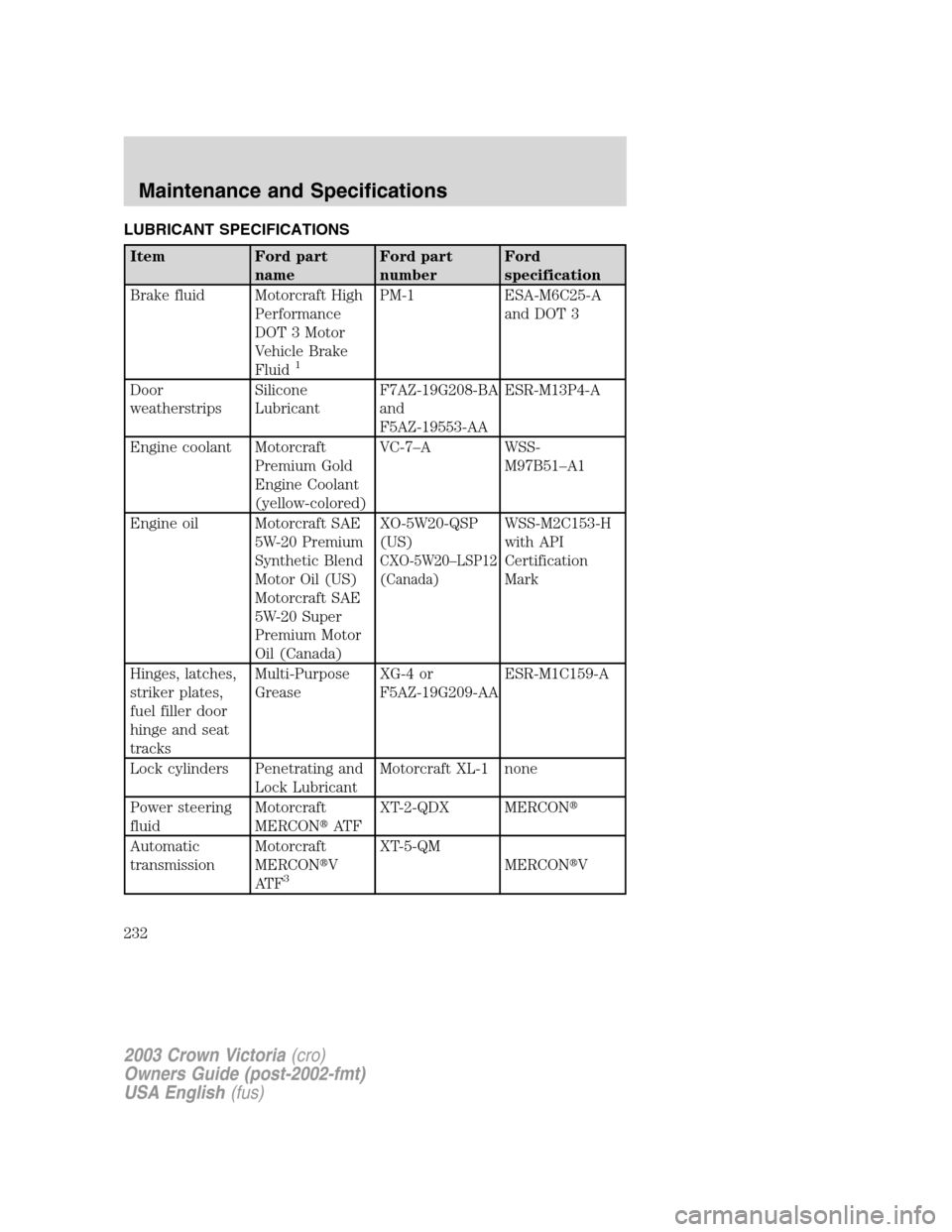
LUBRICANT SPECIFICATIONS
Item Ford part
nameFord part
numberFord
specification
Brake fluid Motorcraft High
Performance
DOT 3 Motor
Vehicle Brake
Fluid
1
PM-1 ESA-M6C25-A
and DOT 3
Door
weatherstripsSilicone
LubricantF7AZ-19G208-BA
and
F5AZ-19553-AAESR-M13P4-A
Engine coolant Motorcraft
Premium Gold
Engine Coolant
(yellow-colored)VC-7–A WSS-
M97B51–A1
Engine oil Motorcraft SAE
5W-20 Premium
Synthetic Blend
Motor Oil (US)
Motorcraft SAE
5W-20 Super
Premium Motor
Oil (Canada)XO-5W20-QSP
(US)
CXO-5W20–LSP12
(Canada)
WSS-M2C153-H
with API
Certification
Mark
Hinges, latches,
striker plates,
fuel filler door
hinge and seat
tracksMulti-Purpose
GreaseXG-4 or
F5AZ-19G209-AAESR-M1C159-A
Lock cylinders Penetrating and
Lock LubricantMotorcraft XL-1 none
Power steering
fluidMotorcraft
MERCON�AT FXT-2-QDX MERCON�
Automatic
transmissionMotorcraft
MERCON�V
AT F
3
XT-5-QM
MERCON�V
2003 Crown Victoria(cro)
Owners Guide (post-2002-fmt)
USA English(fus)
Maintenance and Specifications
232
Page 233 of 248
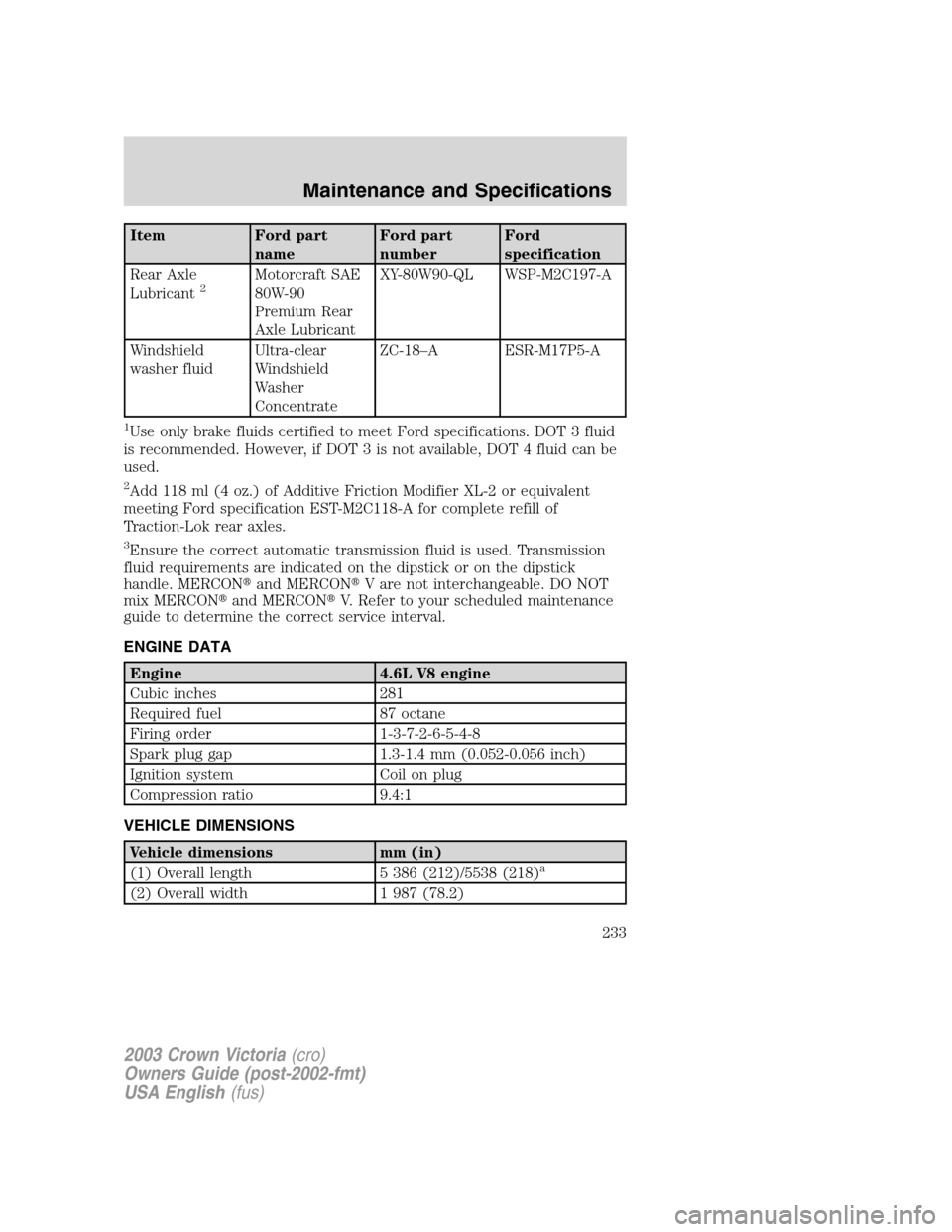
Item Ford part
nameFord part
numberFord
specification
Rear Axle
Lubricant
2Motorcraft SAE
80W-90
Premium Rear
Axle LubricantXY-80W90-QL WSP-M2C197-A
Windshield
washer fluidUltra-clear
Windshield
Washer
ConcentrateZC-18–A ESR-M17P5-A
1Use only brake fluids certified to meet Ford specifications. DOT 3 fluid
is recommended. However, if DOT 3 is not available, DOT 4 fluid can be
used.
2Add 118 ml (4 oz.) of Additive Friction Modifier XL-2 or equivalent
meeting Ford specification EST-M2C118-A for complete refill of
Traction-Lok rear axles.
3Ensure the correct automatic transmission fluid is used. Transmission
fluid requirements are indicated on the dipstick or on the dipstick
handle. MERCON�and MERCON�V are not interchangeable. DO NOT
mix MERCON�and MERCON�V. Refer to your scheduled maintenance
guide to determine the correct service interval.
ENGINE DATA
Engine 4.6L V8 engine
Cubic inches 281
Required fuel 87 octane
Firing order 1-3-7-2-6-5-4-8
Spark plug gap 1.3-1.4 mm (0.052-0.056 inch)
Ignition system Coil on plug
Compression ratio 9.4:1
VEHICLE DIMENSIONS
Vehicle dimensions mm (in)
(1) Overall length 5 386 (212)/5538 (218)a
(2) Overall width 1 987 (78.2)
2003 Crown Victoria(cro)
Owners Guide (post-2002-fmt)
USA English(fus)
Maintenance and Specifications
233