2003 FIAT PALIO air
[x] Cancel search: airPage 110 of 156

109
IMPORTANT - Air cleaner
Using the car on dusty roads, replace
the air cleaner more frequently than
indicated in the Scheduled Servicing
Plan.
For any doubt on the air cleaner re-
placement, in relation to how the car
is used, contact the
Fiat Dealership.
The maintenance of the
car must be committed
to Fiat Dealership. For
those interventions of ordinary
and small maintenance, always
make sure to have the adequate
equipment, Fiat spare parts and
the consumption fluids; in any
event, do not perform such op-
erations, if you do not have any
experience. IMPORTANT - Fuel filter
Check the conditions of the fuel fil-
ter when changes (choking) are no-
ticed in the engine operation.
IMPORTANT - Battery
We suggest you to carry out the
check of the state of battery charge,
preferably at the beginning of the cold
season in order to avoid the possibil-
ity of freezing the electrolyte.
Such check must be carried out
more frequently if the car is mainly
used for short distances, or if it is
equipped with permanent absorption
users with disconnected key, above all
if applied in after market.
Please refer page no. 52 of 24
hours service assistance booklet
for BAT MOBILE service extend-
ed by M/s. Exide Batteries.You should check the battery fluid
(electrolyte) level more frequently
than shown in the service schedulein
this chapter if the car is used in hot cli-
mates or particularly demanding con-
ditions.
24 HOURS SERVICE
CALL - 9628 290 260
This single response num-
ber is available in 9 cities.*
AHMEDABAD - BANGALORE -
KOLKATA - CHENNAI - DELHI -
HYDERABAD - MUMBAI -
PUNE - LUCKNOW
* If you are not in, but near any of the above
cities; Dial city code followed by the single
response numberFor further information about Fiat Service Network please refer 24 Hours Service
AssistanceBooklet provided.
104-127 03/03/2003 06:53 PM Page 109
Page 117 of 156
116
AIR CLEANER
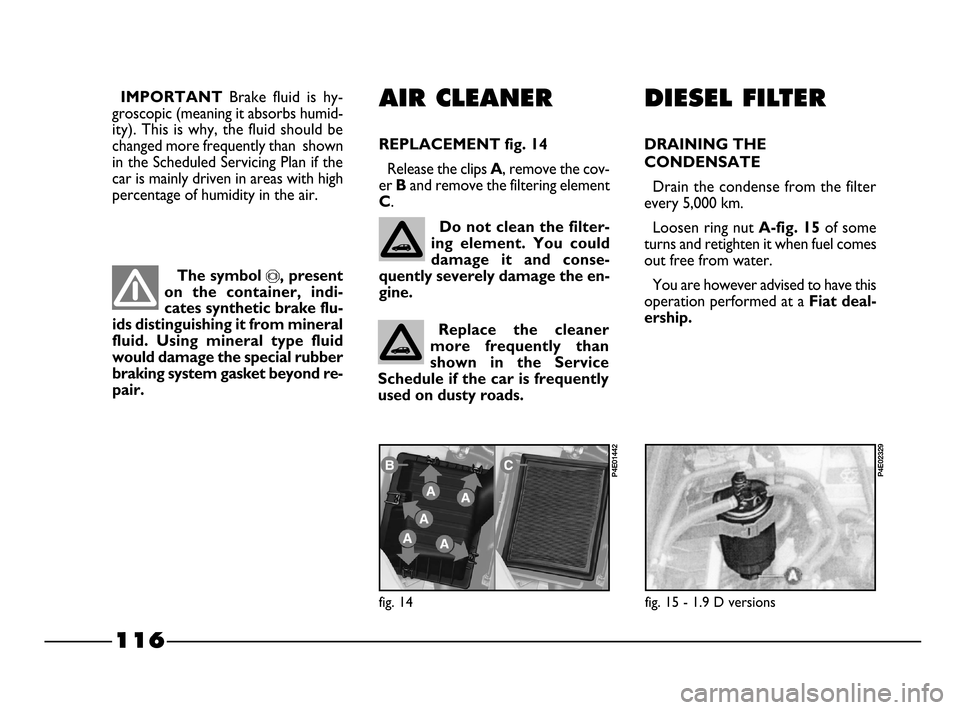
REPLACEMENT fig. 14
Release the clips A, remove the cov-
er
Band remove the filtering element
C.
fig. 14
P4E01442
The symbol π, present
on the container, indi-
cates synthetic brake flu-
ids distinguishing it from mineral
fluid. Using mineral type fluid
would damage the special rubber
braking system gasket beyond re-
pair.
Do not clean the filter-
ing element. You could
damage it and conse-
quently severely damage the en-
gine.
Replace the cleaner
more frequently than
shown in the Service
Schedule if the car is frequently
used on dusty roads. IMPORTANT
Brake fluid is hy-
groscopic (meaning it absorbs humid-
ity). This is why, the fluid should be
changed more frequently than shown
in the Scheduled Servicing Plan if the
car is mainly driven in areas with high
percentage of humidity in the air.
fig. 15 - 1.9 D versions
P4E02329
DIESEL FILTER
DRAINING THE
CONDENSATE
Drain the condense from the filter
every 5,000 km.
Loosen ring nut
A-fig. 15of some
turns and retighten it when fuel comes
out free from water.
You are however advised to have this
operation performed at a
Fiat deal-
ership.
104-127 03/03/2003 06:53 PM Page 116
Page 118 of 156
117
BATTERY
The Fiat Palio battery is of the “lim-
ited maintenance” type: under normal
conditions it will not need to be
topped up with distilled water.
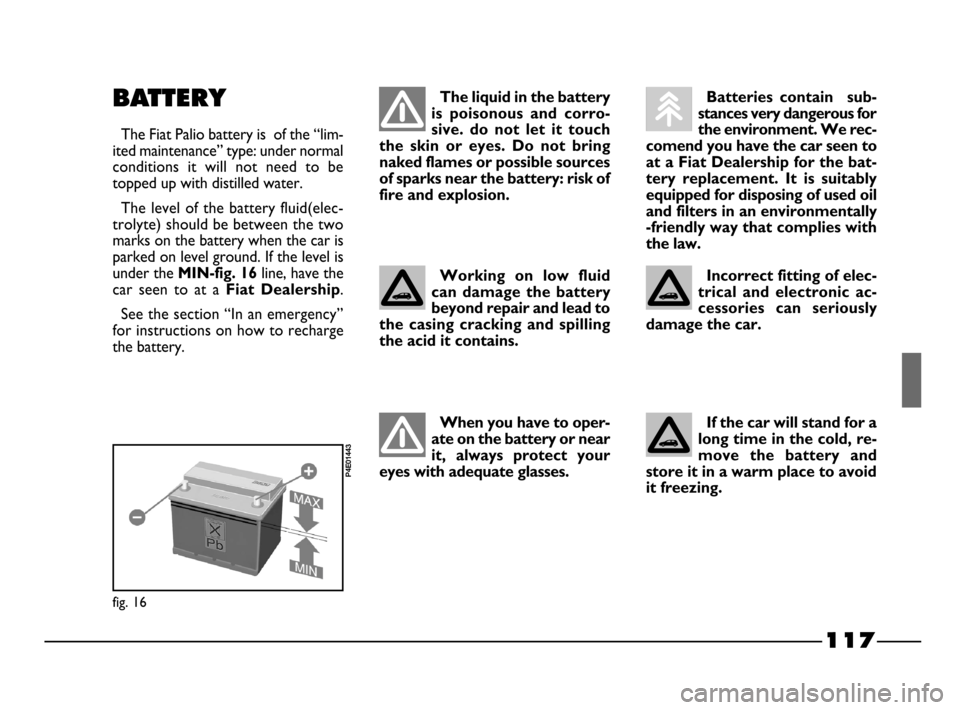
The level of the battery fluid(elec-
trolyte) should be between the two
marks on the battery when the car is
parked on level ground. If the level is
under the
MIN-fig. 16 line, have the
car seen to at a
Fiat Dealership.
See the section “In an emergency”
for instructions on how to recharge
the battery.
The liquid in the battery
is poisonous and corro-
sive. do not let it touch
the skin or eyes. Do not bring
naked flames or possible sources
of sparks near the battery: risk of
fire and explosion.
Working on low fluid
can damage the battery
beyond repair and lead to
the casing cracking and spilling
the acid it contains.
When you have to oper-
ate on the battery or near
it, always protect your
eyes with adequate glasses.
fig. 16
P4E01443
Batteries contain sub-
stances very dangerous for
the environment. We rec-
comend you have the car seen to
at a Fiat Dealership for the bat-
tery replacement. It is suitably
equipped for disposing of used oil
and filters in an environmentally
-friendly way that complies with
the law.
Incorrect fitting of elec-
trical and electronic ac-
cessories can seriously
damage the car.
If the car will stand for a
long time in the cold, re-
move the battery and
store it in a warm place to avoid
it freezing.
104-127 03/03/2003 06:53 PM Page 117
Page 121 of 156

IMPORTANT If the sound system
or car alarm systems are not installed
correctly, they can interfere with the
working of the electronic control
units.
Modifications or repairs
to the electrical system
carried out incorrectly
and without bearing the features
of the system in mind can cause
malfunctions with the risk of fire.
120
ELECTRONIC
CONTROL UNITS
When the car is being used normal-
ly, special measures are not necessary.
The following instructions must be
followed very carefully however, if you
work on the electrical system or
where emergency starting is neces-
sary:
– Never disconnect the battery from
the electrical system while the engine
is running.
– Disconnect the battery from the
electrical system if you are recharg-
ing it. Modern battery chargers can
discharge voltage up to 20 V.
– Never perform emergency star-
tups with a battery charger. Always
use an auxiliary battery (see “Startup
with auxiliary battery” in “In an emer-
gency” chapter).– Be particularly careful when con-
necting the battery to the electrical
system. Make sure that the polarity is
correct and the connection is efficient.
After reconnecting the battery, the in-
jection/ignition control unit will need
to readapt its internal parameters.
Therefore, the car’s performance may
change slightly during the first few kilo-
meters.
– Do not connect or disconnect the
terminals of the electronic units while
the ignition key is at
MAR.
– Do not check polarity through
sparking.
– Disconnect the electronic units if
you are electrically welding the car
body. Remove the units if tempera-
tures exceed 80°C (special operations
on the bodywork etc.).
104-127 03/03/2003 06:53 PM Page 120
Page 127 of 156

126
Detergents pollute wa-
ter. For this reason, the
car must be washed in an
area equipped for the collection
and purification of the liquids
used while washing.
To wash the car properly:
1)Wash the body using a low pres-
sure jet of water.
2)Wipe a sponge with a slightly
soapy solution over the bodywork,
frequently rinsing the sponge.
3) Rinse well with water and dry
with a jet of air or a chamois leather.
When drying the car, be careful to
get at those parts which are not so
easily seen e.g. the door frames, bon-
net and around the headlights where
water can most readily collect. You
should leave the car out in the open
so that any water remaining can evap-
orate more easily.
Do not wash the car after it has been
parked in the sun or while the bon-
net is hot: it could take the shine off
the paint.Outside plastic parts must be cleaned
following the usual car washing pro-
cedure.
Avoid parking the car under trees;
the resinous substances that certain
species of tree shed dull the paintwork
and increase the possibility of rust
forming.
IMPORTANTBird droppings must
be washed off immediately and with
great care as their acid is particularly
aggressive.
Windows
Use specific window cleaners to
clean the windows. Use very clean
cloths to avoid scratching the glass or
damaging its transparency.
TIPS FOR KEEPING THE
BODY IN GOOD CONDITION
Paintwork
The paintwork is not only to make
your car look attractive but also to
protect the steel.
If the paint is scuffed or scratched
deeply you are advised to touch up as
necessary to prevent rust from form-
ing.
Only use genuine products when
touching up the paintwork (see the
“Technical Specifications”).
Ordinary maintenance of the paint-
work means washing it. The frequen-
cy you should do this depends on the
conditions and the environment the
car is driven in. For example:
– in areas with a high level of air pol-
lution;
– on roads sprinkled with road salt-
wash;
– parking under trees which drop
resin. In these cases, you should wash
your car more frequently.
104-127 03/03/2003 06:53 PM Page 126
Page 133 of 156

132
FUEL SUPPLY/ IGNITION
Integrated multipoint electronic in-
jection and ignition system: only one
electronic control unit controls both
functions. It processes both the time
the injection lasts (for petrol meter-
ing) and the ignition advance angle.
Type: Multipoint.
Air cleaner: dry, with paper filtering
element.
Fuel pump: by immersion, in the tank.
Injection pressure 3 barMixture metered by electronic pro-
cessing of the data picked up by the
engine speed sensor and absolute
pressure sensor in the intake manifold.
Petrol metering system : a “Closed
Loop” (information on the combus-
tion trend transmitted by the sensor
Lambda).
Ignition order: 1-3-4-2.
Spark plugs:
Modifications or repairs
to the fuel feed system
that are not carried out
properly or do not take the sys-
tem’s technical specifications in-
to account can cause malfunc-
tions leading to the risk of fire.
LUBRICATION
Forced-feed with gear pump with
pressure relief valve incorporated.
Oil purification through full-flow car-
tridge filter.
COOLING
Cooling system with radiator, cen-
trifugal pump and expansion tank.
Thermostat on the secondary circuit
for recirculating the water from the
engine to the radiator. “By-pass con-
trolled” thermostat.
Electrical fan for cooling the radiator
with connection/disconnection, con-
trolled by a thermostatic switch lo-
cated on the radiator.
Spark plug (type)
1.2
Champion RC7BMCChampion RC8BYC
1.6NGK BKR5EZ
Champion RC10YCC
Bosch FR8DE
Other equivalent Spark plug for 1.6 engine
is Champion RC10YCC.
128-143 03/03/2003 07:39 PM Page 132
Page 136 of 156

135
STEERING
Energy absorbing steering wheel (air
bag, if provided).
Rake adjustable, jointed energy ab-
sorbing steering column.
Mechanical or hydraulic rack and pin-
ion command with permanent lubri-
cation.
Hydraulic power steering (as pro-
vided).
Permanent lubrication joints.
Minimum turning diameter:
10.2 metres.
Number of steering wheel turns lock
to lock:
3.69 turns for mechanical steering;
2.66 turns for hydraulic steering.
Do not push the power
steering to its limit while
the engine is running for
more than 15 seconds: this will
make a noise and could damage
the system.
128-143 03/03/2003 07:39 PM Page 135
Page 138 of 156

Delivered power
1.20.8 kW
1.61.3 kW
1.9 D1.4 kW
137
ALTERNATOR
Rectifier bridge and built-in elec-
tronic voltage regulator. Battery be-
gins recharging as soon as the engine
starts.
STARTER MOTOR Modifications or repairs
to the electrical system
carried out incorrectly
and without bearing the features
of the system in mind can cause
malfunctions with the risk of fire.
ELECTRIC SYSTEM
Supply voltage: 12 Volt.
BATTERY
With negative earth.
Discharge capacity Discharge current 20 hour fast cold (–18°C)
1.250 Ah 250A
1.650 Ah 250A
1.9 D60 Ah 320A
Max supplied nominalcurrent
1.290A
1.690A
1.9 D90A
128-143 03/03/2003 07:39 PM Page 137