2003 FIAT PALIO seats
[x] Cancel search: seatsPage 54 of 156

53
If you want to carry a
can of petrol as a reserve,
adhere to the laws in
force. Not following precautions
increases the risk of fire in the
event of an accident. To remove the
parcel shelf
1)
Free the upper extremities A-fig.
61
of the two tie rods, withdrawing
the eyelets from the pins.
2)Free the cover pins A-fig. 62
from their seats Band remove it.
After removing, the cover can be
transversally positioned between the
front seat backs and the tipped chush-
ion of the rear seat.
IMPORTANT If the load in the
boot is fairly heavy and you are trav-
elling at night, check and adjust the
height of the dipped beam headlights
(see“ Headlights” paragraph in this
chapter).
Heavy loads which are
not securely anchored
could seriously injure pas-
sengers in the event of an acci-
dent.
We suggest you do not
drive with the tailgate
open, as the exhaust gas-
es can come inside the car via the
boot.
fig. 62
P4E01750
20-63 03/03/2003 06:03 PM Page 53
Page 62 of 156
61
STANDARD EQUIPMENT
The system consists of:
- radio power supply cables;
- cables for speakers and tweeters on
front doors;
- cables for rear speakers on lug-
gage cover supports.
- Aerial wire;
- radio housing;
- front speaker housing (on front
doors);
- rear speaker housing (on luggage
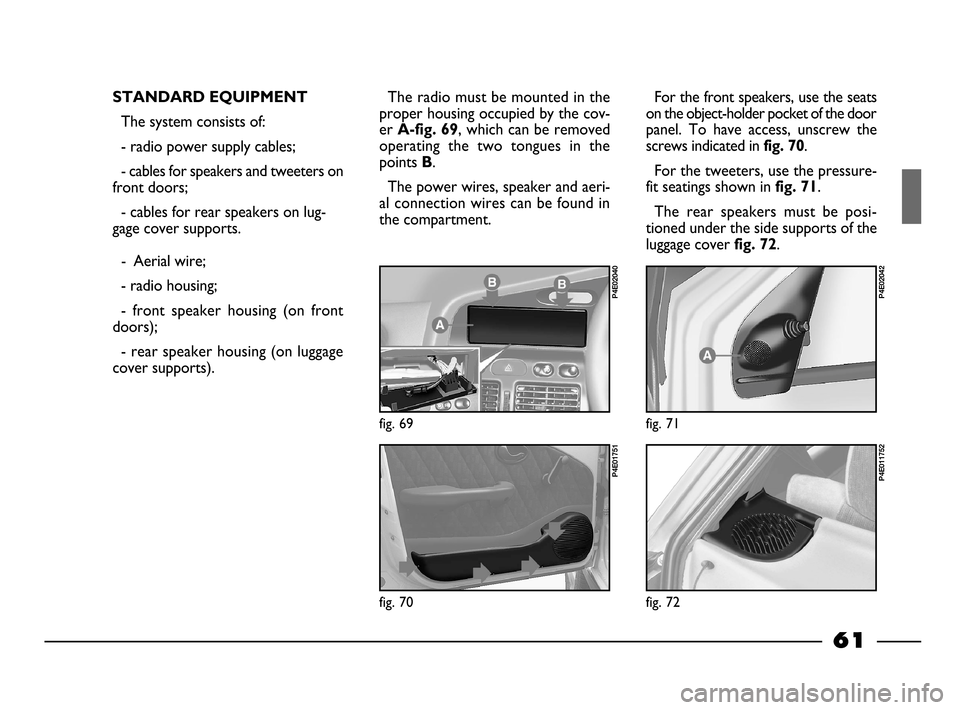
cover supports).The radio must be mounted in the
proper housing occupied by the cov-
er A-fig. 69, which can be removed
operating the two tongues in the
points
B.
The power wires, speaker and aeri-
al connection wires can be found in
the compartment.For the front speakers, use the seats
on the object-holder pocket of the door
panel. To have access, unscrew the
screws indicated in
fig. 70.
For the tweeters, use the pressure-
fit seatings shown in
fig. 71.
The rear speakers must be posi-
tioned under the side supports of the
luggage cover
fig. 72.
fig. 69
P4E02040
fig. 70
P4E01751
fig. 71
P4E02042
fig. 72
P4E011752
20-63 03/03/2003 06:03 PM Page 61
Page 68 of 156

67
With handbrake engaged and igni-
tion key at
MAR, the instrument pan-
el warning light
x
comes on.
To disengage the handbrake:
1)Slightly lift the handbrake and
press release button
A.
2)Keep the button pressed in and
lower the lever. Warning light
x
will
go out.
3)To prevent accidental movement
of the car, this procedure should be
carried out with the brake pedal
pressed down.
HANDBRAKE fig. 1
The handbrake lever is situated be-
tween the two front seats.
Pull the handbrake lever upwards un-
til the car cannot be moved. Four or
five clicks are generally enough when
the car is on level ground while nine
or ten may be required if the car is
on a steep slope or loaded.
IMPORTANTIf this is not the
case, take the car to a
Fiat Dealer-
ship
to have the handbrake adjusted.
Never leave unsuper-
vised children in the car.
Always remove the key
from the ignition switch and take
it with you when you get out of
the car.
fig. 1
P4E02046
PARKING
Stop the engine, engage the hand-
brake and engage first gear if the car
is faced uphill or reverse gear if it is
faced downhill in compliance with the
national Highway Code and leave the
wheels steered towards the road bor-
ders or the kerb. Block the wheels
with a wedge or a stone if the car is
parked on a steep slope.
Do not leave the ignition key at
MARbecause it drains the battery.
Always remove the key when you
leave the car.
64-79 03/03/2003 06:45 PM Page 67
Page 70 of 156

69
Water, ice or salt sprin-
kled on the road can de-
posit on the brake discs
and reduce efficiency of the first
braking.
Consider that fitting ex-
tra spoilers, alloy rims or
non standard wheel caps
can reduce ventilation of the
brakes and reduce their efficien-
cy under conditions of violent or
repeated braking or long down-
hill travel.
BEFORE GETTING BEHIND
THE WHEEL
– Make sure all lights including the
headlights are working properly.
– Adjust the position of the seats, the
steering wheel and the rearview mir-
rors properly for the best driving po-
sition.
– Carefully adjust the head restraints
so the back of the head and not the
nape of the neck is supported.
– Make sure that nothing (mats etc.)
gets in the way of the pedals when
they are pushed down.
– Do not drive using the clutch ped-
al as a foot rest. Such behaviour can
cause a premature wear of the clutch.
– Make sure that any child restraint
systems (child seats, carriers, etc.) are
properly fixed preferably on the back
seat. Follow the precautions listed in
the “Transporting children in safety”
paragraph in the “Getting to know the
car” chapter.
– Arrange the load in the boot in such
a way that it cannot be thrown for-
wards in the event of an accident.– Do not place clear objects or
sheets of paper on the dashboard that
reflect on the windscreen.
– Do not eat a heavy meal before
travelling. Light eating will help keep
your reflexes prompt. Above all, do
not have anything alcoholic to drink.
The use of some medicines can reduce
the driving capability: carefully read the
relevant use warnings.
Remember to periodically carry out
the checks specified in the “Repeated
checks before long trips” paragraph
given in this section.
64-79 03/03/2003 06:45 PM Page 69
Page 71 of 156

70
WHEN TRAVELLING
– The first rule of safe driving is pru-
dence.
– Prudence also means putting your-
self into a position where you can pre-
dict wrong or imprudent behaviour
from other drivers.
– Stick closely to the rules of the
road in the particular country where
the car is being driven and, above all,
do not exceed speed limits.
– Ensure that, besides yourself, all the
other passengers in the car have their
seat belts fastened, that children are
sitting in the appropriate child seats
and any animals in the car are placed
in suitable compartments.
Driving under the influ-
ence of drugs or certain
medicines is dangerous
for both you and other road
users.
Always fasten both front
and back seat belts, in-
cluding the child restraint
systems. Travelling with the seat
belts unfastened increases the
risk of injury or death in an acci-
dent.
Do not drive with ob-
jects on the floor in front
of the driver’s seat: they
could get caught under the ped-
als making braking or accelerat-
ing impossible.
Pay attention to the
measurements of car-
pets. Any hinderance,
even modest, to the braking sys-
tem could necessiate a longer
than normal pedal run.
You should be physically fit and men-
tally alert before setting out on long
journeys.
– Do not drive too many hours at a
time but stop at intervals to stretch
your legs and recoup your energy.
– Constantly change the air in the
passenger compartment.
– Never coast downhill (i.e. with the
engine off): if you do, you lose the aid
of engine braking and the brake boost-
er so that braking requires greater ef-
fort.
64-79 03/03/2003 06:45 PM Page 70
Page 128 of 156

127
Detergents pollute wa-
ter. The car must there-
fore be washed in an area
equipped for the collection and
purification of the liquids used
while washing.
IMPORTANT
The engine com-
partment should be washed while the
engine is cold and with the ignition key
at
STOP. After washing make sure
that the various protections (e.g. rub-
ber boots and various guards) have
not been removed or damaged.
IMPORTANTTo prevent damage
to the electric heater element, wipe the
inside of the heated rear window gen-
tly in the same direction as the ele-
ments.
Engine compartment
At the end of each winter season,
carefully clean the engine compart-
ment. Have this done at a garage.
INTERIORS
Periodically check that water has not
collected under the mats (from dip-
ping shoes, umbrellas etc.) which could
cause the steel to rust
CLEANING SEATS AND
FABRIC COMPONENTS
– Remove dust with a soft brush or
vacuum cleaner.
– Brush the seats with a damp
sponge with water and a neutral soap.
Never use flammable
products (petroleum
ether or petrol) to clean
the inside of the car. Electro-
static charges generated by rub-
bing while cleaning could cause
fires.
Do not keep aerosol
cans in the car. There is
the risk they might ex-
plode. Aerosol cans must never
be exposed to a temperature
above 50°C; when the weather
starts to get hot the temperature
inside the car might go well be-
yond that figure.
PLASTIC PARTS INSIDE THE
CAR
Use special products designed not to
alter the appearance of the compo-
nents.
IMPORTANTDo not use alcohol
or petrol to clean the glass of the in-
strument panel.
104-127 03/03/2003 06:53 PM Page 127
Page 147 of 156

146
Main beam headlights
- control ..................................... 13-41
- flashing...................................... 13-42
- bulb replacement ................... 88
Maintenance
- Additional interventions ..... 108
- servicing schedule.................. 105
- servicing schedule plan......... 106
Max speeds ................................... 138
Paintwork identification
plate ............................................ 130
Paintwork
- maintenance .......................... 126
- Identification plate ............... 130
Parking ........................................... 67
Passenger compartment air vents 38
Performances ................................ 138
Periodic checks and before
long distances........................... 78
Plate light ...................................... 92
Power steering fluid level ......... 114
Pretensioners ................................ 32
Protecting emission control
devices ....................................... 74Protecting the environment ..... 63
Raising the car .......................... 99
Ready to start ............................... 8
Rear mirror
- rear view mirrors .................. 14-24
- driving mirror ......................... 23
Rear window washer
- control ..................................... 13-43
- fluid level ................................ 114
Rear window wiper
- controls.................................... 13-43
- blades ...................................... 127
- sprayer ..................................... 124
Rev counter................................... 34
Reversing lights
(bulb replacement) ................. 90
Roof rack ....................................... 55
Safe driving
- travelling ................................. 70
- driving with ABS ................... 73
- driving in rain.......................... 71
- driving at night ...................... 71
- driving in the mountains ...... 72- driving in fog ........................... 71
- driving on snow and ice .... 72
- before driving ........................ 69
Seat belts ........................................ 12-24
- general warnings .................... 27
- use ..................................... 12-24-26
- maintenance .......................... 28
- adjusting the height of the
seat belts ................................ 12-25
Seats
- cleaning .................................... 127
- adjustments ............................. 11-22
Side/tail lights
- control .................................... 13-41
- front bulb replacement ...... 89
- rear bulb replacement.......... 90
Side/tail lights
- control ..................................... 13-42
- front bulb replacement ...... 89
- side bulb replacement ......... 89
- rear bulb replacement.......... 90
Snow chains ................................. 77
Sound system ............................... 60
- aerial ......................................... 62
- standard equipment .............. 61
144-152 03/03/2003 07:30 PM Page 146