Page 89 of 486
If your vehicle has this option in a bucket seat, each
bucket seat that has the built-in child restraint ®ts in only
one location in your vehicle. To ®nd out where a
bucket seat that has a built-in child restraint must be
located in your vehicle see
Rear Seat Operation
on page 1-7. If your vehicle has this option in a 60/40
bench seat, this bench seat will only ®t in the second
row of your vehicle. In both types of seats, the built-in
child restraint works the same way.
This child restraint system conforms to all applicable
Federal Motor Vehicle Safety Standards.
Each child restraint is designed for use only by children
who weigh between 22 and 40 pounds (10 and 18 kg)
and whose height is between 33.5 and 40 inches
(850 and 1 016 mm) and who are capable of sitting
upright alone.
The child should also be at least one year old. It is
important to use a rear-facing infant restraint until the
child is about a year old. A rear-facing restraint gives the
infant's head, neck and body the support they would
need in a crash. See
Older Children on page 1-55orInfants and Young Children on page 1-58.
Q:What if the top of my child's shoulders is above
the shoulder belt slots for the ®ve-point child
restraint harness system?
A:A child whose shoulders are above the shoulder
belt slots for the ®ve point child restraint harness
system shouldn't use this child restraint. Instead,
the child should sit on the vehicle's regular
seat cushion and use the vehicle's adult
safety belts.
{CAUTION:
BEFORE YOU USE THIS CHILD RESTRAINT,
BE SURE THE TOP OF THE CHILD'S
SHOULDERS IS BELOW THE SLOTS THAT
THE HARNESS GOES THROUGH. A CHILD
WHOSE SHOULDERS ARE ABOVE THOSE
SLOTS COULD BE INJURED DURING A
SUDDEN STOP OR CRASH. IF THE TOP OF
THE CHILD'S SHOULDERS IS ABOVE THE
SLOTS, DON'T USE THIS CHILD RESTRAINT
WHILE THE VEHICLE IS IN MOTION.
1-83
Page 90 of 486
Securing a Child in the Built-In Child
Restraint
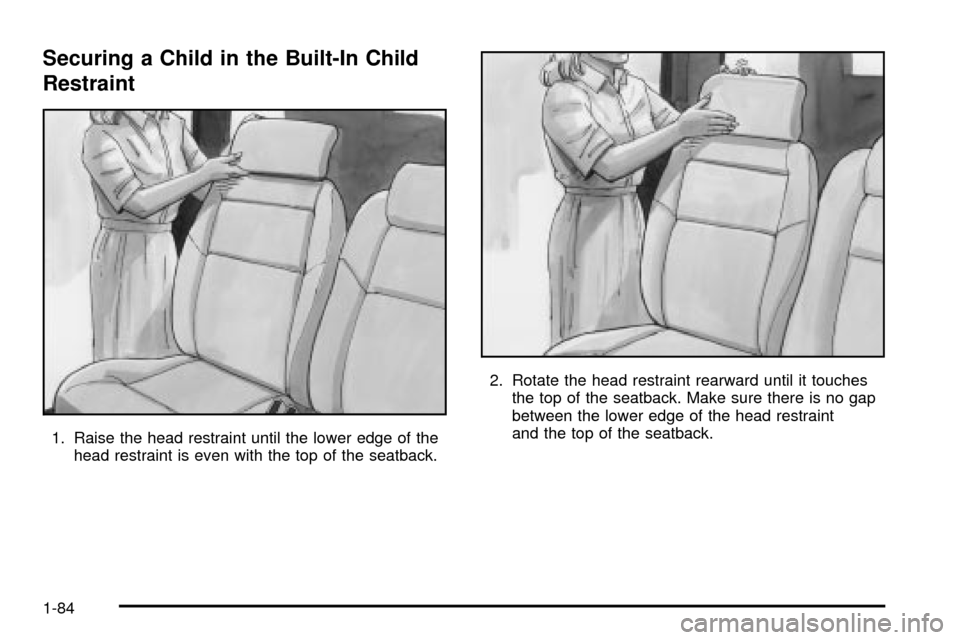
1. Raise the head restraint until the lower edge of the
head restraint is even with the top of the seatback.2. Rotate the head restraint rearward until it touches
the top of the seatback. Make sure there is no gap
between the lower edge of the head restraint
and the top of the seatback.
1-84
Page 92 of 486
{CAUTION:
Using the vehicle's regular safety belts on a
child seated on the child restraint cushion can
cause serious injury to the child in a sudden
stop or crash. If a child is the proper size for
the built-in child restraint, secure the child
using the child restraint's harness. But
children who are too large for the built-in child
restraint should sit on the vehicle's regular
seat and use the vehicle's adult safety belts.
Warning:Failure to follow the manufacturer's
instructions on the use of this child restraint system can
result in your child striking the vehicle's interior during
a sudden stop or crash. Snugly adjust the belts provided
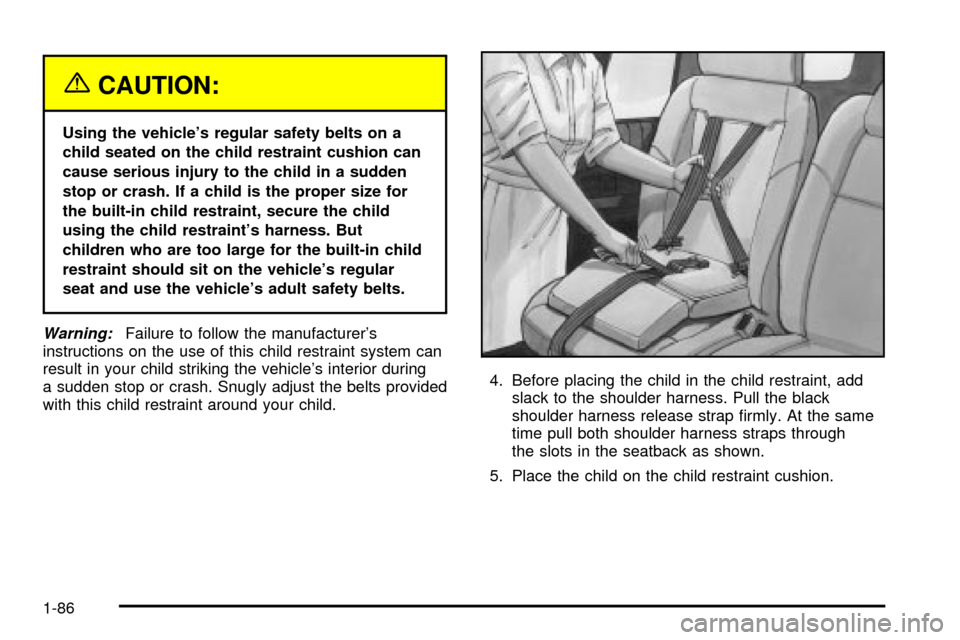
with this child restraint around your child.4. Before placing the child in the child restraint, add
slack to the shoulder harness. Pull the black
shoulder harness release strap ®rmly. At the same
time pull both shoulder harness straps through
the slots in the seatback as shown.
5. Place the child on the child restraint cushion.
1-86
Page 95 of 486
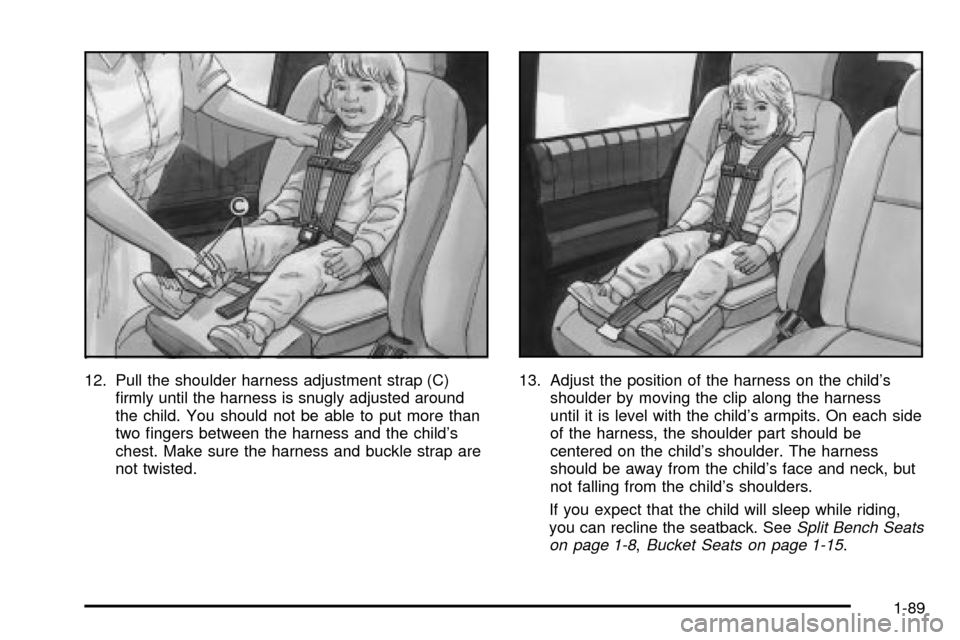
12. Pull the shoulder harness adjustment strap (C)
®rmly until the harness is snugly adjusted around
the child. You should not be able to put more than
two ®ngers between the harness and the child's
chest. Make sure the harness and buckle strap are
not twisted.13. Adjust the position of the harness on the child's
shoulder by moving the clip along the harness
until it is level with the child's armpits. On each side
of the harness, the shoulder part should be
centered on the child's shoulder. The harness
should be away from the child's face and neck, but
not falling from the child's shoulders.
If you expect that the child will sleep while riding,
you can recline the seatback. See
Split Bench Seats
on page 1-8,Bucket Seats on page 1-15.
1-89
Page 97 of 486
Storing the Built-In Child Restraint
Always properly store the built-in child restraint before
using the vehicle's lap-shoulder belt.
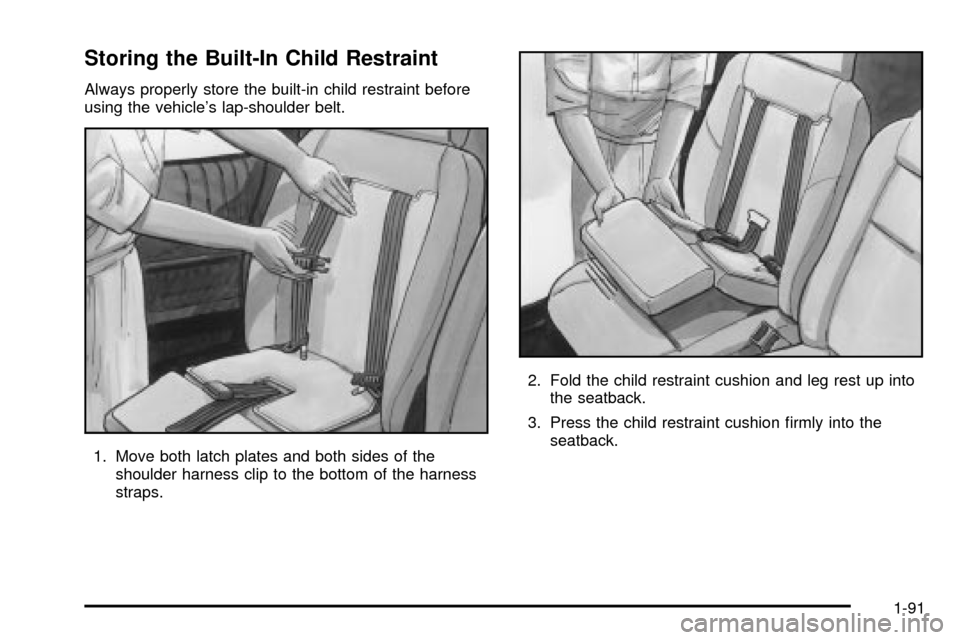
1. Move both latch plates and both sides of the
shoulder harness clip to the bottom of the harness
straps.2. Fold the child restraint cushion and leg rest up into
the seatback.
3. Press the child restraint cushion ®rmly into the
seatback.
1-91
Page 98 of 486
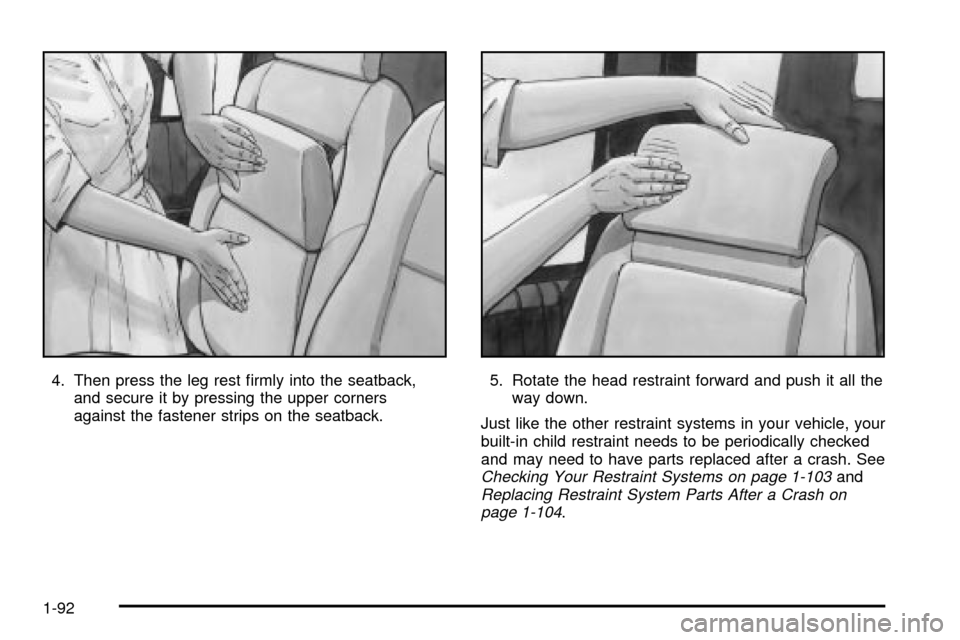
4. Then press the leg rest ®rmly into the seatback,
and secure it by pressing the upper corners
against the fastener strips on the seatback.5. Rotate the head restraint forward and push it all the
way down.
Just like the other restraint systems in your vehicle, your
built-in child restraint needs to be periodically checked
and may need to have parts replaced after a crash. See
Checking Your Restraint Systems on page 1-103andReplacing Restraint System Parts After a Crash on
page 1-104.
1-92
Page 110 of 486
Replacing Restraint System Parts
After a Crash
{CAUTION:
A crash can damage the restraint systems in
your vehicle. A damaged restraint system may
not properly protect the person using it,
resulting in serious injury or even death in a
crash. To help make sure your restraint
systems are working properly after a crash,
have them inspected and any necessary
replacements made as soon as possible.If you've had a crash, do you need new safety belts or
built-in child restraint parts or LATCH system parts?
After a very minor collision, nothing may be necessary.
But if the safety belts or built-in child restraint harness
straps were stretched, as they would be if worn during a
more severe crash, then you need new parts. If the
LATCH system was being used during a more severe
crash, then you may need new LATCH system parts.
If the frontal air bags in¯ate, you'll also need to replace
the driver's and right front passenger's safety belt
buckle assembly. Be sure to do so. Then the new buckle
assembly will be there to help protect you in a collision.
If safety belts or built-in child restraint harness straps
are cut or damaged, replace them. Collision damage
also may mean you will need to have safety belt, built-in
child restraint, LATCH system or seat parts repaired
or replaced. New parts and repairs may be necessary
even if the safety belt, built-in child restraint or
LATCH system wasn't being used at the time of the
collision.
If an air bag in¯ates, you'll need to replace air bag
system parts. See the part on the air bag system earlier
in this section.
1-104
Page 321 of 486
If you put things inside your vehicle ± like suitcases,
tools, packages, or anything else ± they will go as fast
as the vehicle goes. If you have to stop or turn
quickly, or if there is a crash, they'll keep going.
{CAUTION:
Things you put inside your vehicle can strike
and injure people in a sudden stop or turn, or
in a crash.
·Put things in the cargo area of your
vehicle. Try to spread the weight evenly.
·Never stack heavier things, like suitcases,
inside the vehicle so that some of them
are above the tops of the seats.
·Don't leave an unsecured child restraint in
your vehicle.
·When you carry something inside the
vehicle, secure it whenever you can.
·Don't leave a seat folded down unless you
need to.
Automatic Level Control
On vehicles equipped with the automatic level control,
the rear of the vehicle is automatically kept level as you
load or unload your vehicle. However, you should still
not exceed the GVWR or the GAWR.
If the engine is running or the ignition key is in
ACCESSORY or when Retained Accessory Power
(RAP) is active, you may hear the compressor operating
when you load or unload your vehicle, and periodically
as the system self-adjusts. This is normal. See
ªRetained Accessory Powerº under
Ignition Positions on
page 2-31.
The compressor should operate for brief periods of time.
If the sound continues for an extended period of time,
your vehicle needs service.
Using heavier suspension components to get added
durability might not change your weight ratings. Ask your
dealer to help you load your vehicle the right away.
4-35