Page 63 of 486
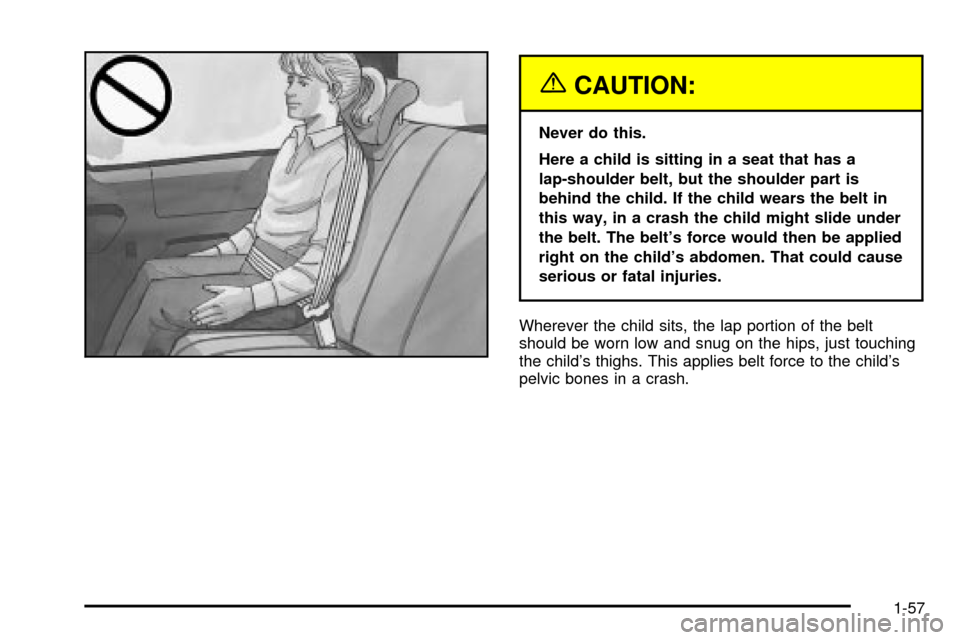
{CAUTION:
Never do this.
Here a child is sitting in a seat that has a
lap-shoulder belt, but the shoulder part is
behind the child. If the child wears the belt in
this way, in a crash the child might slide under
the belt. The belt's force would then be applied
right on the child's abdomen. That could cause
serious or fatal injuries.
Wherever the child sits, the lap portion of the belt
should be worn low and snug on the hips, just touching
the child's thighs. This applies belt force to the child's
pelvic bones in a crash.
1-57
Page 66 of 486
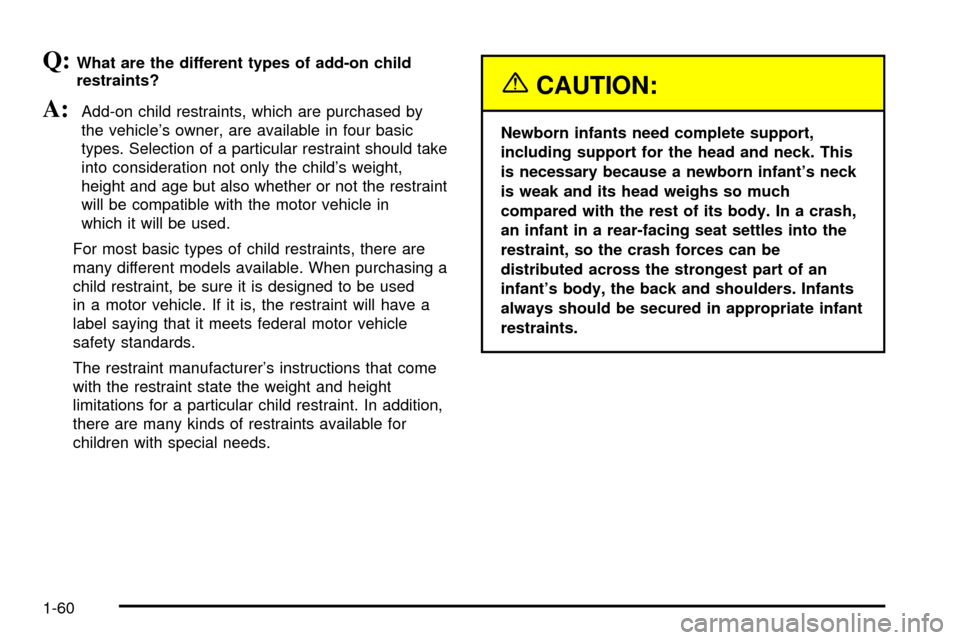
Q:What are the different types of add-on child
restraints?
A:Add-on child restraints, which are purchased by
the vehicle's owner, are available in four basic
types. Selection of a particular restraint should take
into consideration not only the child's weight,
height and age but also whether or not the restraint
will be compatible with the motor vehicle in
which it will be used.
For most basic types of child restraints, there are
many different models available. When purchasing a
child restraint, be sure it is designed to be used
in a motor vehicle. If it is, the restraint will have a
label saying that it meets federal motor vehicle
safety standards.
The restraint manufacturer's instructions that come
with the restraint state the weight and height
limitations for a particular child restraint. In addition,
there are many kinds of restraints available for
children with special needs.
{CAUTION:
Newborn infants need complete support,
including support for the head and neck. This
is necessary because a newborn infant's neck
is weak and its head weighs so much
compared with the rest of its body. In a crash,
an infant in a rear-facing seat settles into the
restraint, so the crash forces can be
distributed across the strongest part of an
infant's body, the back and shoulders. Infants
always should be secured in appropriate infant
restraints.
1-60
Page 68 of 486
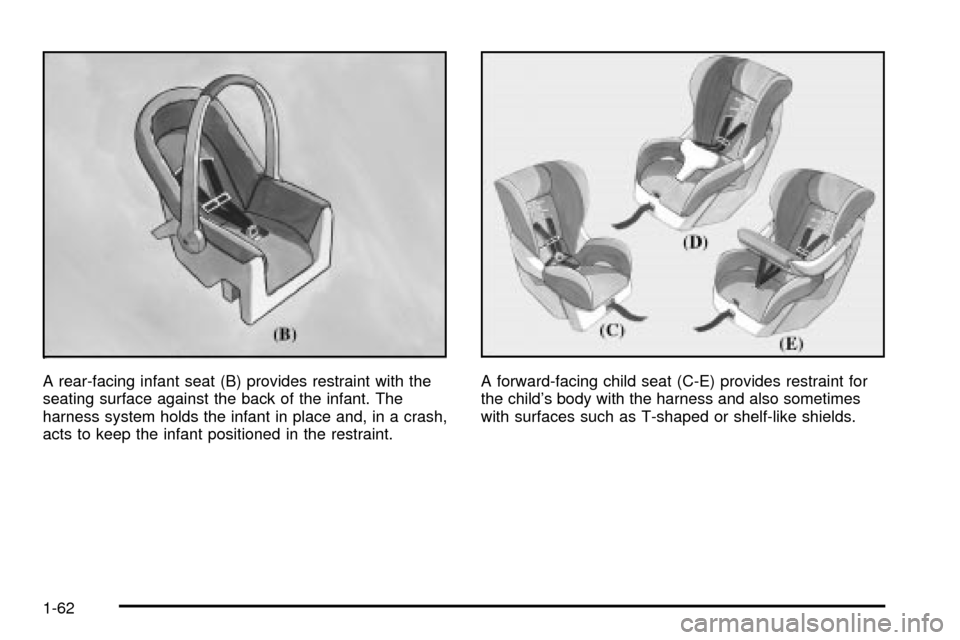
A rear-facing infant seat (B) provides restraint with the
seating surface against the back of the infant. The
harness system holds the infant in place and, in a crash,
acts to keep the infant positioned in the restraint.A forward-facing child seat (C-E) provides restraint for
the child's body with the harness and also sometimes
with surfaces such as T-shaped or shelf-like shields.
1-62
Page 69 of 486
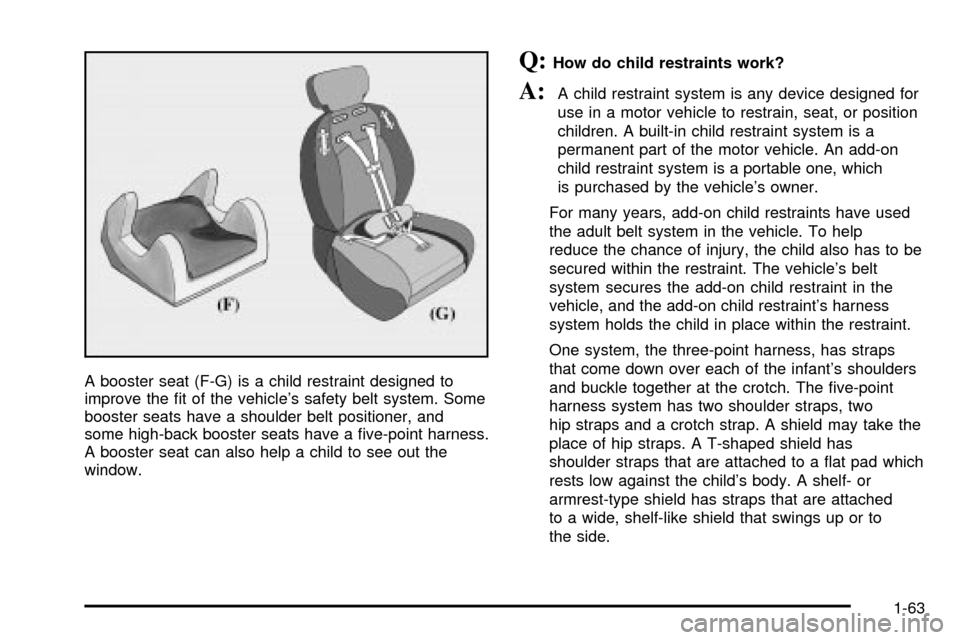
A booster seat (F-G) is a child restraint designed to
improve the ®t of the vehicle's safety belt system. Some
booster seats have a shoulder belt positioner, and
some high-back booster seats have a ®ve-point harness.
A booster seat can also help a child to see out the
window.
Q:How do child restraints work?
A:A child restraint system is any device designed for
use in a motor vehicle to restrain, seat, or position
children. A built-in child restraint system is a
permanent part of the motor vehicle. An add-on
child restraint system is a portable one, which
is purchased by the vehicle's owner.
For many years, add-on child restraints have used
the adult belt system in the vehicle. To help
reduce the chance of injury, the child also has to be
secured within the restraint. The vehicle's belt
system secures the add-on child restraint in the
vehicle, and the add-on child restraint's harness
system holds the child in place within the restraint.
One system, the three-point harness, has straps
that come down over each of the infant's shoulders
and buckle together at the crotch. The ®ve-point
harness system has two shoulder straps, two
hip straps and a crotch strap. A shield may take the
place of hip straps. A T-shaped shield has
shoulder straps that are attached to a ¯at pad which
rests low against the child's body. A shelf- or
armrest-type shield has straps that are attached
to a wide, shelf-like shield that swings up or to
the side.
1-63
Page 70 of 486

When choosing a child restraint, be sure the child
restraint is designed to be used in a vehicle. If it is, it
will have a label saying that it meets federal
motor vehicle safety standards.
Then follow the instructions for the restraint. You
may ®nd these instructions on the restraint itself or
in a booklet, or both. These restraints use the
belt system in your vehicle, but the child also has to
be secured within the restraint to help reduce the
chance of personal injury. When securing an add-on
child restraint, refer to the instructions that come
with the restraint which may be on the restraint itself
or in a booklet, or both, and to this manual. The
child restraint instructions are important, so if they
are not available, obtain a replacement copy
from the manufacturer.Q:When securing an aftermarket child seat in a
bucket seat, I am unable to get the seat
fastened in snugly enough. What should I do?
A:With some child seats, it may be difficult to tighten
the vehicle belts so that there is less side-to-side
or front-to-back movement of the child seat. A
replacement buckle, which makes it easier
to secure your child seat, is available from your
dealer at no charge to you.
1-64
Page 71 of 486
Where to Put the Restraint
Accident statistics show that children are safer if they
are restrained in the rear rather than the front seat.
General Motors, therefore, recommends that child
restraints be secured in a rear seat, including an infant
riding in a rear-facing infant seat, a child riding in a
forward-facing child seat and an older child riding in a
booster seat.
Neverput a rear-facing child restraint
in the front passenger seat. Here's why:
{CAUTION:
A child in a rear-facing child restraint can be
seriously injured or killed if the right front
passenger's air bag in¯ates. This is because
the back of the rear-facing child restraint
would be very close to the in¯ating air bag.
Always secure a rear-facing child restraint in a
rear seat.
CAUTION: (Continued)
CAUTION: (Continued)
You may secure a forward-facing child
restraint in the right front seat, but before you
do, always move the front passenger seat as
far back as it will go. It's better to secure the
child restraint in a rear seat.
Wherever you install it, be sure to secure the child
restraint properly.
Keep in mind that an unsecured child restraint can
move around in a collision or sudden stop and injure
people in the vehicle. Be sure to properly secure
any child restraint in your vehicle ± even when no child
is in it.
1-65
Page 73 of 486
In Canada, the law requires that forward-facing child
restraints have a top strap, and that the strap be
anchored. In the United States, some child restraints
also have a top strap. If your child restraint has a
top strap, it should be anchored.
Don't use a child restraint that requires a top strap in
the right front passenger's position because there's
no place to anchor the top strap.
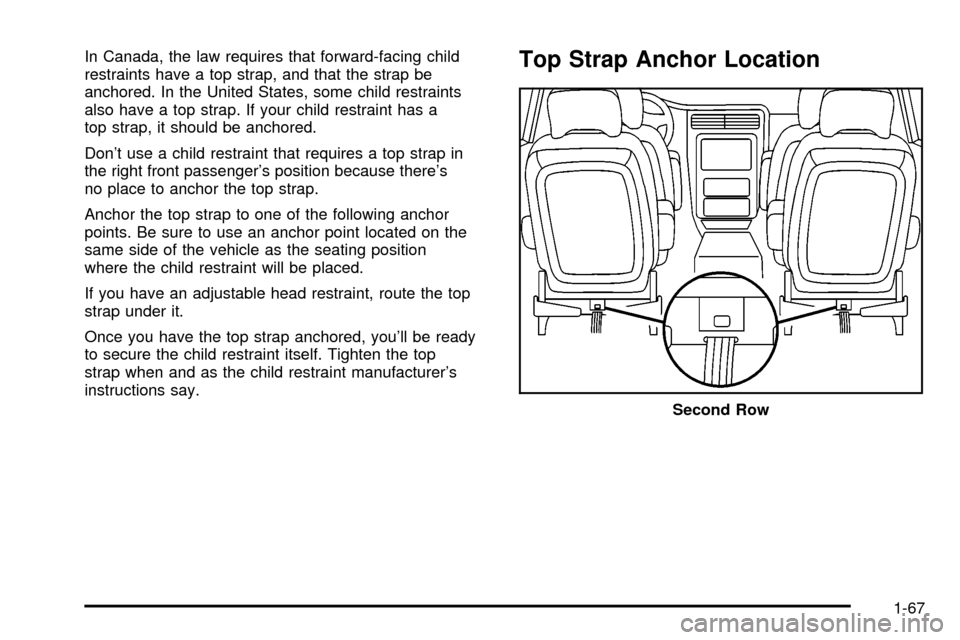
Anchor the top strap to one of the following anchor
points. Be sure to use an anchor point located on the
same side of the vehicle as the seating position
where the child restraint will be placed.
If you have an adjustable head restraint, route the top
strap under it.
Once you have the top strap anchored, you'll be ready
to secure the child restraint itself. Tighten the top
strap when and as the child restraint manufacturer's
instructions say.Top Strap Anchor Location
Second Row
1-67
Page 75 of 486
Lower Anchorages and Top Tethers
for Children (LATCH System)
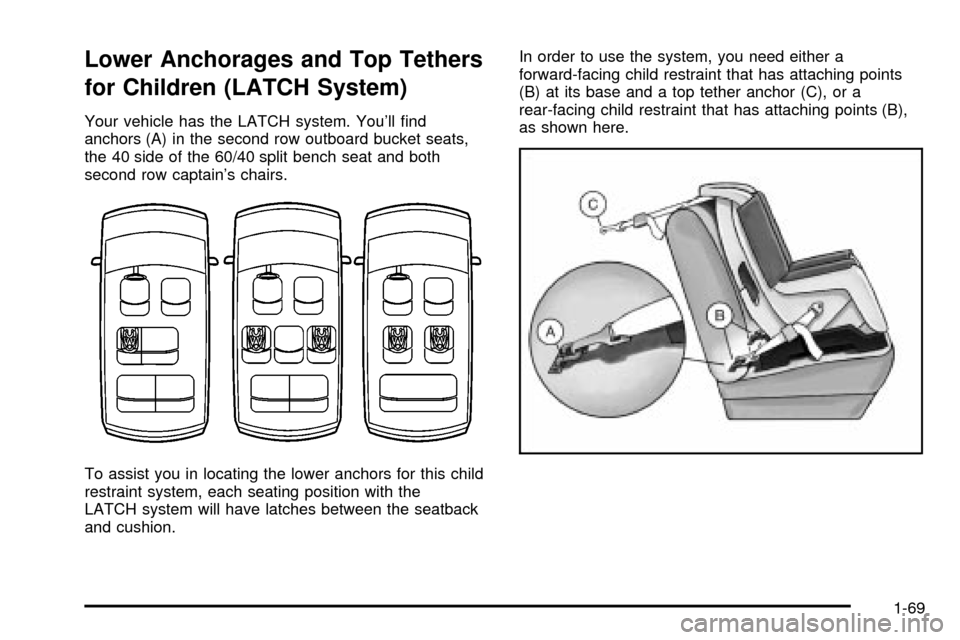
Your vehicle has the LATCH system. You'll ®nd
anchors (A) in the second row outboard bucket seats,
the 40 side of the 60/40 split bench seat and both
second row captain's chairs.
To assist you in locating the lower anchors for this child
restraint system, each seating position with the
LATCH system will have latches between the seatback
and cushion.In order to use the system, you need either a
forward-facing child restraint that has attaching points
(B) at its base and a top tether anchor (C), or a
rear-facing child restraint that has attaching points (B),
as shown here.
1-69