Page 251 of 372

How to Add Coolant to the Coolant
Recovery Tank
If you haven't found a problem yet, but the coolant level
isn't at or above the FULL mark, add a 50/50 mixture of
clean, drinkable waterand a proper coolant at the coolant
recovery tank. SeeEngine Coolant on page 5-28for
more information about the proper coolant mixture.
{CAUTION:
Adding only plain water to your cooling system
can be dangerous. Plain water, or some other
liquid such as alcohol, can boil before the
proper coolant mixture will. Your vehicle's
coolant warning system is set for the proper
CAUTION: (Continued)
CAUTION: (Continued)
coolant mixture. With plain water or the wrong
mixture, your engine could get too hot but you
wouldn't get the overheat warning. Your
engine could catch ®re and you or others
could be burned. Use a 50/50 mixture of clean,
drinkable water and a proper coolant.
Notice:In cold weather, water can freeze and crack
the engine, radiator, heater core and other parts.
Use the recommended coolant and the proper
coolant mixture.
5-35
Page 252 of 372
{CAUTION:
You can be burned if you spill coolant on hot
engine parts. Coolant contains ethylene glycol
and it will burn if the engine parts are hot
enough. Do not spill coolant on a hot engine.When the coolant in the coolant recovery tank is at or
above the FULL mark, start your vehicle.
If the overheat warning continues, there's one more
thing you can try. You can add the proper coolant
mixture directly to the radiator, but be sure the cooling
system is cool before you do it.
{CAUTION:
Steam and scalding liquids from a hot cooling
system can blow out and burn you badly.
They are under pressure, and if you turn
the radiator pressure cap Ð even a
little Ð they can come out at high speed.
CAUTION: (Continued)
5-36
Page 253 of 372
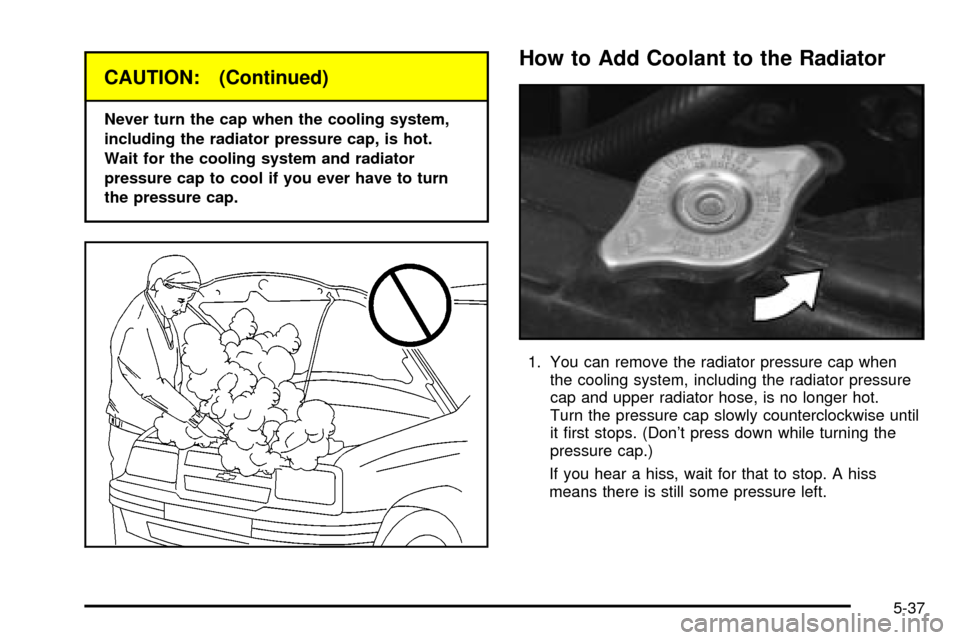
CAUTION: (Continued)
Never turn the cap when the cooling system,
including the radiator pressure cap, is hot.
Wait for the cooling system and radiator
pressure cap to cool if you ever have to turn
the pressure cap.
How to Add Coolant to the Radiator
1. You can remove the radiator pressure cap when
the cooling system, including the radiator pressure
cap and upper radiator hose, is no longer hot.
Turn the pressure cap slowly counterclockwise until
it ®rst stops. (Don't press down while turning the
pressure cap.)
If you hear a hiss, wait for that to stop. A hiss
means there is still some pressure left.
5-37
Page 254 of 372
2. Then keep turning the pressure cap, but now push
down as you turn it. Remove the pressure cap.3. Fill the radiator with the proper coolant mixture, up
to the base of the ®ller neck. See
Engine Coolant
on page 5-28for more information about the proper
coolant mixture.
4. Then ®ll the coolant recovery tank to the FULL mark.
5. Put the cap back on the coolant recovery tank,
but leave the radiator pressure cap off.
5-38
Page 255 of 372
6. Start the engine and let it run until you can feel the
upper radiator hose getting hot. Watch out for the
engine cooling fan.
7. By this time, the coolant level inside the radiator
®ller neck may be lower. If the level is lower, add
more of the proper coolant mixture through the
®ller neck until the level reaches the base of the
®ller neck.8. Then replace the pressure cap. At any time during
this procedure if coolant begins to ¯ow out of the
®ller neck, reinstall the pressure cap. Be sure
the arrows on the pressure cap line up like this.
5-39
Page 321 of 372

qChange differential ¯uid.
qInspect propeller shafts and U-joints for looseness and
damage (or every 15 months, whichever occurs ®rst).
Inspect more frequently if used off-road or for pulling a
trailer. Tighten U-joint ¯ange bolts if necessary.
18,000 Miles (30 000 km)
qChange engine oil and ®lter (or every 3 months,
whichever occurs ®rst).An Emission Control Service.
qIf Equipped: Inspect passenger compartment air ®lters.
qRotate tires. See
Tire Inspection and Rotation on
page 5-60for proper rotation pattern and additional
information.(See footnote +.)
21,000 Miles (35 000 km)
qChange engine oil and ®lter (or every 3 months,
whichever occurs ®rst).An Emission Control Service.
24,000 Miles (40 000 km)
qChange engine oil and ®lter (or every 3 months,
whichever occurs ®rst).An Emission Control Service.
qIf Equipped: Inspect passenger compartment air ®lters.
qRotate tires. See
Tire Inspection and Rotation on
page 5-60for proper rotation pattern and additional
information.(See footnote +.)
27,000 Miles (45 000 km)
qChange engine oil and ®lter (or every 3 months,
whichever occurs ®rst).An Emission Control Service.
30,000 Miles (50 000 km)
qChange engine oil and ®lter (or every 3 months,
whichever occurs ®rst).An Emission Control Service.
qIf Equipped: Replace passenger compartment
air ®lters.
qInspect fuel tank, cap and lines for damage or leaks.
Inspect fuel cap gasket for any damage. Replace
parts as needed.
An Emission Control Service.
(See footnote ².)
qInspect engine accessory drive belts (or every
30 months, whichever occurs ®rst).An Emission
Control Service.
qDrain, ¯ush and re®ll cooling system (or every
30 months, whichever occurs ®rst). SeeEngine
Coolant on page 5-28for what to use. Inspect hoses.
Clean radiator, condenser, pressure cap and neck.
Pressure test the cooling system and pressure
cap.
An Emission Control Service. (See footnote ².)
qInspect ignition coil plug cap (or every 30 months,
whichever occurs ®rst).An Emission Control
Service. (See footnote ².)
6-9
Page 324 of 372

54,000 Miles (90 000 km)
qChange engine oil and ®lter (or every 3 months,
whichever occurs ®rst).An Emission Control Service.
qIf Equipped: Inspect passenger compartment
air ®lters.
qRotate tires. See
Tire Inspection and Rotation on
page 5-60for proper rotation pattern and additional
information.(See footnote +.)
57,000 Miles (95 000 km)
qChange engine oil and ®lter (or every 3 months,
whichever occurs ®rst).An Emission Control Service.
60,000 Miles (100 000 km)
qChange engine oil and ®lter (or every 3 months,
whichever occurs ®rst).An Emission Control Service.
qIf Equipped: Replace passenger compartment
air ®lters.
qChange automatic transmission ¯uid and ®lter if the
vehicle is mainly driven under one or more of these
conditions:
þ In heavy city traffic where the outside
temperature regularly reaches 90ÉF (32ÉC) or
higher.
þ In hilly or mountainous terrain.þ When doing frequent trailer towing.
þ Uses such as found in taxi, police or delivery
service.
If you do not use your vehicle under any of these
conditions, change the ¯uid and ®lter every
100,000 miles (166 000 km).
qInspect engine accessory drive belts (or every
30 months, whichever occurs ®rst).An Emission
Control Service.
qDrain, ¯ush and re®ll cooling system (or every
30 months, whichever occurs ®rst). SeeEngine
Coolant on page 5-28for what to use. Inspect hoses.
Clean radiator, condenser, pressure cap and neck.
Pressure test the cooling system and pressure cap.
An Emission Control Service. (See footnote ².)
qReplace spark plugs.An Emission Control Service.
qInspect ignition coil plug cap (or every 30 months,
whichever occurs ®rst).An Emission Control Service.
qDrain, re®ll and bleed the brake system.
qInspect fuel tank, cap and lines for damage or leaks.
Inspect fuel cap gasket for any damage. Replace parts
as needed.
An Emission Control Service.
(See footnote ².)
6-12
Page 327 of 372

87,000 Miles (145 000 km)
qChange engine oil and ®lter (or every 3 months,
whichever occurs ®rst).An Emission Control Service.
90,000 Miles (150 000 km)
qChange engine oil and ®lter (or every 3 months,
whichever occurs ®rst).An Emission Control Service.
qIf Equipped: Replace passenger compartment
air ®lters.
qInspect automatic transmission ¯uid hose (or every
45 months, whichever occurs ®rst).
qChange automatic transmission ¯uid and ®lter if the
vehicle is mainly driven under one or more of these
conditions:
þ In heavy city traffic where the outside
temperature regularly reaches 90ÉF (32ÉC)
or higher.
þ In hilly or mountainous terrain.
þ When doing frequent trailer towing.
þ Uses such as found in taxi, police or delivery
service.
If you do not use your vehicle under any of these
conditions, change the ¯uid and ®lter every
100,000 miles (166 000 km).
qInspect engine accessory drive belts (or every
30 months, whichever occurs ®rst).An Emission
Control Service.
qInspect fuel tank, cap and lines for damage or leaks.
Inspect fuel cap gasket for any damage. Replace
parts as needed.
An Emission Control Service.
(See footnote ².)
qInspect ignition coil plug cap (or every 30 months,
whichever occurs ®rst).An Emission Control
Service.
qDrain, ¯ush and re®ll cooling system (or every
30 months, whichever occurs ®rst). SeeEngine
Coolant on page 5-28for what to use. Inspect hoses.
Clean radiator, condenser, pressure cap and neck.
Pressure test the cooling system and pressure
cap.
An Emission Control Service. (See footnote ².)
qReplace engine air cleaner ®lter. SeeEngine
Air Cleaner/Filter on page 5-20for more information.An Emission Control Service.
qRotate tires. SeeTire Inspection and Rotation on
page 5-60for proper rotation pattern and additional
information.(See footnote +.)
qChange manual transmission ¯uid.
qChange transfer case ¯uid.
6-15