Page 249 of 372
Cooling System
When you decide it's safe to lift the hood, here's what
you'll see:
A. Coolant Recovery Tank
B. Radiator Pressure Cap
C. Engine Cooling Fan{CAUTION:
An electric engine cooling fan under the hood
can start up even when the engine is not
running and can injure you. Keep hands,
clothing and tools away from any underhood
electric fan. Don't reach through the grill to
release the underhood lever.
If the coolant inside the coolant recovery tank is boiling,
don't do anything else until it cools down. The vehicle
should be parked on a level surface.
5-33
Page 250 of 372
The coolant level should be at or above FULL. If it isn't,
you may have a leak at the pressure cap or in the
radiator hoses, heater hoses, radiator, water pump or
somewhere else in the cooling system.
{CAUTION:
Heater and radiator hoses, and other engine
parts, can be very hot. Do not touch them.
If you do, you can be burned.
Do not run the engine if there is a leak. If you
run the engine, it could lose all coolant. That
could cause an engine ®re, and you could be
burned. Get any leak ®xed before you drive the
vehicle.
If there seems to be no leak, start the engine again.
The engine cooling fan speed should increase when idle
speed is doubled by pushing the accelerator pedal
down. If it doesn't, your vehicle needs service. Turn off
the engine.
Notice:Engine damage from running your engine
without coolant isn't covered by your warranty.
5-34
Page 251 of 372

How to Add Coolant to the Coolant
Recovery Tank
If you haven't found a problem yet, but the coolant level
isn't at or above the FULL mark, add a 50/50 mixture of
clean, drinkable waterand a proper coolant at the coolant
recovery tank. SeeEngine Coolant on page 5-28for
more information about the proper coolant mixture.
{CAUTION:
Adding only plain water to your cooling system
can be dangerous. Plain water, or some other
liquid such as alcohol, can boil before the
proper coolant mixture will. Your vehicle's
coolant warning system is set for the proper
CAUTION: (Continued)
CAUTION: (Continued)
coolant mixture. With plain water or the wrong
mixture, your engine could get too hot but you
wouldn't get the overheat warning. Your
engine could catch ®re and you or others
could be burned. Use a 50/50 mixture of clean,
drinkable water and a proper coolant.
Notice:In cold weather, water can freeze and crack
the engine, radiator, heater core and other parts.
Use the recommended coolant and the proper
coolant mixture.
5-35
Page 252 of 372
{CAUTION:
You can be burned if you spill coolant on hot
engine parts. Coolant contains ethylene glycol
and it will burn if the engine parts are hot
enough. Do not spill coolant on a hot engine.When the coolant in the coolant recovery tank is at or
above the FULL mark, start your vehicle.
If the overheat warning continues, there's one more
thing you can try. You can add the proper coolant
mixture directly to the radiator, but be sure the cooling
system is cool before you do it.
{CAUTION:
Steam and scalding liquids from a hot cooling
system can blow out and burn you badly.
They are under pressure, and if you turn
the radiator pressure cap Ð even a
little Ð they can come out at high speed.
CAUTION: (Continued)
5-36
Page 253 of 372
CAUTION: (Continued)
Never turn the cap when the cooling system,
including the radiator pressure cap, is hot.
Wait for the cooling system and radiator
pressure cap to cool if you ever have to turn
the pressure cap.
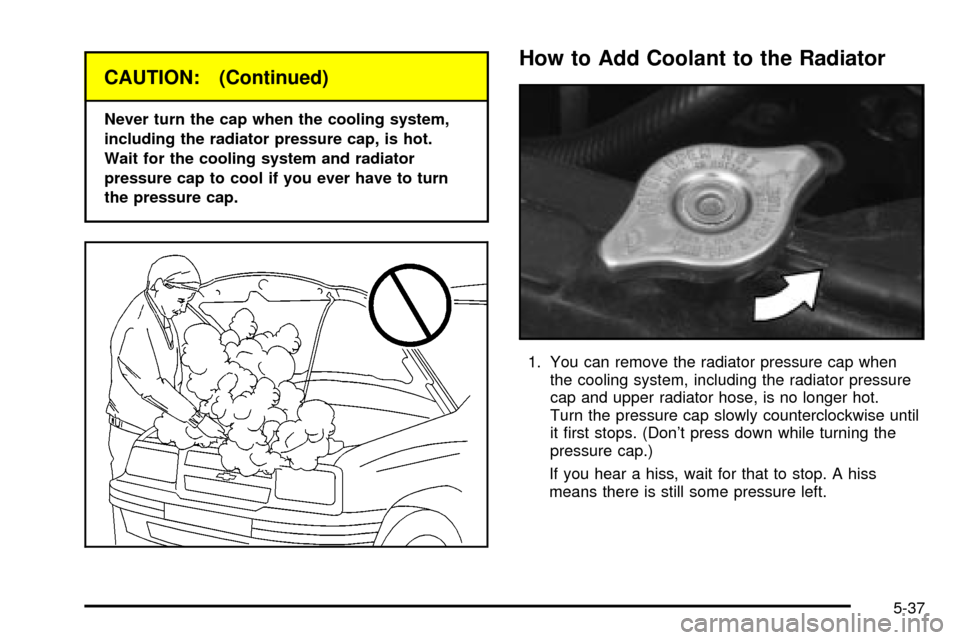
How to Add Coolant to the Radiator
1. You can remove the radiator pressure cap when
the cooling system, including the radiator pressure
cap and upper radiator hose, is no longer hot.
Turn the pressure cap slowly counterclockwise until
it ®rst stops. (Don't press down while turning the
pressure cap.)
If you hear a hiss, wait for that to stop. A hiss
means there is still some pressure left.
5-37
Page 255 of 372
6. Start the engine and let it run until you can feel the
upper radiator hose getting hot. Watch out for the
engine cooling fan.
7. By this time, the coolant level inside the radiator
®ller neck may be lower. If the level is lower, add
more of the proper coolant mixture through the
®ller neck until the level reaches the base of the
®ller neck.8. Then replace the pressure cap. At any time during
this procedure if coolant begins to ¯ow out of the
®ller neck, reinstall the pressure cap. Be sure
the arrows on the pressure cap line up like this.
5-39
Page 281 of 372

Each new wheel should have the same load-carrying
capacity, diameter, width, offset and be mounted
the same way as the one it replaces.
If you need to replace any of your wheels, wheel bolts
or wheel nuts, replace them only with new GM
original equipment parts. This way, you will be sure to
have the right wheel, wheel bolts and wheel nuts
for your vehicle.
{CAUTION:
Using the wrong replacement wheels, wheel
bolts or wheel nuts on your vehicle can be
dangerous. It could affect the braking and
handling of your vehicle, make your tires lose
air and make you lose control. You could have
a collision in which you or others could be
injured. Always use the correct wheel, wheel
bolts and wheel nuts for replacement.
Notice:The wrong wheel can also cause problems
with bearing life, brake cooling, speedometer or
odometer calibration, headlamp aim, bumper height,
vehicle ground clearance and tire or tire chain
clearance to the body and chassis.
See
Changing a Flat Tire on page 5-67for more
information.
Used Replacement Wheels
{CAUTION:
Putting a used wheel on your vehicle is
dangerous. You can't know how it's been used
or how far it's been driven. It could fail
suddenly and cause a crash. If you have to
replace a wheel, use a new GM original
equipment wheel.
5-65
Page 309 of 372
Capacities and Speci®cations
The following approximate capacities are given in English and metric conversions.
Capacities and Speci®cations
ApplicationCapacities
English Metric
Air Conditioning Refrigerant R134a and Polyalkylene
Glycol (PAG) refrigerant oil with dye0.9 lbs. 0.4 kg
Automatic Transmission
Drain and Re®ll2.6 quarts 2.5 L*
Cooling System
2.0L Engine
2.5L Engine6.9 quarts
8.5 quarts6.5 L
8.0 L
Differential
Front
Rear1.1 quarts
2.3 quarts1.0 L*
2.2 L*
Engine Oil with Filter
2.0L Engine
2.5L Engine5.5 quarts
5.8 quarts5.2 L**
5.5 L**
Fuel Tank
Two-Door Convertible
Four-Door Hardtop14.8 gallons
16.9 gallons56 L
64 L
5-93