2003 CHEVROLET SUBURBAN Service
[x] Cancel search: ServicePage 373 of 552

Heavy-Duty Trailer Wiring Harness
Package
Your vehicle is equipped with the seven-wire trailer
towing harness. This harness with a seven-pin universal
trailer connector is attached to a bracket on the hitch
platform.The seven-wire harness contains the following trailer
circuits:
·Yellow: Left Stop/Turn Signal
·Dark Green: Right Stop/Turn Signal
·Brown: Taillamps
·White: Ground
·Light Green: Back-up Lamps
·Red: Battery Feed
·Dark Blue: Trailer Brake
If your trailer is equipped with electronic brakes, you
can get a jumper harness (electric trailer brake control)
with a trailer battery feed fuse from your dealer. This
harness and fuse should be installed by your dealer or a
quali®ed service center.
If you need to tow a light-duty trailer with a standard
four-way round pin connector, you can also get an
adapter.
4-79
Page 374 of 552
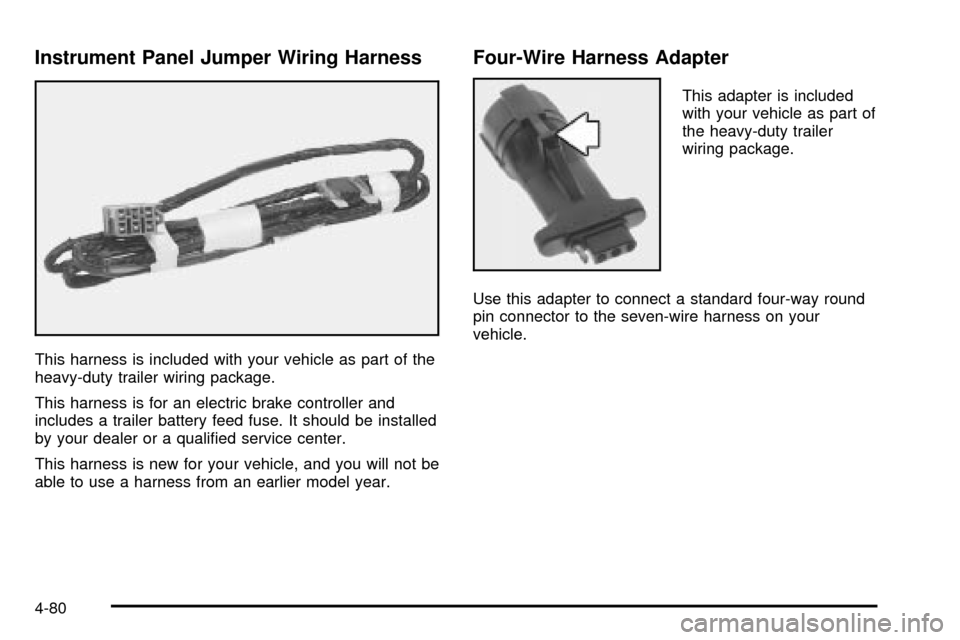
Instrument Panel Jumper Wiring Harness
This harness is included with your vehicle as part of the
heavy-duty trailer wiring package.
This harness is for an electric brake controller and
includes a trailer battery feed fuse. It should be installed
by your dealer or a quali®ed service center.
This harness is new for your vehicle, and you will not be
able to use a harness from an earlier model year.
Four-Wire Harness Adapter
This adapter is included
with your vehicle as part of
the heavy-duty trailer
wiring package.
Use this adapter to connect a standard four-way round
pin connector to the seven-wire harness on your
vehicle.
4-80
Page 377 of 552

Service............................................................5-3
Doing Your Own Service Work.........................5-3
Adding Equipment to the Outside
of Your Vehicle...........................................5-4
Fuel................................................................5-4
Gasoline Octane............................................5-5
Gasoline Speci®cations....................................5-5
California Fuel...............................................5-6
Additives.......................................................5-6
Fuel E-85 (85% Ethanol).................................5-7
Fuels in Foreign Countries...............................5-8
Filling Your Tank............................................5-9
Filling a Portable Fuel Container.....................5-11
Checking Things Under
the Hood....................................................5-12
Hood Release..............................................5-12
Engine Compartment Overview.......................5-14
Engine Oil...................................................5-18
Engine Air Cleaner/Filter................................5-23
Automatic Transmission Fluid.........................5-26
Engine Coolant.............................................5-29
Coolant Surge Tank Pressure Cap..................5-32
Engine Overheating.......................................5-33Cooling System............................................5-36
Engine Fan Noise.........................................5-42
Power Steering Fluid.....................................5-43
Windshield Washer Fluid................................5-44
Brakes........................................................5-45
Battery........................................................5-48
Jump Starting...............................................5-49
All-Wheel Drive..............................................5-55
Rear Axle.......................................................5-56
Four-Wheel Drive............................................5-57
Front Axle......................................................5-58
Bulb Replacement..........................................5-59
Halogen Bulbs..............................................5-59
Headlamps..................................................5-60
Front Turn Signal, Sidemarker and Daytime
Running Lamps.........................................5-61
Side Identi®cation Marker Lamps.....................5-62
Roof Marker Lamps......................................5-62
Taillamps.....................................................5-64
Replacement Bulbs.......................................5-66
Windshield Wiper Blade Replacement..............5-66
Section 5 Service and Appearance Care
5-1
Page 378 of 552

Tires..............................................................5-67
In¯ation Ð Tire Pressure...............................5-68
Tire Inspection and Rotation...........................5-69
When It Is Time for New Tires.......................5-70
Buying New Tires.........................................5-71
Uniform Tire Quality Grading..........................5-72
Wheel Alignment and Tire Balance..................5-74
Wheel Replacement......................................5-74
Tire Chains..................................................5-76
If a Tire Goes Flat........................................5-76
Changing a Flat Tire.....................................5-77
Spare Tire...................................................5-98
Appearance Care............................................5-99
Cleaning the Inside of Your Vehicle.................5-99
Care of Safety Belts....................................5-102
Weatherstrips.............................................5-102
Cleaning the Outside of Your Vehicle.............5-102
Sheet Metal Damage...................................5-104Finish Damage...........................................5-104
Underbody Maintenance...............................5-105
Chemical Paint Spotting...............................5-105
Vehicle Care/Appearance Materials................5-105
Vehicle Identi®cation.....................................5-107
Vehicle Identi®cation Number (VIN)................5-107
Service Parts Identi®cation Label...................5-107
Electrical System..........................................5-108
Add-On Electrical Equipment.........................5-108
Windshield Wiper Fuses...............................5-108
Power Windows and Other Power Options......5-108
Fuses and Circuit Breakers..........................5-109
Capacities and Speci®cations........................5-118
Capacities and Speci®cations........................5-118
Normal Maintenance Replacement Parts.........5-121
Normal Maintenance Replacement Parts.........5-121
Section 5 Service and Appearance Care
5-2
Page 379 of 552
Service
Your dealer knows your vehicle best and wants you to
be happy with it. We hope you will go to your dealer
for all your service needs. You will get genuine GM parts
and GM-trained and supported service people.
We hope you will want to keep your GM vehicle all GM.
Genuine GM parts have one of these marks:
Doing Your Own Service Work
If you want to do some of your own service work, you'll
want to use the proper service manual. It tells you
much more about how to service your vehicle than this
manual can. To order the proper service manual,
see
Service Publications Ordering Information on
page 7-11.
Your vehicle has an air bag system. Before attempting
to do your own service work, see
Servicing Your Air
Bag-Equipped Vehicle on page 1-87.
You should keep a record with all parts receipts and list
the mileage and the date of any service work you
perform. See
Part E: Maintenance Record on page 6-20.
{CAUTION:
You can be injured and your vehicle could be
damaged if you try to do service work on a
vehicle without knowing enough about it.
·Be sure you have sufficient knowledge,
experience, the proper replacement parts
and tools before you attempt any vehicle
maintenance task.
CAUTION: (Continued)
5-3
Page 381 of 552
Gasoline Octane
Use regular unleaded gasoline with a posted octane of 87
or higher. If the octane is less than 87, you may get a
heavy knocking noise when you drive. If this occurs, use
a gasoline rated at 87 octane or higher as soon as
possible. Otherwise, you might damage your engine.
A little pinging noise when you accelerate or drive uphill is
considered normal. This does not indicate a problem
exists or that a higher-octane fuel is necessary. If you are
using 87 octane or higher-octane fuel and hear heavy
knocking, your engine needs service.
Gasoline Speci®cations
It is recommended that gasoline meet speci®cations
which were developed by the American Automobile
Manufacturers Association and endorsed by the
Canadian Vehicle Manufacturers Association for better
vehicle performance and engine protection. Gasoline
meeting these speci®cations could provide improved
driveability and emission control system performance
compared to other gasoline.
In Canada, look for the
ªAuto Makers' Choiceº
label on the pump.
Canada Only
5-5
Page 383 of 552

Some gasolines that are not reformulated for low
emissions may contain an octane-enhancing additive
called methylcyclopentadienyl manganese tricarbonyl
(MMT); ask the attendant where you buy gasoline
whether the fuel contains MMT. General Motors does
not recommend the use of such gasolines. Fuels
containing MMT can reduce the life of spark plugs and
the performance of the emission control system may
be affected. The malfunction indicator lamp may turn on.
If this occurs, return to your authorized GM dealer for
service.
Fuel E-85 (85% Ethanol)
The 8th digit of your vehicle identi®cation number (VIN)
shows the code letter or number that identi®es your
engine. You will ®nd the VIN at the top left of the
instrument panel. See
Vehicle Identi®cation Number
(VIN) on page 5-107.
If your vehicle has the 5.3L V8 engine (VIN Code Z
only), you may use either regular unleaded gasoline or
ethanol fuel containing up to 85% ethanol (E-85);
also see
Fuel on page 5-4. In all other engines, including
the 5.3L V8 (VIN Code T), use only regular unleaded
gasoline.Only vehicles that have the 5.3L V8 engine (VIN Code Z)
may use 85% ethanol fuel (E-85).
Many service stations will not have an 85% ethanol fuel
(E-85) pump available. The U. S. Department of
Energy has an alternative fuels website
(http://afdcmap.nrel.gov/nrel/) that can help you ®nd
E-85 fuel. Those stations that do have E-85 should have
a label indicating ethanol content. Do not use the fuel
if the ethanol content is
greaterthan 85%. Your vehicle
may not operate properly if the ethanol content is
greater than 85%.
At a minimum, E-85 should meet ASTM Speci®cation
D 5798.
To insure quick starts in the wintertime, the E-85 fuel
must be formulated properly for your climate according
to ASTM speci®cation D 5798. If you have trouble
starting on E-85, it may be because your E-85 fuel is
not properly formulated for your climate. If this happens,
switching to gasoline or adding gasoline to your fuel
tank may improve starting. Your vehicle is designed to
accommodate a mixture of gasoline and E-85 fuel.
For good starting and heater efficiency below 32ÉF
(0ÉC), the fuel mix in the fuel tank should contain no
more than 70% ethanol.
5-7
Page 396 of 552

The engine oil ®ll cap for
the VORTECŸ 4800,
5300, 6000 and 8100 V8
engine is located on
the engine valve cover, on
the passenger's side of
the vehicle.
Your vehicle may have a cap with text and a graphic, or
just a graphic as shown. See
Engine Compartment
Overview on page 5-14for more information on location.
Be sure to ®ll it enough to put the level somewhere in
the proper operating range. Push the dipstick all the way
back in when you're through.
What Kind of Engine Oil to Use
Oils recommended for your vehicle can be identi®ed by
looking for the starburst symbol.
This symbol indicates that the oil has been certi®ed by
the American Petroleum Institute (API). Do not use
any oil which does not carry this starburst symbol.If you choose to perform
the engine oil change
service yourself, be sure
the oil you use has
the starburst symbol on
the front of the oil
container. If you have your
oil changed for you, be
sure the oil put into
your engine is American
Petroleum Institute certi®ed
for gasoline engines.
You should also use the proper viscosity oil for your
vehicle, as shown in the viscosity chart.
5-20