Page 206 of 374
City Driving
One of the biggest problems with city streets is the
amount of traffic on them. You will want to watch out for
what the other drivers are doing and pay attention to
traffic signals.Here are ways to increase your safety in city driving:
Know the best way to get to where you are
going. Get a city map and plan your trip into
an unknown part of the city just as you would for a
cross-country trip.
Try to use the freeways that rim and crisscross
most large cities. You will save time and energy.
SeeFreeway Driving on page 4-21.
Treat a green light as a warning signal. A traffic
light is there because the corner is busy enough
to need it. When a light turns green, and just before
you start to move, check both ways for vehicles
that have not cleared the intersection or may
be running the red light.
4-20
Page 207 of 374
Freeway Driving
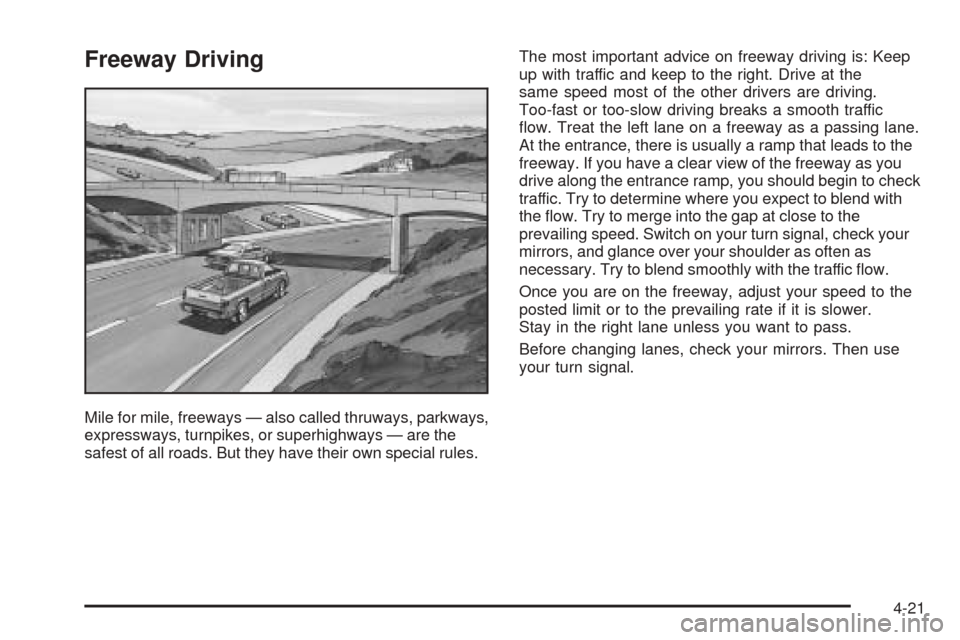
Mile for mile, freeways — also called thruways, parkways,
expressways, turnpikes, or superhighways — are the
safest of all roads. But they have their own special rules.The most important advice on freeway driving is: Keep
up with traffic and keep to the right. Drive at the
same speed most of the other drivers are driving.
Too-fast or too-slow driving breaks a smooth traffic
ow. Treat the left lane on a freeway as a passing lane.
At the entrance, there is usually a ramp that leads to the
freeway. If you have a clear view of the freeway as you
drive along the entrance ramp, you should begin to check
traffic. Try to determine where you expect to blend with
the ow. Try to merge into the gap at close to the
prevailing speed. Switch on your turn signal, check your
mirrors, and glance over your shoulder as often as
necessary. Try to blend smoothly with the traffic ow.
Once you are on the freeway, adjust your speed to the
posted limit or to the prevailing rate if it is slower.
Stay in the right lane unless you want to pass.
Before changing lanes, check your mirrors. Then use
your turn signal.
4-21
Page 233 of 374
Backing Up
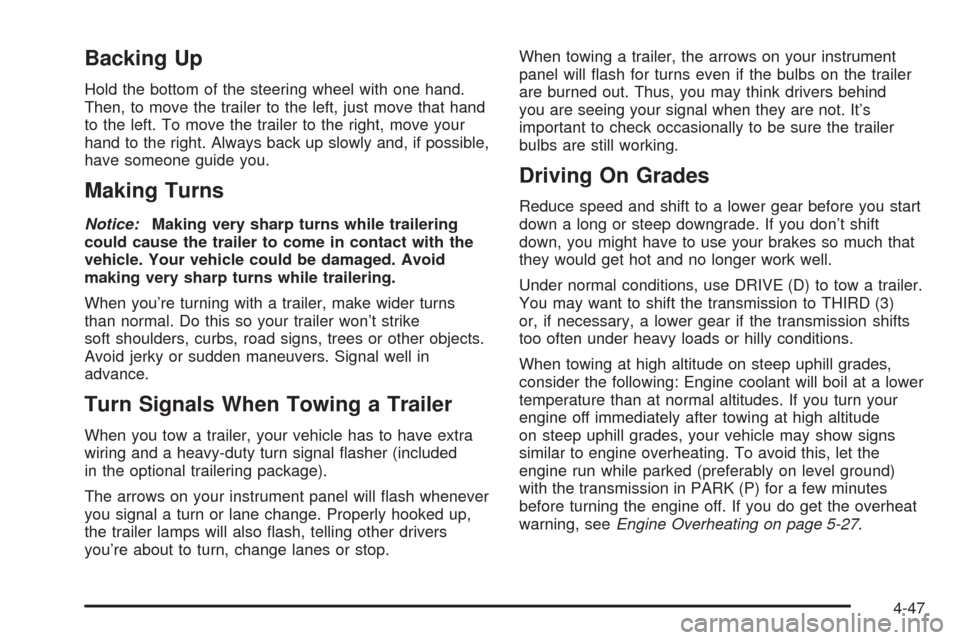
Hold the bottom of the steering wheel with one hand.
Then, to move the trailer to the left, just move that hand
to the left. To move the trailer to the right, move your
hand to the right. Always back up slowly and, if possible,
have someone guide you.
Making Turns
Notice:Making very sharp turns while trailering
could cause the trailer to come in contact with the
vehicle. Your vehicle could be damaged. Avoid
making very sharp turns while trailering.
When you’re turning with a trailer, make wider turns
than normal. Do this so your trailer won’t strike
soft shoulders, curbs, road signs, trees or other objects.
Avoid jerky or sudden maneuvers. Signal well in
advance.
Turn Signals When Towing a Trailer
When you tow a trailer, your vehicle has to have extra
wiring and a heavy-duty turn signal asher (included
in the optional trailering package).
The arrows on your instrument panel will ash whenever
you signal a turn or lane change. Properly hooked up,
the trailer lamps will also ash, telling other drivers
you’re about to turn, change lanes or stop.When towing a trailer, the arrows on your instrument
panel will ash for turns even if the bulbs on the trailer
are burned out. Thus, you may think drivers behind
you are seeing your signal when they are not. It’s
important to check occasionally to be sure the trailer
bulbs are still working.
Driving On Grades
Reduce speed and shift to a lower gear before you start
down a long or steep downgrade. If you don’t shift
down, you might have to use your brakes so much that
they would get hot and no longer work well.
Under normal conditions, use DRIVE (D) to tow a trailer.
You may want to shift the transmission to THIRD (3)
or, if necessary, a lower gear if the transmission shifts
too often under heavy loads or hilly conditions.
When towing at high altitude on steep uphill grades,
consider the following: Engine coolant will boil at a lower
temperature than at normal altitudes. If you turn your
engine off immediately after towing at high altitude
on steep uphill grades, your vehicle may show signs
similar to engine overheating. To avoid this, let the
engine run while parked (preferably on level ground)
with the transmission in PARK (P) for a few minutes
before turning the engine off. If you do get the overheat
warning, seeEngine Overheating on page 5-27.
4-47
Page 237 of 374

Service............................................................5-3
Doing Your Own Service Work.........................5-4
Adding Equipment to the Outside
of Your Vehicle...........................................5-5
Fuel................................................................5-5
Gasoline Octane............................................5-5
Gasoline Specications....................................5-6
California Fuel...............................................5-6
Additives.......................................................5-7
Fuels in Foreign Countries...............................5-7
Filling the Tank..............................................5-8
Filling a Portable Fuel Container.....................5-10
Checking Things Under the Hood....................5-10
Hood Release..............................................5-11
Engine Compartment Overview.......................5-12
Engine Oil...................................................5-14
Engine Cover...............................................5-19
Engine Air Cleaner/Filter................................5-20
Automatic Transmission Fluid.........................5-21
Engine Coolant.............................................5-24
Coolant Surge Tank Pressure Cap..................5-26
Engine Overheating.......................................5-27
Cooling System............................................5-28
Power Steering Fluid.....................................5-31
Windshield Washer Fluid................................5-32Brakes........................................................5-33
Battery........................................................5-36
Jump Starting...............................................5-36
Rear Axle.......................................................5-42
Headlamp Aiming...........................................5-42
Bulb Replacement..........................................5-43
Halogen Bulbs..............................................5-43
Headlamps..................................................5-43
Front Turn Signal, Sidemarker and
Parking Lamps..........................................5-44
Taillamps.....................................................5-46
Back-Up Lamps............................................5-47
Replacement Bulbs.......................................5-48
Windshield Wiper Blade Replacement..............5-48
Tires..............................................................5-51
Ination - Tire Pressure.................................5-56
Tire Inspection and Rotation...........................5-57
When It Is Time for New Tires.......................5-58
Buying New Tires.........................................5-59
Uniform Tire Quality Grading..........................5-60
Wheel Alignment and Tire Balance..................5-61
Wheel Replacement......................................5-62
Tire Chains..................................................5-64
If a Tire Goes Flat........................................5-65
Tire Inator Kit.............................................5-66
Section 5 Service and Appearance Care
5-1
Page 280 of 374
5. Disconnect the bulb socket from the wiring harness
and replace the unit.
6. Reinstall the bulb socket back into the headlamp
assembly by turning it clockwise.
7. Reinstall the headlamp cover and tighten the
fastener.
Front Turn Signal, Sidemarker and
Parking Lamps
Front Turn and Parking Lamps
To replace the front turn or parking lamp bulbs, do the
following:
1. Open the hood. SeeHood Release on page 5-11
for more information.
2. Locate the bar that runs across the front of the
vehicle and remove the two screws located near
the front of the hood that hold the bar in place.
3. Release the tabs that attach the bar to the
headlamps.
5-44
Page 284 of 374
Replacement Bulbs
Exterior Lamp Bulb Number
Back-up Lamps 2057
Headlamps
High-Beam 9005HB3
Low-Beam H11
Parking Lamps T20
Sidemarker Lamps 194
Taillamps 3157
Turn Signal Lamps T20
For replacement bulbs not listed here, contact
your dealer.
Windshield Wiper Blade
Replacement
Windshield wiper blades should be inspected at
least twice a year for wear and cracking. See “Wiper
Blade Check” underAt Least Twice a Year on page 6-9.
Replacement blades come in different types and are
removed in different ways. For proper type and length,
seeNormal Maintenance Replacement Parts on
page 5-91.
Notice:Allowing the wiper blade arm to touch
the windshield when no wiper blade is installed
could damage the windshield. Any damage
that occurs would not be covered by your warranty.
Do not allow the wiper blade arm to touch the
windshield.
5-48
Page 320 of 374
Fuses Usage
25 Blank
26 Blank
27 HomeLink
®System
28 Roof Door Module
29 Blank
31 Truck Body Controller
32 Remote Keyless Entry (RKE)
33 Windshield Wipers
34 Stoplamps
35 Blank
36Climate Control System,
Driver’s Door Unlock
37 Front Parking Lamps
38 Driver’s Side Turn Signal
39 Climate Control System
40 Truck Body Controller
41 Radio
42 Trailer Parking Lamps
43 Passenger’s Side Turn Signal
44 Blank
Fuses Usage
46 Accessory Power Outlets
47 Ignition
48 Blank
49 Blank
50 Truck Body Controller, Ignition
51 Brakes
52 Blank
Relays Usage
18 Locks
24 Unlock
30 Parking Lamps
45Rear Window Defogger,
Outside Power Heated Mirrors
Circuit
BreakersUsage
01 Roof & Door Module
02 Roof Pump
08 Power Seats
5-84
Page 322 of 374
Fuses Usage
6 Ignition
7 Driver’s Side High Beam Headlamp
8Passenger’s Side High Beam
Headlamp
9 Ignition
10Instrument Panel Cluster, Driver
Information Center (DIC)
11 Driver’s Side Low Beam Headlamp
12Passenger’s Side Low Beam
Headlamp
13 Powertrain Control Module (PCM)
14 Air Bag System
15 Truck Body Controller
16 Truck Body Control, Ignition
17 Driver’s Side Stoplamp/Turn Signals
18Passenger’s Side Stoplamp/
Turn Signals
19 Back-up Lamps
20 Throttle Actuator Control (TAC)
21 Fog LampsFuses Usage
22 Horn
23 Injector A
24 Injector B
25 Oxygen Sensor A
26 Oxygen Sensor B
27 Windshield Washer
28 Cigarette Lighter
29 Powertrain Control Module (PCM)
30 Blank
31 Cargo Cover Release
32 Hazard Warning Flashers
33 Stoplamps
44 Engine Cooling Fan
45 Climate Control Fan
46 Ignition A
47 Ignition B
48 Anti-lock Brake System (ABS)
49 Body Fuse
5-86


