Page 436 of 556
Four-Wheel Drive
Lubricant checks in this section also apply to these
vehicles. However, there are two additional systems that
need lubrication.
Transfer Case
When to Check Lubricant
Refer to the Maintenance Schedule to determine how
often to check the lubricant. SeePart C: Periodic
MaintenanceInspections on page 6-17.
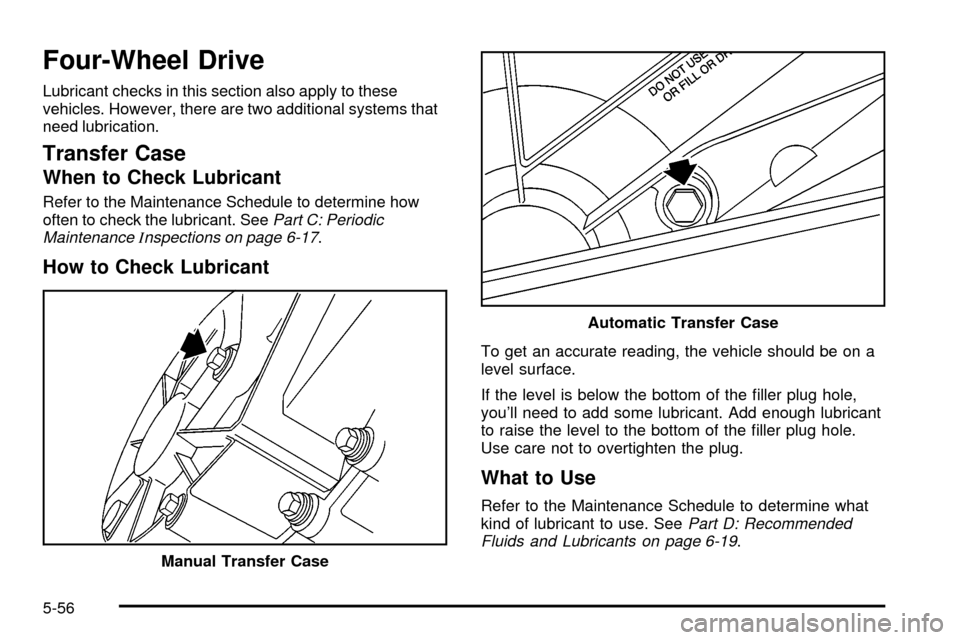
How to Check Lubricant
To get an accurate reading, the vehicle should be on a
level surface.
If the level is below the bottom of the ®ller plug hole,
you'll need to add some lubricant. Add enough lubricant
to raise the level to the bottom of the ®ller plug hole.
Use care not to overtighten the plug.
What to Use
Refer to the Maintenance Schedule to determine what
kind of lubricant to use. SeePart D: Recommended
Fluids and Lubricants on page 6-19.
Manual Transfer Case
Automatic Transfer Case
5-56
Page 437 of 556
Front Axle
When to Check Lubricant
Refer to the Maintenance Schedule to determine how
often to check the lubricant. SeePart A: Scheduled
Maintenance Services on page 6-4.
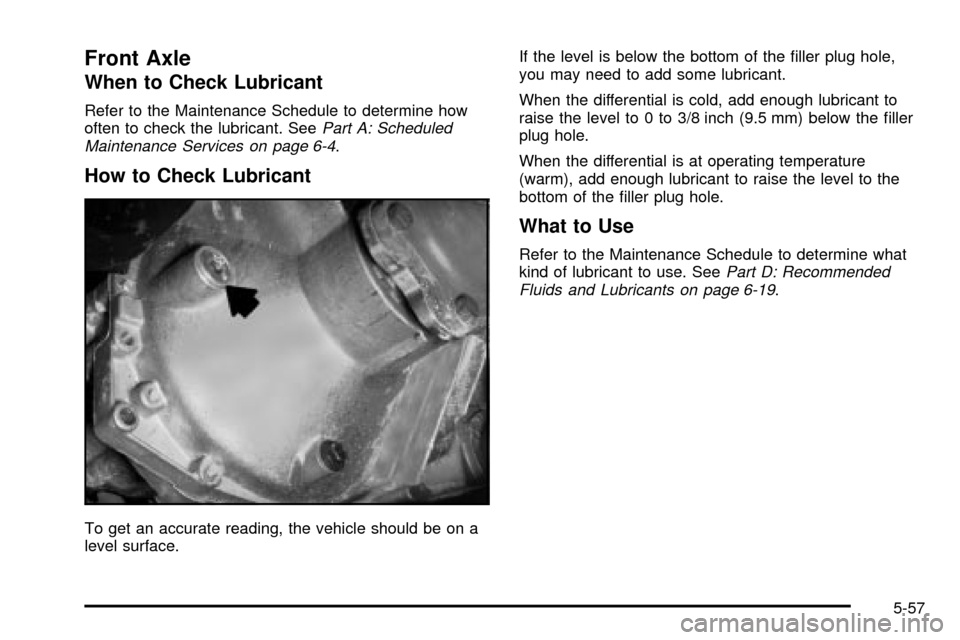
How to Check Lubricant
To get an accurate reading, the vehicle should be on a
level surface.If the level is below the bottom of the ®ller plug hole,
you may need to add some lubricant.
When the differential is cold, add enough lubricant to
raise the level to 0 to 3/8 inch (9.5 mm) below the ®ller
plug hole.
When the differential is at operating temperature
(warm), add enough lubricant to raise the level to the
bottom of the ®ller plug hole.
What to Use
Refer to the Maintenance Schedule to determine what
kind of lubricant to use. SeePart D: Recommended
Fluids and Lubricants on page 6-19.
5-57
Page 483 of 556
Care of Safety Belts
Keep belts clean and dry.
{CAUTION:
Do not bleach or dye safety belts. If you do, it
may severely weaken them. In a crash, they
might not be able to provide adequate
protection. Clean safety belts only with mild
soap and lukewarm water.
Weatherstrips
Silicone grease on weatherstrips will make them last
longer, seal better, and not stick or squeak. Apply
silicone grease with a clean cloth at least every six
months. During very cold, damp weather more frequent
application may be required. See
Part D: Recommended
Fluids and Lubricants on page 6-19.
Cleaning the Outside of Your
Vehicle
The paint ®nish on your vehicle provides beauty, depth
of color, gloss retention and durability.
Washing Your Vehicle
The best way to preserve your vehicle's ®nish is to keep
it clean by washing it often with lukewarm or cold
water.
Don't wash your vehicle in the direct rays of the sun.
Use a car washing soap. Don't use strong soaps
or chemical detergents. Be sure to rinse the vehicle
well, removing all soap residue completely. You can get
GM-approved cleaning products from your dealer.
See
Vehicle Care/Appearance Materials on page 5-107.
Don't use cleaning agents that are petroleum based,
or that contain acid or abrasives. All cleaning agents
should be ¯ushed promptly and not allowed to dry on the
surface, or they could stain. Dry the ®nish with a soft,
clean chamois or an all-cotton towel to avoid surface
scratches and water spotting.
High pressure car washes may cause water to enter
your vehicle.
If your vehicle is equipped with QUADRASTEERŸ see
QUADRASTEERŸ on page 4-15.
5-103
Page 488 of 556
Vehicle Care/Appearance Materials
(cont'd)
Description Usage
Wash Wax ConcentrateMedium foaming
shampoo. Cleans and
lightly waxes.
Biodegradable and
phosphate free.
Spot LifterQuickly and easily
removes spots and stains
from carpets, vinyl and
cloth upholstery.
Odor EliminatorOdorless spray odor
eliminator used on
fabrics, vinyl, leather and
carpet.
See your General Motors parts department for these
products. See
Part D: Recommended Fluids and
Lubricants on page 6-19.
Vehicle Identi®cation
Vehicle Identi®cation Number (VIN)
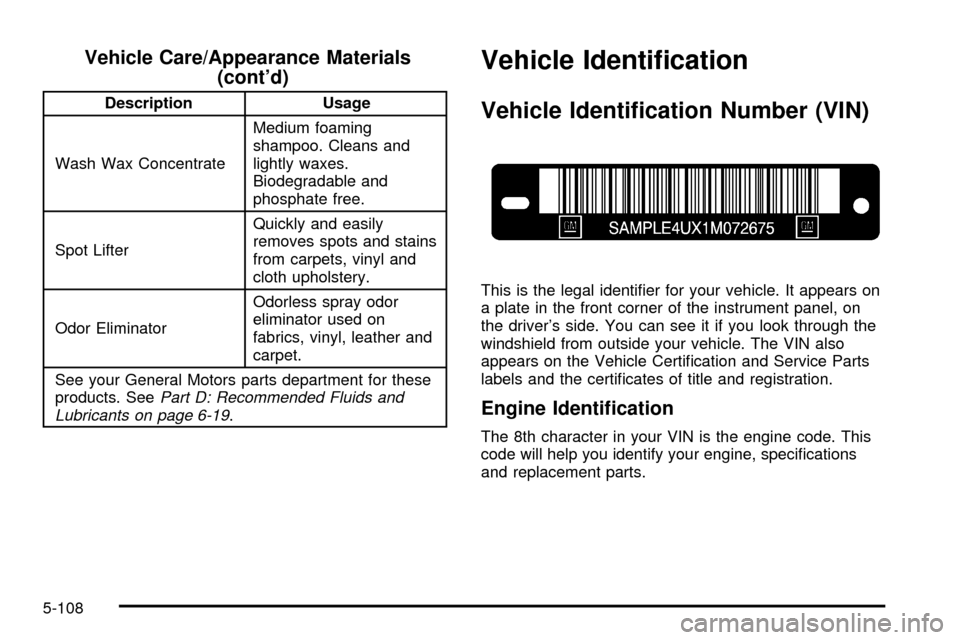
This is the legal identi®er for your vehicle. It appears on
a plate in the front corner of the instrument panel, on
the driver's side. You can see it if you look through the
windshield from outside your vehicle. The VIN also
appears on the Vehicle Certi®cation and Service Parts
labels and the certi®cates of title and registration.
Engine Identi®cation
The 8th character in your VIN is the engine code. This
code will help you identify your engine, speci®cations
and replacement parts.
5-108
Page 498 of 556
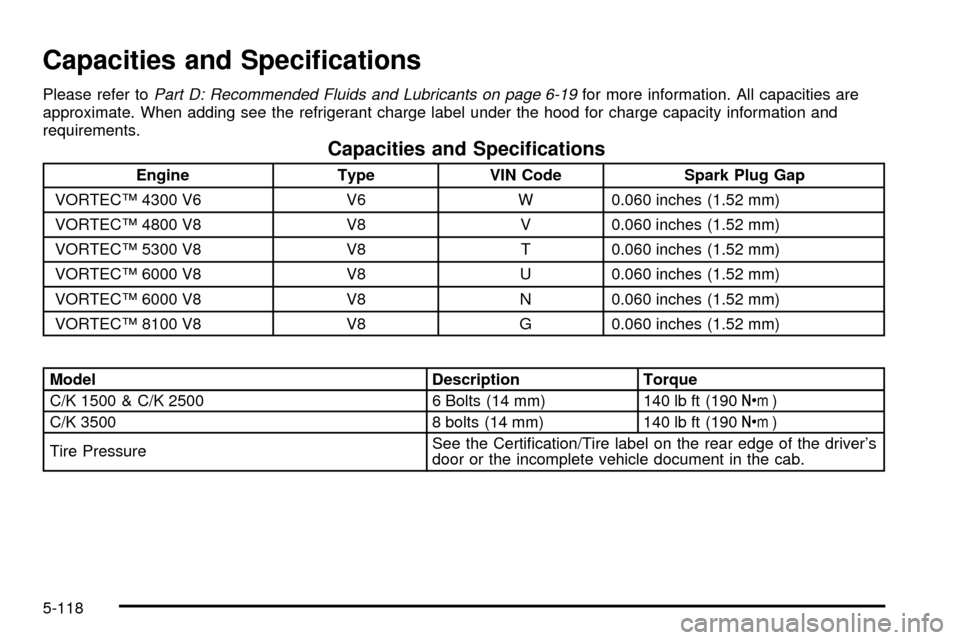
Capacities and Speci®cations
Please refer toPart D: Recommended Fluids and Lubricants on page 6-19for more information. All capacities are
approximate. When adding see the refrigerant charge label under the hood for charge capacity information and
requirements.
Capacities and Speci®cations
Engine Type VIN Code Spark Plug Gap
VORTECŸ 4300 V6 V6 W 0.060 inches (1.52 mm)
VORTECŸ 4800 V8 V8 V 0.060 inches (1.52 mm)
VORTECŸ 5300 V8 V8 T 0.060 inches (1.52 mm)
VORTECŸ 6000 V8 V8 U 0.060 inches (1.52 mm)
VORTECŸ 6000 V8 V8 N 0.060 inches (1.52 mm)
VORTECŸ 8100 V8 V8 G 0.060 inches (1.52 mm)
Model Description Torque
C/K 1500 & C/K 2500 6 Bolts (14 mm) 140 lb ft (190Y)
C/K 3500 8 bolts (14 mm) 140 lb ft (190Y)
Tire PressureSee the Certi®cation/Tire label on the rear edge of the driver's
door or the incomplete vehicle document in the cab.
5-118
Page 503 of 556
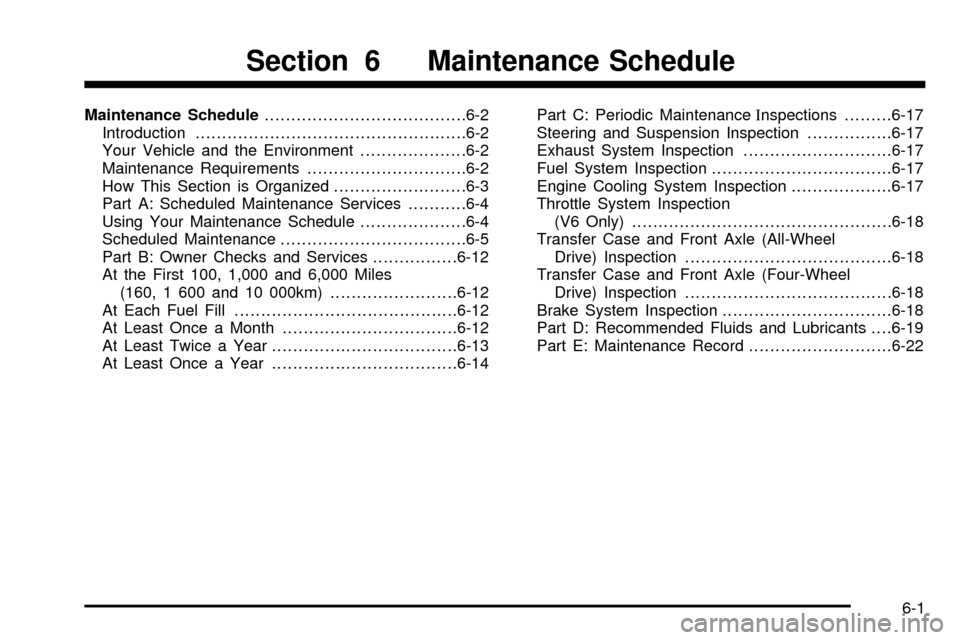
Maintenance Schedule......................................6-2
Introduction...................................................6-2
Your Vehicle and the Environment....................6-2
Maintenance Requirements..............................6-2
How This Section is Organized.........................6-3
Part A: Scheduled Maintenance Services...........6-4
Using Your Maintenance Schedule....................6-4
Scheduled Maintenance...................................6-5
Part B: Owner Checks and Services................6-12
At the First 100, 1,000 and 6,000 Miles
(160, 1 600 and 10 000km)........................6-12
At Each Fuel Fill..........................................6-12
At Least Once a Month.................................6-12
At Least Twice a Year...................................6-13
At Least Once a Year...................................6-14Part C: Periodic MaintenanceInspections.........6-17
Steering and Suspension Inspection................6-17
Exhaust System Inspection............................6-17
Fuel System Inspection..................................6-17
Engine Cooling System Inspection...................6-17
Throttle System Inspection
(V6 Only).................................................6-18
Transfer Case and Front Axle (All-Wheel
Drive) Inspection.......................................6-18
Transfer Case and Front Axle (Four-Wheel
Drive) Inspection.......................................6-18
Brake System Inspection................................6-18
Part D: Recommended Fluids and Lubricants. . . .6-19
Part E: Maintenance Record...........................6-22
Section 6 Maintenance Schedule
6-1
Page 515 of 556

At Least Twice a Year
Restraint System Check
Make sure the safety belt reminder light and all your
belts, buckles, latch plates, retractors and anchorages
are working properly. Look for any other loose or
damaged safety belt system parts. If you see anything
that might keep a safety belt system from doing its
job, have it repaired. Have any torn or frayed safety belts
replaced.
Also look for any opened or broken air bag coverings,
and have them repaired or replaced. (The air bag
system does not need regular maintenance.)
Wiper Blade Check
Inspect wiper blades for wear or cracking. Replace
blade inserts that appear worn or damaged or that
streak or miss areas of the windshield. Also see
Cleaning the Outside of Your Vehicle on page 5-103.
Spare Tire Check
At least twice a year, after the monthly in¯ation check of
the spare tire determines that the spare is in¯ated to
the correct tire in¯ation pressure, make sure that
the spare tire is stored securely. Push, pull, and then try
to rotate or turn the tire. If it moves, use the wheel
wrench/ratchet to tighten the cable. See
Changing a Flat
Tire on page 5-80.
Weatherstrip Lubrication
Silicone grease on weatherstrips will make them last
longer, seal better, and not stick or squeak. Apply
silicone grease with a clean cloth. During very cold,
damp weather more frequent application may be
required. See
Part D: Recommended Fluids and
Lubricants on page 6-19.
Manual Transmission Check
Check the transmission ¯uid level; add if needed. SeeManual Transmission Fluid on page 5-28. Check
for leaks. A ¯uid leak is the only reason for ¯uid loss.
Have the system inspected and repaired if needed.
Automatic Transmission Check
Check the transmission ¯uid level; add if needed. SeeAutomatic Transmission Fluid (Except Allison
Transmissionž) on page 5-23orAutomatic Transmission
Fluid (Allison Transmissionž) on page 5-26. A ¯uid
loss may indicate a problem. Check the system
and repair if needed.
6-13
Page 521 of 556
Part D: Recommended Fluids and
Lubricants
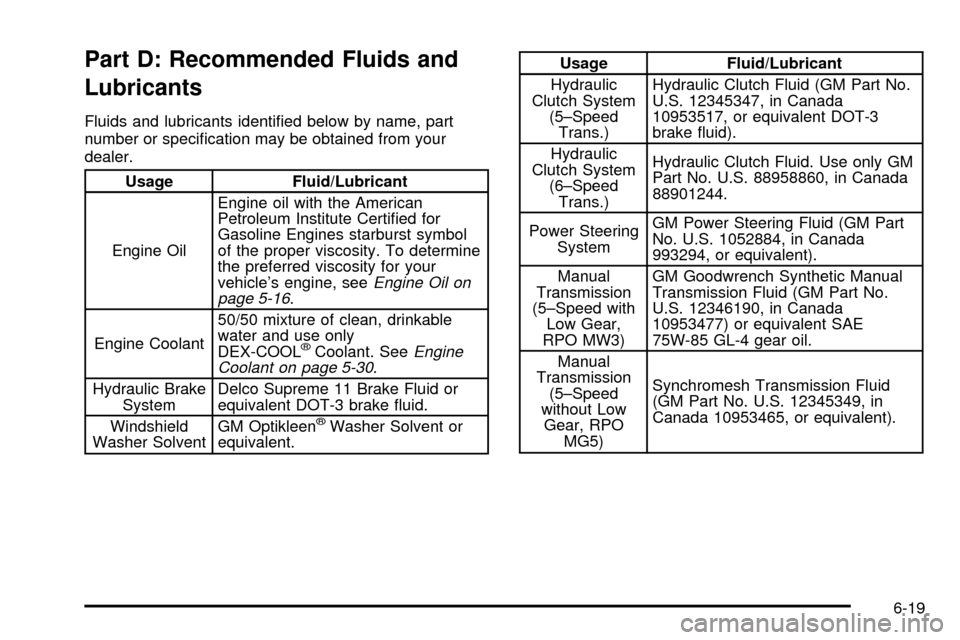
Fluids and lubricants identi®ed below by name, part
number or speci®cation may be obtained from your
dealer.
Usage Fluid/Lubricant
Engine OilEngine oil with the American
Petroleum Institute Certi®ed for
Gasoline Engines starburst symbol
of the proper viscosity. To determine
the preferred viscosity for your
vehicle's engine, see
Engine Oil on
page 5-16.
Engine Coolant50/50 mixture of clean, drinkable
water and use only
DEX-COOL
žCoolant. SeeEngine
Coolant on page 5-30.
Hydraulic Brake
SystemDelco Supreme 11 Brake Fluid or
equivalent DOT-3 brake ¯uid.
Windshield
Washer SolventGM Optikleen
žWasher Solvent or
equivalent.
Usage Fluid/Lubricant
Hydraulic
Clutch System
(5±Speed
Trans.)Hydraulic Clutch Fluid (GM Part No.
U.S. 12345347, in Canada
10953517, or equivalent DOT-3
brake ¯uid).
Hydraulic
Clutch System
(6±Speed
Trans.)Hydraulic Clutch Fluid. Use only GM
Part No. U.S. 88958860, in Canada
88901244.
Power Steering
SystemGM Power Steering Fluid (GM Part
No. U.S. 1052884, in Canada
993294, or equivalent).
Manual
Transmission
(5±Speed with
Low Gear,
RPO MW3)GM Goodwrench Synthetic Manual
Transmission Fluid (GM Part No.
U.S. 12346190, in Canada
10953477) or equivalent SAE
75W-85 GL-4 gear oil.
Manual
Transmission
(5±Speed
without Low
Gear, RPO
MG5)Synchromesh Transmission Fluid
(GM Part No. U.S. 12345349, in
Canada 10953465, or equivalent).
6-19