Page 10 of 432
Power Seats
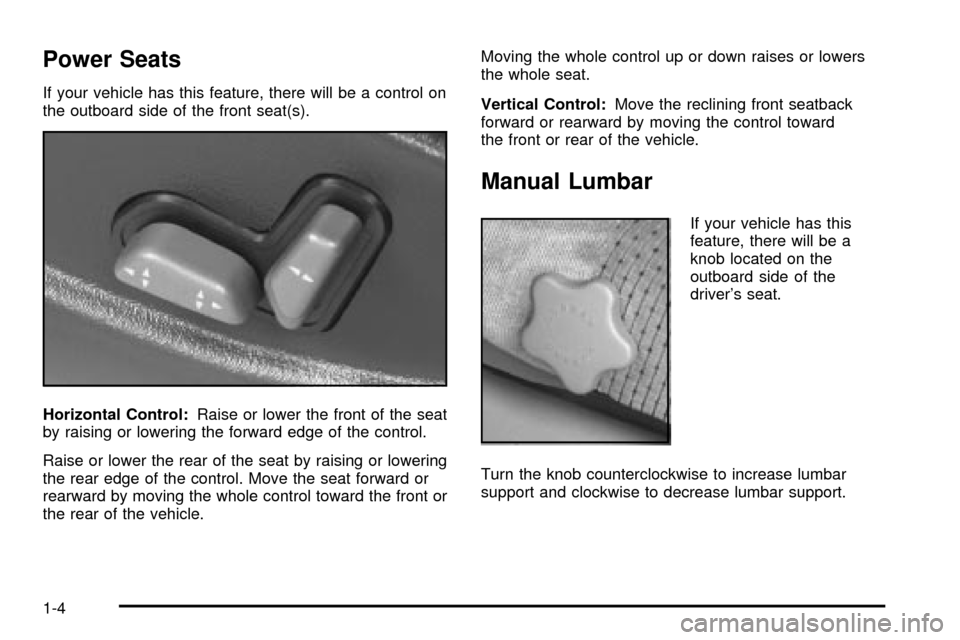
If your vehicle has this feature, there will be a control on
the outboard side of the front seat(s).
Horizontal Control:Raise or lower the front of the seat
by raising or lowering the forward edge of the control.
Raise or lower the rear of the seat by raising or lowering
the rear edge of the control. Move the seat forward or
rearward by moving the whole control toward the front or
the rear of the vehicle.Moving the whole control up or down raises or lowers
the whole seat.
Vertical Control:Move the reclining front seatback
forward or rearward by moving the control toward
the front or rear of the vehicle.
Manual Lumbar
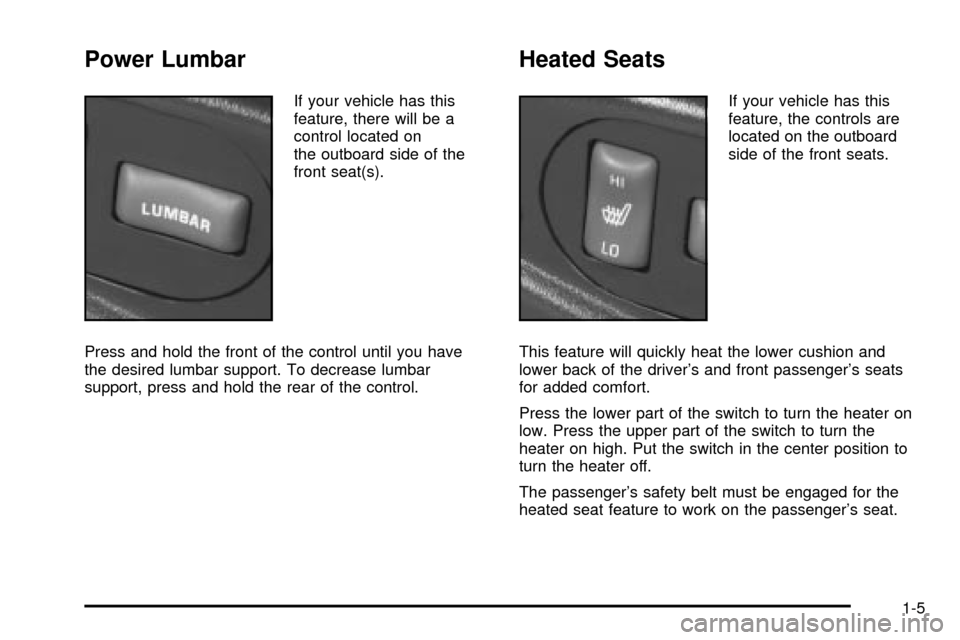
If your vehicle has this
feature, there will be a
knob located on the
outboard side of the
driver's seat.
Turn the knob counterclockwise to increase lumbar
support and clockwise to decrease lumbar support.
1-4
Page 11 of 432
Power Lumbar
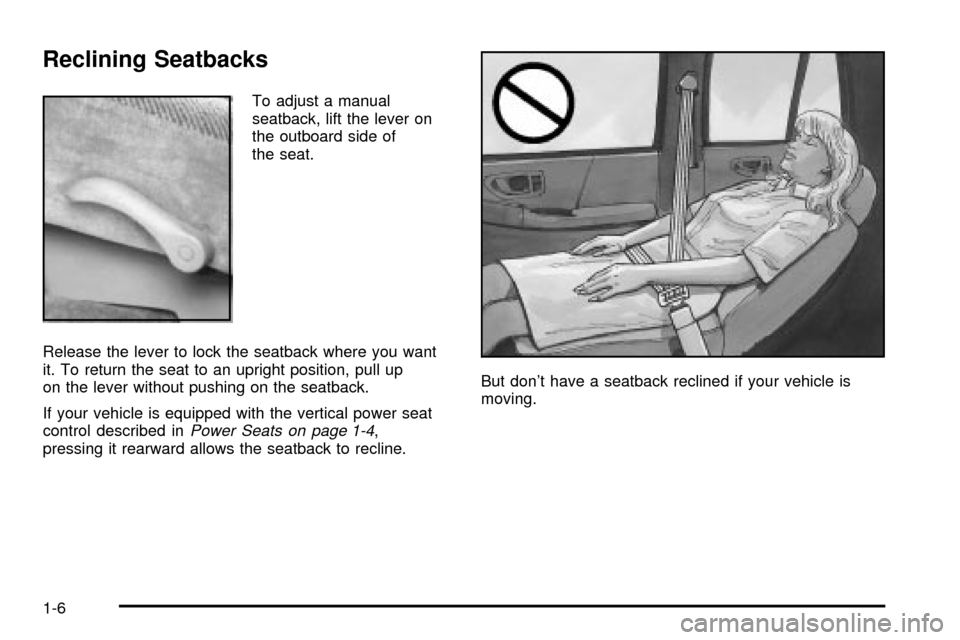
If your vehicle has this
feature, there will be a
control located on
the outboard side of the
front seat(s).
Press and hold the front of the control until you have
the desired lumbar support. To decrease lumbar
support, press and hold the rear of the control.
Heated Seats
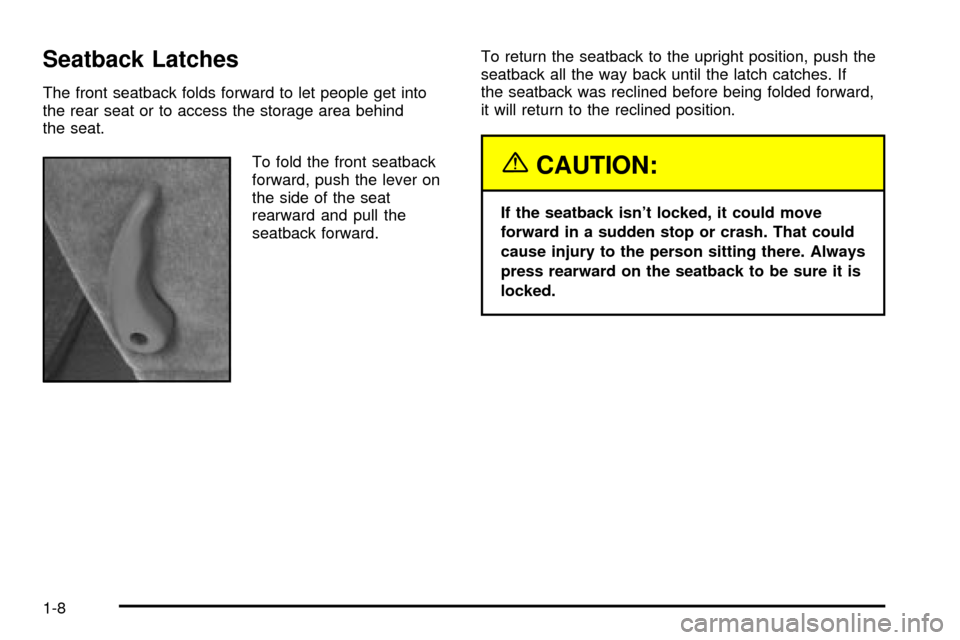
If your vehicle has this
feature, the controls are
located on the outboard
side of the front seats.
This feature will quickly heat the lower cushion and
lower back of the driver's and front passenger's seats
for added comfort.
Press the lower part of the switch to turn the heater on
low. Press the upper part of the switch to turn the
heater on high. Put the switch in the center position to
turn the heater off.
The passenger's safety belt must be engaged for the
heated seat feature to work on the passenger's seat.
1-5
Page 12 of 432
Reclining Seatbacks
To adjust a manual
seatback, lift the lever on
the outboard side of
the seat.
Release the lever to lock the seatback where you want
it. To return the seat to an upright position, pull up
on the lever without pushing on the seatback.
If your vehicle is equipped with the vertical power seat
control described in
Power Seats on page 1-4,
pressing it rearward allows the seatback to recline.But don't have a seatback reclined if your vehicle is
moving.
1-6
Page 14 of 432
Seatback Latches
The front seatback folds forward to let people get into
the rear seat or to access the storage area behind
the seat.
To fold the front seatback
forward, push the lever on
the side of the seat
rearward and pull the
seatback forward.To return the seatback to the upright position, push the
seatback all the way back until the latch catches. If
the seatback was reclined before being folded forward,
it will return to the reclined position.
{CAUTION:
If the seatback isn't locked, it could move
forward in a sudden stop or crash. That could
cause injury to the person sitting there. Always
press rearward on the seatback to be sure it is
locked.
1-8
Page 15 of 432
Rear Seats
Rear Seat Operation
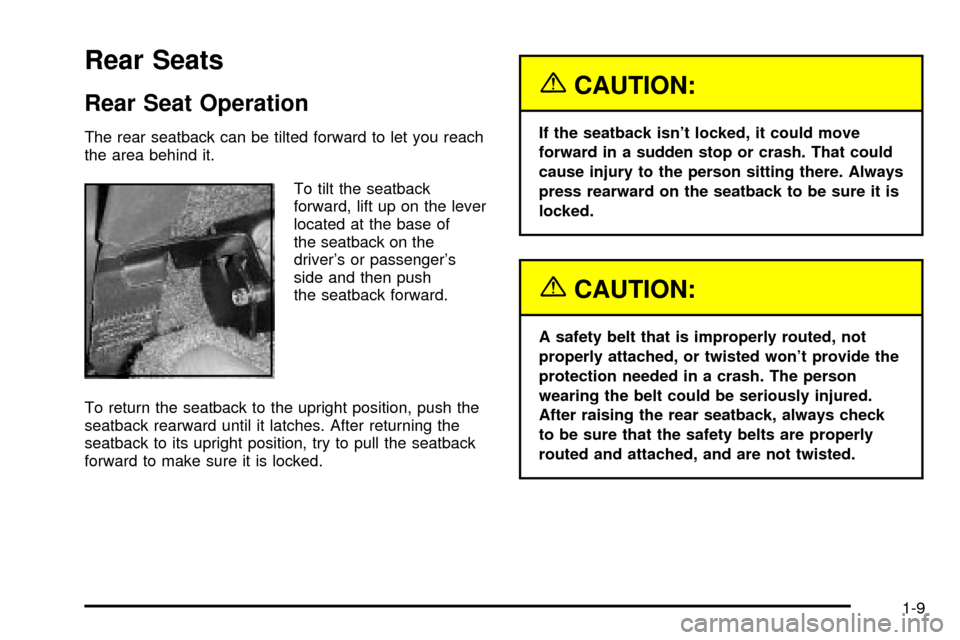
The rear seatback can be tilted forward to let you reach
the area behind it.
To tilt the seatback
forward, lift up on the lever
located at the base of
the seatback on the
driver's or passenger's
side and then push
the seatback forward.
To return the seatback to the upright position, push the
seatback rearward until it latches. After returning the
seatback to its upright position, try to pull the seatback
forward to make sure it is locked.
{CAUTION:
If the seatback isn't locked, it could move
forward in a sudden stop or crash. That could
cause injury to the person sitting there. Always
press rearward on the seatback to be sure it is
locked.
{CAUTION:
A safety belt that is improperly routed, not
properly attached, or twisted won't provide the
protection needed in a crash. The person
wearing the belt could be seriously injured.
After raising the rear seatback, always check
to be sure that the safety belts are properly
routed and attached, and are not twisted.
1-9
Page 45 of 432
Where to Put the Restraint (Regular
Cab and Extended Cab Pickup)
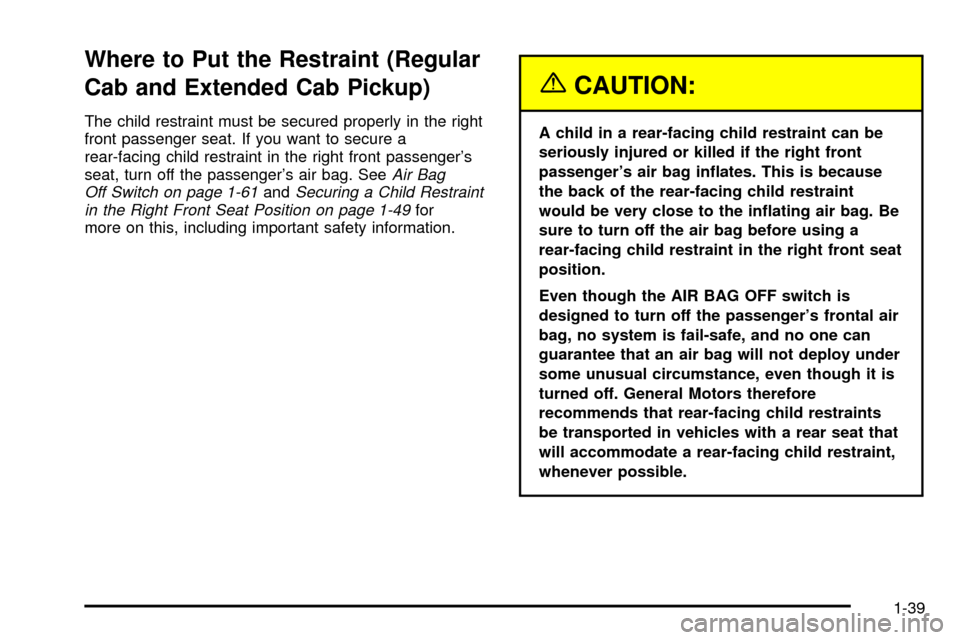
The child restraint must be secured properly in the right
front passenger seat. If you want to secure a
rear-facing child restraint in the right front passenger's
seat, turn off the passenger's air bag. See
Air Bag
Off Switch on page 1-61andSecuring a Child Restraint
in the Right Front Seat Position on page 1-49for
more on this, including important safety information.
{CAUTION:
A child in a rear-facing child restraint can be
seriously injured or killed if the right front
passenger's air bag in¯ates. This is because
the back of the rear-facing child restraint
would be very close to the in¯ating air bag. Be
sure to turn off the air bag before using a
rear-facing child restraint in the right front seat
position.
Even though the AIR BAG OFF switch is
designed to turn off the passenger's frontal air
bag, no system is fail-safe, and no one can
guarantee that an air bag will not deploy under
some unusual circumstance, even though it is
turned off. General Motors therefore
recommends that rear-facing child restraints
be transported in vehicles with a rear seat that
will accommodate a rear-facing child restraint,
whenever possible.
1-39
Page 55 of 432
Securing a Child Restraint in a
Center Seat Position
Don't use child restraints in these positions. The
restraints won't work properly.
Securing a Child Restraint in the
Right Front Seat Position
If your child restraint is equipped with the LATCH
system, seeLower Anchorages and Top Tethers for
Children (LATCH System) on page 1-44.
Your vehicle has a passenger air bag. If your vehicle is
a regular cab pickup or an extended cab pickup,
there's a switch on the instrument panel that you can
use to turn off the right front passenger's air bag
when you want to secure a rear-facing child restraint at
the right front passenger's position. See
Air Bag Off
Switch on page 1-61for more on this, including
important safety information.
1-49
Page 56 of 432
Unless your vehicle has the air bag off switch and the
passenger's air bag has been turned off, never put
a rear facing child restraint in the right front
passenger's seat.Here's why:
{CAUTION:
A child in a rear-facing child restraint can be
seriously injured or killed if the right front
passenger's air bag in¯ates. This is because
the back of the rear-facing child restraint
would be very close to the in¯ating air bag. If
your vehicle is a crew cab, do not use a
rear-facing child restraint in the right front
passenger's position. If your vehicle is a
regular cab pickup or an extended cab pickup,
be sure to turn off the air bag before using a
rear-facing child restraint in the right front seat
position.
Even though the AIR BAG OFF switch is
designed to turn off the passenger's frontal air
bag, no system is fail-safe, and no one can
guarantee that an air bag will not deploy under
CAUTION: (Continued)
1-50