Page 51 of 432
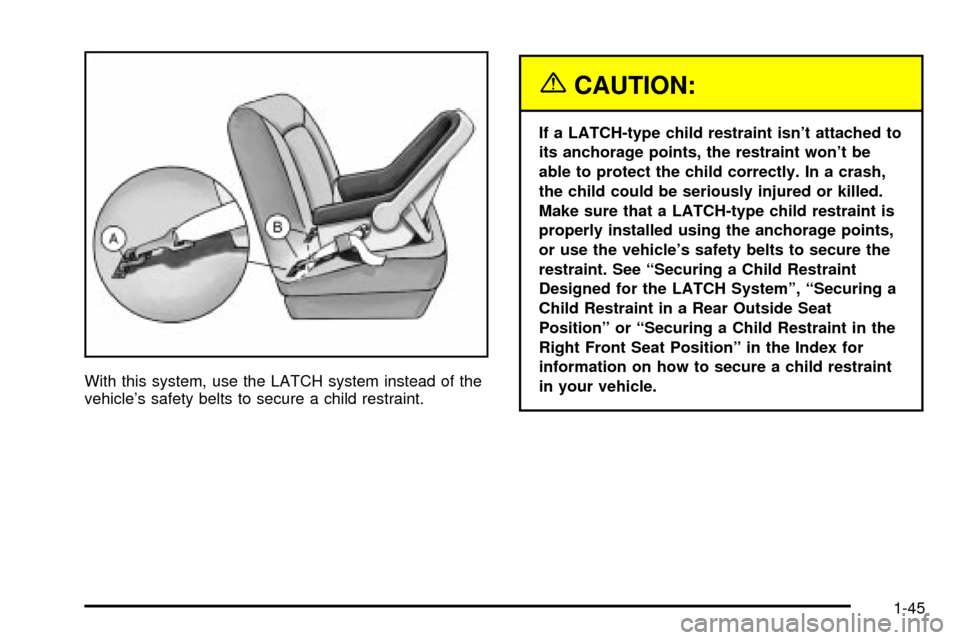
With this system, use the LATCH system instead of the
vehicle's safety belts to secure a child restraint.
{CAUTION:
If a LATCH-type child restraint isn't attached to
its anchorage points, the restraint won't be
able to protect the child correctly. In a crash,
the child could be seriously injured or killed.
Make sure that a LATCH-type child restraint is
properly installed using the anchorage points,
or use the vehicle's safety belts to secure the
restraint. See ªSecuring a Child Restraint
Designed for the LATCH Systemº, ªSecuring a
Child Restraint in a Rear Outside Seat
Positionº or ªSecuring a Child Restraint in the
Right Front Seat Positionº in the Index for
information on how to secure a child restraint
in your vehicle.
1-45
Page 52 of 432
Securing a Child Restraint Designed
for the LATCH System
1. Find the anchors for the seating position you want
to use, where the bottom of the seatback meets the
back of the seat cushion.
2. Put the child restraint on the seat.
3. Attach the anchor points on the child restraint to the
anchors in the vehicle. The child restraint
instructions will show you how.
4. If the child restraint is forward-facing, attach the top
strap to the top strap anchor. See
Top Strap on
page 1-41. Tighten the top strap according to
the child restraint instructions.
5. Push and pull the child restraint in different
directions to be sure it is secure.
To remove the child restraint, simply unhook the top
strap from the top tether anchor and then disconnect the
anchor points.
Securing a Child Restraint in a Rear
Outside Seat Position
Crew Cabž
If your child restraint is equipped with the LATCH system,
seeLower Anchorages and Top Tethers for Children
(LATCH System) on page 1-44.
You'll be using the lap-shoulder belt. See
Top Strap on
page 1-41if the child restraint has one. Be sure to
follow the instructions that came with the child restraint.
Secure the child in the child restraint when and as the
instructions say.
1. Put the restraint on the seat.
1-46
Page 53 of 432
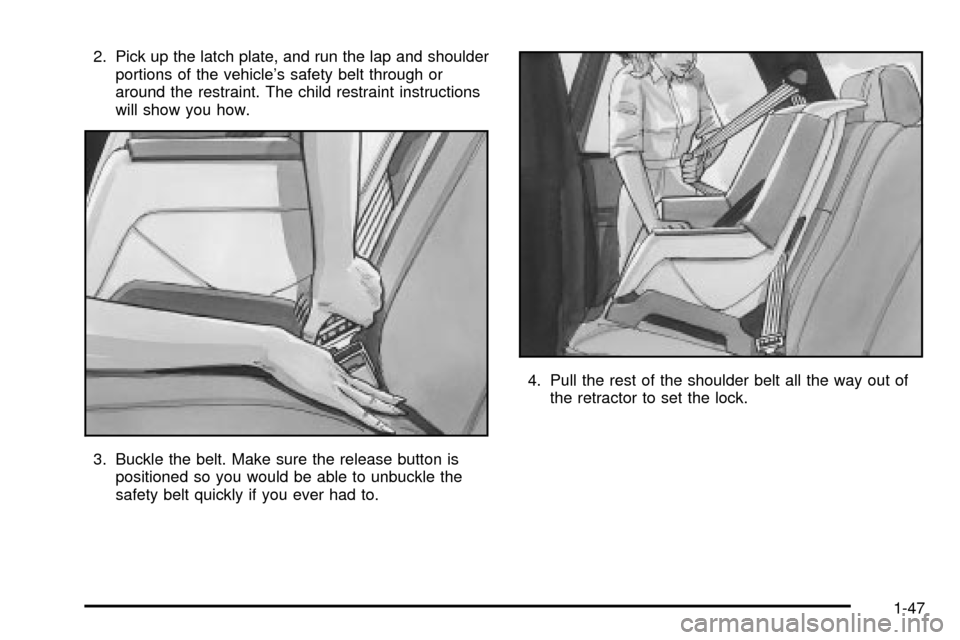
2. Pick up the latch plate, and run the lap and shoulder
portions of the vehicle's safety belt through or
around the restraint. The child restraint instructions
will show you how.
3. Buckle the belt. Make sure the release button is
positioned so you would be able to unbuckle the
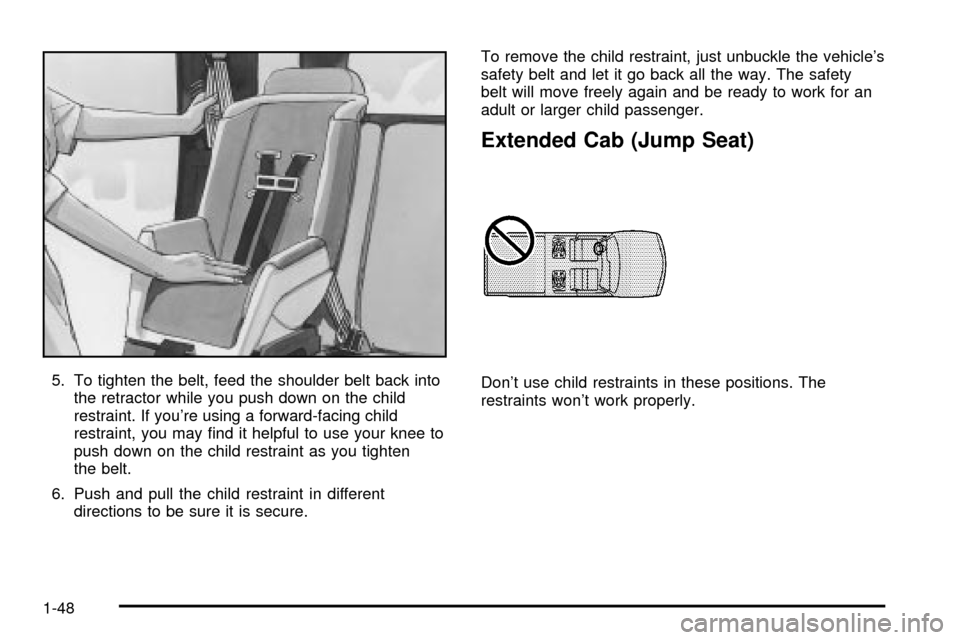
safety belt quickly if you ever had to.4. Pull the rest of the shoulder belt all the way out of
the retractor to set the lock.
1-47
Page 54 of 432
5. To tighten the belt, feed the shoulder belt back into
the retractor while you push down on the child
restraint. If you're using a forward-facing child
restraint, you may ®nd it helpful to use your knee to
push down on the child restraint as you tighten
the belt.
6. Push and pull the child restraint in different
directions to be sure it is secure.To remove the child restraint, just unbuckle the vehicle's
safety belt and let it go back all the way. The safety
belt will move freely again and be ready to work for an
adult or larger child passenger.
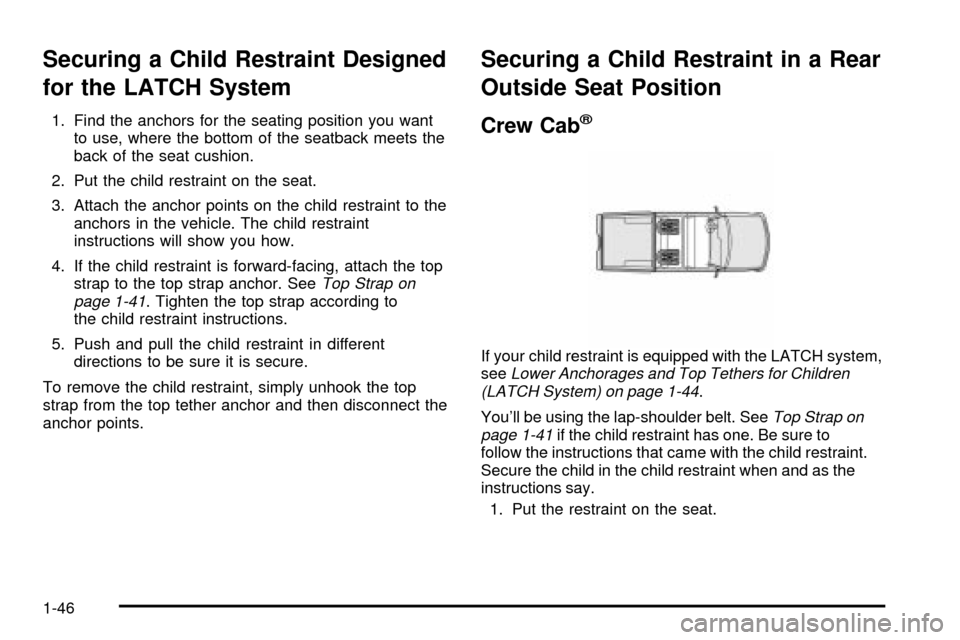
Extended Cab (Jump Seat)
Don't use child restraints in these positions. The
restraints won't work properly.
1-48
Page 58 of 432
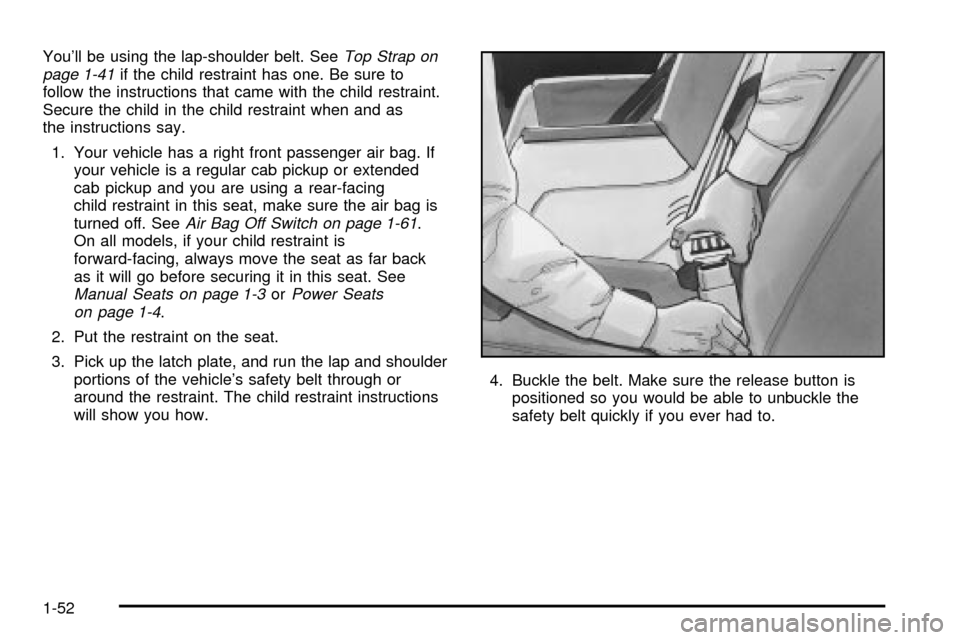
You'll be using the lap-shoulder belt. SeeTop Strap on
page 1-41if the child restraint has one. Be sure to
follow the instructions that came with the child restraint.
Secure the child in the child restraint when and as
the instructions say.
1. Your vehicle has a right front passenger air bag. If
your vehicle is a regular cab pickup or extended
cab pickup and you are using a rear-facing
child restraint in this seat, make sure the air bag is
turned off. See
Air Bag Off Switch on page 1-61.
On all models, if your child restraint is
forward-facing, always move the seat as far back
as it will go before securing it in this seat. See
Manual Seats on page 1-3orPower Seats
on page 1-4.
2. Put the restraint on the seat.
3. Pick up the latch plate, and run the lap and shoulder
portions of the vehicle's safety belt through or
around the restraint. The child restraint instructions
will show you how.4. Buckle the belt. Make sure the release button is
positioned so you would be able to unbuckle the
safety belt quickly if you ever had to.
1-52
Page 59 of 432
5. Pull the rest of the lap belt all the way out of the
retractor to set the lock.6. To tighten the belt, feed the shoulder belt back into
the retractor while you push down on the child
restraint. If you are using a forward-facing child
restraint, you may ®nd it helpful to use your knee to
push down on the child restraint as you tighten
the belt.
7. Push and pull the child restraint in different
directions to be sure it is secure.
1-53
Page 60 of 432

To remove the child restraint, just unbuckle the vehicle's
safety belt and let it go back all the way. The safety
belt will move freely again and be ready to work for an
adult or larger child passenger.
If you were using a rear-facing child restraint in a
regular cab model or a extended cab model, turn on the
right front passenger's air bag when you remove the
rear-facing child restraint from the vehicle unless
the person who will be sitting there is a member of a
passenger air bag risk group. See
Air Bag Off Switch on
page 1-61.
{CAUTION:
If the right front passenger's air bag is turned
off for a person who isn't in a risk group
identi®ed by the national government, that
person won't have the extra protection of an
air bag. In a crash, the air bag wouldn't be able
to in¯ate and help protect the person sitting
there. Don't turn off the passenger's air bag
unless the person sitting there is in a risk
group. See²Air Bag Off Switch²in the Index
for more on this, including important safety
information.
1-54
Page 61 of 432
Air Bag System
This part explains the air bag system.
Your vehicle has air bags ± one air bag for the driver
and another air bag for the right front passenger.
Frontal air bags are designed to help reduce the risk of
injury from the force of an in¯ating air bag. But these
air bags must in¯ate very quickly to do their job
and comply with federal regulations.
Here are the most important things to know about the
air bag system:
{CAUTION:
You can be severely injured or killed in a crash
if you aren't wearing your safety belt Ð even if
you have air bags. Wearing your safety belt
during a crash helps reduce your chance of
hitting things inside the vehicle or being
ejected from it. Air bags are designed to work
CAUTION: (Continued)
CAUTION: (Continued)
with safety belts, but don't replace them. Air
bags are designed to deploy only in moderate
to severe frontal and near frontal crashes.
They aren't designed to in¯ate at all in rollover,
rear or low-speed frontal crashes, or in many
side crashes. And, for some unrestrained
occupants, air bags may provide less
protection in frontal crashes than more
forceful air bags have provided in the past.
Everyone in your vehicle should wear a safety
belt properly Ð whether or not there's an air
bag for that person.
1-55