Page 269 of 408

A. Windshield Washer Fluid Reservoir. SeeWindshield
Washer Fluid on page 5-44.
B. Battery. See
Battery on page 5-48.
C. Remote Positive (+) Terminal. See
Jump Starting on
page 5-49.
D. Upper Underhood Fuse Block. See ªUpperhood
Fuse Block (Upper)º under
Fuses and Circuit
Breakers on page 5-95.
E. Lower Underhood Fuse Block. See ªUnderhood
Fuse Block (Lower)º under
Fuses and Circuit
Breakers on page 5-95.
F. Radiator Pressure Cap. See
Radiator Pressure Cap
on page 5-30.
G. Engine Coolant Recovery Tank. See
Cooling System
on page 5-33.
H. Power Steering Fluid Reservoir. See
Power Steering
Fluid on page 5-43.I. Electric Cooling Fan. See
Cooling System on
page 5-33.
J. Engine Oil Fill Cap. See ªChecking Engine Oilº
under
Engine Oil on page 5-16.
K. Engine Oil Dipstick. See ªChecking Engine Oilº
under
Engine Oil on page 5-16.
L. Bleed Valves (underneath engine shield). See ªHow
to Add Coolant to the Radiatorº under
Cooling
System on page 5-33.
M. Transaxle Fluid Dipstick. See
Automatic Transaxle
Fluid on page 5-24.
N. Brake Master Cylinder Reservoir. See
Brakes on
page 5-45.
O. Engine Air Cleaner/Filter. See
Engine Air
Cleaner/Filter on page 5-22.
5-13
Page 271 of 408

A. Windshield Washer Fluid Reservoir. SeeWindshield
Washer Fluid on page 5-44.
B. Battery. See
Battery on page 5-48.
C. Remote Positive (+) Terminal. See
Jump Starting on
page 5-49.
D. Upper Underhood Fuse Block. See ªUpperhood
Fuse Block (Upper)º under
Fuses and Circuit
Breakers on page 5-95.
E. Lower Underhood Fuse Block. See ªUnderhood
Fuse Block (Lower)º under
Fuses and Circuit
Breakers on page 5-95.
F. Radiator Pressure Cap. See
Radiator Pressure Cap
on page 5-30.
G. Engine Coolant Recovery Tank. See
Cooling System
on page 5-33
H. Power Steering Fluid Reservoir (low in engine
compartment). SeePower Steering Fluid on
page 5-43.I. Electric Cooling Fan. See
Cooling System on
page 5-33.
J. Engine Oil Dipstick. See ªChecking Engine Oilº
under
Engine Oil on page 5-16.
K. Engine Oil Fill Cap. See ªChecking Engine Oilº
under
Engine Oil on page 5-16.
L. Bleed Valves (underneath engine shield). See ªHow
to Add Coolant to the Radiatorº under
Cooling
System on page 5-33.
M. Transaxle Fluid Dipstick. See
Automatic Transaxle
Fluid on page 5-24.
N. Brake Master Cylinder Reservoir. See
Brakes on
page 5-45.
O. Engine Air Cleaner/Filter. See
Engine Air
Cleaner/Filter on page 5-22.
5-15
Page 284 of 408
What to Use
Use a mixture of one-halfclean, drinkable waterand
one-half DEX-COOLžcoolant which won't damage
aluminum parts. If you use this coolant mixture,
you don't need to add anything else.
{CAUTION:
Adding only plain water to your cooling
system can be dangerous. Plain water, or
some other liquid such as alcohol, can boil
before the proper coolant mixture will. Your
vehicle's coolant warning system is set for the
proper coolant mixture. With plain water or the
wrong mixture, your engine could get too hot
but you wouldn't get the overheat warning.
Your engine could catch ®re and you or others
could be burned. Use a 50/50 mixture of clean,
drinkable water and DEX-COOL
žcoolant.
Notice:If you use an improper coolant mixture,
your engine could overheat and be badly damaged.
The repair cost wouldn't be covered by your
warranty. Too much water in the mixture can freeze
and crack the engine, radiator, heater core and
other parts.If you have to add coolant more than four times a year,
have your dealer check your cooling system.
Notice:If you use the proper coolant, you don't
have to add extra inhibitors or additives which claim
to improve the system. These can be harmful.
Checking Coolant
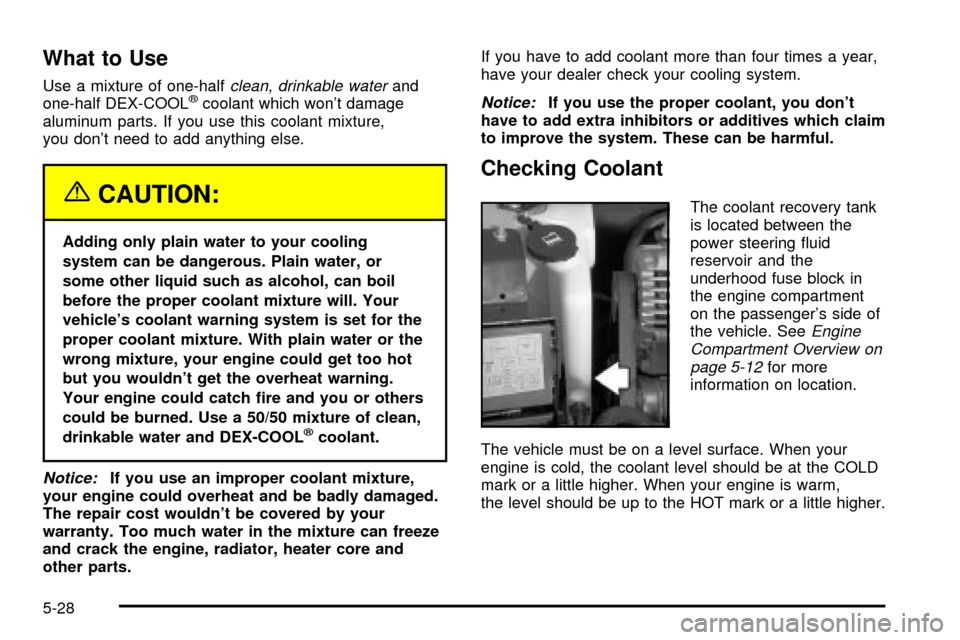
The coolant recovery tank
is located between the
power steering ¯uid
reservoir and the
underhood fuse block in
the engine compartment
on the passenger's side of
the vehicle. See
Engine
Compartment Overview on
page 5-12
for more
information on location.
The vehicle must be on a level surface. When your
engine is cold, the coolant level should be at the COLD
mark or a little higher. When your engine is warm,
the level should be up to the HOT mark or a little higher.
5-28
Page 301 of 408
Notice:
·When using concentrated washer ¯uid,
follow the manufacturer's instructions for
adding water.
·Don't mix water with ready-to-use washer ¯uid.
Water can cause the solution to freeze and
damage your washer ¯uid tank and other parts
of the washer system. Also, water doesn't
clean as well as washer ¯uid.
·Fill your washer ¯uid tank only three-quarters
full when it's very cold. This allows for
expansion if freezing occurs, which could
damage the tank if it is completely full.
·Don't use engine coolant (antifreeze) in your
windshield washer. It can damage your
washer system and paint.
Brakes
Brake Fluid
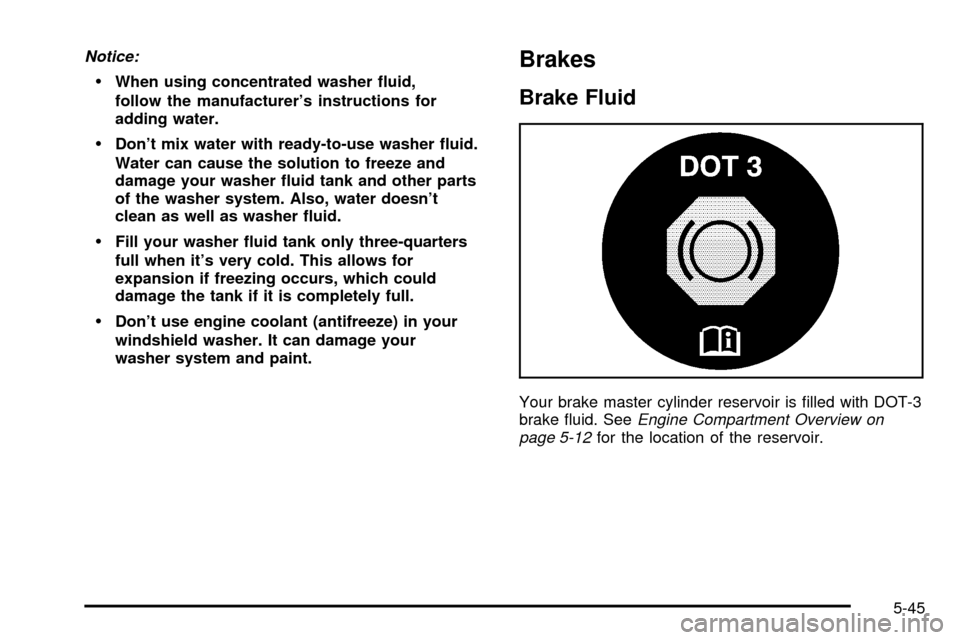
Your brake master cylinder reservoir is ®lled with DOT-3
brake ¯uid. SeeEngine Compartment Overview on
page 5-12for the location of the reservoir.
5-45