2003 CHEVROLET EXPRESS CARGO VAN heating
[x] Cancel search: heatingPage 236 of 386

Passing
You'll need more passing distance up ahead when
you're towing a trailer. And, because you're a good deal
longer, you'll need to go much farther beyond the
passed vehicle before you can return to your lane.
Backing Up
Hold the bottom of the steering wheel with one hand.
Then, to move the trailer to the left, just move that hand
to the left. To move the trailer to the right, move your
hand to the right. Always back up slowly and, if possible,
have someone guide you.
Making Turns
Notice:Making very sharp turns while trailering
could cause the trailer to come in contact with the
vehicle. Your vehicle could be damaged. Avoid
making very sharp turns while trailering.
When you're turning with a trailer, make wider turns than
normal. Do this so your trailer won't strike soft shoulders,
curbs, road signs, trees or other objects. Avoid jerky or
sudden maneuvers. Signal well in advance.
Turn Signals When Towing a Trailer
When you tow a trailer, your vehicle has to have extra
wiring and a heavy-duty turn signal ¯asher (included
in the optional trailering package).The arrows on your instrument panel will ¯ash whenever
you signal a turn or lane change. Properly hooked up,
the trailer lamps will also ¯ash, telling other drivers
you're about to turn, change lanes or stop.
When towing a trailer, the arrows on your instrument
panel will ¯ash for turns even if the bulbs on the trailer
are burned out. Thus, you may think drivers behind
you are seeing your signal when they are not. It's
important to check occasionally to be sure the trailer
bulbs are still working.
Driving On Grades
Reduce speed and shift to a lower gearbeforeyou start
down a long or steep downgrade. If you don't shift
down, you might have to use your brakes so much that
they would get hot and no longer work well.
When towing at high altitude on steep uphill grades,
consider the following: Engine coolant will boil at a lower
temperature than at normal altitudes. If you turn your
engine off immediately after towing at high altitude
on steep uphill grades, your vehicle may show signs
similar to engine overheating. To avoid this, let the
engine run while parked (preferably on level ground)
with the automatic transmission in PARK (P) for a
few minutes before turning the engine off. If you do get
the overheat warning, see
Engine Overheating on
page 5-24.
4-42
Page 271 of 386

Service............................................................5-3
Doing Your Own Service Work.........................5-3
Adding Equipment to the Outside of Your
Vehicle......................................................5-4
Fuel................................................................5-4
Gasoline Octane............................................5-4
Gasoline Speci®cations....................................5-5
California Fuel...............................................5-5
Additives.......................................................5-6
Fuels in Foreign Countries...............................5-6
Filling Your Tank............................................5-7
Filling a Portable Fuel Container.......................5-9
Checking Things Under
the Hood......................................................5-9
Hood Release..............................................5-10
Engine Compartment Overview.......................5-12
Engine Oil...................................................5-13
Engine Air Cleaner/Filter................................5-17
Automatic Transmission Fluid.........................5-19
Engine Coolant.............................................5-21
Radiator Pressure Cap..................................5-24
Engine Overheating.......................................5-24Cooling System............................................5-26
Engine Fan Noise.........................................5-34
Power Steering Fluid.....................................5-34
Windshield Washer Fluid................................5-35
Brakes........................................................5-37
Battery........................................................5-40
Jump Starting...............................................5-41
All-Wheel Drive..............................................5-46
Rear Axle.......................................................5-47
Front Axle......................................................5-48
Noise Control System.....................................5-49
Tampering with Noise Control System
Prohibited.................................................5-49
Bulb Replacement..........................................5-50
Halogen Bulbs..............................................5-50
Headlamps..................................................5-50
Front Turn Signal, Sidemarker and Parking
Lamps.....................................................5-52
Taillamps.....................................................5-52
Replacement Bulbs.......................................5-54
Section 5 Service and Appearance Care
5-1
Page 291 of 386
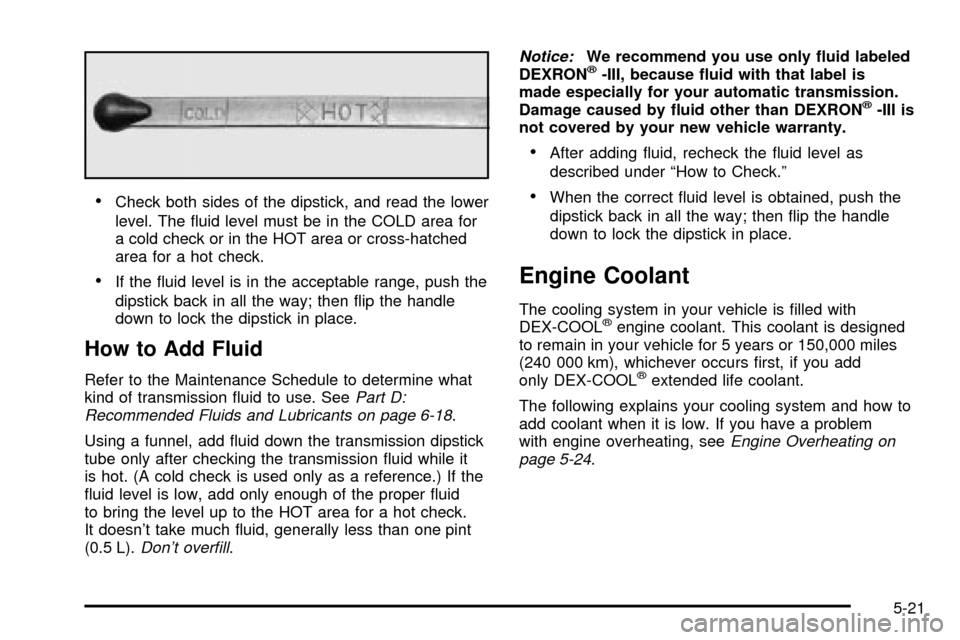
·Check both sides of the dipstick, and read the lower
level. The ¯uid level must be in the COLD area for
a cold check or in the HOT area or cross-hatched
area for a hot check.
·If the ¯uid level is in the acceptable range, push the
dipstick back in all the way; then ¯ip the handle
down to lock the dipstick in place.
How to Add Fluid
Refer to the Maintenance Schedule to determine what
kind of transmission ¯uid to use. SeePart D:
Recommended Fluids and Lubricants on page 6-18.
Using a funnel, add ¯uid down the transmission dipstick
tube only after checking the transmission ¯uid while it
is hot. (A cold check is used only as a reference.) If the
¯uid level is low, add only enough of the proper ¯uid
to bring the level up to the HOT area for a hot check.
It doesn't take much ¯uid, generally less than one pint
(0.5 L).
Don't over®ll.
Notice:We recommend you use only ¯uid labeled
DEXRONž-III, because ¯uid with that label is
made especially for your automatic transmission.
Damage caused by ¯uid other than DEXRON
ž-III is
not covered by your new vehicle warranty.
·After adding ¯uid, recheck the ¯uid level as
described under ªHow to Check.º
·When the correct ¯uid level is obtained, push the
dipstick back in all the way; then ¯ip the handle
down to lock the dipstick in place.
Engine Coolant
The cooling system in your vehicle is ®lled with
DEX-COOLžengine coolant. This coolant is designed
to remain in your vehicle for 5 years or 150,000 miles
(240 000 km), whichever occurs ®rst, if you add
only DEX-COOL
žextended life coolant.
The following explains your cooling system and how to
add coolant when it is low. If you have a problem
with engine overheating, see
Engine Overheating on
page 5-24.
5-21
Page 294 of 386
Radiator Pressure Cap
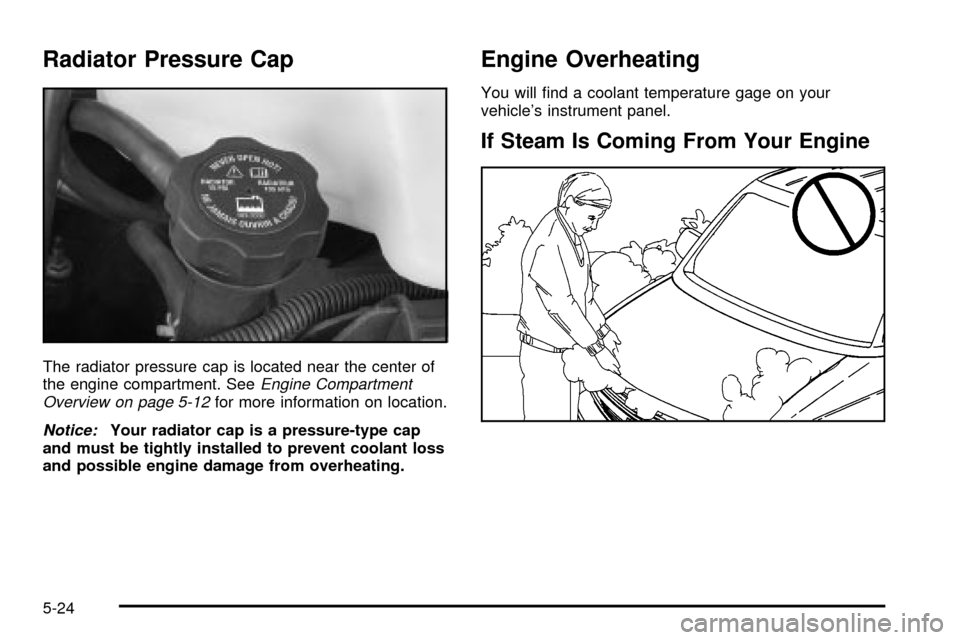
The radiator pressure cap is located near the center of
the engine compartment. SeeEngine Compartment
Overview on page 5-12for more information on location.
Notice:Your radiator cap is a pressure-type cap
and must be tightly installed to prevent coolant loss
and possible engine damage from overheating.
Engine Overheating
You will ®nd a coolant temperature gage on your
vehicle's instrument panel.
If Steam Is Coming From Your Engine
5-24
Page 326 of 386
Tires
Your new vehicle comes with high-quality tires made by
a leading tire manufacturer. If you ever have questions
about your tire warranty and where to obtain service,
see your Chevrolet Warranty booklet for details.
{CAUTION:
Poorly maintained and improperly used tires
are dangerous.
·Overloading your tires can cause
overheating as a result of too much
friction. You could have an air-out and a
serious accident. See ªLoading Your
Vehicleº in the Index.
·Underin¯ated tires pose the same danger
as overloaded tires. The resulting accident
could cause serious injury. Check all tires
frequently to maintain the recommended
pressure. Tire pressure should be checked
when your tires are cold.
CAUTION: (Continued)
CAUTION: (Continued)
·
Overin¯ated tires are more likely to be
cut, punctured or broken by a sudden
impact Ð such as when you hit a pothole.
Keep tires at the recommended pressure.
·Worn, old tires can cause accidents. If
your tread is badly worn, or if your tires
have been damaged, replace them.
In¯ation -- Tire Pressure
The Certi®cation/Tire label, which is on the rear edge of
the driver's door, shows the correct in¯ation pressures
for your tires when they're cold. ªColdº means your
vehicle has been sitting for at least three hours or driven
no more than 1 mile (1.6 km).
Notice:Don't let anyone tell you that underin¯ation
or overin¯ation is all right. It's not. If your tires
don't have enough air (underin¯ation), you can get
the following:
·Too much ¯exing
·Too much heat
·Tire overloading
5-56
Page 374 of 386

Cleaning the Windshield and Wiper Blades.........5-85
Cleaning Tires................................................5-86
Cleaning Vinyl................................................5-82
Cleaning........................................................5-80
Inside of Your Vehicle..................................5-80
Outside of Your Vehicle................................5-83
Underbody Maintenance...............................5-87
Weatherstrips..............................................5-83
Climate Control System...................................3-19
Rear Air Conditioning and Heating System......3-21
Rear Heating System...................................3-20
Compact Disc Messages.................3-48, 3-59, 3-70
Control of a Vehicle.......................................... 4-5
Coolant.........................................................3-32
Engine Temperature Gage............................3-32
Heater, Engine............................................2-23
Low Warning Light.......................................3-33
Cooling System..............................................5-26
Cruise Control Light........................................3-38
Cruise Control................................................3-10
Current and Past Model Order Forms................7-10
Customer Assistance Information........................ 7-7
Courtesy Transportation.................................. 7-7
Customer Assistance for Text
Telephone (TTY) Users............................... 7-4
Customer Assistance Offices........................... 7-4
Customer Satisfaction Procedure..................... 7-2
GM Mobility Program for Persons with
Disabilities................................................ 7-5
Reporting Safety Defects to General Motors...... 7-9Customer Assistance Information (cont.)
Reporting Safety Defects to the Canadian
Government.............................................. 7-9
Reporting Safety Defects to the United States
Government.............................................. 7-8
Roadside Assistance Program......................... 7-5
Service Publications Ordering Information......... 7-9
D
Daytime Running Lamps Indicator Light.............3-38
Daytime Running Lamps..................................3-15
Defensive Driving............................................. 4-2
Defogging and Defrosting.................................3-22
Doing Your Own Service Work........................... 5-3
Dome Lamp Override......................................3-16
Dome Lamps.................................................3-17
Door.............................................................2-13
60/40 Swing-Out Side Door...........................2-13
Cargo Door Relocking.................................... 2-8
Locks.......................................................... 2-7
Power Door Locks......................................... 2-8
Rear Door Security Locks............................... 2-8
Rear Doors.................................................2-14
Sliding Side Door........................................2-11
Driver............................................................1-16
Position, Safety Belt.....................................1-16
Driving On Grades..........................................4-42
Driving on Snow or Ice....................................4-24
4
Page 375 of 386

Driving Through Deep Standing Water...............4-17
Driving Through Flowing Water.........................4-17
Driving with a Trailer.......................................4-41
Driving..........................................................4-13
At Night.....................................................4-13
City...........................................................4-18
Defensive..................................................... 4-2
Drunken....................................................... 4-2
Freeway.....................................................4-19
Hill and Mountain Roads..............................4-22
In Rain and on Wet Roads...........................4-15
Winter........................................................4-24
Dual Stage Air Bags........................................1-67
Dual Tire Operation.........................................5-57
E
Electrical System............................................5-91
Add-On Equipment......................................5-91
Fuses and Circuit Breakers...........................5-92
Headlamp Wiring.........................................5-91
Windshield Wiper Fuses...............................5-91
Electronic Road-Speed Governor.......................3-26
Emissions Inspection and Maintenance
Programs...................................................3-35Engine Compartment Fuse Block......................5-94
Engine Coolant Level Check.............................6-11
Engine Oil Additives........................................5-15
Engine Oil and Chassis Lubrication Scheduled
Maintenance................................................. 6-5
Engine Oil Level Check...................................6-11
Engine..........................................................5-17
Air Cleaner/Filter.........................................5-17
Battery.......................................................5-40
Change Engine Oil Light...............................3-37
Check and Service Engine Soon Light............3-33
Compartment Overview................................5-12
Coolant Heater............................................2-23
Coolant Temperature Gage...........................3-32
Coolant......................................................5-21
Cooling System Inspection............................6-16
Exhaust.....................................................2-30
Fan Noise..................................................5-34
Oil .............................................................5-13
Overheating................................................5-24
Starting......................................................2-22
Entry Lighting.................................................3-17
Exit Lighting...................................................3-17
Extender, Safety Belt.......................................1-33
Exterior Lamps...............................................3-13
5
Page 381 of 386

Passenger Vans with an Air Bag Off Switch........1-46
Passenger Vans without an Air Bag Off
Switch.......................................................1-45
Passing.................................................4-11, 4-42
Passlock
ž......................................................2-19
Payload.....................................................4-30, ii
Plan Ahead When Possible................................ 7-7
Playing a Cassette Tape..................................3-54
Playing a Compact Disc..................3-46, 3-57, 3-65
Playing a Speci®c Loaded
Compact Disc.............................................3-67
Playing the Radio...................3-41, 3-44, 3-48, 3-59
Power Steering................................................ 4-8
Power...........................................................3-18
Accessory Outlets........................................3-18
Door Locks.................................................. 2-8
Seat............................................................ 1-4
Steering Fluid.............................................5-34
Windows....................................................2-17
Primary Radio Controls....................................3-71
Q
Questions and Answers About Safety Belts.........1-14
R
Radiator Pressure Cap....................................5-24
Radio Messages.............................3-43, 3-46, 3-54
Radios..........................................................3-40
AM-FM Radio.............................................3-41
Care of Your Cassette Tape Player................3-74
Care of Your CD Player...............................3-75
Care of Your CDs........................................3-75
Radio with Cassette and CD.........................3-48
Radio with CD............................................3-44
Radio with Six-Disc CD................................3-59
Rear Seat Audio..........................................3-71
Setting the Time for Radios with Radio Data
Systems (RDS)........................................3-41
Setting the Time for Radios without Radio
Data Systems (RDS)................................3-40
Theft-Deterrent............................................3-73
Understanding Reception..............................3-73
RDS Messages......................................3-53, 3-64
Reading Lamps..............................................3-17
Rear Air Conditioning and Heating System.........3-21
Rear Axle......................................................5-47
Locking........................................................ 4-8
Service......................................................6-17
11