Page 197 of 364

Driving at Night
Night driving is more dangerous than day driving.
One reason is that some drivers are likely to be
impaired Ð by alcohol or drugs, with night vision
problems, or by fatigue.Here are some tips on night driving.
·Drive defensively.
·Don't drink and drive.
·Adjust your inside rearview mirror to reduce the
glare from headlamps behind you.
·Since you can't see as well, you may need to slow
down and keep more space between you and
other vehicles.
·Slow down, especially on higher speed roads. Your
headlamps can light up only so much road ahead.
·In remote areas, watch for animals.
·If you're tired, pull off the road in a safe place and
rest.
No one can see as well at night as in the daytime. But
as we get older these differences increase. A
50-year-old driver may require at least twice as much
light to see the same thing at night as a 20-year-old.
What you do in the daytime can also affect your
night vision. For example, if you spend the day in bright
sunshine you are wise to wear sunglasses. Your
eyes will have less trouble adjusting to night. But if
you're driving, don't wear sunglasses at night. They may
cut down on glare from headlamps, but they also
make a lot of things invisible.
4-15
Page 198 of 364

You can be temporarily blinded by approaching
headlamps. It can take a second or two, or even several
seconds, for your eyes to readjust to the dark. When
you are faced with severe glare (as from a driver
who doesn't lower the high beams, or a vehicle with
misaimed headlamps), slow down a little. Avoid staring
directly into the approaching headlamps.
Keep your windshield and all the glass on your vehicle
clean Ð inside and out. Glare at night is made much
worse by dirt on the glass. Even the inside of the glass
can build up a ®lm caused by dust. Dirty glass makes
lights dazzle and ¯ash more than clean glass would,
making the pupils of your eyes contract repeatedly.
Remember that your headlamps light up far less of a
roadway when you are in a turn or curve. Keep
your eyes moving; that way, it's easier to pick out dimly
lighted objects. Just as your headlamps should be
checked regularly for proper aim, so should your eyes
be examined regularly. Some drivers suffer from
night blindness Ð the inability to see in dim light Ð and
aren't even aware of it.Driving in Rain and on Wet Roads
Rain and wet roads can mean driving trouble. On a wet
road, you can't stop, accelerate or turn as well
because your tire-to-road traction isn't as good as on
dry roads. And, if your tires don't have much tread left,
you'll get even less traction. It's always wise to go
slower and be cautious if rain starts to fall while you are
driving. The surface may get wet suddenly when your
re¯exes are tuned for driving on dry pavement.
4-16
Page 211 of 364

Run your engine only as long as you must. This saves
fuel. When you run the engine, make it go a little
faster than just idle. That is, push the accelerator
slightly. This uses less fuel for the heat that you get and
it keeps the battery charged. You will need a
well-charged battery to restart the vehicle, and possibly
for signaling later on with your headlamps. Let the
heater run for a while.
Then, shut the engine off and close the window almost
all the way to preserve the heat. Start the engine
again and repeat this only when you feel really
uncomfortable from the cold. But do it as little as
possible. Preserve the fuel as long as you can. To help
keep warm, you can get out of the vehicle and do
some fairly vigorous exercises every half hour or so until
help comes.
If You Are Stuck: In Sand, Mud, Ice
or Snow
In order to free your vehicle when it is stuck, you will
need to spin the wheels, but you don't want to spin your
wheels too fast. The method known as ªrockingº can
help you get out when you're stuck, but you must
use caution.
{CAUTION:
If you let your tires spin at high speed, they
can explode, and you or others could be
injured. And, the transaxle or other parts of the
vehicle can overheat. That could cause an
engine compartment ®re or other damage.
When you're stuck, spin the wheels as little as
possible. Don't spin the wheels above 35 mph
(55 km/h) as shown on the speedometer.
Notice:Spinning your wheels can destroy parts of
your vehicle as well as the tires. If you spin the
wheels too fast while shifting your transaxle back
and forth, you can destroy your transaxle. See
ªRocking Your Vehicle To Get It Out.º
For information about using tire chains on your vehicle,
see
Tire Chains on page 5-59.
4-29
Page 223 of 364

Service............................................................5-3
Doing Your Own Service Work.........................5-3
Adding Equipment to the Outside of Your
Vehicle......................................................5-4
Fuel................................................................5-4
Gasoline Octane............................................5-4
Gasoline Speci®cations....................................5-5
California Fuel...............................................5-5
Additives.......................................................5-5
Fuels in Foreign Countries...............................5-6
Filling Your Tank............................................5-7
Filling a Portable Fuel Container.......................5-9
Checking Things Under
the Hood....................................................5-10
Hood Release..............................................5-10
Engine Compartment Overview.......................5-12
Engine Oil...................................................5-14
Engine Air Cleaner/Filter................................5-18
Automatic Transaxle Fluid..............................5-20
Manual Transaxle Fluid..................................5-20
Hydraulic Clutch...........................................5-21
Engine Coolant.............................................5-22
Coolant Surge Tank Pressure Cap..................5-24
Engine Overheating.......................................5-25
Cooling System............................................5-27Power Steering Fluid.....................................5-33
Windshield Washer Fluid................................5-34
Brakes........................................................5-35
Battery........................................................5-39
Jump Starting...............................................5-40
Bulb Replacement..........................................5-45
Halogen Bulbs..............................................5-45
Headlamps..................................................5-45
Front Turn Signal and Parking Lamps..............5-47
Taillamps and Turn Signal Lamps...................5-48
Back-Up Lamps............................................5-49
Replacement Bulbs.......................................5-49
Windshield Wiper Blade Replacement..............5-50
Tires..............................................................5-51
In¯ation -- Tire Pressure................................5-52
Tire Inspection and Rotation...........................5-53
When It Is Time for New Tires.......................5-54
Buying New Tires.........................................5-55
Uniform Tire Quality Grading..........................5-56
Wheel Alignment and Tire Balance..................5-57
Wheel Replacement......................................5-57
Tire Chains..................................................5-59
If a Tire Goes Flat........................................5-60
Changing a Flat Tire.....................................5-61
Compact Spare Tire......................................5-70
Section 5 Service and Appearance Care
5-1
Page 224 of 364

Appearance Care............................................5-71
Cleaning the Inside of Your Vehicle.................5-71
Care of Safety Belts......................................5-74
Weatherstrips...............................................5-74
Cleaning the Outside of Your Vehicle..............5-74
Sheet Metal Damage.....................................5-77
Finish Damage.............................................5-77
Underbody Maintenance................................5-77
Chemical Paint Spotting.................................5-77
Vehicle Care/Appearance Materials..................5-78
Vehicle Identi®cation......................................5-79
Vehicle Identi®cation Number (VIN).................5-79
Service Parts Identi®cation Label.....................5-80Electrical System............................................5-80
Add-On Electrical Equipment..........................5-80
Headlamp Wiring..........................................5-81
Windshield Wiper Fuses................................5-81
Power Windows and Other Power Options.......5-81
Fuses and Circuit Breakers............................5-81
Capacities and Speci®cations..........................5-85
Normal Maintenance Replacement Parts..........5-86
Normal Maintenance Replacement Parts..........5-86
Section 5 Service and Appearance Care
5-2
Page 267 of 364
Bulb Replacement
For the type of bulb to use, seeReplacement Bulbs on
page 5-49.
For any bulb changing procedure not listed in this
section, contact your dealer.
Halogen Bulbs
{CAUTION:
Halogen bulbs have pressurized gas inside
and can burst if you drop or scratch the bulb.
You or others could be injured. Be sure to read
and follow the instructions on the bulb
package.
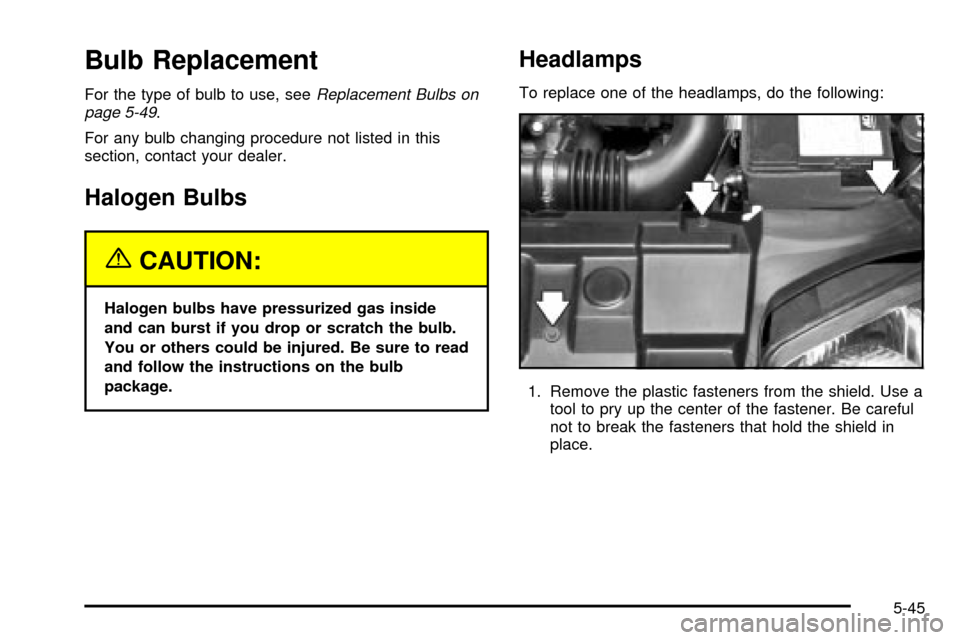
Headlamps
To replace one of the headlamps, do the following:
1. Remove the plastic fasteners from the shield. Use a
tool to pry up the center of the fastener. Be careful
not to break the fasteners that hold the shield in
place.
5-45
Page 268 of 364
2. Remove the two bolts from the headlamp assembly.
Pull the headlamp assembly up and toward the
front of the vehicle to access the bulb assembly.3. Remove the cover by
turning it
counterclockwise.
4. Disconnect the bulb
base from the socket
by lifting the plastic
locking tab.
5. Remove the black collar by turning it clockwise.
5-46
Page 269 of 364
6. Remove the bulb by
pulling it straight out.
7. Snap a new bulb into the socket.
8. Reinstall the bulb assembly by reversing Steps 1
through 5.Front Turn Signal and Parking
Lamps
To replace the turn signal and parking lamp, do the
following:
1. Follow Steps 1 and 2 under
Headlamps on
page 5-45.
2. Hold down the tab at
the top of the bulb
retainer. Twist
the retainer one-eighth
of a turn
counterclockwise and
pull the assembly out.
3. Remove the bulb by pulling the bulb straight out.
4. Snap in a new bulb.
5. Reinstall the bulb assembly by reversing
Steps 1 and 2.
5-47