Page 297 of 420
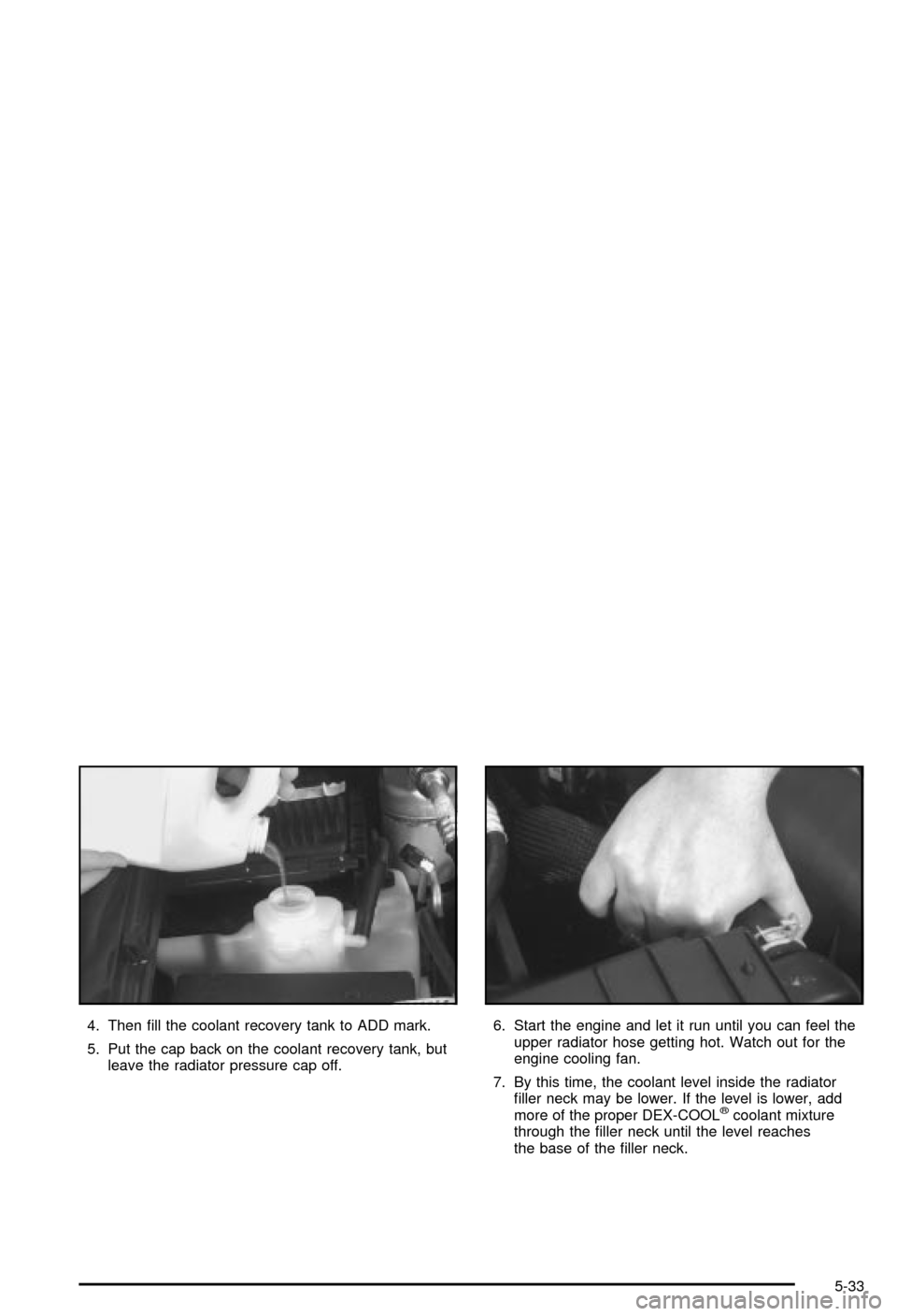
4. Then ®ll the coolant recovery tank to ADD mark.
5. Put the cap back on the coolant recovery tank, but
leave the radiator pressure cap off.6. Start the engine and let it run until you can feel the
upper radiator hose getting hot. Watch out for the
engine cooling fan.
7. By this time, the coolant level inside the radiator
®ller neck may be lower. If the level is lower, add
more of the proper DEX-COOL
žcoolant mixture
through the ®ller neck until the level reaches
the base of the ®ller neck.
5-33
Page 374 of 420

150,000 Miles (240 000 km)
qDrain, ¯ush and re®ll cooling system (or every
60 months since last service, whichever occurs ®rst).
See
Engine Coolant on page 5-22for what to use.
Inspect hoses. Clean radiator, condenser, pressure
cap and neck. Pressure test cooling system and
pressure cap.
An Emission Control Service.
qInspect engine accessory drive belt.An Emission
Control Service.
Long Trip/Highway Scheduled
Maintenance
The services shown in this schedule up to 100,000 miles
(166 000 km) should be repeated after 100,000 miles
(166 000 km) at the same intervals for the life of
this vehicle. The services shown at 150,000 miles
(240 000 km) should be repeated at the same interval
after 150,000 miles (240 000 km) for the life of this
vehicle.
See
Part B: Owner Checks and Services on page 6-26andPart C: Periodic MaintenanceInspections on
page 6-31.
Footnotes
²The U.S. Environmental Protection Agency or the
California Air Resources Board has determined that the
failure to perform this maintenance item will not nullify
the emission warranty or limit recall liability prior to
the completion of the vehicle's useful life. We, however,
urge that all recommended maintenance services be
performed at the indicated intervals and the
maintenance be recorded.
#Lubricate the front suspension, ball joints, steering
linkage, parking brake cable guides, propshaft splines,
universal joints and brake pedal springs.
+A good time to check your brakes is during tire
rotation. See Brake System Inspection on page 6-32.
**
Drive axle service. See Part D: Recommended Fluids
and Lubricants on page 6-33for proper lubricant to use.
·Check ¯uid level and add ¯uid as needed.
·If your vehicle has a locking differential, drain ¯uid
and re®ll at ®rst engine oil change.
6-18
Page 381 of 420
100,000 Miles (166 000 km)
qInspect spark plug wires.An Emission Control
Service.
qReplace spark plugs.An Emission Control Service.
qIf you haven't used your vehicle under severe service
conditions listed previously and, therefore, haven't
changed your automatic transmission ¯uid, change
both the ¯uid and ®lter. Manual transmission
¯uid doesn't require change.
qAutomatic Transfer Case Only: Change transfer case
¯uid.
qInspect Positive Crankcase Ventilation (PCV) valve.
An Emission Control Service.
150,000 Miles (240 000 km)
qDrain, ¯ush and re®ll cooling system (or every
60 months since last service, whichever occurs ®rst).
See
Engine Coolant on page 5-22for what to use.
Inspect hoses. Clean radiator, condenser, pressure
cap and neck. Pressure test the cooling system
and pressure cap.
An Emission Control Service.
qInspect engine accessory drive belt.An Emission
Control Service.
6-25
Page 387 of 420

Part C: Periodic
MaintenanceInspections
Listed in this part are inspections and services which
should be performed at least twice a year (for instance,
each spring and fall).
You should let your dealer's
service department do these jobs. Make sure any
necessary repairs are completed at once.
Proper procedures to perform these services may be
found in a service manual. SeeService Publications
Ordering Information on page 7-11.
Steering, Suspension and Front
Drive Axle Boot and Seal Inspection
Inspect the front and rear suspension and steering
system for damaged, loose or missing parts, signs of
wear or lack of lubrication. Inspect the power steering
lines and hoses for proper hook-up, binding, leaks,
cracks, cha®ng, etc. Clean and then inspect the drive
axle boot seals for damage, tears or leakage. Replace
seals if necessary.
Exhaust System Inspection
Inspect the complete exhaust system. Inspect the body
near the exhaust system. Look for broken, damaged,
missing or out-of-position parts as well as open seams,
holes, loose connections or other conditions which
could cause a heat build-up in the ¯oor pan or could let
exhaust fumes into the vehicle. See
Engine Exhaust
on page 2-39.
Fuel System Inspection
Inspect the complete fuel system for damage or leaks.
Engine Cooling System Inspection
Inspect the hoses and have them replaced if they
are cracked, swollen or deteriorated. Inspect all pipes,
®ttings and clamps; replace as needed. Clean the
outside of the radiator and air conditioning condenser.
To help ensure proper operation, a pressure test of
the cooling system and pressure cap is recommended
at least once a year.
6-31
Page 415 of 420

P
Park (P)........................................................2-35
Shifting Into................................................2-35
Shifting Out of............................................2-37
Parking Brake and Automatic Transmission
Park (P) Mechanism Check...........................6-30
Parking on Hills..............................................4-63
Parking Your Vehicle.......................................2-38
Parking.........................................................2-34
Brake........................................................2-34
Over Things That Burn.................................2-38
Part A - Scheduled Maintenance Services............ 6-4
Part B - Owner Checks and Services................6-26
Part C - Periodic MaintenanceInspections..........6-31
Part D - Recommended Fluids and Lubricants....6-33
Part E - Maintenance Record...........................6-35
Passing.................................................4-13, 4-61
Passlock
ž......................................................2-18
Payload.........................................................4-54
Plan Ahead When Possible................................ 7-8
Playing a Cassette Tape..................................3-53
Playing a Compact Disc..................3-46, 3-55, 3-63
Playing a Speci®c Loaded
Compact Disc.............................................3-64
Playing the Radio...................3-38, 3-41, 3-48, 3-58
Power Steering...............................................4-10
Power...........................................................3-15
Accessory Outlets........................................3-15
Door Locks.................................................. 2-8Power (cont.)
Electrical System.........................................5-85
Lumbar Controls........................................... 1-4
Seat............................................................ 1-3
Steering Fluid.............................................5-35
Windows....................................................2-12
Programmable Automatic Door Locks.................. 2-8
Programming the HomeLink Transmitter.............2-45
Q
Questions and Answers About Safety Belts.........1-13
R
Radiator Pressure Cap....................................5-25
Radio Messages.............................3-40, 3-45, 3-53
Radios..........................................................3-37
AM-FM Radio.............................................3-38
Care of Your Cassette Tape Player................3-69
Care of Your CD Player...............................3-70
Care of Your CDs........................................3-70
Radio with Cassette and CD.........................3-48
Radio with CD............................................3-41
Radio with Six-Disc CD................................3-58
Setting the Time for Radios with Radio Data
Systems (RDS)........................................3-38
Setting the Time for Radios without Radio
Data Systems (RDS)................................3-37
11