Page 293 of 420
Notice:When adding coolant, it is important that
you use only DEX-COOLž(silicate-free) coolant.
If coolant other than DEX-COOLžis added to
the system, premature engine, heater core or
radiator corrosion may result. In addition, the engine
coolant will require change sooner Ð at 30,000 miles
(50 000 km) or 24 months, whichever occurs ®rst.
Damage caused by the use of coolant other
than DEX-COOL
žis not covered by your new vehicle
warranty.
How to Add Coolant to the Coolant
Recovery Tank
If you haven't found a problem yet, but the coolant level
isn't at the ADD mark, add a 50/50 mixture ofclean,
drinkable waterand DEX-COOLžengine coolant at the
coolant recovery tank. SeeEngine Coolant on
page 5-22for more information.
{CAUTION:
Adding only plain water to your cooling
system can be dangerous. Plain water, or
some other liquid such as alcohol, can boil
before the proper coolant mixture will. Your
vehicle's coolant warning system is set for the
proper coolant mixture. With plain water or the
wrong mixture, your engine could get too hot
but you wouldn't get the overheat warning.
Your engine could catch ®re and you or others
could be burned. Use a 50/50 mixture of clean,
drinkable water and DEX-COOL
žcoolant.
Notice:In cold weather, water can freeze and crack
the engine, radiator, heater core and other parts.
Use the recommended coolant and the proper
coolant mixture.
5-29
Page 297 of 420
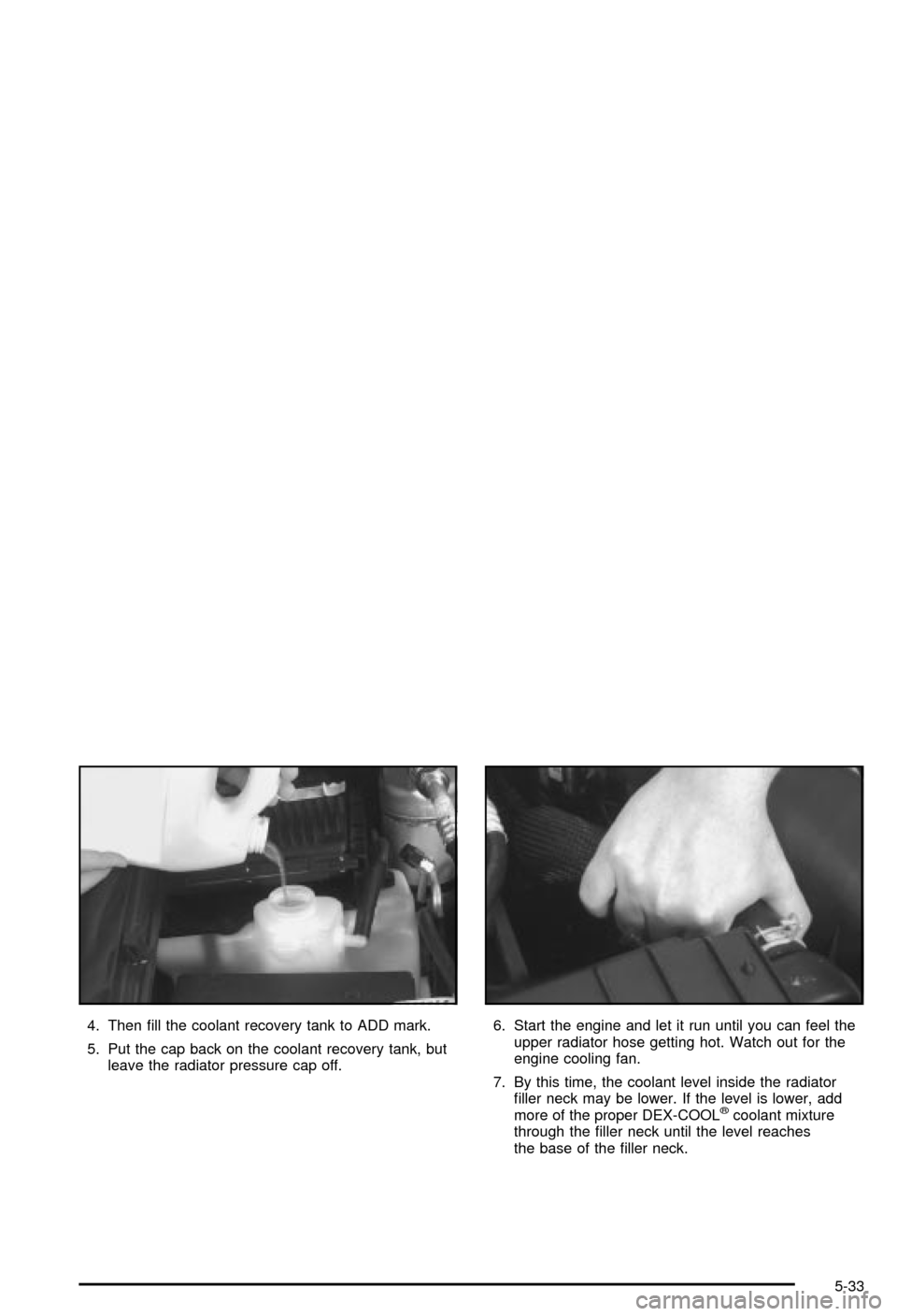
4. Then ®ll the coolant recovery tank to ADD mark.
5. Put the cap back on the coolant recovery tank, but
leave the radiator pressure cap off.6. Start the engine and let it run until you can feel the
upper radiator hose getting hot. Watch out for the
engine cooling fan.
7. By this time, the coolant level inside the radiator
®ller neck may be lower. If the level is lower, add
more of the proper DEX-COOL
žcoolant mixture
through the ®ller neck until the level reaches
the base of the ®ller neck.
5-33
Page 374 of 420

150,000 Miles (240 000 km)
qDrain, ¯ush and re®ll cooling system (or every
60 months since last service, whichever occurs ®rst).
See
Engine Coolant on page 5-22for what to use.
Inspect hoses. Clean radiator, condenser, pressure
cap and neck. Pressure test cooling system and
pressure cap.
An Emission Control Service.
qInspect engine accessory drive belt.An Emission
Control Service.
Long Trip/Highway Scheduled
Maintenance
The services shown in this schedule up to 100,000 miles
(166 000 km) should be repeated after 100,000 miles
(166 000 km) at the same intervals for the life of
this vehicle. The services shown at 150,000 miles
(240 000 km) should be repeated at the same interval
after 150,000 miles (240 000 km) for the life of this
vehicle.
See
Part B: Owner Checks and Services on page 6-26andPart C: Periodic MaintenanceInspections on
page 6-31.
Footnotes
²The U.S. Environmental Protection Agency or the
California Air Resources Board has determined that the
failure to perform this maintenance item will not nullify
the emission warranty or limit recall liability prior to
the completion of the vehicle's useful life. We, however,
urge that all recommended maintenance services be
performed at the indicated intervals and the
maintenance be recorded.
#Lubricate the front suspension, ball joints, steering
linkage, parking brake cable guides, propshaft splines,
universal joints and brake pedal springs.
+A good time to check your brakes is during tire
rotation. See Brake System Inspection on page 6-32.
**
Drive axle service. See Part D: Recommended Fluids
and Lubricants on page 6-33for proper lubricant to use.
·Check ¯uid level and add ¯uid as needed.
·If your vehicle has a locking differential, drain ¯uid
and re®ll at ®rst engine oil change.
6-18
Page 382 of 420

Part B: Owner Checks and Services
Listed in this part are owner checks and services
which should be performed at the intervals speci®ed to
help ensure the safety, dependability and emission
control performance of your vehicle.
Be sure any necessary repairs are completed at once.
Whenever any ¯uids or lubricants are added to your
vehicle, make sure they are the proper ones, as shown
in Part D.
At Each Fuel Fill
It is important for you or a service station attendant to
perform these underhood checks at each fuel ®ll.
Engine Oil Level Check
Check the engine oil level and add the proper oil if
necessary. SeeEngine Oil on page 5-11for further
details.
Engine Coolant Level Check
Check the engine coolant level and add DEX-COOLž
coolant mixture if necessary. SeeEngine Coolant
on page 5-22for further details.
Windshield Washer Fluid Level Check
Check the windshield washer ¯uid level in the windshield
washer tank and add the proper ¯uid if necessary.
See
Windshield Washer Fluid on page 5-36for further
details.
At Least Once a Month
Tire In¯ation Check
Make sure tires are in¯ated to the correct pressures.
Don't forget to check your spare tire. SeeTires on
page 5-54for further details.
6-26
Page 409 of 420

Driving On Grades..........................................4-62
Driving on Off-Road Hills.................................4-19
Driving on Snow or Ice....................................4-38
Driving Through Deep Standing Water...............4-32
Driving Through Flowing Water.........................4-32
Driving Uphill..................................................4-20
Driving with a Trailer.......................................4-60
Driving..........................................................4-28
At Night.....................................................4-28
City...........................................................4-33
Defensive..................................................... 4-3
Drunken....................................................... 4-4
Environment................................................. 4-3
Freeway.....................................................4-34
Hill and Mountain Roads..............................4-36
In Rain and on Wet Roads...........................4-30
Winter........................................................4-38
E
Electrical System............................................5-84
Add-On Equipment......................................5-84
Fuses and Circuit Breakers...........................5-85
Headlamps.................................................5-84
Power Windows and Other Power Options......5-85
Windshield Wiper Fuses...............................5-85
Electronic Transfer Case..................................2-29
Emergency Release for Opening Tailgate...........2-15Emissions Inspection and Maintenance
Programs...................................................3-32
Engine Compartment Fuse Block......................5-88
Engine Coolant Level Check.............................6-26
Engine Oil Additives........................................5-14
Engine Oil Level Check...................................6-26
Engine..........................................................5-15
Air Cleaner/Filter.........................................5-15
Battery.......................................................5-40
Check and Service Engine Soon Light............3-30
Compartment Overview................................5-10
Coolant Heater............................................2-22
Coolant Temperature Gage...........................3-29
Coolant......................................................5-22
Cooling System Inspection............................6-31
Exhaust.....................................................2-39
Fan Noise..................................................5-34
Oil .............................................................5-11
Overheating................................................5-25
Starting......................................................2-21
Entry Lighting.................................................3-14
Environmental Concerns..................................4-17
Erasing HomeLink
žButtons..............................2-47
Exit Lighting...................................................3-14
Express Down Window....................................2-12
Extender, Safety Belt.......................................1-31
Exterior Lamps...............................................3-11
5