Page 247 of 386
Add coolant mixture at the recovery tank, but be careful
not to
mill it.
You can be burned if you
spill coolant on hot
engine parts. Coolant contains ethylene glycol, and
it will burn if the engine parts are hot
Radiator Pressure Cap
Occasionally check the coolant level in the radiator.
For information on how to add coolant to the radiator,
see
Cooling System on page 5-33.
A L
The radiator pressure cap is located in the engine
compartment on the
passenger's side of
the vehicle.
Notice: Your radiator cap is a 15.6 psi (1 10 kPa)
pressure-type cap and must be tightly installed
to prevent coolant
loss and possible engine damage
from overheating. Be sure the arrows on the cap
line up with the overflow tube on the radiator filler.
5-30
Page 250 of 386
Cooling System
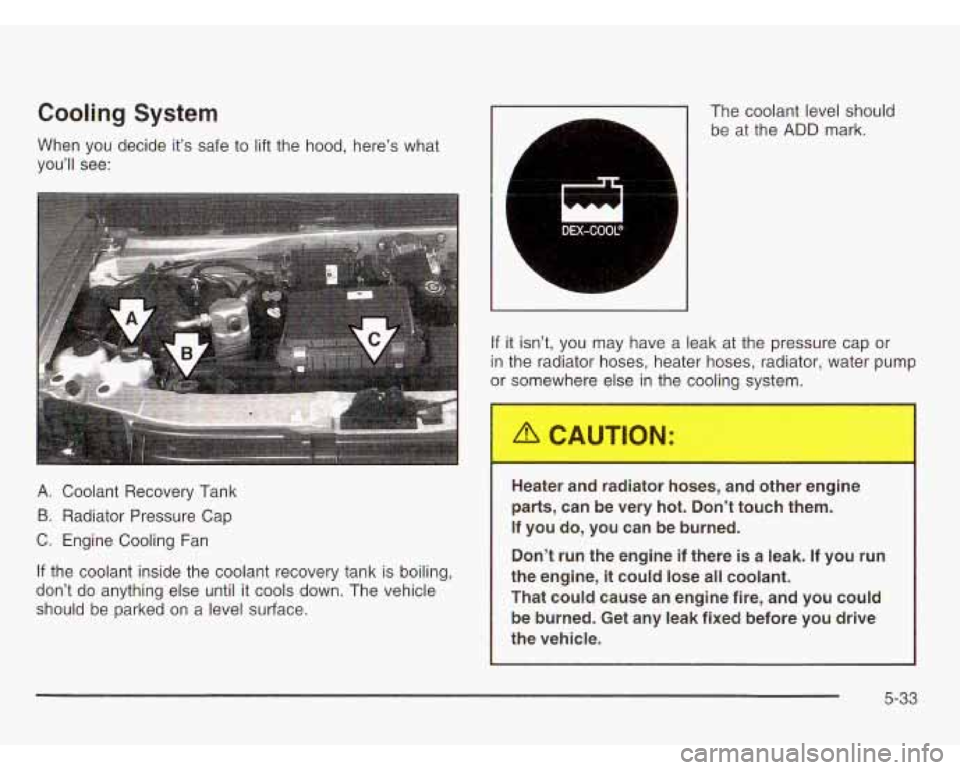
When you decide it’s safe to lift the hood, here’s what
you’ll see: The
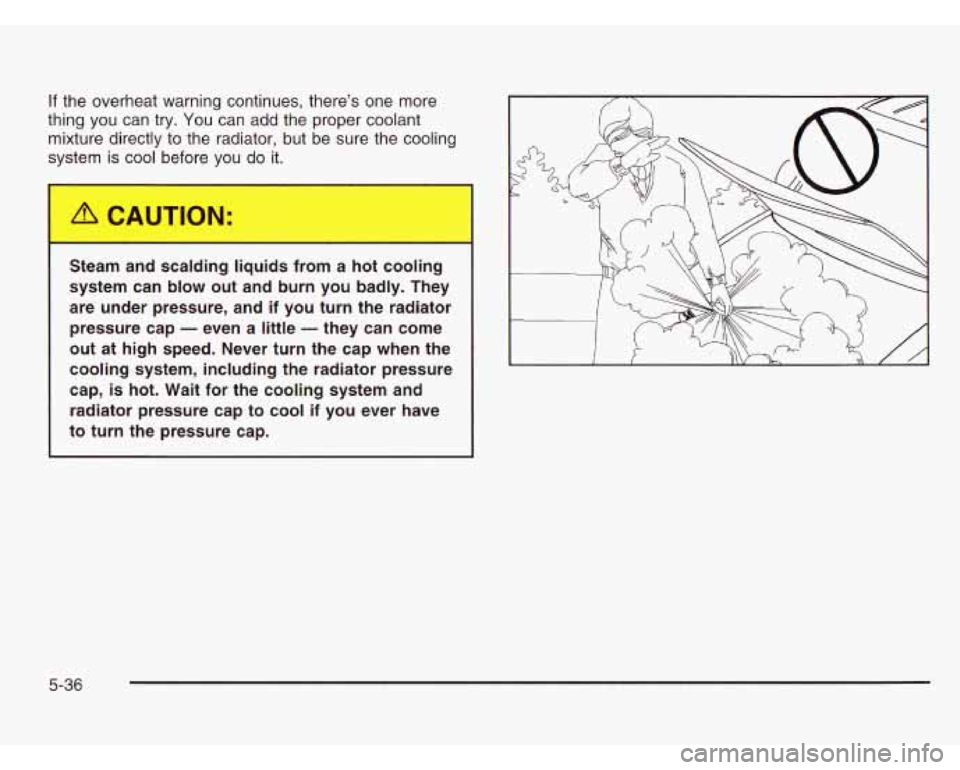
coolant level should
be at the
ADD mark.
A. Coolant Recovery Tank
B. Radiator Pressure Cap
C. Engine Cooling Fan
If the coolant inside the coolant recovery tank is boiling,
don’t do anything else until it cools down. The vehicle
should be parked
on a level surface.
A
If it isn’t, you may have a leak at the pressure cap or
in the radiator hoses, heater hoses, radiator, water pump
or somewhere else
in the cooling system.
Heater and radiator hoses, and other engine
parts, can be very hot. Don’t touch them.
If you do, you can be burned.
Don’t run the engine if there
is a leak. If you run
the engine,
it could lose all coolant.
That could cause an engine fire, and you could be burned. Get any leak fixed before you drive
the vehicle.
5-33
Page 251 of 386
If there seems to be no leak, start the engine again. How to Add Coolant to the Coolant
The engine cooling fan speed should increase when idle
speed is doubled by pushing the accelerator pedal
Recovery Tank
down. If it doesn’t, your vehicle needs service. Turn off If you haven’t found a problem yet, but the coolant level
the engine. isn’t at the
ADD mark, add a 50/50 mixture of clean
Nofice: Engine damage from running your engine
without coolant isn’t covered by your warranty.
Notice: When adding coolant, it is important that
you use only
DEX-COOL@ (silicate-free) coolant.
If coolant other than DEX-COOL@’ is added to the
system, premature engine, heater core or radiator
corrosion may result.
In addition, the engine coolant
will require change sooner
- at 30,000 miles
(50 000 km) or 24 months, whichever occurs first.
Damage caused by the use of coolant other than
DEX-COOL@ is not covered by your new vehicle
warranty.
drinkable wafer, and DEX-COOL@ engine coolant at
the coolant recovery tank. See
Engine Coolant on
page 5-28 for more information.
Adding only p.,,n water to your coG...rg
system can be dangerous. Plain water, or
some other
liquid such as alcohol, can boil
before the proper coolant mixture will. Your
vehicle’s coolant warning system
is set for the
proper coolant mixture. With plain water or the
wrong mixture, your engine could get too hot but you wouldn’t get the overheat warning.
Your engine could catch fire and you or others
could be burned. Use a
50/50 mixture of clean,
drinkable water and DEX COOL@ coolant.
5-34
Page 253 of 386
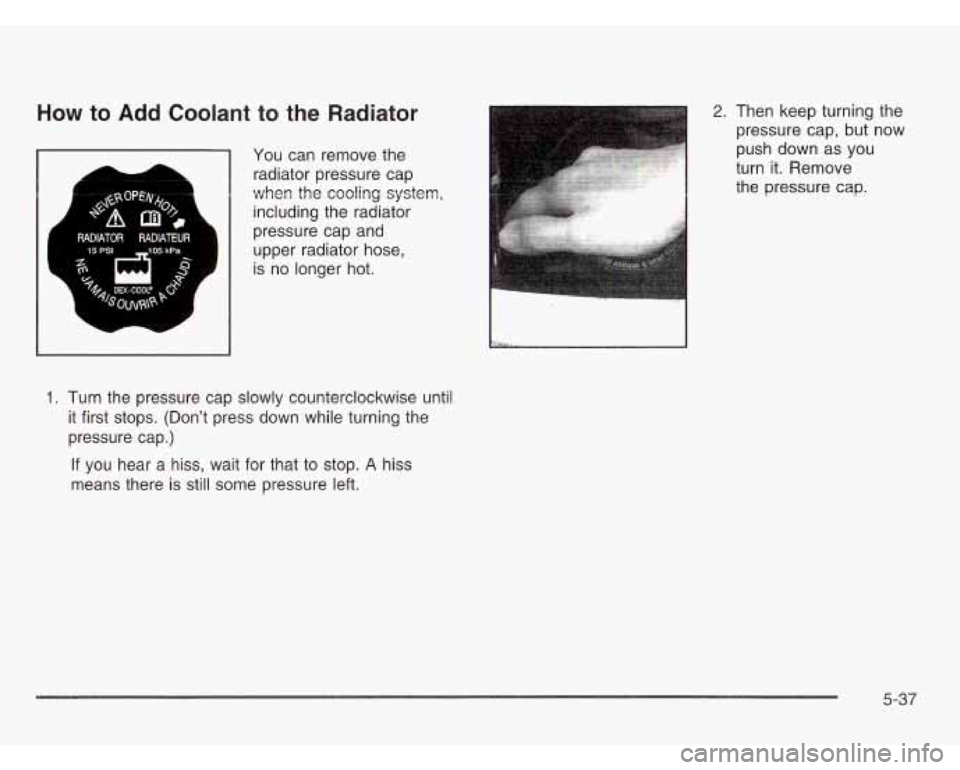
If the overheat warning continues, there’s one more
thing you can try.
You can add the proper coolant
mixture directly to the radiator, but be sure the cooling
system is cool before you do it.
1
Steam and scalding liquids from a hot cooling
system can blow out and burn you badly. They
are under pressure, and
if you turn the radiator
pressure cap
- even a little - they can come
out at high speed. Never turn the cap when
the
cooling system, including the radiator pressure
cap, is hot. Wait for the cooling system and
radiator pressure cap to cool if you ever have
to
turn the pressure cap.
5-36
Page 254 of 386
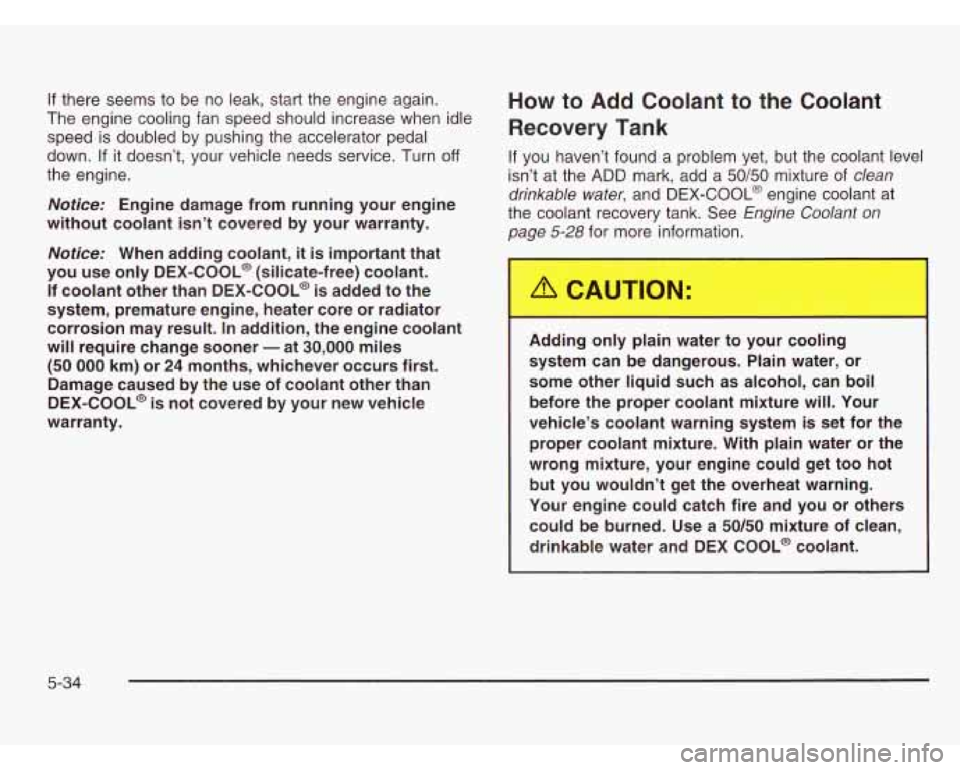
How to Add Coolant to the Radiator
You can remove the
radiator pressure cap
when the cooling system,
including the radiator
pressure cap and
upper radiator hose,
is no longer hot.
1. Turn the pressure cap slowly counterclockwise until
it first stops. (Don't press down while turning the
pressure cap.)
2. Then keep turning the pressure cap, but now
push down as you
turn it. Remove
the pressure cap.
If you hear a hiss, wait for that
to stop. A hiss
means there is still some pressure left.
5-37
Page 256 of 386
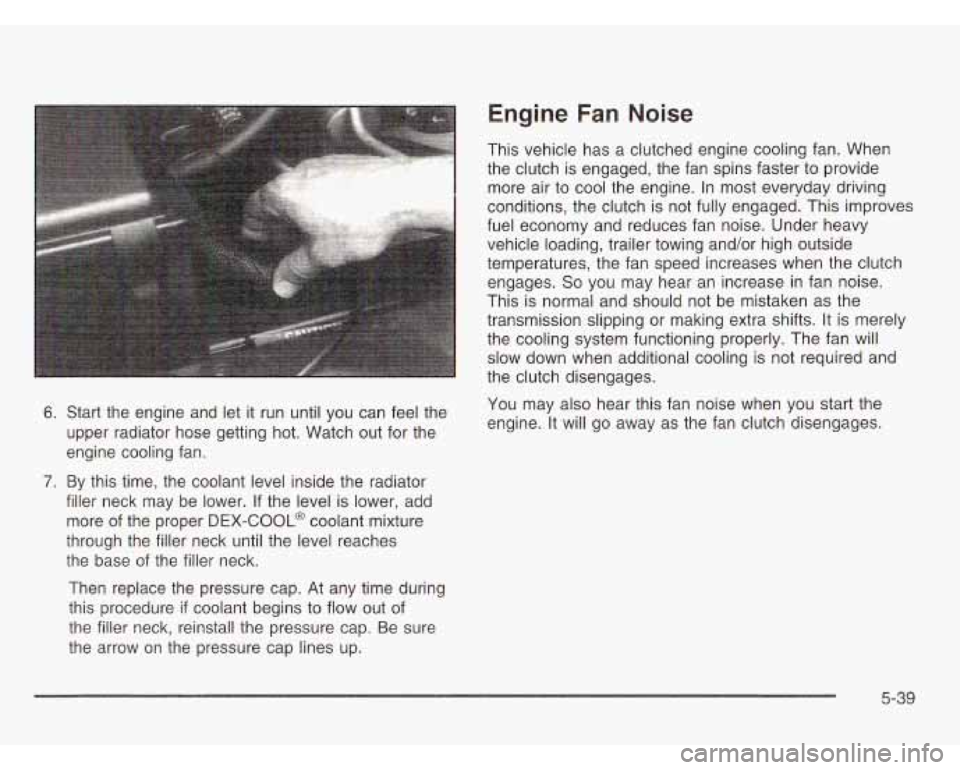
6. Start the engine and let it run until you can feel the
upper radiator hose getting hot. Watch out for the
engine cooling fan.
7. By this time, the coolant level inside the radiator
filler neck may be lower.
If the level is lower, add
more of the proper
DEX-COOL@ coolant mixture
through the filler neck until the level reaches
the base of the filler neck.
Then replace the pressure cap. At any time during
this procedure
if coolant begins to flow out of
the filler neck, reinstall the pressure cap. Be sure
the arrow on the pressure cap lines up.
Engine Fan Noise
This vehicle has a clutched engine cooling fan. When
the clutch is engaged, the fan spins faster to provide
more air to cool the engine. In most everyday driving
conditions, the clutch is not fully engaged. This improves
fuel economy and reduces fan noise. Under heavy
vehicle loading, trailer towing and/or high outside
temperatures, the fan speed increases when the clutch
engages.
So you may hear an increase in fan noise.
This is normal and should not be mistaken as the
transmission slipping or making extra shifts. It is merely
the cooling system functioning properly. The fan will
slow down when additional cooling is not required and
the clutch disengages.
You may also hear this fan noise when you start the
engine. It will go away as the fan clutch disengages.
5-39
Page 286 of 386

Wheel Alignment and Tire Balance If you need to replace any of your wheels, wheel bolts
or wheel nuts, replace them only with new
GM
The wheels on your vehicle were aligned and balanced original
equipment parts. This way, you will be sure to
carefully at the factory to give you the longest tire life have
the right wheel, wheel bolts and wheel nuts for
and best overall performance.
your
vehicle.
Scheduled wheel alignment and wheel balancing are
not needed. However,
if you notice unusual tire wear or
your vehicle pulling one way or the other, the alignment
may need to be reset.
If you notice your vehicle
vibrating when driving on a smooth road, your wheels
may need to be rebalanced.
Wheel Replacement
Replace any wheel that is bent, cracked or badly
rusted or corroded.
If wheel nuts keep coming loose,
the wheel, wheel bolts and wheel nuts should be
replaced. If the wheel leaks air, replace it (except some
aluminum wheels, which can sometimes be repaired).
See your dealer
if any of these conditions exist.
Your dealer will know the kind of wheel you need.
Each new wheel should have the same load-carrying
capacity, diameter, width, offset and be mounted
the same way as the one it replaces. the wrong replacement wheels, wheel
bolts or wheel nuts on your vehicle can be
dangerous.
It could affect the braking and
handling of your vehicle, make your tires lose
air and make you lose control. You could have
a collision
in which you or others could be
injured. Always use the correct wheel, wheel
bolts and wheel nuts for replacement.
Notice: The wrong wheel can also cause problems
with bearing life, brake cooling, speedometer or
odometer calibration, headlamp aim, bumper height,
vehicle ground clearance and tire or tire chain clearance to the body and chassis.
See
Changing a Flat Tire on page 5-71 for more
information.
-~
5-69
Page 320 of 386

Section 6 Maintenance Schedule
Maintenance Schedule ............................... 6.2
Introduction
................................................... 6.2
Your Vehicle and the Environment
.................... 6-2
Maintenance Requirements
.............................. 6-2
How This Section
is Organized ......................... 6-3
Part
A: Scheduled Maintenance Services ........... 6.4
Using Your Maintenance Schedule
.................... 6.4
Selecting the Right Schedule
........................... 6-5
Short Trip/City Scheduled Maintenance
.............. 6.7
Long Trip/Highway Scheduled Maintenance
...... 6.18
Part B: Owner Checks and Services
................ 6.26
At Each Fuel Fill
.......................................... 6-26
At Least Once a Month
................................. 6.26
At Least Twice a Year
................................... 6.26 At
Least Once a Year
................................... 6-27
Part C: Periodic Maintenance inspections
......... 6.30
Steering. Suspension and Front Drive Axle
Boot and Seal Inspection
............................ 6.30
Exhaust System Inspection
............................ 6.30
Fuel System Inspection
.................................. 6.30
Engine Cooling System Inspection
................... 6.30
Throttle System Inspection
............................ -6-31
Transfer Case and Front Axle
(All-Wheel Drive) Inspection
....................... -6-31
Brake System Inspection
................................ 6.31
Part D: Recommended Fluids
and Lubricants
.......................................... 6.32
Part E: Maintenance Record
........................... 6.34
6-
1