2003 CHEVROLET ASTRO change time
[x] Cancel search: change timePage 207 of 386
If yours was built with trailering options, as many are,
it’s ready for heavier trailers. But trailering is different
than just driving your vehicle by itself. Trailering means
changes in handling, durability and fuel economy.
Successful, safe trailering takes correct equipment,
and it has to be used properly.
That’s the reason for this part. In it are many time-tested,
important trailering tips and safety rules. Many of these
are important for your safety and that of your passengers.
So please read this section carefully before you pull
a trailer.
If You Do Decide To Pull A Trailer
If you do, here are some important points:
e
e
There are many different laws, including speed limit
restrictions, having to do with trailering. Make sure
your rig will
be legal, not only where you live
but also where you’ll be driving.
A good source for
this information can be state or provincial police.
Consider using
a sway control if your trailer will
weigh 2,000 Ibs
(900 kg) or less. You should
always use a sway control
if your trailer will weigh
more than 2,000
Ibs (900 kg). You can ask a
hitch dealer about sway controls.
e
e
e
Don’t tow a trailer at all during the first 500 miles
(800 km) your new vehicle is driven. Your engine,
axle or other parts could be damaged.
Then, during the first
500 miles (800 km) that you
tow a trailer, don’t drive over
50 mph (80 km/h)
and don’t make starts at full throttle. This helps your
engine and other parts of your vehicle wear in at
the heavier loads.
You can tow in
DRIVE (D). You may want to shift
the transmission to THIRD (3) or,
if necessary, a
lower gear selection
if the transmission shifts
too often (e.g., under heavy loads and/or hilly
conditions).
Three important considerations have to do with weight:
the weight of the trailer,
the weight of the trailer tongue
and the weight on your vehicle’s tires.
4-32
Page 208 of 386
Tow/Haul Mode
The tow/haul mode is a feature that assists when pulling
a heavy trailer. The purpose of the tow/haul mode is:
e to reduce the frequency of shifts when pulling a
heavy trailer.
to provide the same shift feel when pulling a heavy
trailer as when the vehicle is unloaded.
to reduce the need to change throttle position when
pulling a heavy trailer.
This feature is turned on or off by pressing a button on
the column shift lever. When the feature
is on, a
light on the instrument panel will illuminate to indicate
that the tow/haul mode has been selected.
See
Tow/Haul Mode Light on page 3-36. The tow/haul
mode is automatically turned
off each time the vehicle
is started.
The tow/haul mode is most effective when the vehicle
and trailer combined weight is at least
75% of the Gross
Vehicle Weight Rating (GVWR) and the maximum
trailer weight rating for the vehicle. The tow/haul
mode for hauling a heavy trailer is most
useful under the following conditions:
When driving through hilly terrain at speeds below
55 mph
(88 km/h).
When driving in low speed or stop and go traffic
below
55 mph (88 km/h).
When driving in parking lots.
Operating in the tow/haul mode when not pulling a
heavy trailer will not cause damage to the vehicle,
but you may experience reduced fuel economy
and undesirable petformance from the engine and
transmission. The tow/haul mode should be used only
when pulling a heavy trailer.
Weight of the Trailer
How heavy can a trailer safely be?
It depends on how you plan to use your rig. For example,
speed, altitude, road grades, outside temperature and
how much your vehicle is used to pull a trailer are all
important. And, it can also depend on any special
equipment that you have on your vehicle.
4-33
Page 242 of 386

Automatic Transmission Fluid
When to Check and Change
A good time to check your automatic transmission fluid
level is when the engine oil is changed.
Change both the fluid and filter every
15,000 miles
(25
000 km) if the vehicle is mainly driven under one or
more of these conditions:
In heavy city traffic where the outside temperature
In hilly or mountainous terrain.
When doing frequent trailer towing.
Uses such as found in taxi, police or delivery
If you do not use your vehicle under any of these
conditions, change the fluid and filter every
50,000 miles (83 000 km).
See
Part A: Scheduled Maintenance Services on
page
6-4.
regularly reaches 90°F (32°C) or higher.
service.
How to Check
Because this operation can be a little difficult, you may
choose to have this done at the dealership service
department.
If you do it yourself, be sure to follow all the instructions
here, or you could get a false reading on the dipstick.
Notices Too much or too little fluid can damage
your transmission.
Too much can mean that some
of the fluid could come out and fall on hot engine
part or exhaust system parts, starting a fire.
Too little fluid could cause the transmission to
overheat. Be sure to get an accurate reading if you
check your transmission fluid.
Wait at least 30 minutes before checking the
transmission fluid level
if you have been driving:
When outside temperatures are above 90°F (32°C).
0 At high speed for quite a while.
In heavy traffic
- especially in hot weather.
While pulling a trailer.
To get the right reading, the fluid should be at normal
operating temperature, which is 180°F to 200°F
(82°C to 93°C).
5-25
Page 263 of 386
Replacing Brake System Parts
Te braking system on a vehicle is complex. Its many parts
have to be of top quality and work well together
if the
vehicle is to have really good braking. Your vehicle was
designed and tested with top-quality
GM brake parts.
When you replace parts of your braking system -for
example, when your brake linings wear down and you
need new ones put
in - be sure you get new approved
GM replacement parts. If you don’t, your brakes may no
longer work properly.
For example,
if someone puts in brake linings that are
wrong for your vehicle, the balance between your front
and rear brakes can change -for the worse. The braking
performance you’ve come to expect can change
in many
other ways
if someone puts in the wrong replacement
brake parts.
Battery
Your new vehicle comes with a maintenance free
ACDelco@ battery. When it’s time for a new battery,
get one that has the replacement number shown on the
original battery’s label. We recommend an ACDelco@
battery. See
Engine Compartment Overview on
page 5-74 for battery location.
Warnings Battery posts, terminals and related
accessories contain lead and lead compounds,
chemicals known to the State
of California to cause
cancer and reproductive harm. Wash hands after
handling.
5-46
Page 282 of 386
Make sure the spare tire is stored securely. Push,
pull, and then try to rotate or turn the tire.
If it moves,
use the ratchevwheel wrench to tighten the cable.
See
Changing a Flat Tire on page 5-71.
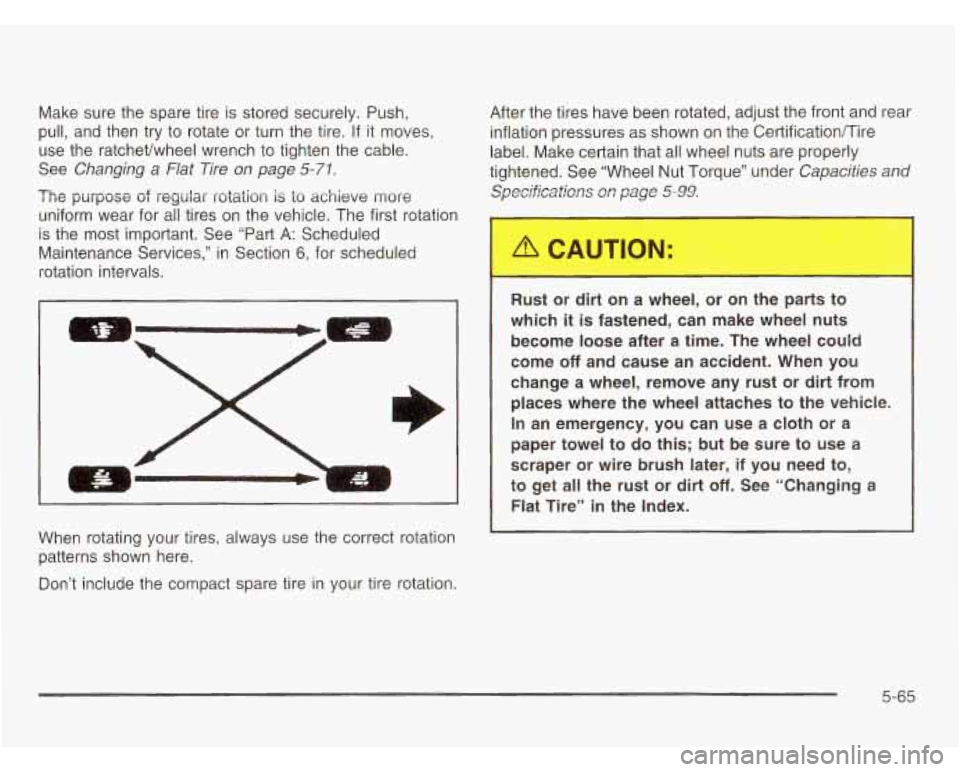
The purpose Gf regular rotation is lo achieve more
uniform wear for all tires on the vehicle. The first rotation
is the most important. See “Part
A: Scheduled
Maintenance Services,” in Section
6, for scheduled
rotation intervals. After
the tires have been rotated, adjust the front and rear
inflation pressures as shown on the CertificationA-ire
label. Make certain that all wheel nuts are properly
tightened. See “Wheel Nut Torque” under
Capacities and
Specifications
on page 5-99.
When rotating your tires, always use the correct rotation
patterns shown here.
ts to
-
Rust or dirt on a wheel, or on the par
which
it is fastened, can make wheel nuts
become loose after a time. The wheel could
come
off and cause an accident. When you
change a wheel, remove any rust or dirt from
places where the wheel attaches to the vehicle.
In an emergency, you can use a cloth or a
paper towel to do
this; but be sure to use a
scraper
or wire brush later, if you need to,
to get all the rust or dirt
off. See “Changing a
Flat Tire” in the Index.
Don’t include the compact spare tire in your tire rotation.
5-65
Page 296 of 386
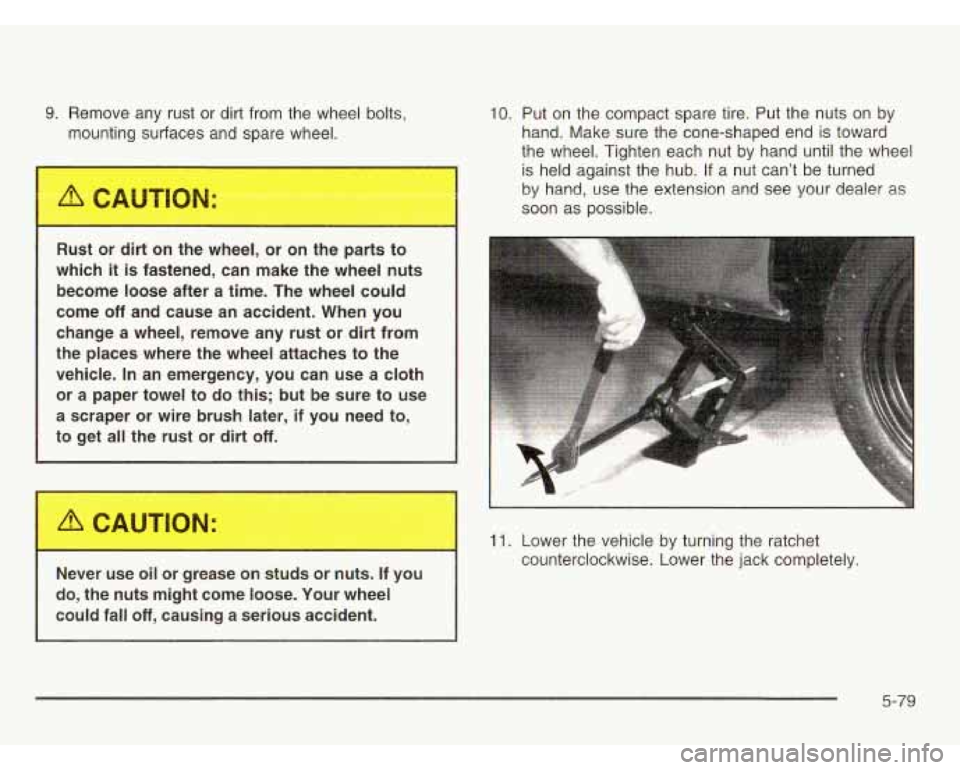
9. Remove any rust or dirt from the wheel bolts,
mounting surfaces and spare wheel.
Rust or dirt on
the wheel, or on the parts to
which
it is fastened, can make the wheel nuts
become loose after
a time. The wheel could
come
off and cause an accident. When you
change a wheel, remove any rust or
dirt from
the places where the wheel attaches to the
vehicle. In an emergency, you can use a cloth
or a paper towel to do this; but be sure to use
a scraper or wire brush later, if you need to,
to get all the rust
or dirt off.
10. Put on the compact spare tire. Put the nuts on by
hand. Make sure the cone-shaped end is toward
the wheel. Tighten each nut by hand until the wheel
is held against the hub.
If a nut can’t be turned
by hand, use the extension and see your dealer as
soon as possible.
Never use oil or grease on studs or nuts. If you
do, the nuts might come
loose. Your wheel
could fall
off, causing a serious accident.
-
11. Lower the vehicle by turning the ratchet
counterclockwise. Lower the jack completely.
5-79
Page 318 of 386

Normal Maintenance Replacement Parts
Replacement part numbers listed in this section are based on the latest information available at the time of printing,
and are subject to change.
If a part listed in this manual is not the same as the part used in your vehicle when it
was built, or
if you have any questions, please contact your GM truck dealer.
Part Number
I Engine Oil Filter
PF47*
Positive Crankcase Ventilation (PCV) Valve CV769C*
I Spark Plugs
41 -932*
I Fuel Filter
GF481*
Wiper Blades (Front)
Type
Length Trico 221 101 58
18 inches (45.7 cm)
Wiper Blades (Rear)
Type
Length Trico 22 1 54396
14 inches (35.5 cm)
5-1 01
Page 326 of 386

Short Trip/City Scheduled Maintenance
The services shown in this schedule up to 100,000 miles
(166 000 km) should be repeated after IQ0,OOQ miles
(166 000 km) at the same intervals for the life of
this vehicle. The services shown at
150,000 miles
(240
000 km) should be repeated at the same interval
after
150,000 miles (240 000 km) for the life of this
vehicle.
See
Part B: Owner Checks and Services on page 6-26
and Part C: Periodic Maintenance Inspections on
page 6-30.
Footnotes
t The U.S. Environmental Protection Agency or the
California Air Resources Board has determined that the
failure to perform this maintenance item will not nullify
the emission warranty or limit recall liability prior to
the completion of the vehicle’s useful life. We, however,
urge that all recommended maintenance services be
performed at the indicated intervals and the
maintenance be recorded.
# Lubricate the front suspension, ball joints and kingpin
bushings, steering linkage, parking brake cable
guides and brake pedal springs.
+ A good time to check your brakes is during tire
rotation. See Brake System Inspection
on page 6-3 1.
3,000 Miles (5 000 km)
0 Change engine oil and filter (or every 3 months,
0 Lubricate chassis components (or every 3 months,
0 Check readfront axle fluid level and add fluid as
whichever
occurs first).
An Emission Control Service.
whichever occurs first). (See footnote #.)
needed. Check constant velocity joints and axle seals
for leaking.
6,000 Miles (IO 000 km)
0
0
0
0
Change engine oil and filter (or every 3 months,
whichever occurs first).
An Emission Control Service.
Lubricate chassis components (or every 3 months,
whichever occurs first).
(See footnote #.)
Check readfront axle fluid level and add fluid as
needed. Check constant velocity joints and axle seals
for leaking.
Rotate tires. See
Tire Inspection and Rotation on
page 5-64
for proper rotation pattern and additional
information.
(See footnote +.)
9,000 Miles (15 000 km)
0 Change engine oil and filter (or every 3 months,
0 Lubricate chassis components (or every 3 months,
0 Check readfront axle fluid level and add fluid as
whichever
occurs first).
An Emission Control Service.
whichever occurs first). (See footnote #.)
needed. Check constant velocity joints and axle seals
for leaking.
6-7