2003 CHEVROLET ASTRO CARGO VAN radiator
[x] Cancel search: radiatorPage 253 of 382
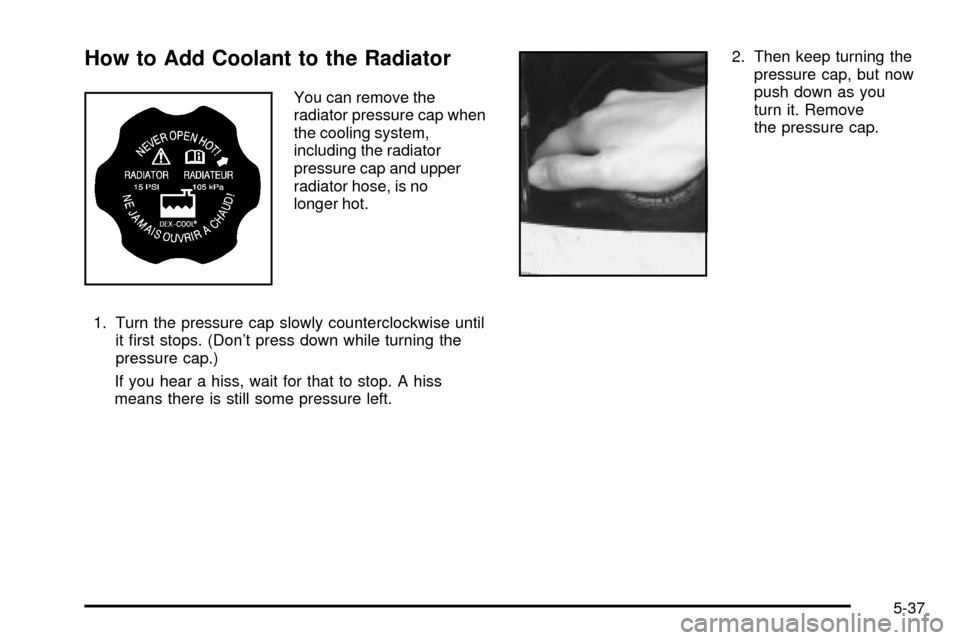
How to Add Coolant to the Radiator
You can remove the
radiator pressure cap when
the cooling system,
including the radiator
pressure cap and upper
radiator hose, is no
longer hot.
1. Turn the pressure cap slowly counterclockwise until
it ®rst stops. (Don't press down while turning the
pressure cap.)
If you hear a hiss, wait for that to stop. A hiss
means there is still some pressure left.2. Then keep turning the
pressure cap, but now
push down as you
turn it. Remove
the pressure cap.
5-37
Page 254 of 382
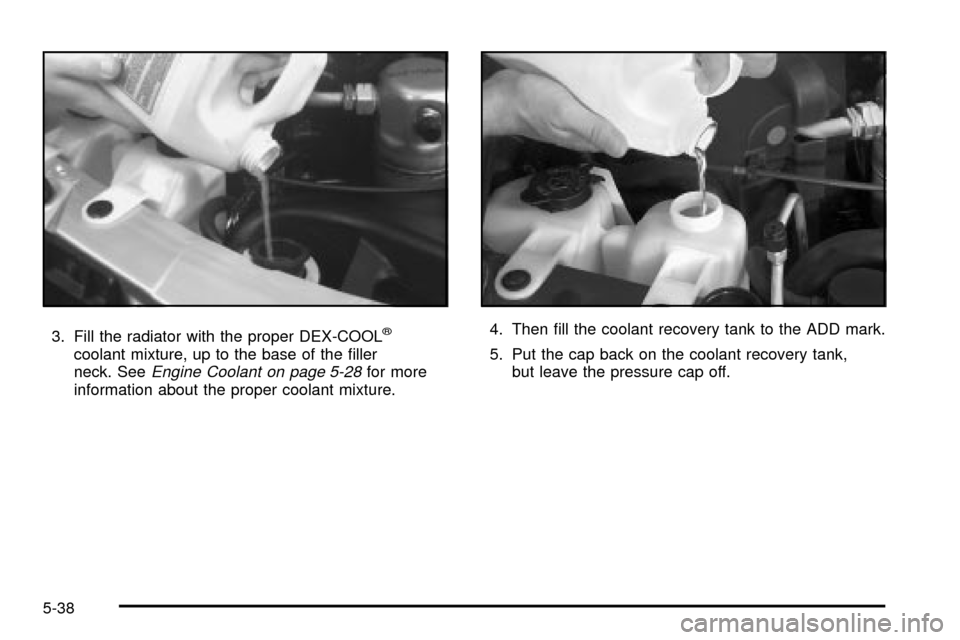
3. Fill the radiator with the proper DEX-COOLž
coolant mixture, up to the base of the ®ller
neck. SeeEngine Coolant on page 5-28for more
information about the proper coolant mixture.4. Then ®ll the coolant recovery tank to the ADD mark.
5. Put the cap back on the coolant recovery tank,
but leave the pressure cap off.
5-38
Page 255 of 382
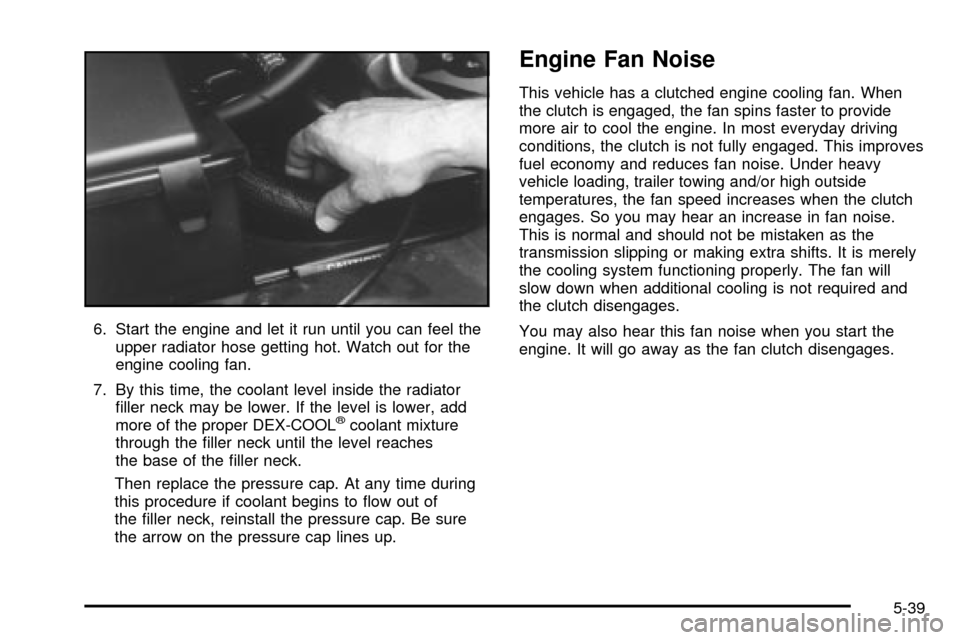
6. Start the engine and let it run until you can feel the
upper radiator hose getting hot. Watch out for the
engine cooling fan.
7. By this time, the coolant level inside the radiator
®ller neck may be lower. If the level is lower, add
more of the proper DEX-COOL
žcoolant mixture
through the ®ller neck until the level reaches
the base of the ®ller neck.
Then replace the pressure cap. At any time during
this procedure if coolant begins to ¯ow out of
the ®ller neck, reinstall the pressure cap. Be sure
the arrow on the pressure cap lines up.
Engine Fan Noise
This vehicle has a clutched engine cooling fan. When
the clutch is engaged, the fan spins faster to provide
more air to cool the engine. In most everyday driving
conditions, the clutch is not fully engaged. This improves
fuel economy and reduces fan noise. Under heavy
vehicle loading, trailer towing and/or high outside
temperatures, the fan speed increases when the clutch
engages. So you may hear an increase in fan noise.
This is normal and should not be mistaken as the
transmission slipping or making extra shifts. It is merely
the cooling system functioning properly. The fan will
slow down when additional cooling is not required and
the clutch disengages.
You may also hear this fan noise when you start the
engine. It will go away as the fan clutch disengages.
5-39
Page 335 of 382

93,000 Miles (155 000 km)
qChange engine oil and ®lter (or every 3 months,
whichever occurs ®rst).An Emission Control Service.
qLubricate chassis components (or every 3 months,
whichever occurs ®rst).(See footnote #.)
qCheck rear/front axle ¯uid level and add ¯uid as
needed. Check constant velocity joints and axle seals
for leaking.
96,000 Miles (160 000 km)
qChange engine oil and ®lter (or every 3 months,
whichever occurs ®rst).An Emission Control Service.
qLubricate chassis components (or every 3 months,
whichever occurs ®rst).(See footnote #.)
qCheck rear/front axle ¯uid level and add ¯uid as
needed. Check constant velocity joints and axle seals
for leaking.
qRotate tires. See
Tire Inspection and Rotation on
page 5-64for proper rotation pattern and additional
information.(See footnote +.)
99,000 Miles (165 000 km)
qChange engine oil and ®lter (or every 3 months,
whichever occurs ®rst).An Emission Control Service.
qLubricate chassis components (or every 3 months,
whichever occurs ®rst).(See footnote #.)
qCheck rear/front axle ¯uid level and add ¯uid as
needed. Check constant velocity joints and axle seals
for leaking.
100,000 Miles (166 000 km)
qInspect spark plug wires.An Emission Control
Service.
qReplace spark plugs.An Emission Control Service.
qIf you haven't used your vehicle under severe service
conditions listed previously and, therefore, haven't
changed your automatic transmission ¯uid, change
both the ¯uid and ®lter.
qChange transfer case ¯uid.
qInspect Positive Crankcase Ventilation (PCV) valve.
An Emission Control Service.
150,000 Miles (240 000 km)
qDrain, ¯ush and re®ll cooling system (or every
60 months since last service, whichever occurs ®rst).
See
Engine Coolant on page 5-28for what to use.
Inspect hoses. Clean radiator, condenser, pressure
cap and neck. Pressure test cooling system and
pressure cap.
An Emission Control Service.
qInspect engine accessory drive belt.An Emission
Control Service.
6-17
Page 343 of 382

97,500 Miles (162 500 km)
qChange engine oil and ®lter (or every 12 months,
whichever occurs ®rst).An Emission Control
Service.
qLubricate chassis components (or every 12 months,
whichever occurs ®rst).(See footnote #).
qCheck rear/front axle ¯uid level and add ¯uid as
needed. Check constant velocity joints and axle seals
for leaking.
qRotate tires. See
Tire Inspection and Rotation on
page 5-64for proper rotation pattern and additional
information.(See footnote +).
100,000 Miles (166 000 km)
qInspect spark plug wires.An Emission Control
Service.
qReplace spark plugs.An Emission Control Service.
qIf you haven't used your vehicle under severe service
conditions listed previously and, therefore, haven't
changed your automatic transmission ¯uid, change
both the ¯uid and ®lter.
qChange transfer case ¯uid.
qInspect Positive Crankcase Ventilation (PCV) valve.
An Emission Control Service.
150,000 Miles (240 000 km)
qDrain, ¯ush and re®ll cooling system (or every
60 months since last service, whichever occurs ®rst).
See
Engine Coolant on page 5-28for what to use.
Inspect hoses. Clean radiator, condenser, pressure
cap and neck. Pressure test the cooling system
and pressure cap.
An Emission Control Service.
qInspect engine accessory drive belt.An Emission
Control Service.
6-25
Page 348 of 382

Part C: Periodic Maintenance
Inspections
Listed in this part are inspections and services which
should be performed at least twice a year (for instance,
each spring and fall).
You should let your dealer's
service department do these jobs. Make sure any
necessary repairs are completed at once.
Proper procedures to perform these services may be
found in a service manual. SeeService Publications
Ordering Information on page 7-11.
Steering, Suspension and Front
Drive Axle Boot and Seal Inspection
Inspect the front and rear suspension and steering
system for damaged, loose or missing parts, signs of
wear or lack of lubrication. Inspect the power steering
lines and hoses for proper hook-up, binding, leaks,
cracks, cha®ng, etc. Clean and then inspect the drive
axle boot seals for damage, tears or leakage. Replace
seals if necessary.
Exhaust System Inspection
Inspect the complete exhaust system. Inspect the body
near the exhaust system. Look for broken, damaged,
missing or out-of-position parts as well as open seams,
holes, loose connections or other conditions which
could cause a heat build-up in the ¯oor pan or could let
exhaust fumes into the vehicle. See
Engine Exhaust
on page 2-30.
Fuel System Inspection
Inspect the complete fuel system for damage or leaks.
Engine Cooling System Inspection
Inspect the hoses and have them replaced if they
are cracked, swollen or deteriorated. Inspect all pipes,
®ttings and clamps; replace as needed. Clean the
outside of the radiator and air conditioning condenser.
To help ensure proper operation, a pressure test of
the cooling system and pressure cap is recommended
at least once a year.
6-30
Page 373 of 382

How to Add Coolant to the Coolant
Recovery Tank............................................5-34
How to Add Coolant to the Radiator..................5-37
How to Add Fluid............................................5-27
How to Check Lubricant...................................5-53
How to Check Power Steering Fluid..................5-40
How to Check........................................5-25, 5-64
How to Inspect the Engine Air Cleaner/Filter.......5-24
How to Use This Manual...................................... ii
How to Wear Safety Belts Properly...................1-18
Hydroplaning..................................................4-18
I
If No Steam Is Coming From Your Engine..........5-32
If Steam Is Coming From Your Engine...............5-31
If the Light Is Flashing.....................................3-32
If the Light Is On Steady.................................3-32
If You Are Stuck in Sand, Mud, Ice or Snow.......4-28
If You Do Decide To Pull A Trailer.....................4-32
If You're Caught in a Blizzard...........................4-26
Ignition Positions.............................................2-19
Ignition Transmission Lock Check......................6-29
Infants and Young Children, Restraints...............1-38
In¯ation Ð Tire Pressure.................................5-64
Inspection......................................................6-31
Brake System.............................................6-31
Engine Cooling System................................6-30Inspection (cont.)
Exhaust System..........................................6-30
Fuel System...............................................6-30
Part C - Periodic Maintenance.......................6-30
Steering, Suspension and Front Drive Axle
Boot and Seal.........................................6-30
Throttle System...........................................6-31
Transfer Case and Front Axle
(All-Wheel Drive)......................................6-31
Installing a Garage Door Opener.......................2-40
Instrument Panel Brightness Control..................3-15
Instrument Panel Fuse Block............................5-93
Instrument Panel.............................................3-24
Cluster.......................................................3-24
Overview..................................................... 3-2
Interior Lamps................................................3-15
J
Jump Starting.................................................5-47
K
Key Lock Cylinders Service..............................6-27
Keyless Entry System....................................... 2-4
Keys............................................................... 2-2
7
Page 377 of 382

R
Radiator Pressure Cap....................................5-30
Radios..........................................................3-38
AM-FM Radio.............................................3-39
Care of Your CD Player...............................3-50
Care of Your CDs........................................3-50
Radio with CD............................................3-41
Rear Seat Audio..........................................3-46
Setting the Time for Radios with
HR and MN Buttons.................................3-38
Setting the Time for Radios with
the Set Button.........................................3-38
Theft-Deterrent............................................3-47
Understanding Reception..............................3-50
Reading Lamps..............................................2-40
Rear Air Conditioning System...........................3-20
Rear Axle......................................................5-53
Locking........................................................ 4-9
Rear Climate Control System............................3-21
Rear Doors....................................................2-13
Rear Heating System......................................3-19
Rear Safety Belt Comfort Guides......................1-32
Rear Seat Audio (RSA)....................................3-46
Rear Seat Operation......................................... 1-7
Rear Seat Outside Passenger Positions.............1-29
Rear Seat Passengers, Safety Belts..................1-29
Rear Window Defogger....................................3-21Rearview Mirrors.............................................2-32
Reclining Seatbacks.......................................... 1-4
Recreational Vehicle Towing.............................4-29
Reinstalling the Engine Cover...........................5-23
Remote Keyless Entry System, Operation............ 2-5
Remote Keyless Entry System............................ 2-4
Removing the Engine Cover.............................5-20
Removing the Flat Tire and Installing
the Spare Tire.............................................5-76
Removing the Rear Seats.................................. 1-7
Removing the Spare Tire and Tools...................5-72
Removing the Wheel Covers............................5-75
Replacement Bulbs.........................................5-61
Replacing Brake System Parts..........................5-46
Replacing Restraint System Parts After a Crash.....1-71
Replacing the Rear Seats.................................. 1-9
Reporting Safety Defects.................................7-11
Canadian Government..................................7-11
General Motors...........................................7-11
United States Government............................7-10
Reprogramming a Single HomeLink
žButton.......2-37
Resetting Defaults...........................................2-37
Restraint System Check...................................6-26
Checking Your Restraint Systems...................1-71
Replacing Restraint System Parts
After a Crash..........................................1-71
11