Page 309 of 382
Fuses and Circuit Breakers
The wiring circuits in your vehicle are protected from
short circuits by a combination of fuses, circuit breakers
and fusible thermal links. This greatly reduces the
chance of ®res caused by electrical problems.
Look at the silver-colored band inside the fuse. If the
band is broken or melted, replace the fuse. Be sure you
replace a bad fuse with a new one of the identical
size and rating.
Spare fuses and a fuse puller are located in the
underhood fuse block. You can remove fuses with the
fuse puller. Remember to replace any of the spare fuses
you use, so you will have some if you ever need them
again.
If you ever have a problem on the road and don't have
a spare fuse, you can borrow one that has the same
amperage. Just pick some feature of your vehicle
that you can get along without ± like the radio or
cigarette lighter ± and use its fuse, if it is the correct
amperage. Replace it as soon as you can.
There are two fuse blocks in your vehicle: one is inside
the vehicle and one is in the engine compartment.
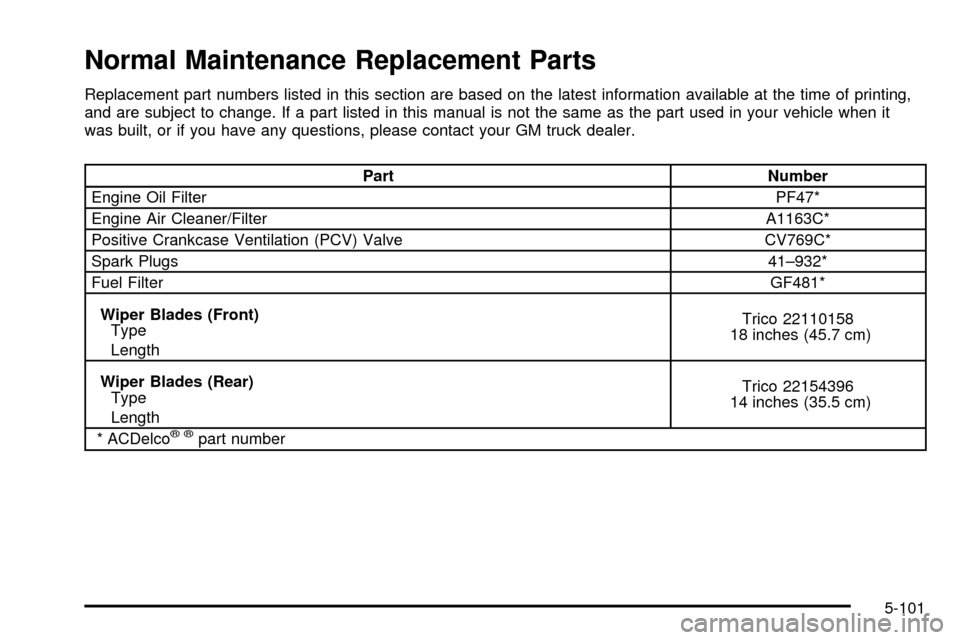
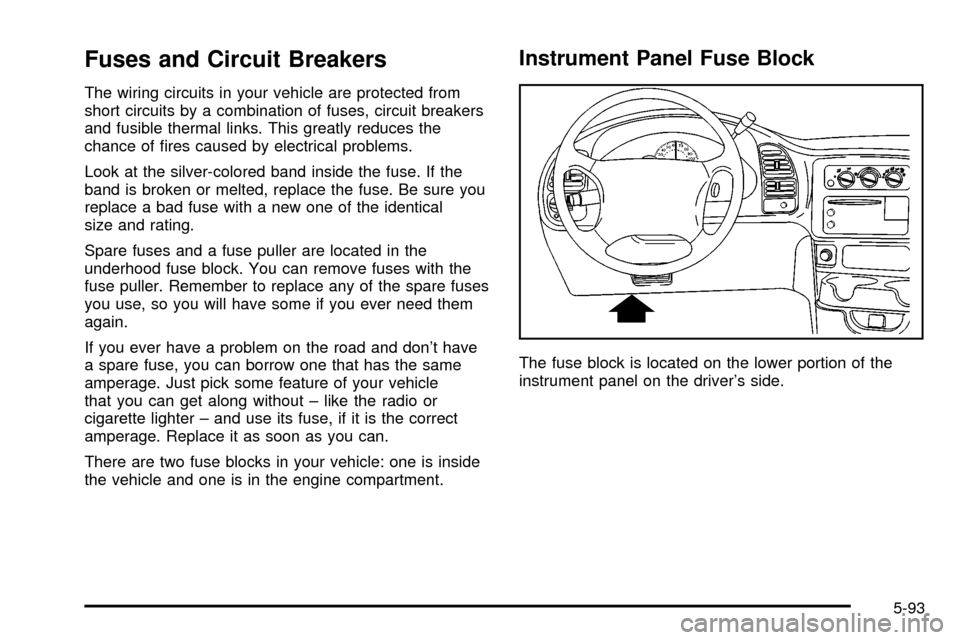
Instrument Panel Fuse Block
The fuse block is located on the lower portion of the
instrument panel on the driver's side.
5-93
Page 312 of 382
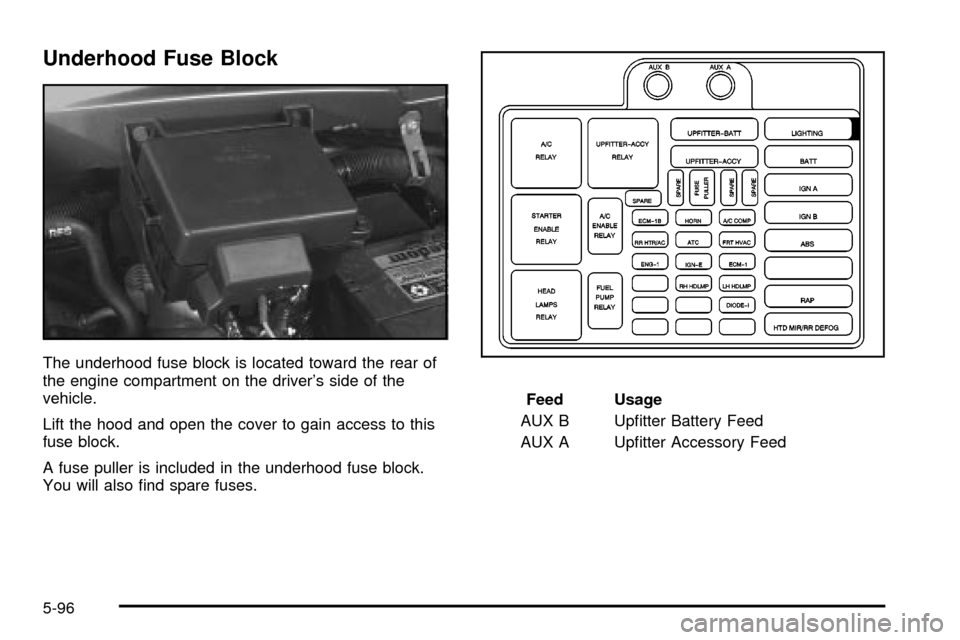
Underhood Fuse Block
The underhood fuse block is located toward the rear of
the engine compartment on the driver's side of the
vehicle.
Lift the hood and open the cover to gain access to this
fuse block.
A fuse puller is included in the underhood fuse block.
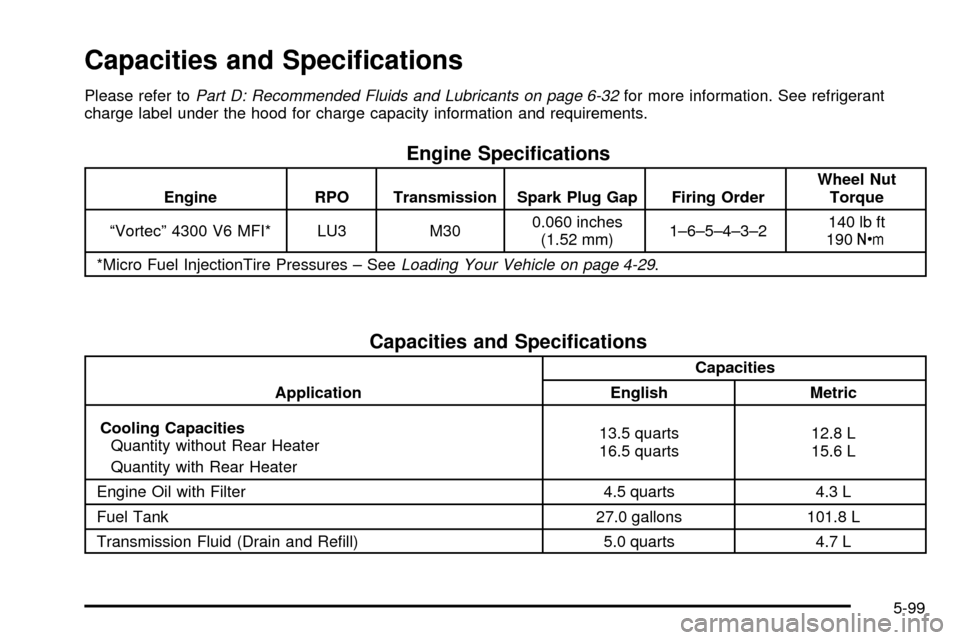
You will also ®nd spare fuses.Feed Usage
AUX B Up®tter Battery Feed
AUX A Up®tter Accessory Feed
5-96
Page 315 of 382
Capacities and Speci®cations
Please refer toPart D: Recommended Fluids and Lubricants on page 6-32for more information. See refrigerant
charge label under the hood for charge capacity information and requirements.
Engine Speci®cations
Engine RPO Transmission Spark Plug Gap Firing OrderWheel Nut
Torque
ªVortecº 4300 V6 MFI* LU3 M300.060 inches
(1.52 mm)1±6±5±4±3±2140 lb ft
190Y
*Micro Fuel InjectionTire Pressures ± See
Loading Your Vehicle on page 4-29.
Capacities and Speci®cations
ApplicationCapacities
English Metric
Cooling Capacities
Quantity without Rear Heater
Quantity with Rear Heater13.5 quarts
16.5 quarts12.8 L
15.6 L
Engine Oil with Filter 4.5 quarts 4.3 L
Fuel Tank 27.0 gallons 101.8 L
Transmission Fluid (Drain and Re®ll) 5.0 quarts 4.7 L
5-99
Page 317 of 382
Normal Maintenance Replacement Parts
Replacement part numbers listed in this section are based on the latest information available at the time of printing,
and are subject to change. If a part listed in this manual is not the same as the part used in your vehicle when it
was built, or if you have any questions, please contact your GM truck dealer.
Part Number
Engine Oil FilterPF47*
Engine Air Cleaner/Filter A1163C*
Positive Crankcase Ventilation (PCV) Valve CV769C*
Spark Plugs41±932*
Fuel FilterGF481*
Wiper Blades (Front)
Type
LengthTrico 22110158
18 inches (45.7 cm)
Wiper Blades (Rear)
Type
LengthTrico 22154396
14 inches (35.5 cm)
* ACDelco
žžpart number
5-101
Page 319 of 382
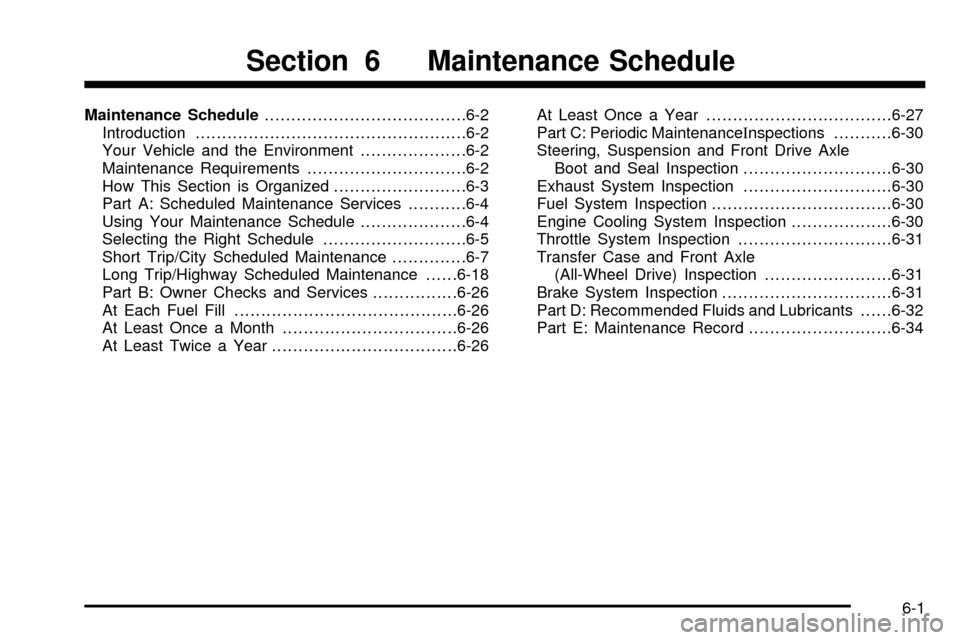
Maintenance Schedule......................................6-2
Introduction...................................................6-2
Your Vehicle and the Environment....................6-2
Maintenance Requirements..............................6-2
How This Section is Organized.........................6-3
Part A: Scheduled Maintenance Services...........6-4
Using Your Maintenance Schedule....................6-4
Selecting the Right Schedule...........................6-5
Short Trip/City Scheduled Maintenance..............6-7
Long Trip/Highway Scheduled Maintenance......6-18
Part B: Owner Checks and Services................6-26
At Each Fuel Fill..........................................6-26
At Least Once a Month.................................6-26
At Least Twice a Year...................................6-26At Least Once a Year...................................6-27
Part C: Periodic MaintenanceInspections...........6-30
Steering, Suspension and Front Drive Axle
Boot and Seal Inspection............................6-30
Exhaust System Inspection............................6-30
Fuel System Inspection..................................6-30
Engine Cooling System Inspection...................6-30
Throttle System Inspection.............................6-31
Transfer Case and Front Axle
(All-Wheel Drive) Inspection........................6-31
Brake System Inspection................................6-31
Part D: Recommended Fluids and Lubricants......6-32
Part E: Maintenance Record...........................6-34
Section 6 Maintenance Schedule
6-1
Page 320 of 382

Maintenance Schedule
Introduction
Important: Keep engine oil at the proper level and
change as recommended.
Have you purchased the GM Protection Plan? The Plan
supplements your new vehicle warranties. See your
Warranty and Owner Assistance booklet or your dealer
for details.
Your Vehicle and the Environment
Proper vehicle maintenance not only helps to keep your
vehicle in good working condition, but also helps the
environment. Improper vehicle maintenance can
even affect the quality of the air we breathe. Improper
¯uid levels or the wrong tire in¯ation can increase
the level of emissions from your vehicle. To help protect
our environment, and to keep your vehicle in good
condition, be sure to maintain your vehicle properly.
Maintenance Requirements
Maintenance intervals, checks, inspections and
recommended ¯uids and lubricants as prescribed in this
manual are necessary to keep your vehicle in good
working condition. Any damage caused by failure
to follow scheduled maintenance may not be covered by
warranty.
6-2
Page 323 of 382

Selecting the Right Schedule
First you'll need to decide which of the two schedules is
right for your vehicle. Here's how to decide which
schedule to follow:
Short Trip/City De®nition
Follow the Short Trip/City Scheduled Maintenance if any
one of these conditions is true for your vehicle:
·Most trips are less than 5 miles (8 km). This is
particularly important when outside temperatures
are below freezing.
·Most trips include extensive idling (such as frequent
driving in stop-and-go traffic).
·You frequently tow a trailer or use a carrier on top
of your vehicle.
·If the vehicle is used for delivery service, police,
taxi or other commercial application.
One of the reasons you should follow this schedule if
you operate your vehicle under any of these conditions
is that these conditions cause engine oil to break
down sooner.
Short Trip/City Intervals
Every 3,000 Miles (5 000 km):Engine Oil and Filter
Change (or 3 months, whichever occurs ®rst). Chassis
Lubrication (or 3 months, whichever occurs ®rst).
Drive Axle Fluid Check.
Every 6,000 Miles (10 000 km):Tire Rotation.
Every 15,000 Miles (25 000 km):Engine Air Cleaner
Filter Inspection. Front Wheel Bearing Repack
(two±wheel drive only) (or at each brake relining,
whichever occurs ®rst). Automatic Transmission Service
(severe conditions only).
Every 30,000 Miles (50 000 km):Engine Air Cleaner
Filter Replacement. Fuel Filter Replacement.
Every 50,000 Miles (83 000 km):Automatic
Transmission Service (normal conditions). Transfer
Case Fluid Change.
Every 100,000 Miles (166 000 km):Spark Plug Wire
Inspection. Spark Plug Replacement. Positive
Crankcase Ventilation (PCV) Valve Inspection.
Every 150 000 Miles (240 000 km):Cooling System
Service (or every 60 months, whichever occurs
®rst). Engine Accessory Drive Belt Inspection.
These intervals only summarize maintenance services.
Be sure to follow the complete scheduled maintenance
on the following pages.
6-5
Page 324 of 382

Long Trip/Highway De®nition
Follow this scheduled maintenanceonlyif none of the
conditions from the Short Trip/City Scheduled
Maintenance are true. Do not use this schedule if the
vehicle is used for trailer towing, driven in a dusty area
or used off paved roads. Use the Short Trip/City
schedule for these conditions
Driving a vehicle with a fully warmed engine under
highway conditions will cause engine oil to break down
slower.
Long Trip/Highway Intervals
Every 7,500 Miles (12 500 km):Engine Oil and Filter
Change (or every 12 months, whichever occurs ®rst).
Chassis Lubrication (or 12 months, whichever occurs
®rst). Drive Axle Fluid Check. Tire Rotation.
Every 15,000 Miles (25 000 km):Engine Air Cleaner
Filter Inspection. Automatic Transmission Service
(severe conditions only).Every 30,000 Miles (50 000 km):Fuel Filter
Replacement. Engine Air Cleaner Filter Replacement.
Front Wheel Bearing Repack (two±wheel drive only)
(or at each brake relining, whichever occurs ®rst).
Every 50,000 Miles (83 000 km):Automatic
Transmission Service (normal conditions). Transfer
Case Fluid Change.
Every 100,000 Miles (166 000 km):Spark Plug Wire
Inspection. Spark Plug Replacement. Positive
Crankcase Ventilation (PCV) Valve Inspection.
Every 150,000 Miles (240 000 km):Cooling System
Service (or every 60 months, whichever occurs
®rst). Engine Accessory Drive Belt Inspection.
These intervals only summarize maintenance services.
Be sure to follow the complete scheduled maintenance
on the following pages.
6-6