Page 309 of 408
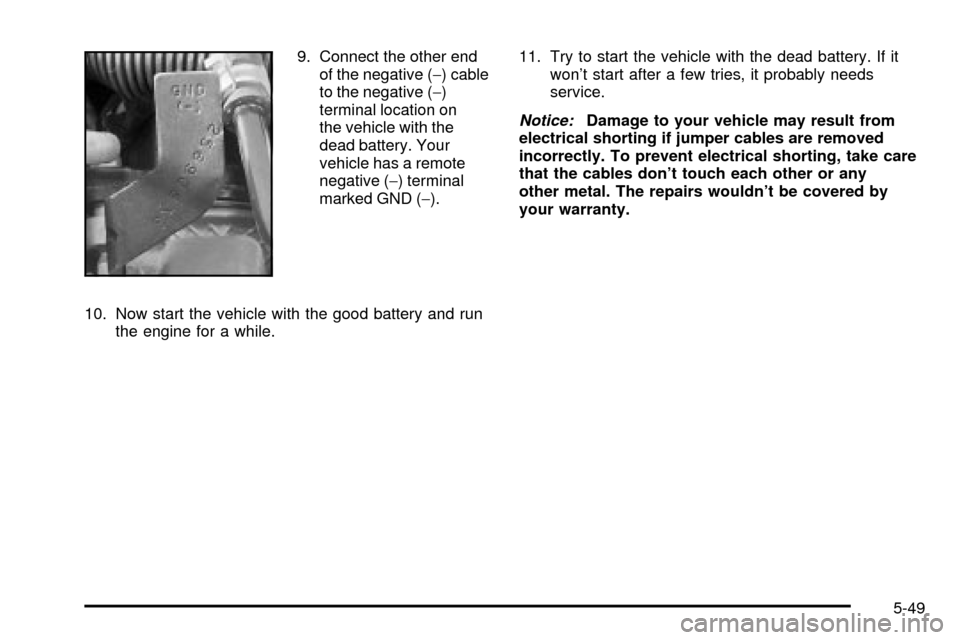
9. Connect the other end
of the negative (-) cable
to the negative (-)
terminal location on
the vehicle with the
dead battery. Your
vehicle has a remote
negative (-) terminal
marked GND (-).
10. Now start the vehicle with the good battery and run
the engine for a while.11. Try to start the vehicle with the dead battery. If it
won't start after a few tries, it probably needs
service.
Notice:Damage to your vehicle may result from
electrical shorting if jumper cables are removed
incorrectly. To prevent electrical shorting, take care
that the cables don't touch each other or any
other metal. The repairs wouldn't be covered by
your warranty.
5-49
Page 310 of 408
A. Dead Battery or Remote Positive (+) Terminal
B. Good Battery or Remote Positive (+) and Remote
Negative (-) Terminals
C. Heavy, Unpainted Metal Engine Part or Remote
Negative (-) Terminal (GND)To disconnect the jumper cables from both vehicles, do
the following:
1. Disconnect the black negative (-) cable from the
vehicle that had the dead battery.
2. Disconnect the black negative (-) cable from the
vehicle with the good battery.
3. Disconnect the red positive (+) cable from the
vehicle with the good battery.
4. Disconnect the red positive (+) cable from the other
vehicle.
5. Return the remote positive (+) terminal cover to its
original position.
Jumper Cable Removal
5-50
Page 326 of 408

If the TPM system detects low tire pressure, below
25 psi (172 kPa), or high tire pressure, above 38 psi
(262 kPa), a message, CHECK TIRE PRESSURE, will
appear on the Driver Information Center (DIC)
display. By pressing the INFO button, the DIC screen
will show which tire(s) has the low or high pressure
condition. See
In¯ation -- Tire Pressure on page 5-64for
information regarding correct tire in¯ation. If a tire is
low, you should stop as soon as possible and check all
your tires for damage. If a tire is ¯at, see
If a Tire
Goes Flat on page 5-73.
Notice:Do not use a tire sealant if your vehicle is
equipped with Tire Pressure Monitors. The liquid
sealant can damage the tire pressure monitor
sensors.
Once a low or high tire pressure condition is detected,
the TPM system will display the CHECK TIRE
MESSAGE each time the engine is started, until the
tire(s) are set to the correct in¯ation pressure.
The Tire-Loading Information Label, which is located on
the rear edge of the driver's door, shows the correct
in¯ation pressure for the tires on your vehicle.
The TPM system also allows the driver to check the air
pressure status of each road tire using the Driver
Information Center (DIC). Each tire's air pressure will belisted individually, in the following order: LF (left front or
driver's side front tire), RF (right front or passenger's
side front tire), RR (right rear or passenger's side
rear tire) and LR (left rear or driver's side rear tire). See
In¯ation -- Tire Pressure on page 5-64for information
regarding correct tire in¯ation. Also, seeDriver
Information Center (DIC) on page 3-53for information
on the DIC controls and displays.
If the DIC display doesn't show tire pressures or the
SERVICE TPM SYSTEM message appears, see
your dealer for service. The TPM system may not work
properly while the compact spare tire is installed.
Anytime you replace one or more tires or rotate your
tires, the TPM system will need to be reset. A special
tool is needed to reset the sensor identi®cation
codes. See your dealer for service.
Your vehicle was delivered from the factory with
aluminum valve stem caps. If you ever have to replace
the valve stem caps on your vehicle, you should
replace them with aluminum or plastic caps.
The TPM system can alert you about a low or high tire
pressure condition, but it doesn't replace normal tire
maintenance. See
Tires on page 5-63.
5-66
Page 334 of 408
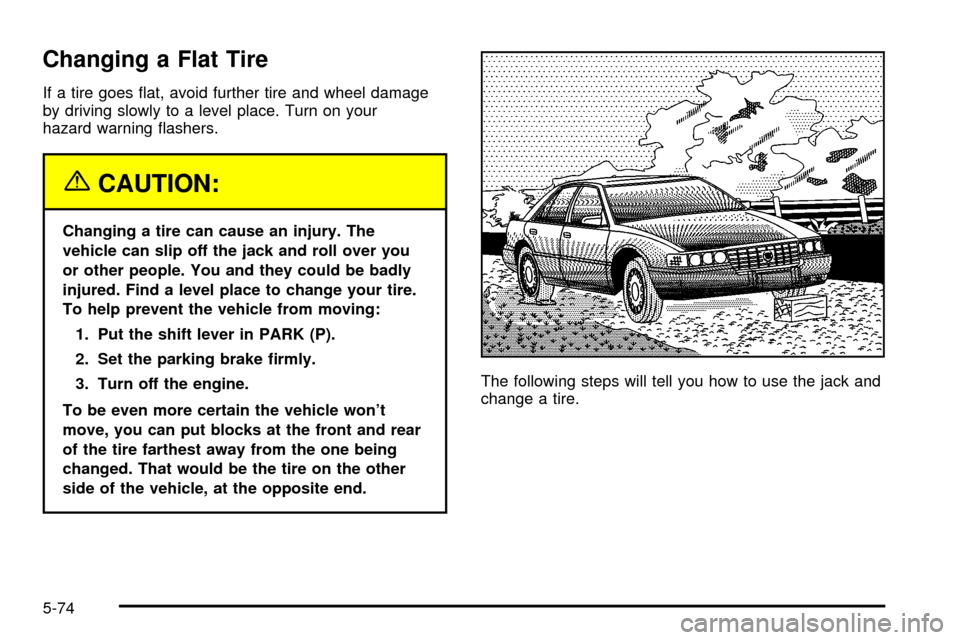
Changing a Flat Tire
If a tire goes ¯at, avoid further tire and wheel damage
by driving slowly to a level place. Turn on your
hazard warning ¯ashers.
{CAUTION:
Changing a tire can cause an injury. The
vehicle can slip off the jack and roll over you
or other people. You and they could be badly
injured. Find a level place to change your tire.
To help prevent the vehicle from moving:
1. Put the shift lever in PARK (P).
2. Set the parking brake ®rmly.
3. Turn off the engine.
To be even more certain the vehicle won't
move, you can put blocks at the front and rear
of the tire farthest away from the one being
changed. That would be the tire on the other
side of the vehicle, at the opposite end.The following steps will tell you how to use the jack and
change a tire.
5-74
Page 351 of 408

Vehicle Care/Appearance Materials
(cont'd)
Description Usage
Wash Wax ConcentrateMedium foaming
shampoo. Cleans and
lightly waxes.
Biodegradable and
phosphate free.
Spot LifterQuickly and easily
removes spots and stains
from carpets, vinyl and
cloth upholstery.
Odor EliminatorOdorless spray odor
eliminator used on
fabrics, vinyl, leather and
carpet.
See your General Motors parts department for these
products. See
Part D: Recommended Fluids and
Lubricants on page 6-15.
Vehicle Identi®cation
Vehicle Identi®cation Number (VIN)
This is the legal identi®er for your vehicle. It appears on
a plate in the front corner of the instrument panel, on
the driver's side. You can see it if you look through the
windshield from outside your vehicle. The VIN also
appears on the Vehicle Certi®cation and Service Parts
labels and the certi®cates of title and registration.
Engine Identi®cation
The 8th character in your VIN is the engine code. This
code will help you identify your engine, speci®cations
and replacement parts.
5-91
Page 353 of 408
Fuses and Circuit Breakers
The wiring circuits in your vehicle are protected from
short circuits by a combination of fuses and circuit
breakers. This greatly reduces the chance of ®res
caused by electrical problems.
Look at the silver-colored band inside the fuse. If the
band is broken or melted, replace the fuse. Be sure you
replace a bad fuse with a new one of the identical
size and rating. If a fuse should blow, see your dealer
for service immediately.
If you ever have a problem on the road and don't have
a spare fuse, you can ªborrowº one that has the
same amperage. Pick some feature of your vehicle that
you can get along without ± like the radio or cigarette
lighter ± and use its fuse, if it is the correct amperage.
Replace it as soon as you can.
The fuses are located in two fuse blocks, one located
near the engine compartment on the passenger's
side and the other under the rear seat on the driver's
side. If a fuse should blow, have your vehicle serviced
by your dealer immediately.
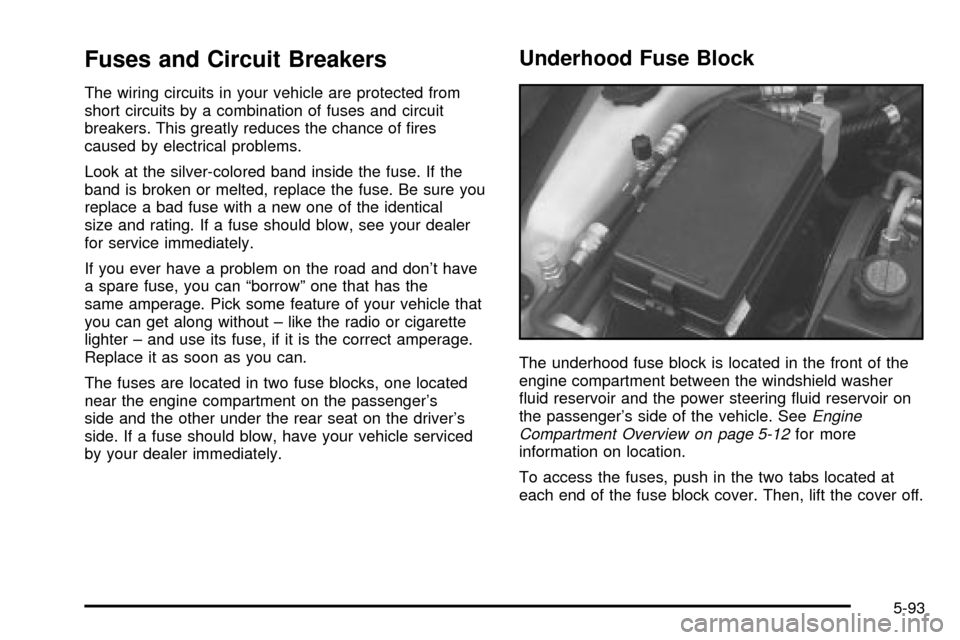
Underhood Fuse Block
The underhood fuse block is located in the front of the
engine compartment between the windshield washer
¯uid reservoir and the power steering ¯uid reservoir on
the passenger's side of the vehicle. See
Engine
Compartment Overview on page 5-12for more
information on location.
To access the fuses, push in the two tabs located at
each end of the fuse block cover. Then, lift the cover off.
5-93
Page 360 of 408
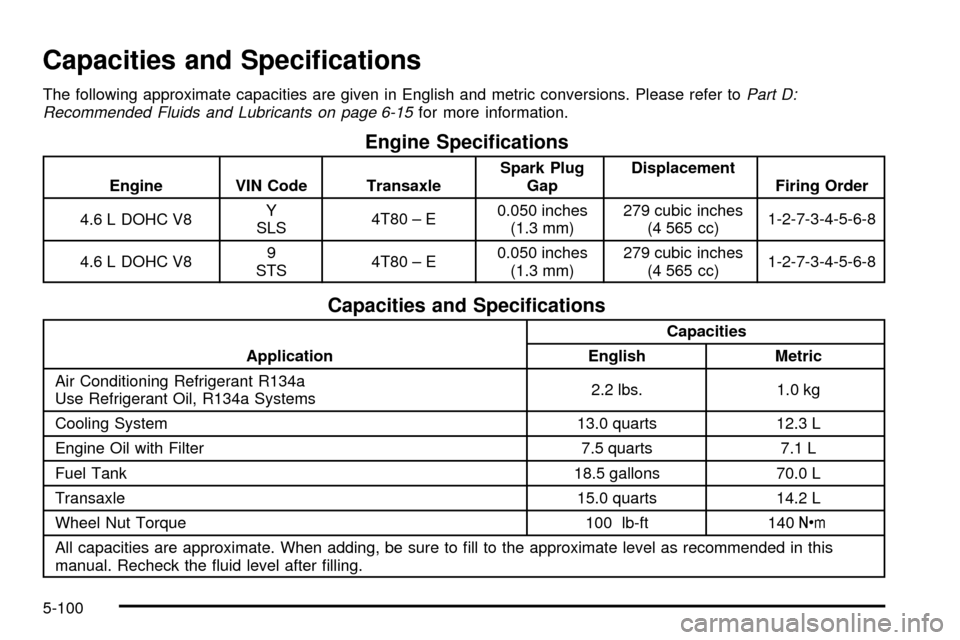
Capacities and Speci®cations
The following approximate capacities are given in English and metric conversions. Please refer toPart D:
Recommended Fluids and Lubricants on page 6-15for more information.
Engine Speci®cations
Engine VIN Code TransaxleSpark Plug
GapDisplacement
Firing Order
4.6 L DOHC V8Y
SLS4T80 ± E0.050 inches
(1.3 mm)279 cubic inches
(4 565 cc)1-2-7-3-4-5-6-8
4.6 L DOHC V89
STS4T80 ± E0.050 inches
(1.3 mm)279 cubic inches
(4 565 cc)1-2-7-3-4-5-6-8
Capacities and Speci®cations
ApplicationCapacities
English Metric
Air Conditioning Refrigerant R134a
Use Refrigerant Oil, R134a Systems2.2 lbs. 1.0 kg
Cooling System 13.0 quarts 12.3 L
Engine Oil with Filter 7.5 quarts 7.1 L
Fuel Tank 18.5 gallons 70.0 L
Transaxle 15.0 quarts 14.2 L
Wheel Nut Torque 100 lb-ft 140Y
All capacities are approximate. When adding, be sure to ®ll to the approximate level as recommended in this
manual. Recheck the ¯uid level after ®lling.
5-100
Page 361 of 408
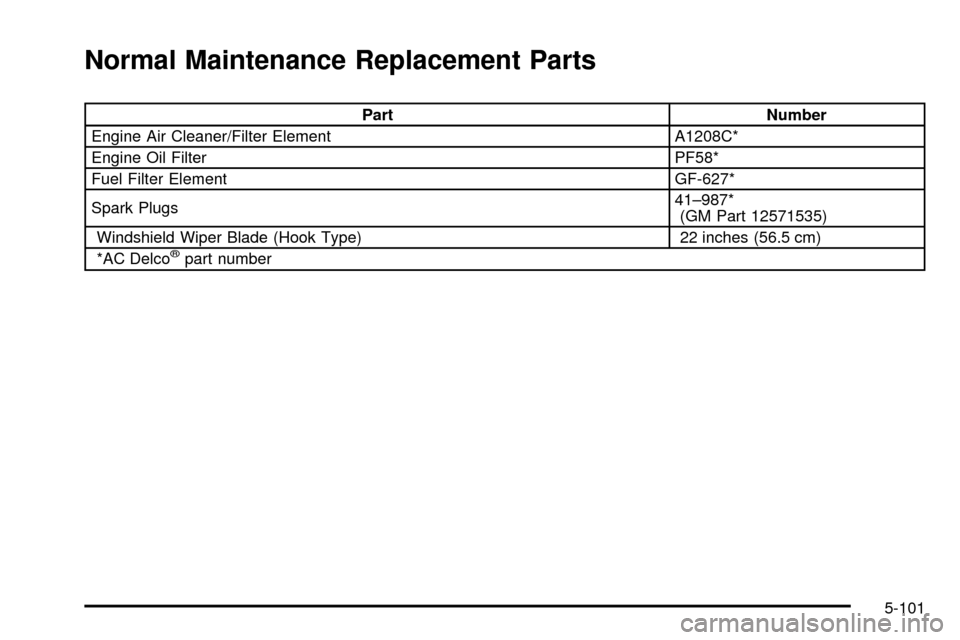
Normal Maintenance Replacement Parts
Part Number
Engine Air Cleaner/Filter Element A1208C*
Engine Oil Filter PF58*
Fuel Filter Element GF-627*
Spark Plugs41±987*
(GM Part 12571535)
Windshield Wiper Blade (Hook Type) 22 inches (56.5 cm)
*AC Delco
žpart number
5-101