Page 306 of 423
4. With the coolant surge tank pressure cap off, start
the engine and let it run until you can feel the upper
radiator hose getting hot. Watch out for the
engine cooling fans.
By this time, the coolant level inside the coolant
surge tank may be lower. If the level is lower, add
more of the proper mixture to the coolant surge tank
until the level reaches about 4.5 inches (11.4 cm)
from the top of the ®ller neck.5. Then replace the pressure cap. Be sure the arrow
on the pressure cap lines up like this.
Start the engine and allow it to warm up. If the CHECK
COOLANT LEVEL message does not appear on the
Driver Information Center, coolant is at the proper
®ll level. If a CHECK COOLANT LEVEL message does
appear, repeat Steps 1 to 3 and reinstall the pressure
cap or see your dealer.
5-35
Page 340 of 423
Wheel Replacement
Replace any wheel that is bent, cracked or badly rusted
or corroded. If wheel nuts keep coming loose, the
wheel, wheel bolts and wheel nuts should be replaced.
If the wheel leaks air, replace it (except some
aluminum wheels, which can sometimes be repaired).
See your dealer if any of these conditions exist.
Your dealer will know the kind of wheel you need.
Each new wheel should have the same load-carrying
capacity, diameter, width, offset and be mounted
the same way as the one it replaces.
If you need to replace any of your wheels, wheel bolts
or wheel nuts, replace them only with new GM
original equipment parts. This way, you will be sure to
have the right wheel, wheel bolts and wheel nuts
for your vehicle.{CAUTION:
Using the wrong replacement wheels, wheel
bolts or wheel nuts on your vehicle can be
dangerous. It could affect the braking and
handling of your vehicle, make your tires lose
air and make you lose control. You could have
a collision in which you or others could be
injured. Always use the correct wheel, wheel
bolts and wheel nuts for replacement.
Notice:The wrong wheel can also cause problems
with bearing life, brake cooling, speedometer or
odometer calibration, headlamp aim, bumper height,
vehicle ground clearance and tire or tire chain
clearance to the body and chassis.
See
Changing a Flat Tire on page 5-72for more
information.
5-69
Page 366 of 423
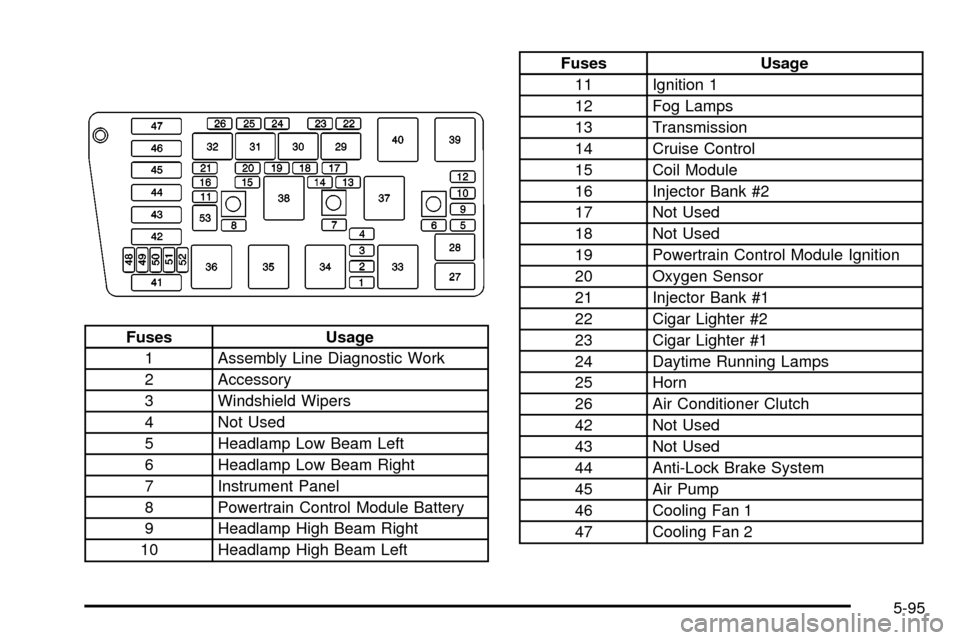
Fuses Usage
1 Assembly Line Diagnostic Work
2 Accessory
3 Windshield Wipers
4 Not Used
5 Headlamp Low Beam Left
6 Headlamp Low Beam Right
7 Instrument Panel
8 Powertrain Control Module Battery
9 Headlamp High Beam Right
10 Headlamp High Beam Left
Fuses Usage
11 Ignition 1
12 Fog Lamps
13 Transmission
14 Cruise Control
15 Coil Module
16 Injector Bank #2
17 Not Used
18 Not Used
19 Powertrain Control Module Ignition
20 Oxygen Sensor
21 Injector Bank #1
22 Cigar Lighter #2
23 Cigar Lighter #1
24 Daytime Running Lamps
25 Horn
26 Air Conditioner Clutch
42 Not Used
43 Not Used
44 Anti-Lock Brake System
45 Air Pump
46 Cooling Fan 1
47 Cooling Fan 2
5-95
Page 367 of 423

Relays Usage
27 Headlamp High Beam
28 Headlamp Low Beam
29 Fog Lamps
30 Daytime Running Lamps
31 Horn
32 Air Conditioner Clutch
33 Not Used
34 Accessory
35 Not Used
36 Starter 1
37 Cooling Fan 1
38 Ignition 1
39 Cooling Fan Series/Parallel
40 Cooling Fan 2
Circuit
BreakersUsage
41 Starter
The spare fuses are located in numbers 48 through 52.
The fuse puller is located in number 53.
Removing the Rear Seat Cushion
Notice:The battery and main fuse blocks are
located under the rear seat cushion. The battery's
ground terminal and some relay wires are exposed.
To help avoid damage to the battery and wires,
be careful when removing or reinstalling the seat
cushion. Do not remove covers from covered parts.
Do not store anything under the seat, as objects
could touch exposed wires and cause a short.
To remove the rear seat cushion, do the following:
1. Pull up on the front of the cushion to release the
front hooks.
2. Pull the cushion up and out toward the front of the
vehicle.
To reinstall the rear seat cushion, do the following:
5-96
Page 373 of 423
Capacities and Speci®cations
ApplicationCapacities
English Metric
Air Conditioning Refrigerant R134a
Use Refrigerant Oil, R134a Systems2.2 lbs 1.0 kg
Cooling System 13.0 quarts 12.3 L
Engine Oil with Filter 7.5 quarts 7.1 L
Fuel Tank 18.5 gallons 70.0 L
Transaxle 15.0 quarts 14.2 L
Wheel Nut Torque 100 lb-ft 140Y
All capacities are approximate. When adding, be sure to ®ll to the approximate level as recommended in this
manual. Recheck ¯uid level after ®lling.
5-102
Page 376 of 423

Maintenance Schedule......................................6-2
Introduction...................................................6-2
Your Vehicle and the Environment....................6-2
Maintenance Requirements..............................6-2
How This Section is Organized.........................6-3
Part A: Scheduled Maintenance Services...........6-4
Using Your Maintenance Schedule....................6-4
Scheduled Maintenance...................................6-4
Part B: Owner Checks and Services.................6-9
At Each Fuel Fill............................................6-9
At Least Once a Month...................................6-9
At Least Twice a Year...................................6-10At Least Once a Year...................................6-10
Part C: Periodic MaintenanceInspections.........6-13
Steering, Suspension and Front Drive Axle
Boot and Seal Inspection............................6-13
Exhaust System Inspection............................6-13
Fuel System Inspection..................................6-13
Engine Cooling System Inspection...................6-14
Throttle System Inspection.............................6-14
Brake System Inspection................................6-14
Part D: Recommended Fluids and Lubricants. . . .6-15
Part E: Maintenance Record...........................6-16
Section 6 Maintenance Schedule
6-1
Page 383 of 423

82,500 Miles (137 500 km)
qRotate tires. SeeTire Inspection and Rotation on
page 5-64for proper rotation pattern and additional
information.(See footnote +.)
90,000 Miles (150 000 km)
qReplace passenger compartment air ®lter. If you
drive regularly under dusty conditions, the ®lter
may require replacement more often.
qInspect throttle body bore and valve plates for
deposits, open the throttle valve and inspect all
surfaces. Clean as required.
An Emission Control
Service. (See footnote ².)
qReplace engine air cleaner ®lter. SeeEngine Air
Cleaner/Filter on page 5-19for more information.An Emission Control Service.
qRotate tires. SeeTire Inspection and Rotation on
page 5-64for proper rotation pattern and additional
information.(See footnote +.)
97,500 Miles (162 500 km)
qRotate tires. SeeTire Inspection and Rotation on
page 5-64for proper rotation pattern and additional
information.(See footnote +.)
100,000 Miles (166 000 km)
qReplace spark plugs.An Emission Control Service.
qChange automatic transaxle ¯uid and ®lter if the
vehicle is mainly driven under one or more of
these conditions:
þ In heavy city traffic where the outside
temperature regularly reaches 90ÉF (32ÉC) or
higher.
þ In hilly or mountainous terrain.
þ When doing frequent trailer towing.
þ Uses such as limousine service.
þ Uses such as high performance operation.
If you do not use your vehicle under any of these
conditions, the ¯uid and ®lter do not require change until
the message CHANGE TRANS FLUID appears on
the Driver Information Center.
150,000 Miles (240 000 km)
qDrain, ¯ush and re®ll cooling system (or every
60 months since last service, whichever occurs ®rst).
See
Engine Coolant on page 5-24for what to use.
Inspect hoses. Clean radiator, condenser, pressure
cap and neck. Pressure test the cooling system
and pressure cap.
An Emission Control Service.
qInspect engine accessory drive belt.An Emission
Control Service.
6-8
Page 389 of 423

Engine Cooling System Inspection
Inspect the hoses and have them replaced if they
are cracked, swollen or deteriorated. Inspect all pipes,
®ttings and clamps; replace as needed. Clean the
outside of the radiator and air conditioning condenser.
To help ensure proper operation, a pressure test of
the cooling system and pressure cap is recommended
at least once a year.
Throttle System Inspection
Inspect the throttle system for interference or binding,
and for damaged or missing parts. Replace parts
as needed. Replace any components that have high
effort or excessive wear. Do not lubricate accelerator
and cruise control cables.
Brake System Inspection
Inspect the complete system. Inspect brake lines and
hoses for proper hook-up, binding, leaks, cracks,
cha®ng, etc. Inspect disc brake pads for wear and rotors
for surface condition. Inspect other brake parts,
including calipers, parking brake, etc. You may need to
have your brakes inspected more often if your driving
habits or conditions result in frequent braking.
6-14